


Advance Study Assignment Guide: Strategy, Procedure, and Journal Tips to Evaluate Science Experiments
An Advance Study Assignment Guide provides a structured framework for approaching academic work that brings together scientific knowledge, practical investigation, evidence, and critical evaluation. An advance study assignment may extend beyond the simple presentation of information by requiring a clear understanding of a scientific problem, appropriate preparation, an organized procedure, accurate observation, and a reasoned interpretation of findings. When an assignment includes an experiment, laboratory activity, or chemistry component, the quality of the final work depends not only on the information presented but also on how systematically the investigation is planned and documented.
The foundation of an effective Advance Study Assignment Guide is the ability to connect theoretical knowledge with practical application. Scientific concepts introduced through classroom instruction become more meaningful when they can be examined through observation, measurement, experimentation, and analysis. For example, an experiment involving a chemical reaction may require an understanding of molecular interactions before measurements can be interpreted correctly. Similarly, a laboratory investigation may require the relationship between a hypothesis, experimental procedure, measured results, and scientific determination to be clearly demonstrated rather than simply listed.
A well-organized study assignment commonly involves several connected stages:
- Preparation and planning – Understanding the instructions, identifying the required components, gathering materials, reviewing relevant science concepts, and establishing an appropriate approach.
- Reference selection – Locating credible sources that provide scientific evidence and background information relevant to the assignment.
- Experimental work – Following the prescribed procedure, applying laboratory instructions, making measurements, and recording observations accurately.
- Documentation – Maintaining organized records through laboratory notes or a journal so that observations and measurements can be traced back to the experimental process.
- Evaluation and interpretation – Examining the evidence, considering whether the results support the hypothesis, identifying limitations, and making a scientifically supported determination.
- Presentation – Organizing the findings, references, summary, and other required components into a clear assignment format.
Each stage contributes to the reliability and clarity of the completed work. Poor preparation, for instance, can affect the procedure, while inaccurate measurement can weaken the interpretation of results. Likewise, a scientifically sound experiment can lose much of its value if observations are poorly documented or if the final summary does not explain what the evidence demonstrates. An Advance Study Assignment Guide therefore treats the assignment as a connected process rather than as a collection of unrelated sections.
The use of reliable references is particularly important when explaining scientific principles or interpreting experimental observations. Reference material can provide established information against which an observation or result can be compared. Sources may include scholarly journal articles, academic textbooks, laboratory manuals, institutional resources, and other credible scientific publications. The purpose is not simply to increase the number of citations but to ensure that important statements, scientific explanations, and interpretations are supported by appropriate evidence.
Experimental work introduces another level of responsibility because the procedure must be followed consistently. Preparation may involve reviewing laboratory instructions, identifying equipment, understanding safety requirements, and determining which measurements need to be recorded. During the investigation, details such as quantities, conditions, observations, timing, and changes in the experimental material may influence the interpretation of the results. Recording these details as the work progresses is more reliable than attempting to reconstruct them later.
The journal or laboratory record can therefore serve as an important source of evidence throughout the Advance Study Assignment Guide. A useful record distinguishes between direct observations and later interpretations. For example, noting that a solution changed from clear to cloudy is an observation, whereas concluding that a particular chemical reaction occurred is an interpretation that requires scientific reasoning. Maintaining this distinction helps demonstrate how evidence was transformed into a determination.
Evaluation also requires more than stating whether an experiment produced the expected result. A meaningful evaluation considers the relationship among the hypothesis, procedure, measurements, observations, and final findings. Depending on the investigation, this may involve examining numerical data, identifying patterns, comparing experimental and expected values, considering sources of error, and determining whether limitations could have affected the outcome. Such analysis demonstrates scientific skills because it shows how evidence is used to reach a defensible conclusion.
An Advance Study Assignment Guide can also provide a framework for integrating practical science with academic communication. A strong assignment should make it possible for the reader to understand what was investigated, why the investigation was undertaken, how the procedure was conducted, what was observed, and what the findings mean. Clear organization is especially important when several components—such as references, experimental records, calculations, journal entries, and a final summary—must be brought together.
The following discussion examines these elements in sequence, beginning with the selection and organization of references. It then addresses experimental preparation and procedure, the structure and strategy of an advance study assignment, chemistry-related problem solving, and the evaluation of experimental findings. Together, these components establish a practical framework for approaching complex scientific work with accuracy, logical reasoning, and careful documentation.
Reference and Source Selection
The quality of an Advance Study Assignment Guide begins with the quality of the evidence used to support it. References provide the scientific foundation for explanations, procedures, interpretations, and claims made throughout an assignment. A strong reference selection process is therefore more than collecting a large number of websites or journal articles; it involves identifying sources that are relevant, credible, current, and appropriate for the subject being investigated. Scholarly guidance emphasizes the importance of selecting sources that are methodologically sound and directly relevant to the topic, with peer-reviewed original research often providing particularly strong evidence for scientific work.
For an Advance Study Assignment Guide, source selection should also reflect the nature of the work being completed. A chemistry investigation, for example, may require authoritative information about chemical properties, molecular processes, laboratory methods, or measurement techniques. A broader science assignment may require journal literature, academic books, government publications, or institutional resources. Using the same type of source for every claim can limit the depth of an assignment, whereas combining appropriate source types allows different components of the topic to be addressed with suitable evidence.
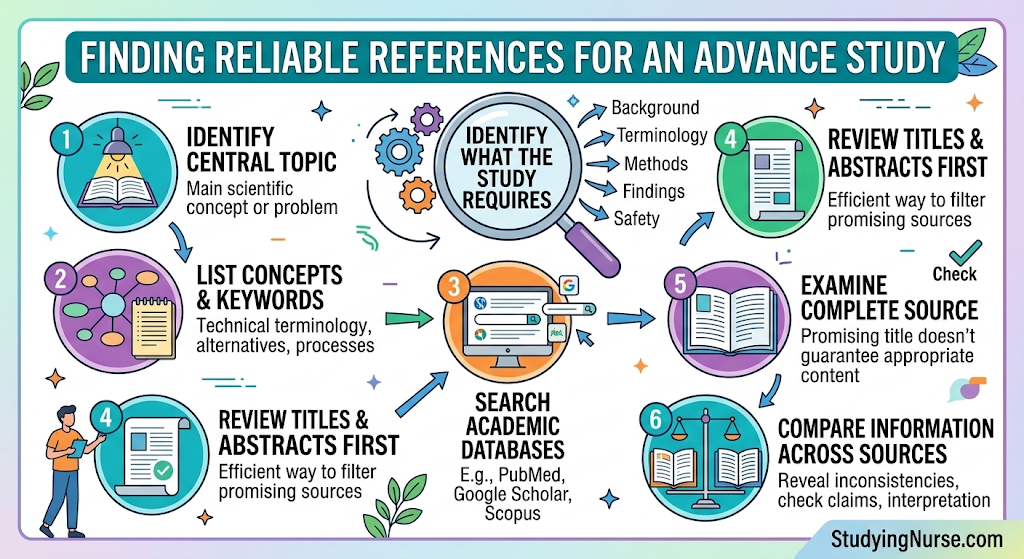
Finding Reliable References for an Advance Study
Finding reliable references begins with identifying exactly what information the study assignment requires. Before searching, it is useful to break the topic into its main information needs. These may include the scientific background, relevant terminology, experimental methods, theoretical explanations, previous findings, safety considerations, or evidence needed to interpret an experiment. This preparation makes the search more focused and reduces the likelihood of collecting sources that are interesting but unrelated to the assignment.
A practical search strategy can involve the following steps:
- Identify the central topic. Determine the main scientific concept or problem being investigated.
- List important concepts and keywords. Include technical terminology, alternative terms, and specific processes associated with the topic.
- Search appropriate academic databases. Depending on the subject, useful databases may include PubMed, CINAHL, Scopus, Web of Science, Google Scholar, or discipline-specific databases.
- Review titles and abstracts first. These provide an efficient way to determine whether a source is likely to address the required topic.
- Examine the complete source. A promising title does not guarantee that the article contains appropriate evidence.
- Compare information across sources. Cross-checking important claims can reveal inconsistencies, outdated information, or differences in scientific interpretation.
A comprehensive literature search should not depend on a single database. The NIH Library notes that searching multiple databases can improve coverage and reduce the possibility of missing relevant evidence. For an Advance Study Assignment Guide, this principle is particularly useful when the topic crosses several areas of science. A chemistry-related investigation, for example, might require both chemistry literature and broader scientific or health literature depending on the purpose of the experiment.
Distinguishing Scholarly Sources From General Online Information
Not every source found through an internet search has the same academic value. Scholarly sources are generally produced by researchers or subject-matter experts and commonly undergo peer review. They also tend to provide references that allow readers to trace the evidence supporting their claims. General websites, blogs, commercial pages, discussion forums, and unsourced educational pages can sometimes provide useful background information, but they should be assessed carefully before being used as major evidence.
Several characteristics can help determine whether a reference is appropriate:
- Authority: Identify the author, institution, research group, or organization responsible for the information.
- Expertise: Determine whether the author has appropriate qualifications or experience in the subject.
- Evidence: Check whether important claims are supported by scientific studies, data, or other authoritative references.
- Currency: Consider when the material was published or last updated, particularly for rapidly developing scientific subjects.
- Relevance: Confirm that the source directly addresses the issue being investigated.
- Methodological quality: For research articles, examine how the study was designed, what methods were used, and whether the findings reasonably support the conclusions.
- Objectivity: Consider whether the source has commercial, institutional, or other interests that could influence its presentation.
Purdue University’s source-evaluation guidance similarly recommends examining author credentials, evidence, references, currency, and the ability to cross-check information with other sources.
The presence of a professional-looking website should not automatically be treated as evidence of reliability. An authoritative source should make it reasonably clear who produced the information, what evidence supports it, and where the original information came from. The National Institutes of Health recommends looking for identifiable authors or responsible organizations and checking whether claims are supported by scientific evidence and references.
Prioritizing Different Types of References
Different references serve different purposes within an Advance Study Assignment Guide. Peer-reviewed journal articles are especially valuable when presenting research findings, experimental evidence, or contemporary scientific knowledge. Original research articles can provide direct evidence from the investigators who conducted the work, while systematic reviews and other evidence syntheses can help summarize findings from multiple studies.
Other useful sources may include:
- Academic textbooks: Useful for established theories, definitions, foundational science, and introductory explanations.
- Peer-reviewed journal articles: Appropriate for current research findings, experimental evidence, and specialized scientific discussions.
- Systematic reviews and evidence syntheses: Useful when an assignment requires an overview of findings across multiple investigations.
- Government and professional organizations: Valuable for standards, regulations, technical information, and authoritative guidance.
- University and research institution resources: Useful when they provide academically reviewed educational or scientific material.
- Laboratory manuals and technical documents: Helpful for understanding established laboratory procedures and experimental instructions.
- Theses and dissertations: Can provide detailed research on specialized topics, although their quality should still be evaluated.
- Conference materials and other grey literature: May provide useful evidence in areas where relevant research has not yet appeared in traditional journals.
The appropriate balance depends on the purpose of the assignment. A basic explanation of a well-established scientific principle may be adequately supported by a reputable academic textbook, whereas a claim about a recent experimental discovery should generally be supported by current scientific literature. Similarly, a laboratory procedure should be based on an authoritative laboratory manual, validated method, research article, or other reliable technical source rather than an anonymous online description.
Evaluating Scientific Journal Articles
A journal article should not be accepted solely because it appears in a scientific publication. The evidence within the article still needs to be examined critically. Reading the abstract can establish whether the article is relevant, but important decisions should be based on the methods, results, and discussion rather than the abstract alone. Scientific articles commonly organize information into sections such as the abstract, methods, results, discussion, and references, which can help determine how the evidence was generated and interpreted.
When examining a journal article for an Advance Study Assignment Guide, consider:
- What question or problem did the researchers investigate?
- What experimental or research approach did they use?
- Were the methods appropriate for the question?
- What population, material, sample, or model was studied?
- How were measurements or observations obtained?
- What were the main findings?
- Do the conclusions accurately reflect the results?
- What limitations did the researchers identify?
- Is the article sufficiently current for the topic?
- Can the findings reasonably support the statement being made in the assignment?
This process helps distinguish evidence from interpretation. It also prevents a common problem in academic writing: citing a source that mentions a topic without actually providing evidence for the specific claim being made.
Cross-Checking and Verifying Information
Verification is particularly important when an Advance Study Assignment Guide contains scientific facts, measurements, chemical properties, or descriptions of experimental processes. A single source may contain an error, an outdated statement, or a conclusion that applies only under specific conditions. Comparing important information across independent, credible sources can help establish whether the information is consistent.
For example, if an assignment discusses a particular chemical reaction, it may be useful to compare information from a chemistry textbook, a peer-reviewed article, and an authoritative laboratory resource. If all three support the same principle, confidence in the explanation is strengthened. If they differ, the discrepancy should be investigated rather than ignored.
Cross-checking is also valuable for numerical information. If a reference reports a specific measurement, concentration, molecular property, or experimental value, the information should be checked against the original publication or another authoritative source when accuracy is important. Purdue OWL specifically identifies cross-referencing as a useful way of evaluating the credibility of information.
A useful rule is to match the strength of the reference to the importance of the claim. A minor background statement may require only a standard academic source, while a central claim that determines the interpretation of an experiment deserves stronger and more direct evidence.
Organizing and Formatting Reference Details
Once reliable sources have been identified, the next step is to organize their details accurately. A reference is not simply a list of websites or article titles; it is a structured record that allows readers to identify and locate the original material. Proper referencing also distinguishes ideas and evidence obtained from other authors from original analysis presented in the study assignment.
Before writing the final reference list, record the essential information for each source. Depending on the source type and required citation style, this may include:
- Author or organization
- Publication date
- Title of the article, chapter, book, or webpage
- Journal title, where applicable
- Volume and issue number
- Page range
- Publisher, when applicable
- DOI or other persistent identifier
- URL for appropriate online sources
- Date of access when required by the selected citation style
Keeping these details while researching is much safer than trying to reconstruct them at the end of the assignment. Missing an author, publication year, journal volume, or DOI can make an otherwise useful reference difficult to verify.
The required format should be determined by the instructor or academic institution. APA, MLA, Chicago, Vancouver, and other citation systems organize reference information differently. In nursing and many health-science contexts, APA is frequently used, although the specific requirements should always be checked before preparing the final submission. The important principle is consistency: once a citation style has been selected, its rules should be applied consistently throughout the assignment.
The reference list should also correspond with the citations used in the main text. If a source is cited in the discussion, the reader should be able to locate the corresponding full reference. Conversely, references that are not used in the written work should generally not be added merely to make the reference list appear more extensive.
For example, consider a chemistry assignment that explains how temperature affects the rate of a reaction. The discussion might cite a journal article describing experimental findings and a chemistry textbook explaining collision theory. The final reference list should provide complete details for both sources, while the text should make clear which information comes from each reference. This creates a traceable connection between the scientific explanation and its supporting evidence.
Reference organization can also be improved by using a citation-management tool when a project contains many sources. Such tools can help collect bibliographic information, insert citations, and generate reference lists. However, automated formatting should still be checked manually because imported metadata can contain errors, incomplete information, or incorrect publication details.
A useful final check is to review the reference list against the completed Advance Study Assignment Guide:
- Confirm that every important borrowed idea or piece of evidence has an appropriate citation.
- Confirm that each in-text citation has a matching reference entry.
- Check author names and publication dates.
- Verify article titles, journal information, volume, issue, and page numbers where applicable.
- Check DOI or URL information.
- Apply the required citation style consistently.
- Remove sources that are listed but never used, unless the instructor specifically requires a bibliography rather than a reference list.
- Compare important references with the original publication to ensure that the details are accurate.
Proper organization also improves the credibility of scientific writing. Responsible referencing allows readers to trace the origin of information, examine the underlying evidence, and assess whether a claim has been represented accurately. Scholarly guidance emphasizes that citations identify the origins of ideas, methods, findings, and arguments and allow readers to examine the supporting work themselves.
For an Advance Study Assignment Guide, references should therefore be treated as an integral part of the scientific process rather than as a formatting requirement added at the end. Careful source selection establishes a dependable evidence base, while accurate organization and formatting make that evidence accessible and verifiable. Together, these practices strengthen the academic quality of the assignment and provide a reliable foundation for the experimental procedure and analysis that follow.
Experimental Procedure and Preparation
A well-designed Advance Study Assignment Guide treats experimental work as a carefully controlled process rather than simply a set of instructions to follow. The reliability of an experiment depends on what happens before, during, and immediately after the practical work. Appropriate preparation establishes what will be investigated, how the investigation will be conducted, what variables will be considered, which materials are required, and how observations and measurements will be documented.
An experimental procedure should provide enough detail for the work to be performed consistently while remaining directly connected to the purpose of the investigation. Preparation should also address laboratory safety, equipment suitability, measurement accuracy, and the conditions under which the experiment will take place. These considerations are especially important when an assignment involves chemistry, molecular processes, biological materials, or other laboratory activities in which small procedural differences can affect the results.
A useful experimental process can be organized around three connected stages:
- Planning the experimental procedure — establishing the purpose, variables, sequence of activities, measurements, and expected observations.
- Preparing materials, equipment, and safety measures — ensuring that everything required for the experiment is available, suitable, and used safely.
- Recording observations and experimental measurements — documenting what occurs during the investigation accurately enough to support later analysis and evaluation.
Keeping these stages distinct helps prevent common problems such as beginning an experiment without sufficient preparation, changing the procedure without documentation, or relying on memory when recording results.
Planning the Experimental Procedure
Planning should begin with a clear understanding of what the experiment is intended to investigate. The purpose provides direction for the entire procedure because it determines what needs to be measured, which conditions need to be controlled, and what evidence will be required to support the final determination.
A useful experimental plan identifies several fundamental elements:
- Purpose: What scientific problem or relationship is being investigated?
- Hypothesis: What outcome is expected, and why?
- Variables: Which factor will be changed, which outcome will be measured, and which conditions should remain controlled?
- Materials: What substances, samples, equipment, and instruments are required?
- Procedure: What sequence of actions will be followed?
- Measurements: What quantities will be measured, and in what units?
- Observations: What qualitative changes should be documented?
- Controls: What comparison or controlled conditions are necessary?
- Safety: What hazards may arise and how will they be addressed?
- Data recording: How will the results be organized for later evaluation?
This framework makes the experimental procedure more than a simple list of laboratory instructions. It creates a logical connection between the question being investigated and the evidence that will be collected.
For example, consider an experiment investigating how temperature affects the rate at which a substance dissolves in water. The procedure should not simply state that water should be heated and the substance added. It should establish the temperatures being compared, the amount of substance used, the volume of water, the method used to determine dissolution time, and the conditions that should remain consistent. If one trial uses 100 mL of water and another uses 200 mL, the difference in volume could influence the result and make the temperature comparison less reliable.
The same principle applies to a chemistry experiment involving reaction rates. If the objective is to examine how concentration affects reaction speed, concentration should be the experimental factor being changed while other relevant conditions—such as temperature, volume, and measurement method—are controlled as consistently as possible.
Establishing a Logical Sequence
A good procedure follows a logical sequence. Each step should prepare for the next rather than requiring unnecessary movement between unrelated activities. Before beginning, the entire procedure should be reviewed to identify steps that require timing, specialized equipment, particular environmental conditions, or careful handling.
A typical sequence may involve:
- Reviewing the experimental objective and hypothesis.
- Preparing the workspace.
- Checking and arranging materials and equipment.
- Confirming safety requirements.
- Establishing the required starting conditions.
- Performing the experimental steps in the specified order.
- Taking measurements at the required points.
- Recording observations immediately.
- Repeating trials when required.
- Securing the workspace and preserving the collected data.
The exact sequence will vary according to the experiment, but the principle remains the same: the procedure should be sufficiently organized that each action has a clear purpose.
Considering Variables and Controls
Understanding variables is central to experimental planning. The independent variable is the factor deliberately changed, while the dependent variable is the outcome measured or observed. Controlled variables are conditions kept consistent to reduce their influence on the results.
For example, an investigation examining the effect of pH on enzyme activity could use pH as the independent variable and reaction rate as the dependent variable. Temperature, enzyme concentration, substrate concentration, reaction volume, and measurement method may need to remain consistent.
Failure to distinguish these factors can make the results difficult to interpret. If both pH and temperature are changed between trials, a difference in reaction rate cannot easily be attributed to pH alone. A strong Advance Study Assignment Guide therefore emphasizes experimental planning that allows the evidence to answer the intended scientific question.
Planning Replication
Repeated trials can improve the reliability of experimental findings by showing whether a result is consistent. A single unexpected observation may represent an error, an unusual event, or genuine variation. Repeated measurements provide more information about the pattern of results.
For example, if the time required for a reaction is measured as 42 seconds, 43 seconds, and 41 seconds across three trials, the results show relatively close agreement. If the measurements are 42 seconds, 71 seconds, and 39 seconds, the variation deserves investigation.
Replication does not automatically eliminate error, but it provides a stronger basis for evaluating consistency. The number of trials should be determined by the experimental design, available resources, laboratory instructions, and the level of precision required.
Following an Established Procedure Without Losing Scientific Judgment
When an instructor, laboratory manual, or research protocol provides a procedure, it should be followed carefully unless authorized changes are necessary. Changing quantities, timing, temperatures, concentrations, or equipment without documenting the change can affect the validity of the experiment.
At the same time, following instructions does not mean working mechanically. Scientific work requires attention to unexpected observations. If a solution changes color earlier than expected, an instrument produces an unusual reading, or a sample behaves differently from previous trials, the observation should be recorded rather than ignored.
Any authorized modification should be documented clearly. For example:
“The procedure specified a five-minute reaction period. Because the instrument required calibration before the measurement, the measurement was taken after calibration and the additional preparation time was documented.”
This type of record helps distinguish the original procedure from what actually occurred.
Preparing Materials, Equipment, and Safety Measures
Preparation ensures that the experimental procedure can be completed efficiently and safely. Beginning laboratory work before checking the required materials can lead to interruptions, substitutions, inaccurate measurements, or unnecessary safety risks.
Materials should be identified according to their role in the experiment. This may include chemical reagents, biological samples, containers, measuring devices, laboratory glassware, protective equipment, and recording materials.
A preparation checklist can include:
- Required substances or samples
- Measuring equipment
- Glassware or containers
- Instruments and accessories
- Labels and markers
- Personal protective equipment
- Waste containers
- Cleaning materials
- Laboratory instructions or protocols
- Data-recording sheets or laboratory journals
The purpose of such preparation is not merely convenience. Equipment that is missing, damaged, unsuitable, or improperly configured can affect the experiment before the first measurement is taken.
Checking Equipment Before Use
Equipment should be inspected before the experiment begins. Measuring instruments require particular attention because inaccurate equipment can produce inaccurate results even when the procedure itself is correct.
Depending on the laboratory activity, preparation may involve checking:
- Whether measuring instruments are functioning properly
- Whether balances are properly zeroed
- Whether glassware is clean and appropriate
- Whether thermometers or probes are functioning
- Whether pipettes or other volume-measuring devices are suitable
- Whether electrical equipment is connected correctly
- Whether calibration is required
- Whether equipment has visible damage
For example, if a balance displays a nonzero reading before a sample is placed on it, the starting condition should be addressed according to the laboratory instructions. Similarly, a damaged measuring cylinder should not be treated as interchangeable with appropriate equipment simply because both appear capable of measuring liquid.
Preparing Chemical and Laboratory Materials
When an experiment involves chemistry, preparation may include identifying chemical concentrations, quantities, storage requirements, labels, and compatibility. Chemical substances should never be used solely because their names appear similar to the materials listed in an assignment. Concentration, purity, formulation, and physical state can influence experimental outcomes and safety.
Chemical labels and safety information should be reviewed before use. The appropriate laboratory safety information should identify hazards, required protective measures, storage considerations, spill procedures, and appropriate waste handling.
For example, an experiment involving an acidic solution requires more than knowing the solution’s name. Preparation should consider its concentration, appropriate protective equipment, the correct container, potential contact hazards, and the approved method for handling and disposal.
Addressing Laboratory Safety
Safety should be incorporated into the experimental procedure from the beginning rather than added as a final paragraph after the practical work has been described. The specific precautions depend on the materials and equipment involved.
Common laboratory safety measures include:
- Wearing appropriate personal protective equipment.
- Keeping the work area organized.
- Labeling materials correctly.
- Using chemicals according to approved instructions.
- Avoiding unauthorized mixing of substances.
- Handling glassware carefully.
- Using appropriate equipment for heating or electrical work.
- Maintaining awareness of nearby hazards.
- Disposing of materials according to laboratory requirements.
- Knowing the location and use of emergency equipment.
Safety instructions should be specific rather than vague. Saying “be careful with chemicals” provides little practical guidance. A stronger instruction identifies the relevant hazard and the required control.
For example, instead of simply stating that a corrosive substance requires caution, the procedure should indicate the appropriate protective equipment and handling practices specified by the laboratory or safety documentation.
Safety also applies to biological materials and equipment. A procedure involving microorganisms, specimens, sharps, centrifuges, or electrical devices may require controls that differ substantially from those used in a basic chemistry experiment.
Creating a Controlled Workspace
The laboratory environment can influence both safety and experimental reliability. A cluttered workspace makes it easier to confuse samples, knock over equipment, contaminate materials, or record measurements incorrectly.
A prepared workspace should allow the equipment and materials to be arranged according to the sequence of the procedure. Frequently used items should be accessible without interfering with hazardous materials or measurement equipment.
Labels are particularly important when several samples are being examined. Each container should be identified according to the experimental requirements so that samples cannot easily be confused.
For example, if three samples are being exposed to different temperatures, labeling them clearly according to the assigned condition reduces the risk of switching samples during measurement.
Recording Observations and Experimental Measurements
Accurate recording is one of the most important parts of an Advance Study Assignment Guide because the final evaluation depends on the quality of the information collected during the experiment. Data should be recorded as the investigation takes place rather than reconstructed later from memory.
Experimental records generally contain both quantitative measurements and qualitative observations.
Quantitative data involve numerical measurements, such as:
- Mass
- Volume
- Temperature
- Time
- Concentration
- pH
- Pressure
- Distance
- Absorbance
- Reaction rate
Qualitative observations describe characteristics that may not initially be expressed numerically, such as:
- Color change
- Formation of a precipitate
- Gas production
- Odor, when observation is safe and specifically permitted
- Change in texture
- Cloudiness
- Physical appearance
- Formation of bubbles
- Changes in state
Both forms of evidence can be important. A numerical measurement may show that temperature increased from one value to another, while a qualitative observation may document that the solution became cloudy during the same period.
Recording Measurements With Appropriate Units
Every numerical measurement should be accompanied by an appropriate unit unless the unit is already clearly established in the table or procedure. Units provide meaning to numbers and allow results to be compared correctly.
For example:
| Measurement | Result |
|---|---|
| Mass | 5.20 g |
| Volume | 25.0 mL |
| Temperature | 37.0°C |
| Reaction time | 48 s |
Writing “mass = 5.20” without specifying grams leaves the measurement incomplete.
The level of precision should also reflect the measuring instrument. A measurement should not imply greater precision than the equipment can reasonably provide. For example, if a device measures temperature to the nearest 0.1°C, reporting an invented value with many additional decimal places can create a false impression of accuracy.
Recording Data Immediately
Data should be recorded immediately after a measurement or observation is made. Delayed recording increases the likelihood of forgetting a value, confusing samples, or incorrectly assigning a measurement to a particular trial.
A well-organized laboratory journal can record:
- Date and time
- Experiment identification
- Sample or trial number
- Experimental condition
- Measurement
- Unit
- Observation
- Relevant procedural change
- Unexpected event
For example:
| Trial | Temperature | Time | Observation |
|---|---|---|---|
| 1 | 20°C | 62 s | Gradual color change |
| 2 | 30°C | 48 s | Faster color change |
| 3 | 40°C | 35 s | Rapid color change |
The table makes the relationship between the experimental condition and observed outcome easier to examine later.
Distinguishing Observation From Interpretation
One of the most important recording skills is distinguishing what was directly observed from what was inferred from that observation.
Consider these examples:
Observation:
“The solution changed from clear to cloudy after the two solutions were mixed.”
Interpretation:
“The cloudiness indicates that a precipitate may have formed.”
The first statement reports what was seen. The second explains what the observation may mean. Keeping the distinction clear prevents assumptions from being recorded as though they were direct measurements.
The same principle applies to unexpected results. If an experimental result differs from the expected outcome, the original observation should still be recorded accurately. The explanation can be developed later during evaluation.
Recording Deviations From the Procedure
An experimental record should also indicate when something differs from the planned procedure. A deviation might involve an equipment problem, an incorrect measurement, a delayed step, an environmental change, or an authorized modification.
For example:
“Trial 2 was repeated because the initial sample was accidentally contaminated before the measurement was taken.”
This information is important when evaluating the results because it explains why the trial may differ from the others.
Silently correcting or deleting an unexpected result can weaken the scientific record. A better approach is to preserve the original observation, identify the problem, and explain how it was addressed.
Maintaining Data Integrity
Data should be recorded honestly and systematically. Results should not be changed simply because they do not agree with the hypothesis. An unexpected result can be scientifically valuable because it may indicate experimental variation, an uncontrolled variable, a measurement problem, or an incorrect assumption.
For example, suppose an experiment predicts that increasing temperature will increase reaction rate, but one trial produces an unexpectedly slow reaction. The appropriate response is not to remove the trial merely because it conflicts with the expected pattern. Instead, the result should be examined alongside the procedure, equipment, measurements, and experimental conditions.
This approach allows the Advance Study Assignment Guide to demonstrate genuine scientific reasoning. Scientific investigation is concerned with what the evidence shows, not with forcing observations to match a predetermined answer.
Careful planning, thorough preparation, and accurate documentation therefore work together. The procedure establishes how the investigation will be conducted, preparation ensures that the required materials and safety controls are in place, and systematic recording preserves the evidence generated by the experiment. These practices provide the foundation needed for meaningful analysis when the experimental findings are later evaluated.
Advance Study Assignment Structure and Strategy
A well-structured Advance Study Assignment Guide provides a clear framework for moving from the initial instructions to a complete and coherent piece of academic work. When an assignment contains several components, such as a scientific explanation, experimental work, calculations, observations, a journal, and a final summary, organization becomes essential. Without a clear structure, important information can be omitted, repeated, or placed in a section where it does not belong.
Structure also affects how effectively scientific reasoning is communicated. An instructor should be able to identify the purpose of the work, understand the approach used, follow the evidence presented, and see how the findings support the final determination. A strong study assignment therefore does more than contain all the required information; it presents that information in a logical order.
A useful strategy is to consider the assignment as a connected sequence:
- Interpret the requirements and determine what the instructor expects.
- Develop an outline that organizes the required components.
- Establish the experimental approach and identify how evidence will be obtained.
- Present the determination based on the available evidence rather than assumptions.
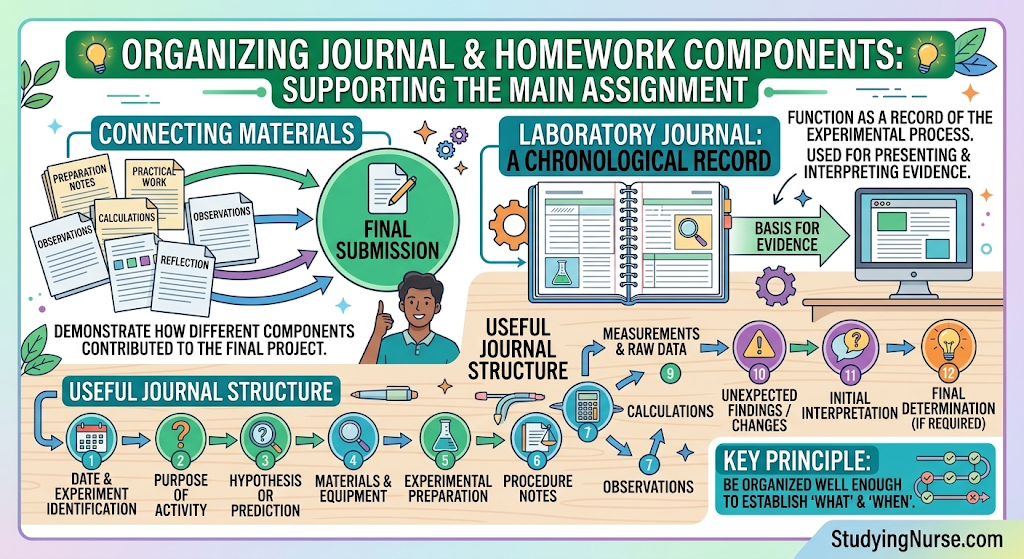
- Organize journal and homework components so that supporting work can be clearly connected to the main assignment.
- Review the completed work for completeness, consistency, accuracy, and alignment with the instructions.
This approach prevents the assignment from becoming a collection of disconnected answers. Each component should contribute to the overall purpose of the investigation.
Creating the Study Assignment Outline
Creating an outline is one of the most effective ways to organize an Advance Study Assignment Guide before substantial writing begins. An outline provides a framework for deciding what information belongs in the assignment and where it should appear. It also makes it easier to identify missing components before the work is submitted.
The first step is to examine the assignment instructions carefully. Important requirements should be identified rather than relying on memory. These may include the required topic, number of sections, experimental work, calculations, references, journal entries, formatting requirements, submission method, and evaluation criteria.
A practical outline can begin with the following sequence:
- Assignment purpose or scientific problem
- Relevant background or theoretical information
- Experimental approach
- Procedure and preparation
- Observations and measurements
- Calculations or problem solving
- Interpretation of findings
- Determination
- Supporting references
- Required journal or homework material
The exact structure should follow the instructions rather than being imposed on every assignment. Some investigations may require a formal laboratory report, while others may use a shorter classroom format. The purpose of an outline is to organize the required content, not to force every type of assignment into an identical template.
Matching the Outline to the Assignment Requirements
A common organizational problem occurs when an outline is created without first examining the assignment requirements. This can result in a polished document that still fails to address an important component.
For example, an instructor may require an experiment involving the effect of concentration on reaction rate and specify that the final submission must contain:
- A hypothesis
- A description of the experimental method
- A data table
- Calculations
- A discussion of the results
- Sources of experimental error
- A final determination
If the outline contains only an introduction, procedure, and conclusion, several required elements have no clear location. A better outline would assign each requirement a specific place.
This process can be represented as a simple planning exercise:
| Requirement | Planned location |
|---|---|
| Hypothesis | Experimental approach |
| Method | Procedure |
| Measurements | Results/data section |
| Calculations | Problem-solving component |
| Error analysis | Evaluation |
| Determination | Final interpretation |
| References | Reference section |
Such mapping helps ensure that every required component is addressed.
Using an Outline to Prevent Repetition
An outline is also useful for preventing the same information from appearing repeatedly. Each section should have a defined purpose.
For example, the procedure should explain what was done, while the evaluation should explain what the resulting evidence means. Repeating the entire procedure in the evaluation adds length without adding understanding.
Similarly:
- The hypothesis states the expected relationship or outcome.
- The procedure explains how the investigation was conducted.
- The results present the observations and measurements.
- The evaluation interprets those results.
- The determination states what can reasonably be concluded from the evidence.
Keeping these functions separate makes the Advance Study Assignment Guide more precise and easier to follow.
Building an Outline Around the Central Purpose
Every part of the outline should contribute to the central purpose of the assignment. If the investigation examines how temperature influences reaction rate, the outline should prioritize concepts that help explain that relationship.
For example:
Topic: Effect of temperature on reaction rate
Possible framework:
- Scientific background on reaction rate
- Hypothesis concerning temperature
- Experimental approach
- Controlled and changing variables
- Procedure
- Recorded measurements
- Calculation of reaction rate
- Comparison of results
- Sources of error
- Scientific determination
This approach prevents unrelated information from taking up space simply because it is associated with the broader subject.
An effective outline can also serve as a checklist during the writing process. As each section is completed, it can be checked against the original instructions to determine whether all required elements have been addressed.
Developing the Experimental Approach and Determination
The experimental approach explains how a scientific question will be investigated. It connects the purpose of the assignment to the procedure, measurements, observations, and evidence needed to answer the question. A strong Advance Study Assignment Guide should make this connection clear rather than treating the experiment as an isolated activity.
The approach begins with identifying the problem or relationship being investigated. From there, the relevant variables, hypothesis, controls, materials, measurements, and methods can be considered.
For example, suppose the investigation asks whether increasing temperature affects the rate at which a chemical reaction occurs. The experimental approach could involve:
- Identifying temperature as the independent variable.
- Defining reaction rate as the dependent variable.
- Keeping relevant conditions consistent.
- Establishing several temperature conditions.
- Measuring the time or another appropriate indicator of reaction progress.
- Repeating measurements where required.
- Comparing the resulting data.
This provides a logical pathway from the scientific question to the evidence.
Connecting the Hypothesis to the Approach
A hypothesis should be connected directly to the experimental approach. It is not simply a prediction added to satisfy an assignment requirement. It identifies an expected relationship that can be examined through evidence.
For example:
“If temperature increases, the reaction rate will increase because greater molecular motion is expected to increase the frequency of effective collisions.”
The experimental approach must then provide a way to test that prediction. If the procedure does not measure reaction rate or compare different temperatures, it cannot adequately evaluate the hypothesis.
This illustrates why planning the hypothesis and experimental approach together is important. The method should generate evidence capable of supporting, challenging, or refining the prediction.
Distinguishing the Experimental Approach From the Procedure
The experimental approach explains the overall method of investigation, while the procedure describes the specific sequence of actions used to carry it out.
For example:
Experimental approach:
Compare reaction rates under different temperature conditions while keeping other relevant variables controlled.
Procedure:
Prepare the required samples, establish the specified temperature conditions, initiate the reaction, record the time or other measurement, and repeat the process for each condition according to the laboratory instructions.
The distinction prevents unnecessary duplication. The approach explains the reasoning behind the investigation, while the procedure provides the practical instructions.
Establishing a Basis for Determination
The determination should emerge from the evidence generated by the experimental approach. It should not be decided before the results are examined.
For example, if the hypothesis predicts that increasing temperature will increase reaction rate, the final determination should consider whether the recorded data actually demonstrate that pattern.
A strong determination may address:
- Whether the results supported the hypothesis
- Whether the observed relationship was consistent
- Whether unexpected findings occurred
- Whether experimental limitations affected interpretation
- What the evidence reasonably demonstrates
A determination does not necessarily have to state that a hypothesis was “correct.” Scientific findings may provide partial support, contradict the prediction, or remain inconclusive.
For example:
“The results generally supported the hypothesis because reaction time decreased as temperature increased. However, the variation observed in the final trial suggests that experimental conditions may have influenced the measurement.”
This is more scientifically meaningful than simply writing:
“The hypothesis was correct.”
The first statement connects the determination to evidence and acknowledges uncertainty where appropriate.
Using Evidence Rather Than Assumptions
A scientifically sound assignment should distinguish evidence from assumptions. If measurements demonstrate a consistent trend, that trend can be discussed. If the evidence is inconsistent, the inconsistency should be acknowledged.
Consider an experiment that produces the following reaction times:
| Temperature | Reaction time |
|---|---|
| 20°C | 65 s |
| 30°C | 51 s |
| 40°C | 39 s |
| 50°C | 41 s |
The data show that reaction time decreased from 20°C to 40°C but increased slightly at 50°C. A simplistic determination might state that reaction time always decreases as temperature increases. The data do not fully support that claim.
A more appropriate interpretation would recognize the general trend while addressing the deviation at 50°C. The deviation could result from experimental variation, measurement limitations, changes in the system, or another factor requiring further investigation.
This demonstrates an important scientific skill: allowing the evidence to shape the determination instead of adjusting the interpretation to match expectations.
Organizing Journal and Homework Components
Journal and homework components often contain information that supports the main assignment but may be presented in a different format. Organizing these materials carefully makes it easier to demonstrate how preparation, practical work, calculations, observations, and reflection contributed to the final submission.
A laboratory journal can function as a chronological record of the experimental process. It may contain preparation notes, observations, measurements, calculations, unexpected events, and procedural changes. The final assignment can then use this record as the basis for presenting and interpreting the evidence.
A useful journal structure may include:
- Date and experiment identification
- Purpose of the activity
- Hypothesis or prediction
- Materials and equipment
- Experimental preparation
- Procedure notes
- Observations
- Measurements and raw data
- Calculations
- Unexpected findings or procedural changes
- Initial interpretation
- Final determination, where required
The exact structure depends on the instructions provided by the instructor or laboratory. The important principle is that entries should be organized well enough to establish what happened and when it happened.
Separating Raw Data From Processed Results
An important organizational principle is to distinguish raw data from calculations or processed results.
Raw data are the measurements obtained directly during the experiment. Processed data are values calculated or transformed from those measurements.
For example, if a reaction is timed three times:
- Trial 1: 42 seconds
- Trial 2: 44 seconds
- Trial 3: 43 seconds
These are raw measurements. Calculating the mean reaction time produces a processed result:
[
\text{Mean} = \frac{42+44+43}{3}=43\text{ seconds}
]
Keeping the original measurements is important because the calculation can be checked against them. If only the final mean is reported, information about variation between trials is lost.
Organizing Homework Calculations
Homework components may include calculations that support the scientific interpretation. These calculations should show enough detail to demonstrate how the result was obtained, particularly when the answer depends on multiple steps.
For example, when calculating concentration:
[
C=\frac{n}{V}
]
where (C) represents concentration, (n) represents the amount of substance, and (V) represents volume.
A complete solution should identify the known values, apply the appropriate equation, substitute the values, perform the calculation, and provide the correct unit. Simply providing a numerical answer may make it difficult to determine whether the correct method was used.
The same principle applies to chemistry problems involving molecular quantities, dilution, reaction rates, percentages, or other calculations. The working process can demonstrate scientific reasoning in addition to producing the final answer.
Connecting Journal Records to the Final Assignment
The journal should support the final study assignment, not exist as a completely separate collection of notes. Important measurements, observations, and procedural details can be transferred into appropriately organized tables or paragraphs when the final work is prepared.
However, the journal should not simply be copied word for word into the assignment. Its purpose is to preserve the working record, while the final assignment presents the relevant information in a more structured academic format.
For example, a journal might contain:
“Sample became cloudy after approximately 30 seconds. Trial repeated because the thermometer reading appeared unstable.”
The final assignment could present the relevant information more formally:
“The sample became visibly cloudy approximately 30 seconds after the reaction began. One trial was repeated because an unstable temperature reading was observed.”
The underlying observation remains the same, but the final presentation is clearer and more appropriate for formal academic work.
Managing Multiple Assignment Components
When an Advance Study Assignment Guide contains several supporting materials, a simple organizational system can prevent files, calculations, and records from becoming confused. Materials can be grouped according to their function:
- Reference materials: journal articles, textbooks, laboratory manuals, and authoritative sources.
- Planning materials: assignment instructions, outline, hypothesis, and experimental approach.
- Laboratory records: journal entries, observations, measurements, and raw data.
- Homework components: calculations, practice problems, and supporting exercises.
- Final assignment: organized written work containing the required analysis, determination, and references.
This separation makes it easier to verify that the final submission contains the required evidence without mixing preliminary notes with finished work.
A final organizational review should confirm that:
- Every required component is present.
- The assignment follows the instructor’s specified format.
- The experimental approach matches the purpose of the investigation.
- Journal records support the reported observations.
- Calculations can be traced to the original measurements.
- The determination is supported by evidence.
- References are properly connected to the information they support.
- Homework and laboratory components are clearly identified where required.
A carefully planned structure therefore gives the Advance Study Assignment Guide a logical progression from purpose to investigation and from evidence to determination. The outline establishes where information belongs, the experimental approach explains how evidence will be obtained, and the journal and homework records preserve the supporting work. When these elements are organized consistently, the completed assignment becomes easier to understand, evaluate, and verify.
Chemistry and Problem-Solving Components
Chemistry components can add an important analytical dimension to an Advance Study Assignment Guide because they require scientific concepts to be applied rather than simply recalled. A chemistry-based assignment may involve molecular structure, chemical reactions, concentration, pH, stoichiometry, energy changes, reaction rates, or laboratory measurements. Each of these areas requires a connection between theoretical knowledge and the evidence generated through an experiment.
Effective chemistry problem solving depends on understanding what a problem is asking before selecting an equation or beginning a calculation. A reliable strategy is to identify the known information, determine the unknown quantity, establish the relevant chemical relationship, select an appropriate equation or principle, perform the calculation carefully, and then evaluate whether the answer is scientifically reasonable.
Chemistry work can therefore be approached through three closely related stages:
- Applying chemistry concepts to explain the scientific principles relevant to the assignment.
- Solving calculations and problems using appropriate equations, units, relationships, and logical reasoning.
- Connecting theory with experimental practice by using observations and measurements to demonstrate how chemical principles operate in a real laboratory setting.
These stages help transform an abstract chemistry concept into an evidence-based scientific explanation.
Applying Chemistry Concepts to the Assignment
Applying chemistry concepts begins with identifying the scientific principle that explains the problem or investigation. An Advance Study Assignment Guide should not merely state a definition; it should demonstrate how the concept relates to the question being investigated.
For example, if an assignment examines the rate of a chemical reaction, it is not enough to define reaction rate as the change in concentration over time. The discussion should explain what influences the rate and how those factors can be examined experimentally. Temperature, concentration, surface area, catalysts, and the nature of the reactants may influence reaction behavior depending on the system being studied.
Similarly, an assignment involving acids and bases may require an understanding of:
- Hydrogen ion concentration
- pH
- Acid-base reactions
- Neutralization
- Indicators
- Concentration
- Titration
- Equivalence and endpoint concepts
The relevant concept should be selected according to the purpose of the study assignment, rather than adding chemistry terminology simply to make the discussion appear more advanced.
Moving From Definitions to Application
A strong chemistry explanation generally progresses from the basic principle to its practical significance.
For example, consider concentration. A basic explanation might state that concentration describes the amount of solute present in a particular amount of solution. A more useful academic explanation connects this idea to an actual problem:
If two solutions contain different amounts of the same solute in equal volumes, the solution containing more solute has the greater concentration. If the concentration affects the rate of a reaction, changing concentration provides a way to investigate that relationship experimentally.
This type of explanation demonstrates how a chemical concept can guide the experimental design.
The same approach can be applied to molecular concepts. If an investigation concerns dissolving, for example, understanding interactions between solute and solvent particles can help explain why some substances dissolve more readily than others. If an experiment involves a chemical reaction, molecular-level explanations can help interpret changes in color, temperature, gas production, precipitate formation, or other observable effects.
Selecting the Relevant Chemistry Concept
A chemistry assignment may contain several concepts, but not all of them need equal attention. The relevant concepts should be selected according to their relationship to the scientific question.
For example, an investigation of reaction rate may require discussion of collision theory. An investigation involving solution preparation may require concentration and dilution. An acid-base titration may require molarity, stoichiometry, pH, and neutralization.
This can be organized as follows:
| Investigation | Relevant chemistry concepts |
|---|---|
| Reaction rate | Collision theory, concentration, temperature |
| Acid-base titration | Acids, bases, molarity, neutralization, stoichiometry |
| Solution preparation | Concentration, molarity, dilution |
| Solubility | Solute-solvent interactions, temperature, saturation |
| Gas production | Chemical reactions, gas laws, molecular behavior |
| Calorimetry | Energy transfer, heat capacity, temperature change |
This approach keeps the Advance Study Assignment Guide focused and prevents unnecessary scientific background from overwhelming the main investigation.
Using Chemical Equations Appropriately
Chemical equations can help demonstrate what occurs during a reaction, but they should be used accurately and explained when necessary. A balanced chemical equation represents the relative quantities of reactants and products involved in a chemical reaction.
For example:
[
2H_2 + O_2 \rightarrow 2H_2O
]
The coefficients indicate the stoichiometric relationship between the substances. They do not simply represent arbitrary numbers; they reflect conservation of atoms during the reaction.
When a chemical equation is included in an assignment, it should support the explanation. The surrounding discussion can explain what the equation demonstrates and how it relates to the experimental activity.
Applying Concepts to Scientific Reasoning
Chemistry concepts become particularly valuable when they help explain why an observation occurred.
For example, suppose a reaction produces bubbles. The observation itself is qualitative: gas bubbles are visible. Chemistry knowledge can then be used to consider whether a chemical reaction generated a gaseous product.
However, the observation should not automatically be treated as proof of a particular substance. The interpretation should be supported by the known reaction, appropriate testing, or other evidence. This distinction between observation and interpretation is important for scientific reasoning.
Solving Chemistry Calculations and Problems
Chemistry calculations require more than inserting numbers into an equation. A reliable problem-solving strategy begins by identifying what information is provided, what must be determined, and which chemical relationship connects the two.
A useful general framework is:
- Read the problem carefully.
- Identify the known quantities.
- Identify the unknown quantity.
- Record the units.
- Select the relevant equation or chemical relationship.
- Rearrange the equation if necessary.
- Substitute the values.
- Perform the calculation.
- Check the units.
- Evaluate whether the answer is chemically reasonable.
This process can be applied to many chemistry problems, from basic concentration calculations to more complex stoichiometric problems.
Concentration Calculations
A common relationship is:
[
C=\frac{n}{V}
]
where:
- (C) = concentration
- (n) = amount of substance in moles
- (V) = volume of solution
Suppose a solution contains 0.20 mol of a solute in 0.50 L of solution:
[
C=\frac{0.20}{0.50}=0.40\text{ mol/L}
]
The result should be expressed with the appropriate unit. Writing simply “0.40” does not communicate the physical meaning of the answer.
If the volume is provided in milliliters, it may need to be converted to liters before applying the equation, depending on the units required.
For example:
[
250\text{ mL}=0.250\text{ L}
]
This unit conversion is a small step, but errors at this stage can produce a substantially incorrect result.
Molarity and Dilution Problems
Dilution problems commonly use:
[
C_1V_1=C_2V_2
]
where the initial concentration and volume are related to the final concentration and volume.
Suppose 50 mL of a 2.0 mol/L solution is diluted to 200 mL. The final concentration can be calculated as:
[
(2.0)(50) = C_2(200)
]
[
C_2=\frac{100}{200}=0.50\text{ mol/L}
]
The calculation demonstrates that increasing the volume while keeping the amount of solute constant decreases the concentration.
When solving a problem in an Advance Study Assignment Guide, the working should be sufficiently clear that another reader can follow the reasoning rather than seeing only the final value.
Stoichiometric Calculations
Stoichiometry connects the quantities of substances involved in a chemical reaction. A balanced chemical equation provides the mole ratios required for the calculation.
Consider:
[
2H_2 + O_2 \rightarrow 2H_2O
]
The equation indicates that two moles of hydrogen react with one mole of oxygen to produce two moles of water. If a problem provides the amount of one substance, the balanced equation can be used to determine the corresponding amount of another substance.
A common approach is:
- Convert the given quantity into moles when necessary.
- Use the mole ratio from the balanced equation.
- Convert the result into the requested unit.
This approach is particularly important when chemistry calculations are connected to an experiment, because experimental quantities may need to be compared with theoretically expected values.
Percent Yield and Experimental Results
When an experimental result is compared with a theoretical value, percent yield may be relevant:
[
\text{Percent yield}=
\frac{\text{Actual yield}}{\text{Theoretical yield}}\times100
]
For example, if an experiment produces an actual yield of 8.5 g while the theoretical yield is 10.0 g:
\frac{8.5}{10.0}\times100
=85%
]
The calculation does not by itself explain why the yield was below 100%. The interpretation may require consideration of incomplete reactions, product loss during transfer or purification, measurement limitations, competing reactions, or other experimental factors.
This illustrates the importance of connecting calculations with scientific reasoning.
Checking Units and Significant Figures
Units provide an essential check on chemistry calculations. If an equation requires liters but the supplied value is in milliliters, the conversion should be addressed before the calculation.
Significant figures can also be important when reporting measured or calculated values. The final reported precision should reflect the precision of the measurements and the rules applicable to the calculation.
For example, reporting a concentration as:
0.500000000 mol/L
does not necessarily make the result more accurate. If the measurements supporting the calculation are only precise to a few significant figures, excessive decimal places may falsely imply a level of certainty that the experiment did not provide.
Evaluating Whether an Answer Makes Sense
A calculated answer should be checked rather than accepted automatically. Several questions can help:
- Is the unit correct?
- Is the magnitude reasonable?
- Were the units converted appropriately?
- Was the correct equation used?
- Does the answer agree with the chemical relationship described?
- Does the result make sense in relation to the experimental conditions?
For example, if a calculation produces a concentration of 400 mol/L for an ordinary aqueous laboratory solution, the value should prompt a review of the calculation. The problem may involve an incorrect unit conversion or equation selection.
This final checking stage helps demonstrate that chemistry problem solving involves reasoning rather than mechanical arithmetic.
Connecting Chemical Theory With Experimental Practice
The value of chemistry becomes clearer when theoretical principles can be connected to what happens in the laboratory. An Advance Study Assignment Guide should show how concepts such as molecular interactions, stoichiometry, reaction kinetics, equilibrium, concentration, and energy transfer help explain experimental observations.
An experiment provides evidence about a chemical system under particular conditions. Theory provides a framework for interpreting that evidence.
For example, collision theory can help explain why increasing temperature may increase the rate of some chemical reactions. At higher temperatures, particles generally have greater kinetic energy, and a larger proportion of collisions may have sufficient energy to overcome the activation barrier. An experiment measuring reaction time at different temperatures can therefore provide practical evidence related to the theoretical principle.
The connection can be represented as:
Chemical theory → experimental prediction → controlled procedure → measurement → observation → interpretation
Each stage has a different role.
Using Molecular Theory to Explain Observations
Many chemistry observations become easier to understand when considered at the molecular level. A visible change may result from processes that cannot be observed directly.
For example, when a solid dissolves in a solvent, the visible disappearance of the solid does not mean that its particles have ceased to exist. The particles have become distributed throughout the solution through interactions with solvent molecules.
Similarly, a temperature change during a reaction may reflect energy being absorbed or released as chemical bonds are broken and formed. The thermometer records the measurable temperature change, while chemical theory provides an explanation for the molecular processes responsible for that change.
This distinction is useful in an assignment because it allows observable evidence and theoretical explanation to remain connected without treating them as identical.
Comparing Theoretical and Experimental Values
A valuable way to connect theory with practice is to compare expected values with experimentally obtained values.
Suppose a calculation predicts that a reaction should produce 10.0 g of product, but the laboratory experiment produces 8.6 g. The difference does not automatically mean that the theory is incorrect. The experimental result may have been affected by:
- Incomplete reaction
- Product loss during transfer
- Impurities
- Measurement error
- Incorrect quantities
- Environmental conditions
- Instrument limitations
- Side reactions
The comparison therefore creates an opportunity to evaluate the quality of the experimental process.
A strong Advance Study Assignment Guide should explain the difference rather than merely reporting that the experimental value was lower.
Linking Calculations to Measurements
Chemistry calculations often give meaning to measurements obtained in the laboratory. For example, a balance may provide mass, a graduated device may provide volume, and an instrument may provide temperature or pH. These measurements can then be used to calculate concentration, reaction rate, yield, or another relevant quantity.
This creates a direct connection between practical work and mathematical reasoning.
For example, if an experiment measures:
- Mass of solute = 5.85 g
- Molar mass = 58.5 g/mol
- Solution volume = 0.500 L
The amount of substance can first be calculated:
[
n=\frac{m}{M}
]
[
n=\frac{5.85}{58.5}=0.100\text{ mol}
]
The concentration can then be determined:
[
C=\frac{n}{V}
]
[
C=\frac{0.100}{0.500}=0.200\text{ mol/L}
]
Here, the calculation transforms laboratory measurements into chemical information that can be interpreted scientifically.
Recognizing the Difference Between Theory and Experimental Evidence
Theory and experimental evidence complement each other, but they should not be treated as interchangeable. A theoretical prediction establishes what might be expected under particular conditions, whereas experimental evidence indicates what occurred under the actual conditions of the investigation.
For example, chemical theory may predict that increasing concentration will increase reaction rate. If the experimental data do not show this expected pattern, the discrepancy should be investigated. Possible explanations could include measurement error, uncontrolled variables, an unsuitable experimental design, or conditions under which the expected relationship does not apply in the assumed way.
The appropriate response is to examine the evidence and the experimental conditions rather than simply changing the recorded data.
Demonstrating Scientific Skills Through Chemistry
Connecting theory with experimental practice allows an Advance Study Assignment Guide to demonstrate several scientific skills at once. These include:
- Applying established scientific principles
- Developing and testing a hypothesis
- Identifying variables
- Selecting appropriate measurements
- Performing calculations
- Interpreting quantitative and qualitative evidence
- Comparing theoretical and experimental values
- Recognizing limitations
- Explaining unexpected results
- Making evidence-based determinations
For example, a chemistry investigation involving reaction rate may require an understanding of molecular collisions, accurate measurement of time, control of temperature and concentration, calculation of reaction rate, comparison of trials, and interpretation of variation. The assignment then demonstrates not only knowledge of chemistry but also the ability to apply that knowledge to an actual investigation.
The strongest chemistry components are therefore those in which theory, calculation, observation, and interpretation reinforce one another. Chemical principles explain why an investigation is designed in a particular way; measurements provide evidence; calculations transform those measurements into meaningful quantities; and scientific reasoning connects the findings back to the original question. This integration makes the chemistry component a meaningful part of the Advance Study Assignment Guide rather than an isolated collection of definitions and mathematical exercises.
Evaluating Results and Writing the Summary
The evaluation stage is where an Advance Study Assignment Guide moves from recording what happened during an experiment to explaining what the findings mean. Collecting measurements, observations, and laboratory notes is only one part of a scientific investigation. The results must also be organized, examined, compared with the original hypothesis, and interpreted in relation to established scientific principles. A strong evaluation demonstrates that the investigator can move from experimental evidence to a reasonable scientific determination.
Evaluation should be based on the evidence produced during the study rather than on what the investigator expected to find. This means that unexpected findings should not be ignored or changed simply because they do not support the original prediction. Instead, they should be examined carefully to determine whether they reflect normal experimental variation, measurement uncertainty, procedural problems, uncontrolled variables, or a scientifically meaningful result.
The evaluation process generally connects four elements:
- Experimental data provide the measurements and observations collected during the laboratory investigation.
- Analysis organizes and examines those findings to identify relationships, differences, patterns, or trends.
- Evaluation considers the quality, accuracy, reliability, and limitations of the evidence.
- Summary and determination explain what the findings demonstrate and whether they support the original hypothesis or objective.
This approach gives the study assignment a logical progression from experimental work to scientific interpretation. It also helps demonstrate scientific skills such as critical thinking, quantitative reasoning, evidence-based decision-making, and the ability to communicate scientific findings clearly.
Analyzing Experimental Data and Findings
Analyzing experimental data involves more than listing measurements obtained during a laboratory procedure. The investigator must determine what the data show, identify meaningful patterns, and connect those patterns to the scientific question being investigated. The analysis should remain closely connected to the experimental objective, hypothesis, and procedure.
A useful starting point is to organize the findings in a form that makes comparisons easier. Depending on the experiment, this may involve tables, calculations, graphs, percentages, averages, or other appropriate methods of presenting data. Raw measurements should be preserved, while calculated values should be clearly distinguished from the original observations.
For example, suppose an experiment investigates how temperature affects the rate at which a substance dissolves. The measurements might be recorded as follows:
| Temperature | Time required for dissolution |
|---|---|
| 20°C | 120 seconds |
| 30°C | 92 seconds |
| 40°C | 68 seconds |
| 50°C | 51 seconds |
Simply reporting these measurements does not constitute a complete analysis. The investigator should identify the trend. In this example, the time required for dissolution decreases as temperature increases. The findings therefore indicate that the substance dissolved more rapidly under the higher-temperature conditions used in the experiment.
The next step is to explain the scientific significance of that pattern. Temperature can influence molecular motion and interactions between particles, which can affect the rate at which a substance dissolves. The analysis should make this connection without claiming more than the experiment actually demonstrates.
A strong interpretation might state that the findings indicate an association between increased temperature and faster dissolution under the tested conditions. It would be less appropriate to claim that temperature is the only factor responsible unless the experimental design adequately controlled other relevant variables.
Comparing Findings With the Hypothesis
The hypothesis provides an important reference point for evaluating results. After analyzing the data, the investigator should determine whether the findings:
- support the hypothesis;
- do not support the hypothesis;
- partially support the hypothesis; or
- produce findings that are inconclusive.
A hypothesis should not be considered correct simply because the results appear favorable. The decision should be based on the actual measurements and the quality of the experimental design.
For example, if the hypothesis predicts that increasing temperature will increase reaction rate, and the measured reaction rate consistently increases across the tested temperature range, the findings may support the hypothesis. However, if the measurements are inconsistent or the difference between conditions is very small, the conclusion should acknowledge that uncertainty.
This distinction is important in an Advance Study Assignment Guide because a scientific investigation is not designed to prove that an expected answer is correct. Its purpose is to test an idea through systematic evidence. A result that does not support the hypothesis can still represent a successful experiment if the procedure was appropriately designed and the findings were accurately recorded.
Identifying Patterns, Relationships, and Trends
Data analysis should examine whether there is a recognizable relationship between variables. Depending on the experiment, the relationship may be direct, inverse, proportional, nonlinear, or absent.
For example:
- If concentration increases while measured reaction rate also increases, the data may show a positive relationship.
- If temperature increases while the time required to complete a reaction decreases, the relationship may be inverse.
- If measurements remain approximately constant despite changes in the independent variable, the experimental condition may have little observable effect within the tested range.
Graphs can be particularly useful because they allow trends to be recognized visually. The independent variable is generally placed on the horizontal axis, while the dependent variable is placed on the vertical axis. Axes should have clear labels and appropriate units.
An Advance Study Assignment Guide should also distinguish between a visible pattern and a scientifically established relationship. A trend in a small set of observations does not automatically establish causation. The strength of the conclusion depends on the experimental design, number of observations, consistency of measurements, and control of relevant variables.
Using Calculations to Strengthen the Analysis
Calculations can transform raw measurements into information that is easier to interpret. Depending on the science or chemistry component of the assignment, calculations may include averages, percentages, concentration, reaction rates, percent yield, or other relevant measures.
For example, if three trials produce reaction times of 48, 52, and 50 seconds, the mean can be calculated as:
Mean = (48 + 52 + 50) ÷ 3 = 50 seconds
The mean provides a useful summary of the three observations, but it should not replace the original measurements. Reporting only the mean could hide important variation between trials.
Similarly, percent yield can be used when an experimental product is compared with a theoretical amount:
Percent yield = (actual yield ÷ theoretical yield) × 100
If the actual yield is 8.5 g and the theoretical yield is 10.0 g:
Percent yield = (8.5 ÷ 10.0) × 100 = 85%
The resulting value can then be interpreted in relation to the experimental procedure. A yield below 100% may reflect incomplete reaction, product loss during transfer or purification, measurement issues, or other factors. The number itself does not identify the cause; the investigator must consider the procedure and available evidence.
Evaluating Accuracy, Errors, and Limitations
A major component of an Advance Study Assignment Guide is evaluating how trustworthy the experimental findings are. Scientific data are affected by measurement conditions, equipment, technique, environmental factors, and limitations in the experimental design. Recognizing these factors demonstrates a deeper understanding of the investigation.
Accuracy refers broadly to how close a measured value is to an accepted or true value, when such a reference is available. Precision concerns the consistency of repeated measurements. These concepts should not be treated as interchangeable.
For example, imagine that the accepted value for a measurement is 10.0 units.
- Measurements of 9.9, 10.0, and 10.1 are both relatively accurate and consistent.
- Measurements of 8.0, 8.1, and 8.0 are consistent but not accurate relative to the accepted value.
- Measurements of 8.0, 10.2, and 11.5 may show greater variability and therefore lower precision.
This distinction helps an investigator determine what type of problem may have affected the results.
Identifying Experimental Errors
An error does not necessarily mean that someone made a mistake. In scientific work, measurement error can arise from limitations associated with instruments, methods, environmental conditions, or unavoidable variation.
Errors can be considered in several ways. Systematic error tends to produce a consistent deviation in one direction, whereas random error produces unpredictable variation between measurements.
For example, a balance that consistently reads 0.20 g higher than the actual mass could introduce systematic error. In contrast, small variations caused by difficulty reading a scale or judging an endpoint may contribute to random variation.
An effective evaluation should identify the specific factor and explain how it could have influenced the findings. A weak statement would simply say:
“There may have been human error.”
A stronger analysis would explain:
“The endpoint was determined visually, so differences in judgment between trials may have introduced variation in the recorded reaction time.”
The second statement identifies a plausible source of error and describes its potential effect on the measurement.
Other possible sources include:
- inaccurate or poorly calibrated equipment;
- inconsistent measurement technique;
- incorrect volume or mass measurements;
- contamination of materials;
- temperature fluctuations;
- timing inconsistencies;
- inadequate mixing;
- failure to maintain the same experimental conditions;
- recording errors;
- limited number of trials; and
- procedural deviations.
The investigator should avoid listing every imaginable source of error. The most useful approach is to identify errors that are reasonably connected to the actual experiment and explain their potential influence.
Distinguishing Error From Experimental Limitation
An experimental limitation is a factor that restricts the strength, scope, or interpretation of the findings. Not every limitation represents an error.
For example, conducting an experiment with only three trials may be a limitation because a small number of observations provides less information about variability than a larger number of trials. Similarly, testing only one concentration may limit the ability to determine whether the observed relationship continues at other concentrations.
A limitation might therefore concern:
- sample size;
- number of experimental trials;
- range of conditions tested;
- equipment sensitivity;
- duration of the investigation;
- environmental control;
- availability of materials;
- measurement resolution;
- experimental design; or
- the extent to which the findings can be generalized.
The distinction matters because a limitation does not necessarily invalidate an experiment. Instead, it defines what can reasonably be concluded from the evidence.
For example, if an experiment evaluates reaction rate at 20°C, 30°C, and 40°C, it would be inappropriate to assume that exactly the same relationship exists at temperatures far outside this range. The tested conditions establish the boundaries of the experimental evidence.
Evaluating Reliability and Reproducibility
Repeated trials can help determine whether an observed finding is consistent. If similar conditions produce substantially similar results, confidence in the pattern generally increases. Large differences between trials require closer examination.
Suppose three measurements of a reaction rate are 0.21, 0.20, and 0.22 mol/L/min. These values are relatively close together. If another set produces 0.10, 0.35, and 0.18 mol/L/min, the greater variation warrants investigation.
The investigator should consider whether the difference resulted from:
- inconsistent procedure;
- measurement difficulties;
- uncontrolled conditions;
- equipment problems; or
- genuine variability in the experimental system.
Reproducibility is especially important when determining whether a finding represents a meaningful scientific pattern rather than an isolated observation.
Explaining How Errors Affect the Findings
The strongest evaluation does not merely identify errors; it explains their direction or likely effect when this can reasonably be determined.
For example, if some of the product was lost during transfer, the measured yield would probably be lower than the amount actually produced. If a balance consistently overestimates mass, calculated concentration could also be affected depending on how the measurement was used.
This creates a useful chain of reasoning:
Source of error → effect on measurement → effect on calculated result → effect on interpretation
Such an approach makes the evaluation more analytical and helps demonstrate scientific reasoning.
Writing the Summary and Final Determination
The summary brings together the most important findings from the investigation without simply repeating every measurement. It should provide a concise account of what was investigated, what was observed, what the data demonstrated, and how the findings relate to the original objective or hypothesis.
A strong summary should be based on evidence from the experiment. It should not introduce an unrelated topic, provide unsupported claims, or repeat the entire procedure.
A useful structure is to address four questions:
- What scientific question or objective was investigated?
- What were the most important findings?
- What do those findings indicate?
- What determination can reasonably be made from the evidence?
For example, consider an experiment designed to investigate the effect of temperature on dissolution time. A suitable summary might explain that increasing temperature was associated with shorter dissolution times across the tested conditions. The findings therefore support the hypothesis that higher temperatures increase the rate of dissolution under the conditions investigated. However, the summary should also acknowledge important limitations if the experiment involved a small number of trials or limited temperature ranges.
The final determination should follow logically from the findings. It should not simply state whether the hypothesis was “right” or “wrong.” Instead, it should explain the relationship between the evidence and the original scientific expectation.
For instance:
The experimental findings support the hypothesis because dissolution time decreased consistently as temperature increased across the tested conditions. Although the results demonstrate a clear trend within the experimental range, the limited number of trials means that additional testing would be useful to determine whether the same relationship persists under broader conditions.
This type of determination is stronger than simply writing, “The hypothesis was correct,” because it identifies the evidence supporting the conclusion while recognizing the limits of the investigation.
The summary should also distinguish between what the experiment demonstrated and what it merely suggested. Scientific writing requires appropriate caution when the evidence does not justify a broad claim. Words such as “indicated,” “suggested,” “was consistent with,” and “supported” can be useful when the findings provide evidence without establishing absolute certainty.
The final determination can also connect the experimental findings to relevant scientific theory. If the results are consistent with a known chemical or molecular principle, the assignment can briefly explain that connection. For example, an experiment involving concentration and reaction rate might conclude that the observed pattern was consistent with the expected relationship under the tested conditions.
A well-written conclusion should also address unexpected findings when they are important. If one trial differs substantially from the others, it should not simply be omitted. The summary can state that one measurement deviated from the general pattern and that possible explanations include measurement variation, procedural inconsistency, or another identified limitation.
The final Advance Study Assignment Guide section should therefore show a progression from evidence to interpretation:
Data → analysis → evaluation → limitations → summary → final determination
This progression demonstrates that the investigator has not merely completed an experiment but has also evaluated its scientific meaning. It brings together the reference material, experimental procedure, journal observations, calculations, chemistry concepts, and scientific reasoning developed throughout the study assignment.
A strong summary is concise but sufficiently detailed to show how the evidence supports the determination. It should answer the original purpose of the experiment, reflect honestly on the quality of the findings, and avoid claims that extend beyond the available evidence. When these elements are combined, the final assignment provides a clear demonstration of scientific skills, careful evaluation, and evidence-based reasoning.
Conclusion
An Advance Study Assignment Guide provides a structured approach to completing scientific work that requires more than memorizing concepts or presenting isolated answers. A well-developed assignment brings together reliable references, careful preparation, an organized experimental procedure, accurate observations, appropriate calculations, and thoughtful evaluation. Each component contributes to a clearer understanding of how scientific knowledge is developed, tested, and communicated.
Effective preparation establishes the foundation for meaningful experimental work, while appropriate reference selection ensures that scientific claims are supported by credible evidence. During the laboratory stage, careful measurement, documentation, and attention to safety help produce findings that can be evaluated with greater confidence. Organizing these elements within a clear study assignment format also makes it easier to distinguish between the purpose of an experiment, its procedure, observations, results, and final determination.
The evaluation stage is particularly important because scientific work should not end when measurements have been collected. Data must be analyzed for patterns and relationships, calculations should be checked, and potential errors and limitations should be considered. A sound determination should reflect the evidence rather than an expected outcome. Whether the findings support or challenge the original hypothesis, they can provide valuable insight when they are accurately interpreted.
An effective Advance Study Assignment Guide therefore develops practical scientific skills alongside subject knowledge. It encourages careful observation, logical problem-solving, evidence-based reasoning, accurate documentation, and clear scientific communication. By connecting classroom instruction with experimental practice, the approach helps transform an assignment from a routine academic task into an opportunity to investigate questions, evaluate evidence, and demonstrate meaningful understanding of science.
Frequently Asked Questions
How to do advance study?
Start by identifying the topic, learning objectives, and assignment requirements. Gather reliable references, create an outline, study the relevant concepts, complete any required experimental or practical work, record findings carefully, and evaluate the evidence before writing your final determination.
What are the 7 steps for writing an assignment?
- Understand the instructions and requirements.
- Choose and research the topic.
- Gather reliable references.
- Create an assignment outline.
- Write the introduction and main discussion.
- Write the conclusion and cite your sources.
- Proofread, edit, and check the required format.
How to be a top 1% student?
Focus on consistent, active learning rather than studying for long hours. Set clear goals, attend to difficult concepts early, use practice questions and retrieval practice, review mistakes, manage your time, seek clarification when needed, and regularly evaluate your progress.
How do I structure my assignment?
A basic structure is:
Introduction → Background/Key Concepts → Main Analysis or Discussion → Experimental/Practical Findings (if applicable) → Evaluation → Conclusion → References
Follow the instructor’s required format because some assignments may also require an abstract, methodology, results, discussion, or appendices.
