

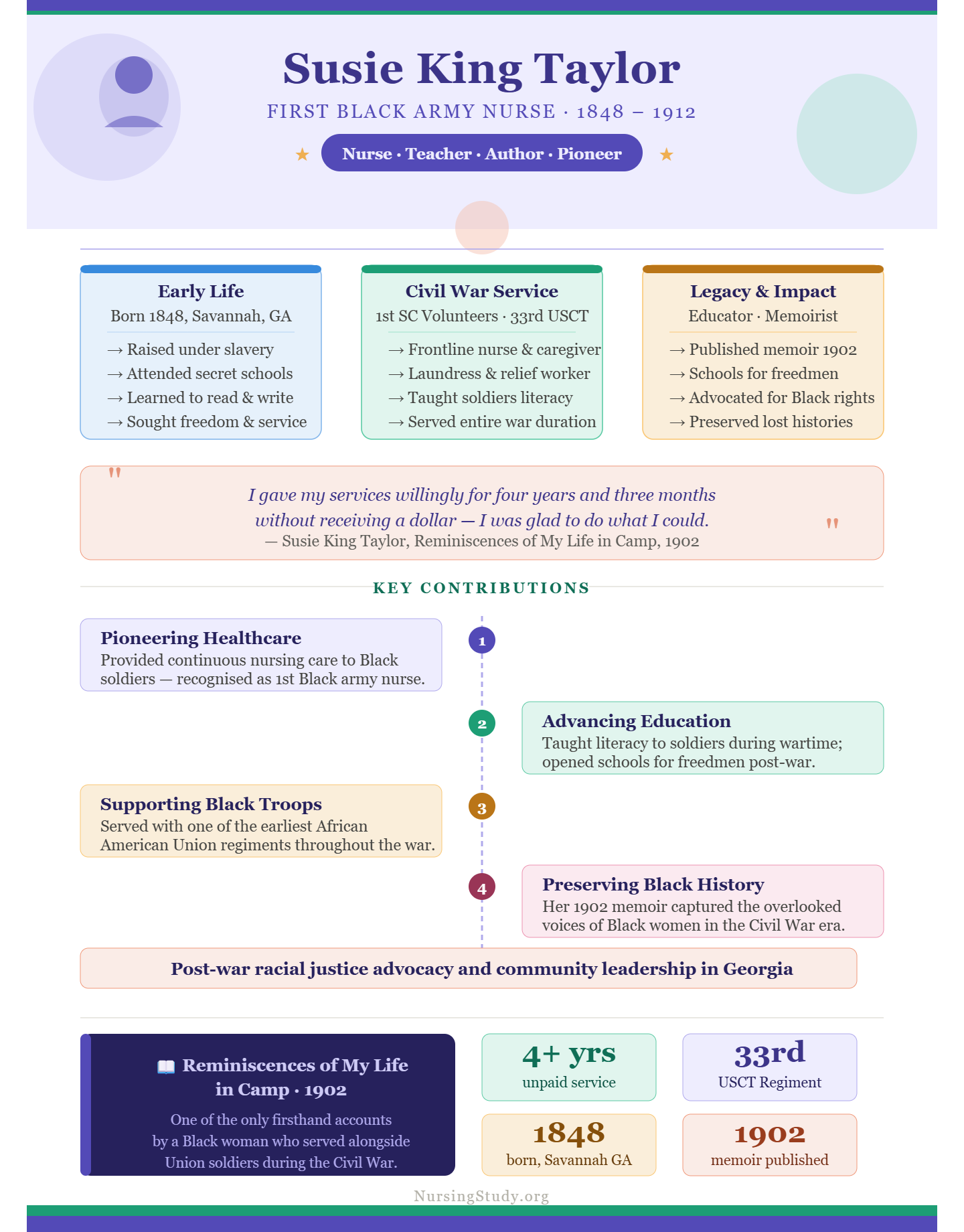
Susie King Taylor: First Black Army Nurse, Laundress, and Educator in the 1st South Carolina Regiment
Introduction to Susie King Taylor
The history of nursing, education, and African American military service during the American Civil War cannot be fully understood without examining the life and contributions of Susie King Taylor. Recognized as the first Black army nurse in the United States, Susie King Taylor played multiple roles throughout the Civil War era, including caregiver, laundress, educator, relief worker, and memoir writer. Her experiences provide valuable insight into the struggles and achievements of African Americans during one of the most transformative periods in American history.
Born in 1848 in Savannah, Georgia, Susie King Taylor grew up during a time when slavery shaped nearly every aspect of life for African Americans in the South. Laws against the formal education of African Americans made literacy dangerous for enslaved people, yet education remained a powerful symbol of freedom and resistance. Despite these restrictions, Susie King Taylor attended two secret schools taught by Black women and other sympathetic educators who risked punishment to help African Americans learn to read and write. These early educational experiences would later shape her lifelong commitment to teaching and community advancement.
The outbreak of the Civil War created significant social and political changes for African Americans across the southern states. As Union forces expanded into areas of South Carolina and Georgia, many formerly enslaved individuals sought opportunities to gain freedom, education, employment, and military service. During this period, Susie King Taylor became associated with the 1st South Carolina Volunteers, one of the earliest Union regiments composed of African American soldiers. This regiment, later reorganized as the 33d United States Colored Troops, played an important role in the Union war effort and represented a major step toward the inclusion of Black soldiers in the United States military.
Within the regiment, Susie King Taylor performed a wide range of responsibilities that demonstrated both resilience and leadership. Throughout the war, she:
- Served as a nurse for sick and wounded soldiers
- Worked as a laundress within military camps
- Assisted with relief work and caregiving duties
- Helped soldiers learn to read and write
- Supported African American troops living in difficult camp conditions
Her work was especially important because military camps during the Civil War were often overcrowded, unsanitary, and medically underprepared. Diseases such as dysentery, typhoid fever, smallpox, and malaria spread rapidly among soldiers. In many cases, caregivers like Susie King Taylor provided the most immediate and consistent support available to injured or ill troops. Although she did not hold an official military nursing title, historians widely acknowledge her as the first African American army nurse because of her continuous service caring for Black soldiers throughout the conflict.
One of the most historically significant aspects of Susie King Taylor’s life was her decision to document her experiences in writing. In 1902, she published Reminiscences of My Life in Camp, a memoir that offered one of the few firsthand accounts written by an African American woman who served alongside Union soldiers during the Civil War. The memoir provides detailed descriptions of:
- Daily life in military camps
- The experiences of African American soldiers
- Conditions within the South Carolina regiment
- Wartime nursing and medical care
- Educational efforts among formerly enslaved communities
- Racial discrimination faced by Black troops and civilians
Because many Civil War records focused primarily on military leaders and battlefield strategies, firsthand narratives such as Reminiscences of My Life in Camp remain essential historical sources. Susie King Taylor’s memoir preserved perspectives that were frequently ignored in traditional Civil War history, particularly the experiences of African American women working in military environments.
In addition to her wartime contributions, Susie King Taylor also made lasting contributions to African American education after the war ended in 1865. She opened schools for freedmen and children in Georgia and continued advocating for educational opportunities within African American communities. Her work reflected broader Reconstruction-era efforts to improve literacy and social mobility among formerly enslaved populations. Education represented more than academic learning; it symbolized independence, citizenship, and the ability to participate more fully in American society.
Several key themes define the historical importance of Susie King Taylor:
- The advancement of African American education during and after slavery
- The role of Black women in wartime healthcare
- The experiences of African American regiments during the Civil War
- The importance of memoirs in preserving marginalized histories
- The relationship between nursing, service, and social advocacy
Today, Susie King Taylor remains an important figure in both nursing history and African American history. Her story demonstrates how ordinary individuals contributed to extraordinary social change during periods of national conflict and uncertainty. Through her work as a teacher and nurse, she challenged racial and gender barriers while supporting communities affected by slavery, war, and discrimination.
This article explores the life and legacy of Susie King Taylor in depth, examining her early life in Savannah, her experiences with secret education, her service with the South Carolina regiment, her contributions as a first Black army nurse and educator, and the lasting impact of her memoir, Reminiscences of My Life in Camp. It also highlights how her experiences continue to shape historical discussions surrounding nursing, education, African American military service, and Civil War history.
Feeling stressed about writing a detailed nursing paper?
Let us produce a thorough, high-quality document.
Historical Importance in African American and Nursing History
Susie King Taylor occupies a unique and influential position in both African American history and the history of nursing in the United States. Her contributions extended far beyond traditional caregiving roles during the Civil War, as she became a symbol of resilience, education, leadership, and service during a period marked by slavery, racial discrimination, and national conflict. Through her work with African American soldiers in the South Carolina regiment, her efforts as an educator, and her publication of Reminiscences of My Life in Camp, Susie King Taylor helped preserve important historical experiences that might otherwise have been excluded from mainstream Civil War narratives.
The historical importance of Susie King Taylor is especially significant because she lived during a time when African American women faced severe legal, educational, and social restrictions. Born in 1848 in Savannah, Georgia, she entered a society where slavery shaped nearly every aspect of daily life for African Americans. Enslaved individuals were denied many basic human rights, including access to formal education. In many southern states, laws against the formal education of African Americans made it illegal to teach enslaved people how to read and write because literacy was viewed as a threat to the institution of slavery. Despite these barriers, Susie King Taylor attended secret schools taught by Black women and sympathetic community members who believed education was essential for freedom and empowerment.
Her ability to read and write later became one of the defining factors that distinguished her from many others living under slavery. Literacy allowed Susie King Taylor to become an educator, communicate effectively within military environments, and eventually document her experiences in one of the most important memoirs written by an African American woman during the Civil War era. At a time when many African Americans were deliberately excluded from historical records, her memoir provided a rare firsthand perspective on war, race, healthcare, and military life.
Historical Importance in African American History
The significance of Susie King Taylor within African American history can be understood through several major contributions.
1. Representation of African American Women During the Civil War
Many Civil War histories historically focused on political leaders, military commanders, and battlefield events while overlooking the experiences of African American women. Susie King Taylor’s life challenged this pattern by documenting how Black women contributed directly to wartime survival, healthcare, education, and community support.
Her experiences demonstrated that African American women were not passive observers during the war. Instead, they actively participated in efforts that supported Union military operations and aided formerly enslaved populations. Throughout the war, Susie King Taylor:
- Served as a nurse for sick and wounded soldiers
- Assisted African American troops living in military camps
- Worked as a laundress within the regiment
- Taught soldiers and children how to read and write
- Participated in relief efforts that supported Black communities
These responsibilities reflected the broader contributions made by African American women during the Civil War, many of whom worked without formal recognition or financial compensation.
2. Educational Advancement for African Americans
Education became one of the most powerful symbols of freedom during and after slavery. Because enslaved individuals were often prohibited from receiving formal education, literacy represented independence, empowerment, and social mobility. Susie King Taylor understood the transformative power of education from an early age because she personally experienced the risks associated with attending secret schools.
After joining Union-controlled areas in South Carolina during the Civil War, she became involved in teaching both children and soldiers. Historical accounts indicate that she established classes for freed African Americans and taught individuals who had previously been denied educational opportunities under slavery. Her work contributed to the broader movement to expand literacy among African Americans during Reconstruction.
For many formerly enslaved people, learning to read and write had practical as well as symbolic importance. Literacy allowed African Americans to:
- Read labor contracts and legal documents
- Participate more fully in civic life
- Access religious materials independently
- Seek employment opportunities
- Strengthen political activism after emancipation
Through her educational work, Susie King Taylor became part of the larger struggle for African American advancement during the nineteenth century.
3. Preservation of African American Civil War Experiences
One of the most important aspects of Susie King Taylor’s historical legacy is her role as an author and eyewitness historian. Her memoir, Reminiscences of My Life in Camp, published in 1902, preserved experiences that were often absent from traditional Civil War histories.
The memoir documented:
- Daily life in military camps
- The conditions faced by Black soldiers
- Wartime healthcare practices
- Experiences within the 1st South Carolina Volunteers and the 33d United States Colored Troops
- Racial inequalities within the military
- Interactions between African American civilians and Union forces
Because relatively few African American women published memoirs during this period, her writings remain especially valuable to historians studying Civil War history, African American life, and women’s experiences during wartime.
Historical Importance in Nursing History
In addition to her contributions to African American history, Susie King Taylor also occupies an important place in the development of American nursing history.
1. Recognition as the First Black Army Nurse
Susie King Taylor is widely recognized as the first Black army nurse because of the caregiving work she performed throughout the Civil War while attached to the South Carolina regiment. Although she lacked official military rank and formal nursing credentials, she consistently cared for soldiers suffering from illness, injury, and disease in camp environments.
Civil War nursing differed greatly from modern professional nursing. During the 1860s:
- Hospitals were overcrowded and poorly supplied
- Germ theory was not yet widely accepted
- Infection control practices were limited
- Medical technology was basic
- Disease caused more deaths than battlefield injuries
Within these harsh conditions, caregivers like Susie King Taylor provided essential support through bathing patients, cleaning wounds, distributing supplies, assisting surgeons, and offering emotional comfort to soldiers.
Her experiences illustrate how nursing responsibilities during wartime often extended beyond medical treatment alone. Nurses and caregivers frequently handled cooking, cleaning, laundry, transportation of supplies, and general camp support. This broader caregiving role reflected the realities of Civil War healthcare systems, particularly within African American regiments that often received fewer resources than white units.
2. Contributions to Wartime Healthcare
The work performed by Susie King Taylor highlights the critical role African American women played in wartime healthcare systems despite receiving limited recognition. During the Civil War, many Black women served informally as nurses, cooks, laundresses, and relief workers for Union forces. However, their contributions were frequently omitted from official records.
By documenting her experiences in Reminiscences of My Life in Camp, Susie King Taylor helped preserve evidence of African American women’s involvement in military healthcare. Her memoir described the realities of caring for soldiers living under difficult camp conditions where poor sanitation, infectious disease, inadequate nutrition, and exhausting labor were common problems.
Examples of illnesses frequently encountered in Civil War camps included:
- Dysentery
- Pneumonia
- Typhoid fever
- Malaria
- Smallpox
Because medical staff shortages were common, caregivers like Susie King Taylor often became essential providers of practical and emotional support for soldiers.
3. Influence on Modern Nursing History
Modern nursing history increasingly recognizes the contributions of historically marginalized groups whose work was previously overlooked. The legacy of Susie King Taylor is now studied within discussions of:
- Diversity in nursing history
- African American contributions to healthcare
- Women in wartime medicine
- Community-based caregiving
- Social justice in healthcare systems
Her story demonstrates that the foundations of nursing were shaped not only by formally trained professionals but also by caregivers who worked under extreme social and political challenges. The resilience, adaptability, and compassion displayed by Susie King Taylor continue to reflect important nursing values today.
Furthermore, her experiences illustrate how healthcare and social advocacy are often interconnected. In addition to caring for sick soldiers, she promoted education, supported freed African Americans, and advocated for recognition of Black veterans after the war. This combination of caregiving and advocacy aligns closely with modern understandings of holistic and community-centered nursing practice.
Ultimately, the historical importance of Susie King Taylor lies in the multiple barriers she overcame and the lasting influence of her work. As an African American woman born into slavery, she became a nurse, teacher, memoir writer, and advocate during one of the most difficult periods in American history. Her life offers valuable insight into the experiences of African Americans during the Civil War while also highlighting the early contributions of Black women to nursing and healthcare in the United States.
Early Life and Education of Susie King Taylor
The early life of Susie King Taylor provides important insight into the experiences of African Americans living in the southern United States before and during the Civil War. Her childhood reflected the harsh realities of slavery, racial discrimination, and limited opportunities for formal education, yet it also demonstrated the determination of African American communities to preserve knowledge, literacy, and cultural identity despite oppressive laws. The experiences that shaped Susie King Taylor during her early years later influenced her work as an educator, army nurse, memoir writer, and advocate for African American advancement.
Understanding the childhood and education of Susie King Taylor is essential because many of the values that defined her later achievements—including resilience, literacy, leadership, and service—were developed during these formative years. Her ability to read and write, acquired under dangerous circumstances, became one of the most important tools that enabled her to teach formerly enslaved individuals, support Black soldiers during the Civil War, and eventually publish Reminiscences of My Life in Camp, one of the most important firsthand narratives written by an African American woman during the nineteenth century.
Birth in 1848 and Childhood in Savannah
Susie King Taylor was born Susan Ann Baker in 1848 in Savannah, Georgia, a major southern city deeply connected to the institution of slavery. Savannah served as an important economic center in the South because of its role in shipping cotton and other agricultural products produced through enslaved labor. During this period, slavery influenced social structures, economic systems, laws, and daily life throughout Georgia and other southern states.
As an African American child born during slavery, Susie King Taylor entered a society where enslaved people were denied basic freedoms and legal rights. African Americans in the South often faced:
- Restrictions on movement and travel
- Limited access to education
- Separation of families through slave sales
- Forced labor and economic exploitation
- Constant surveillance and punishment
- Social systems designed to maintain racial inequality
Shortly after her birth, Susie King Taylor went to live with her grandmother, Susie Baker, in Savannah. Historical accounts suggest that her grandmother played a major role in shaping her upbringing and helping her navigate the dangers of slavery-era society. In many African American families during this period, grandparents and extended relatives served as important caregivers and protectors, especially within communities disrupted by slavery.
Savannah itself was a city marked by sharp racial divisions. Although it contained a significant population of free African Americans alongside enslaved individuals, strict laws controlled nearly every aspect of Black life. African Americans were frequently monitored by local authorities, and opportunities for advancement remained extremely limited. Even free African Americans often experienced discrimination, economic hardship, and restrictions on education and employment.
Despite these barriers, African American communities in Savannah developed strong support networks centered around churches, family relationships, mutual aid, and informal education. These community structures helped preserve cultural traditions and encouraged resistance against systems designed to suppress African American advancement.
The childhood of Susie King Taylor unfolded during a period of growing national tension over slavery in the United States. By the 1850s, political conflicts between northern and southern states regarding slavery, states’ rights, and economic systems intensified. These conflicts eventually contributed to the outbreak of the Civil War in 1861 when Susie King Taylor was still a young girl.
Her early experiences living under slavery deeply influenced her understanding of freedom, education, and social justice. Unlike many enslaved individuals who were completely denied educational opportunities, she was fortunate to encounter people willing to risk punishment in order to teach African American children basic literacy skills.
Secret Schools and Learning to Read and Write
One of the most remarkable aspects of Susie King Taylor’s childhood was her access to secret education during a time when laws against the formal education of African Americans were strictly enforced throughout much of the South. Enslaved individuals who learned to read and write were often viewed as threats to the slave system because literacy could encourage communication, resistance, and greater awareness of political and social issues.
Following slave uprisings such as Nat Turner’s Rebellion in 1831, many southern states strengthened laws prohibiting the education of African Americans. In Georgia and other southern states, teaching enslaved individuals to read could result in severe punishment for both students and teachers. Despite these risks, many African American communities continued organizing hidden educational opportunities known as secret schools.
Susie King Taylor attended two secret schools taught by Black women and other individuals committed to African American education. These schools operated discreetly in homes and private locations to avoid detection by authorities. The existence of such schools demonstrated the determination of African American communities to pursue literacy despite legal restrictions and personal danger.
The educational experiences of Susie King Taylor reflected broader patterns within African American resistance to slavery. Secret schools often depended on:
- Trusted community networks
- Religious institutions and churches
- Women educators within African American communities
- Mutual protection among families
- Instruction held during nighttime or hidden hours
The schools taught basic literacy skills such as reading, writing, spelling, and arithmetic. However, education represented much more than academic instruction alone. For African Americans living under slavery, literacy symbolized freedom, empowerment, and personal dignity.
Learning to read and write gave African Americans opportunities to:
- Read religious texts independently
- Communicate secretly through written messages
- Understand legal and political information
- Teach future generations
- Challenge stereotypes that portrayed Black people as intellectually inferior
The willingness of Black women to organize secret schools taught by Black educators was especially important because women often served as key transmitters of knowledge and cultural preservation within African American communities. These women risked harassment, violence, and legal punishment in order to educate children and adults denied access to formal schooling.
For Susie King Taylor, literacy became a life-changing skill that shaped nearly every stage of her future contributions. Her education later enabled her to:
- Teach African American children and soldiers during the Civil War
- Establish schools for freedmen after emancipation
- Assist soldiers within military camps
- Communicate effectively with Union personnel
- Write and publish her memoir
Her memoir later described the importance of education and the challenges African Americans faced while trying to obtain literacy during slavery. These experiences reveal how deeply education was valued within African American communities despite enormous social barriers.
The determination shown by Susie King Taylor and the educators who taught her also reflected broader patterns of resistance among enslaved populations. Although slavery attempted to limit intellectual development and independence, African Americans continuously developed strategies to preserve learning, family structures, and cultural identity.
By the time the Civil War began, Susie King Taylor possessed literacy skills that distinguished her within many wartime environments. Her ability to read and write later made her an essential educator within the South Carolina regiment and helped establish her role as one of the earliest African American women to publish a wartime memoir.
Ultimately, the early life and education of Susie King Taylor demonstrate how literacy, community support, and perseverance became powerful tools of resistance during slavery. Her childhood experiences in Savannah and her participation in secret schools laid the foundation for her later achievements as a teacher, nurse, humanitarian, and historical author whose legacy continues to influence African American history and nursing history today.
Susie King Taylor and the South Carolina Regiment
The relationship between Susie King Taylor and the South Carolina regiment represented one of the most important periods of her life and historical legacy. Her experiences with the 1st South Carolina Volunteers and later the 33d United States Colored Troops placed her at the center of major developments involving African American military service during the Civil War. Through her work with Black soldiers, she became deeply involved in wartime caregiving, education, and military camp life while witnessing the changing role of African Americans within the Union Army.
The service of Susie King Taylor alongside African American regiments also reflected broader social transformations occurring during the Civil War. Before the conflict, African Americans were largely excluded from military service in the United States Army. Many white political leaders and military officials initially doubted whether Black soldiers should be allowed to fight in the war. However, as the conflict continued and the Union faced increasing military demands, African American enlistment became both a military necessity and a political statement against slavery.
Within this changing environment, Susie King Taylor became associated with some of the earliest African American military units organized by Union forces in South Carolina. Her work within these regiments demonstrated the critical contributions African American women made to military operations even when they were denied official military status or recognition.
Service with the 1st South Carolina Volunteers
The Civil War created opportunities for enslaved African Americans to escape slavery and seek protection within areas controlled by Union forces. In 1862, Susie King Taylor fled to Union-occupied territory near Fort Pulaski along the Georgia coast. This transition marked a major turning point in her life because it brought her into direct contact with Union military operations and African American troops fighting for the Union cause.
Soon after arriving in Union-controlled territory, Susie King Taylor became connected to the 1st South Carolina Volunteers, one of the earliest African American regiments organized during the Civil War. The regiment was formed largely from formerly enslaved men who escaped plantations in South Carolina, Georgia, and nearby coastal regions. These soldiers viewed military service as an opportunity to fight slavery while also proving the capability and patriotism of African Americans.
The creation of the 1st South Carolina Volunteers was historically significant because it challenged widespread racial assumptions held during the nineteenth century. At the beginning of the Civil War, many military leaders believed African Americans should only perform manual labor rather than serve as combat soldiers. The success of early Black regiments such as the 1st South Carolina Volunteers helped weaken these discriminatory beliefs.
While attached to the regiment, Susie King Taylor performed multiple responsibilities that extended far beyond traditional domestic work. Her duties included:
- Assisting sick and wounded soldiers
- Washing clothes as a laundress
- Preparing supplies and supporting camp operations
- Teaching soldiers how to read and write
- Providing emotional and practical support within military camps
Because many soldiers in the regiment had been denied formal education under slavery, literacy instruction became extremely important. Susie King Taylor used the educational skills she acquired in secret schools to help soldiers improve reading and writing abilities while stationed in camp. In many cases, education served as both a practical necessity and a symbol of freedom for formerly enslaved men serving in the Union Army.
Historical accounts suggest that she organized classes and helped soldiers learn basic literacy skills whenever time permitted. These lessons reflected the strong connection between military service and education within African American communities during the Civil War. Many Black soldiers believed literacy was essential for citizenship, independence, and participation in public life after emancipation.
The conditions within military camps were often extremely difficult. Soldiers faced:
- Poor sanitation
- Limited medical resources
- Exposure to infectious diseases
- Inadequate shelter
- Harsh weather conditions
- Food shortages and exhaustion
Within this environment, caregivers like Susie King Taylor became essential sources of support. Although she was not formally enlisted as military personnel, her work contributed directly to the health and functioning of the regiment.
Her service with the 1st South Carolina Volunteers also exposed her to military campaigns and travel throughout coastal regions of South Carolina and Georgia. Through these experiences, she witnessed the realities of war firsthand, including combat preparations, camp life, racial tensions within the military, and the struggles faced by African American troops seeking equal treatment.
Transition to the 33d United States Colored Troops
As the Civil War progressed, the Union Army reorganized many African American regiments under a standardized military system known as the United States Colored Troops (USCT). In 1864, the 1st South Carolina Volunteers became part of the 33d United States Colored Troops.
This transition represented more than a simple name change. The creation of the United States Colored Troops system formalized African American military service within the Union Army and expanded opportunities for Black enlistment throughout the war. By the end of the conflict, nearly 180,000 African American soldiers had served in the Union military.
The 33d United States Colored Troops continued many of the same operations previously carried out by the 1st South Carolina regiment. These duties included:
- Guarding strategic coastal locations
- Participating in military expeditions
- Defending Union-controlled territory
- Supporting occupation efforts in southern regions
- Assisting formerly enslaved communities
Susie King Taylor remained connected to the regiment throughout much of the war. Her memoir, Reminiscences of My Life in Camp, later documented many experiences associated with camp life and military service alongside the 33d United States Colored Troops.
One of the important aspects of her writings is the detailed attention she gave to the everyday realities faced by Black soldiers rather than focusing only on battlefield events. Her memoir described camp conditions, illnesses, food shortages, military movements, and the relationships that developed among soldiers and support workers during the war.
The transition to the 33d United States Colored Troops also highlighted the continuing inequalities faced by African American regiments within the Union Army. Despite their military service, Black soldiers often experienced:
- Lower pay than white soldiers
- Inferior supplies and equipment
- Discriminatory treatment by officers
- Limited promotion opportunities
- Greater physical labor assignments
African American regiments were frequently assigned dangerous tasks such as manual labor, fortification construction, and difficult combat operations. Nevertheless, Black soldiers consistently demonstrated discipline, courage, and commitment throughout the war.
The experiences of Susie King Taylor within the 33d United States Colored Troops provided her with firsthand knowledge of both the achievements and hardships faced by African American military units. Her writings later became valuable historical records because they documented perspectives often excluded from official military reports.
The Role of African American Regiments During the Civil War
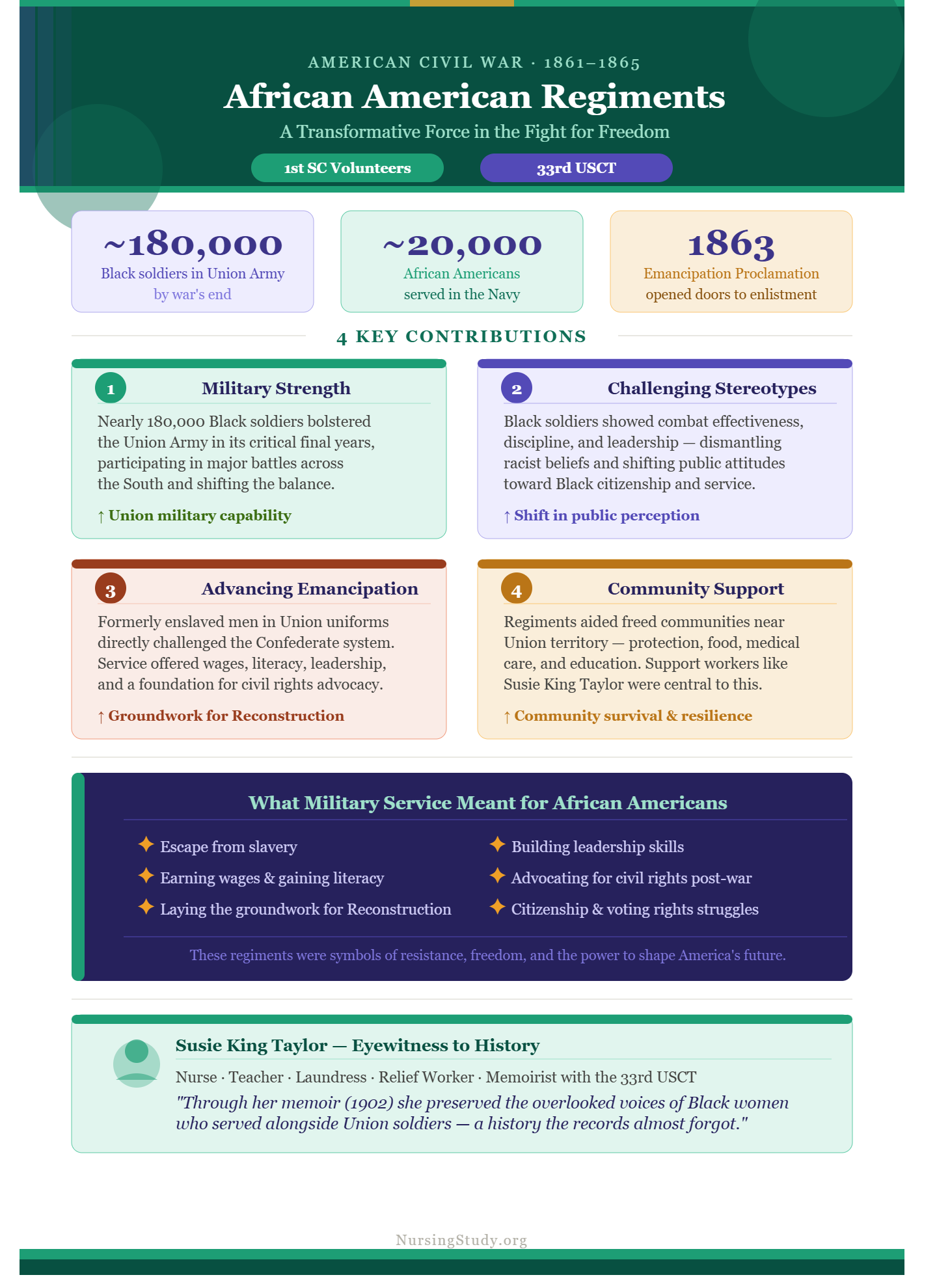
African American regiments played a transformative role during the Civil War and significantly influenced the outcome of the conflict. Initially, the Union government hesitated to allow African Americans to serve as combat soldiers. However, changing military needs and political pressure gradually led to broader acceptance of Black enlistment following measures such as the Emancipation Proclamation in 1863.
The formation of African American regiments marked a major turning point in American history because it linked military service directly to the struggle against slavery. For many African Americans, joining the Union Army represented both a fight for national preservation and a fight for personal freedom.
African American regiments contributed to the Union war effort in several important ways:
1. Increasing Union Military Strength
The Union Army benefited greatly from the enlistment of African American soldiers. By the end of the Civil War:
- Nearly 180,000 Black soldiers had served in the Union Army
- Approximately 20,000 African Americans served in the Navy
- Black troops participated in numerous battles and military campaigns
These additional forces strengthened Union military capabilities during the later years of the war.
2. Challenging Racial Stereotypes
Before the war, racist beliefs portrayed African Americans as intellectually and physically inferior. The military performance of regiments such as the 1st South Carolina Volunteers and the 33d United States Colored Troops challenged these stereotypes.
Black soldiers demonstrated:
- Combat effectiveness
- Discipline under difficult conditions
- Leadership abilities
- Commitment to military objectives
- Strong motivation to fight for freedom
Their service helped shift public attitudes regarding African American citizenship and military participation.
3. Advancing the Cause of Emancipation
African American regiments symbolized the growing connection between Union victory and the destruction of slavery. The presence of formerly enslaved men in Union uniforms represented a direct challenge to the Confederate social system.
Military service also provided African Americans with opportunities to:
- Escape slavery
- Earn wages
- Gain literacy and education
- Build leadership skills
- Advocate for civil rights after the war
The experiences of Black regiments helped lay the groundwork for future struggles involving citizenship, voting rights, and racial equality during Reconstruction.
4. Supporting African American Communities
African American regiments often maintained strong connections with freed communities living near Union-controlled territory. Soldiers and support workers frequently assisted formerly enslaved individuals by providing protection, food, medical aid, and educational opportunities.
Women such as Susie King Taylor played especially important roles within these support systems. Her work as a teacher, nurse, laundress, and relief worker demonstrated how African American women contributed directly to both military operations and community survival during wartime.
The importance of African American regiments extended far beyond military victory alone. These units became symbols of resistance, freedom, and African American participation in shaping the future of the United States. Through her close involvement with the South Carolina regiment, Susie King Taylor witnessed these historic transformations firsthand and later preserved them through her memoir.
Today, her experiences with the 1st South Carolina Volunteers and the 33d United States Colored Troops remain essential to understanding the broader contributions of African Americans during the Civil War. Her story highlights how military service, education, caregiving, and advocacy became interconnected parts of the African American struggle for freedom and equality during one of the most important periods in American history.
Service as a First Black Army Nurse and Laundress
The service of Susie King Taylor as a caregiver, laundress, and relief worker during the Civil War represents one of the most significant aspects of her historical legacy. Her experiences with the South Carolina regiment demonstrated how African American women contributed directly to military healthcare, camp operations, and soldier support during wartime. Although she did not hold an official military title or receive formal nursing training, historians widely recognize Susie King Taylor as the first Black army nurse because of her continuous caregiving service among African American troops throughout the war.
The Civil War created enormous medical and humanitarian challenges for both soldiers and civilians. Disease, poor sanitation, overcrowded camps, and limited medical resources caused widespread suffering within military environments. In many cases, the survival of soldiers depended not only on physicians and surgeons but also on caregivers who provided daily nursing assistance, emotional support, hygiene care, food preparation, and general camp maintenance. Within African American regiments, these responsibilities were especially important because Black soldiers frequently received fewer supplies and less institutional support than white troops.
The work performed by Susie King Taylor illustrates how nursing during the Civil War extended beyond formal medical treatment. Her responsibilities included caregiving, teaching, camp support, laundry work, and relief assistance, all of which contributed to the functioning and well-being of soldiers living under difficult wartime conditions.
Nursing Duties and Medical Care in Camp
The nursing responsibilities carried out by Susie King Taylor reflected the harsh medical realities of Civil War military camps. During the nineteenth century, healthcare systems were far less advanced than modern medicine. Many physicians lacked knowledge of infection prevention, sanitation standards were poor, and hospitals often became overcrowded during military campaigns.
In Civil War camps, disease posed a greater threat to soldiers than battlefield injuries. Unsanitary conditions, contaminated food and water, insect exposure, and inadequate shelter contributed to widespread illness among troops. Common diseases affecting soldiers included:
- Dysentery
- Typhoid fever
- Pneumonia
- Malaria
- Smallpox
- Tuberculosis
- Measles
Because medical personnel were often overwhelmed, caregivers such as Susie King Taylor became essential providers of day-to-day nursing care. Throughout the war, she served as a nurse for sick and wounded soldiers attached to the 1st South Carolina Volunteers and later the 33d United States Colored Troops.
Her nursing duties likely included a variety of practical caregiving responsibilities such as:
- Cleaning wounds and assisting injured soldiers
- Distributing water, food, and medical supplies
- Monitoring sick patients within camp settings
- Assisting with hygiene and bathing
- Providing comfort and emotional reassurance
- Supporting overworked surgeons and medical staff
- Helping manage recovery areas for ill soldiers
Unlike modern nursing, Civil War nursing rarely involved standardized education or professional licensing. Much of the work relied on practical caregiving skills, observation, compassion, and endurance. Women who served as nurses often learned through direct experience rather than formal training programs.
For African American regiments, the situation was frequently even more difficult. Black soldiers often faced shortages of:
- Medical supplies
- Proper uniforms
- Clean bedding
- Nutritious food
- Adequate shelter
- Trained healthcare personnel
As a result, African American women working within military camps became especially important to the health and survival of soldiers. The caregiving work of Susie King Taylor helped address these gaps within wartime healthcare systems.
Her memoir, Reminiscences of My Life in Camp, later provided valuable descriptions of medical conditions within military camps and illustrated the daily struggles associated with wartime nursing. Unlike official military records that focused mainly on battles and military leadership, her writings highlighted the human realities of illness, exhaustion, caregiving, and survival.
The nursing service of Susie King Taylor also challenged racial and gender barriers within nineteenth-century America. During this period, African American women had very limited access to formal professional roles within healthcare. Nevertheless, through her practical service in camp environments, she demonstrated competence, leadership, and dedication under extremely difficult circumstances.
Her work reflected several important nursing principles that remain relevant today:
- Compassionate patient care
- Adaptability in resource-limited environments
- Holistic support for physical and emotional needs
- Commitment to community service
- Advocacy for underserved populations
For these reasons, Susie King Taylor continues to be recognized as an important figure in the history of nursing and wartime healthcare.
Life in Camp and Support for Soldiers
Life within Civil War military camps was physically exhausting, emotionally stressful, and often dangerous. Soldiers spent long periods away from their families while facing harsh weather, poor living conditions, food shortages, and the constant threat of disease or combat. The experiences of Susie King Taylor within these camps provide valuable insight into the everyday realities faced by African American regiments during the war.
Military camps associated with the South Carolina regiment were often temporary settlements established near battle zones, coastal fortifications, or Union-controlled territory. Soldiers typically lived in tents or makeshift shelters with limited protection from rain, heat, insects, and cold weather. Overcrowding and poor sanitation created ideal conditions for the spread of disease.
In many camps:
- Clean drinking water was difficult to obtain
- Food supplies were inconsistent
- Medical facilities were limited
- Waste disposal systems were inadequate
- Soldiers experienced physical exhaustion from military labor
Within these difficult environments, support workers such as Susie King Taylor played an essential role in maintaining daily camp operations and improving soldier morale.
One of her major responsibilities involved supporting Black soldiers beyond direct medical care. Emotional encouragement and companionship were extremely important because many soldiers faced fear, uncertainty, racial discrimination, and separation from loved ones. African American troops also carried the emotional burden of fighting against a system that had enslaved them and their families.
Susie King Taylor’s educational work within the camps was especially significant. Because many formerly enslaved soldiers had been denied literacy opportunities before the war, she taught soldiers how to read and write whenever possible. Education within military camps became a symbol of freedom and self-determination for African American troops.
Learning literacy skills allowed soldiers to:
- Read letters and military documents
- Communicate with family members
- Read religious materials independently
- Gain greater independence after emancipation
- Participate more fully in public and political life
Her teaching responsibilities demonstrated how education and military service became closely connected within African American communities during the Civil War.
The camp experiences described by Susie King Taylor also revealed the strong sense of solidarity that often developed among African American soldiers and support workers. Shared experiences of slavery, discrimination, and military service created close social bonds within many Black regiments.
At the same time, life in camp remained unpredictable and dangerous. Soldiers faced:
- Sudden military movements
- Long marches
- Inadequate medical treatment
- Combat exposure
- Psychological stress
- Harsh environmental conditions
The emotional and physical endurance required to survive these circumstances was considerable. Through her caregiving and support work, Susie King Taylor helped create stability within environments frequently defined by hardship and uncertainty.
Relief Work and Daily Responsibilities in the Regiment
In addition to nursing and educational duties, Susie King Taylor performed extensive relief work and daily camp responsibilities that contributed to the operation of the regiment. Her work as a laundress and support worker reflected the broad range of tasks required to sustain military camps during the Civil War.
The role of the laundress was especially important within nineteenth-century military systems. Clean clothing and bedding helped reduce the spread of disease while improving hygiene and comfort among soldiers. In camps where infectious illnesses spread rapidly, laundry work became directly connected to health and sanitation.
As a laundress, Susie King Taylor likely:
- Washed soldiers’ uniforms and bedding
- Assisted with camp cleanliness
- Helped manage clothing supplies
- Supported sanitation efforts within camp areas
Although laundry work was physically demanding and often undervalued, it played an important role in maintaining camp health. Poor hygiene could quickly contribute to outbreaks of disease within overcrowded military environments.
Relief work within the regiment also involved responding to the practical needs of soldiers and displaced African American civilians affected by the war. During military campaigns, many formerly enslaved individuals sought protection near Union camps after escaping plantations and Confederate-controlled territory.
Support workers within these camps frequently assisted with:
- Food preparation and distribution
- Care for children and families
- Temporary shelter arrangements
- Basic healthcare needs
- Educational instruction for freed populations
The responsibilities carried out by Susie King Taylor therefore extended beyond individual caregiving to broader community support efforts during wartime.
Her ability to balance multiple roles simultaneously was remarkable. Throughout the war, she functioned as:
- A caregiver for wounded and sick soldiers
- A laundress maintaining hygiene and sanitation
- A teacher helping soldiers learn literacy skills
- A relief worker supporting camp communities
- A witness documenting African American military experiences
These overlapping responsibilities reflected the realities faced by many African American women during the Civil War, whose labor often remained unofficial yet indispensable.
The experiences of Susie King Taylor also highlight the limited recognition African American women received despite their contributions. Although she served continuously with the regiment and provided essential support services, she did not receive the same public recognition or institutional status granted to many white military nurses after the war.
Nevertheless, her memoir preserved these experiences and ensured that future generations could better understand the critical role African American women played in wartime caregiving and military support systems. Through Reminiscences of My Life in Camp, she documented the resilience, sacrifices, and achievements of Black soldiers and support workers whose stories were often overlooked in traditional Civil War histories.
Today, the service of Susie King Taylor as a first Black army nurse and laundress remains an important example of how caregiving, education, and humanitarian support contributed to military survival during the Civil War. Her experiences continue to influence discussions surrounding nursing history, African American history, women’s contributions during wartime, and the development of healthcare practices within military settings.
Susie King Taylor as an African American Educator
The contributions of Susie King Taylor to African American education represent one of the most important aspects of her historical legacy. Although she is widely remembered as the first Black army nurse associated with the South Carolina regiment during the Civil War, her role as an educator was equally significant. Throughout her life, Susie King Taylor viewed literacy and education as essential tools for freedom, independence, and social advancement for African Americans living during and after slavery.
Her educational work developed from her own experiences growing up in Savannah, Georgia, where laws against the formal education of African Americans attempted to prevent Black communities from gaining literacy and intellectual independence. Despite these restrictions, Susie King Taylor attended secret schools taught by Black women and other supportive educators who believed education was essential for survival and empowerment. These early experiences shaped her lifelong commitment to teaching African Americans who had been denied educational opportunities under slavery.
During the Civil War and Reconstruction periods, education became one of the central priorities within newly freed African American communities. Formerly enslaved individuals recognized literacy as a pathway toward citizenship, economic opportunity, political participation, and personal dignity. Within this broader historical movement, Susie King Taylor emerged as an important teacher and advocate for African American education in both military and civilian settings.
Teaching Freedmen and Soldiers During the War
The Civil War created dramatic social changes throughout the South, particularly in areas occupied by Union forces. As slavery weakened in coastal regions of South Carolina and Georgia, many formerly enslaved African Americans sought access to education for the first time. Large numbers of freedmen viewed literacy as one of the clearest symbols of freedom because enslaved people had long been prohibited from learning to read and write.
When Susie King Taylor joined Union-controlled territory in 1862 near Fort Pulaski, she quickly became involved in educational work among African American communities connected to the military camps. Because she possessed literacy skills acquired through secret education, she became uniquely positioned to teach soldiers and freed individuals who lacked formal schooling opportunities.
Historical accounts indicate that Susie King Taylor organized classes for African American soldiers serving in the 1st South Carolina Volunteers, later known as the 33d United States Colored Troops. Many soldiers in these regiments had previously lived under slavery and therefore had little or no access to formal education before joining the Union Army.
Her teaching responsibilities included helping soldiers:
- Learn basic reading skills
- Practice writing and spelling
- Improve communication abilities
- Read military materials and letters
- Gain greater educational independence
Education within military camps carried both practical and symbolic importance. Literacy helped soldiers function more effectively within military environments while also reinforcing their identity as free individuals deserving equal rights and citizenship.
For African American soldiers, learning to read and write represented resistance against a system that had historically denied Black people access to knowledge. Many formerly enslaved men viewed education as essential for building independent lives after the war ended.
The educational efforts of Susie King Taylor reflected broader changes occurring throughout the Union military during the Civil War. As African American regiments expanded, many camps became informal centers of learning where soldiers sought opportunities to improve literacy skills during periods away from active combat.
Teaching in wartime conditions was often difficult because camps faced constant movement, overcrowding, disease outbreaks, and supply shortages. Nevertheless, Susie King Taylor continued educational efforts alongside her nursing and camp support responsibilities. Her ability to balance multiple roles demonstrated remarkable resilience and dedication.
The educational work she performed during the war also highlighted the important role African American women played in community leadership. Although women often lacked formal authority within military structures, many became educators, caregivers, organizers, and advocates within Black communities affected by the war.
Several important factors made education during the Civil War especially significant for African Americans:
1. Literacy as a Symbol of Freedom
Under slavery, laws against the formal education of African Americans attempted to maintain social control by limiting access to knowledge. As a result, literacy became closely connected to ideas of liberation and self-determination.
For formerly enslaved individuals, learning to read and write allowed them to:
- Interpret labor contracts independently
- Read newspapers and political information
- Participate in civic and religious life
- Communicate with separated family members
- Pursue employment opportunities
Education therefore represented both personal empowerment and collective advancement within African American communities.
2. Military Service and Educational Advancement
The Union Army became one of the first environments where many African American men encountered organized educational opportunities. Within regiments such as the 1st South Carolina Volunteers, literacy instruction helped soldiers gain confidence and practical skills that extended beyond military service.
Educational programs within camps also strengthened morale and reinforced the belief that military service could contribute to broader social progress for African Americans.
3. African American Women as Educators
Women such as Susie King Taylor played central roles in expanding educational opportunities during the Civil War and Reconstruction periods. Because many African American women had themselves struggled to obtain literacy under slavery, they often became especially committed to teaching others.
Their work helped establish the foundation for future African American educational institutions throughout the South.
The educational service of Susie King Taylor during the war demonstrated how teaching could function as both a humanitarian effort and a form of social resistance during periods of conflict and inequality.
Establishing Schools in Georgia After the Civil War
The end of the Civil War in 1865 marked the beginning of Reconstruction, a period during which formerly enslaved African Americans sought to rebuild families, communities, and institutions throughout the South. Education became one of the highest priorities within freed communities because literacy was viewed as essential for economic independence and political participation.
After the war, Susie King Taylor continued her commitment to African American education by establishing schools in Georgia for freedmen and children. Her efforts reflected the larger movement to create educational opportunities for African Americans during Reconstruction despite widespread racial hostility and limited resources.
Historical records indicate that Susie King Taylor opened a school for African American children in Savannah and surrounding areas shortly after the war. Some accounts suggest that she became one of the first Black teachers for freed children in parts of Georgia. These schools often served communities where formerly enslaved individuals had little or no previous access to formal education.
The establishment of schools after the Civil War faced many challenges. African American educators and students frequently encountered:
- Lack of funding and supplies
- Inadequate school buildings
- Violent opposition from white supremacist groups
- Economic hardship within freed communities
- Shortages of trained teachers
- Political instability during Reconstruction
Despite these obstacles, African American communities strongly supported educational efforts because they recognized education as essential for long-term advancement.
The schools established by Susie King Taylor likely taught:
- Reading and writing
- Arithmetic
- Basic grammar and spelling
- Religious instruction
- Practical life skills
Many Reconstruction-era schools also served broader community functions by acting as meeting places, churches, and centers for political discussion.
The educational work of Susie King Taylor in Georgia reflected several important Reconstruction-era developments.
Expansion of Freedmen’s Education
Following emancipation, organizations such as the Freedmen’s Bureau supported efforts to establish schools for formerly enslaved populations throughout the South. African American teachers and community leaders played vital roles in these educational programs.
The demand for education among freed communities was extremely high because many individuals viewed literacy as a means of protecting newly gained freedom and improving future opportunities for children.
Education as Community Building
Schools became symbols of progress and stability within African American communities recovering from slavery and war. Teachers often served as respected leaders who promoted literacy, civic participation, and social organization.
By establishing schools, Susie King Taylor contributed directly to the rebuilding of African American communities during Reconstruction.
The Continuing Struggle for Educational Equality
Although emancipation ended slavery, African Americans continued facing discrimination and unequal access to educational resources after the Civil War. Segregation, racial violence, and economic inequality limited educational opportunities throughout much of the South.
Nevertheless, African American educators continued developing schools and literacy programs despite these barriers. The work of Susie King Taylor represented part of this larger struggle for educational justice.
In addition to her direct teaching work, her memoir later helped preserve historical evidence of African American educational efforts during and after the Civil War. Through Reminiscences of My Life in Camp, she documented the importance of literacy and the determination of African American communities to pursue learning despite generations of oppression.
The educational legacy of Susie King Taylor remains historically important because it illustrates how African American women contributed to both wartime support systems and postwar community rebuilding efforts. Her work demonstrated that education could function as a powerful tool for empowerment, resistance, and long-term social change.
Today, historians continue to recognize Susie King Taylor not only as a nurse and memoir writer but also as an influential African American educator whose efforts helped expand literacy and educational opportunities during one of the most transformative periods in United States history.
Reminiscences of My Life in Camp
One of the most enduring contributions of Susie King Taylor to American history was her memoir, Reminiscences of My Life in Camp, published in 1902. The book remains one of the few firsthand Civil War narratives written by an African American woman and serves as an invaluable historical source for understanding the experiences of Black soldiers, nurses, educators, and civilians during the Civil War. Through her writing, Susie King Taylor documented the realities of camp life, military service, racial discrimination, healthcare challenges, and educational efforts within African American regiments during one of the most turbulent periods in United States history.
Unlike many Civil War accounts that focused primarily on military commanders or battlefield strategies, Reminiscences of My Life in Camp concentrated on the everyday experiences of ordinary individuals living and working within wartime environments. The memoir offered readers a rare perspective from an African American woman who directly participated in military camp operations while serving alongside the 1st South Carolina Volunteers and the 33d United States Colored Troops.
The importance of the memoir extends far beyond personal storytelling. It preserves historical information that was frequently ignored or underrepresented in traditional Civil War histories, particularly the contributions of African American women and soldiers. Through her detailed observations, Susie King Taylor provided insight into the social realities of war, including the emotional struggles, physical hardships, and acts of resilience that shaped life within Union military camps.
Purpose and Historical Significance of the Memoir
The publication of Reminiscences of My Life in Camp carried enormous historical significance because very few African American women were able to publish personal narratives during the late nineteenth and early twentieth centuries. At the time the memoir was written, African Americans continued to face widespread racial discrimination, segregation, and exclusion from many areas of public life. As a result, the decision by Susie King Taylor to record and publish her experiences represented both a personal achievement and an important act of historical preservation.
One major purpose of the memoir was to document the contributions of African American soldiers and support workers during the Civil War. Many official military histories focused almost exclusively on white officers and political leaders while overlooking the experiences of Black troops and African American civilians who supported the Union war effort.
Through her memoir, Susie King Taylor ensured that the experiences of African Americans within the South Carolina regiment would not be forgotten. She described the sacrifices, bravery, and daily struggles of Black soldiers who fought for freedom and equality despite facing unequal treatment within the military system.
The memoir also served as a response to historical neglect. By the early twentieth century, many public narratives about the Civil War minimized the role African Americans played in securing Union victory and ending slavery. In contrast, Reminiscences of My Life in Camp emphasized the importance of African American participation throughout the war.
Several major themes define the historical importance of the memoir.
1. Preservation of African American Perspectives
One of the greatest strengths of the memoir is its firsthand African American perspective on the Civil War. Many historical records from the nineteenth century were written by white political leaders, journalists, or military officers, meaning African American voices were often excluded from official accounts.
The memoir preserved important perspectives on:
- African American military service
- The transition from slavery to freedom
- Educational efforts during the war
- Camp life within Black regiments
- The role of African American women in wartime support systems
Because Susie King Taylor personally witnessed these events, her observations provide historians with valuable primary source material.
2. Documentation of African American Women’s Contributions
The memoir also highlighted the often-overlooked labor performed by African American women during the Civil War. Throughout the conflict, Black women worked as nurses, laundresses, teachers, cooks, caregivers, and relief workers in support of Union forces and freed communities.
Through her writing, Susie King Taylor documented how women contributed directly to military survival and community support despite receiving limited public recognition.
Her experiences demonstrated that African American women:
- Provided essential wartime healthcare
- Supported military camp operations
- Taught soldiers and freed children
- Assisted displaced civilians
- Helped sustain morale within camps
The memoir therefore challenged historical narratives that minimized the importance of women’s wartime labor.
3. Historical Evidence of Social Conditions During the Civil War
Reminiscences of My Life in Camp also provided detailed descriptions of the social conditions experienced by African Americans during the war. Rather than focusing only on battles, the memoir described the realities of illness, hunger, discrimination, exhaustion, and uncertainty within military environments.
These descriptions help modern readers better understand the human impact of the Civil War beyond military strategy or political conflict.
4. Contribution to Civil War Historiography
Historians studying Civil War history frequently rely on firsthand narratives to reconstruct everyday experiences during the conflict. Because relatively few African American women published memoirs during this era, the writings of Susie King Taylor occupy a unique place within Civil War historiography.
Today, historians use the memoir to study topics such as:
- African American military history
- Women in wartime healthcare
- Reconstruction-era education
- Race relations during the Civil War
- Nursing and caregiving practices in military camps
The memoir remains an important educational resource because it preserves experiences that might otherwise have disappeared from historical memory.
Experiences of African American Soldiers and Nurses
One of the central strengths of Reminiscences of My Life in Camp is its detailed portrayal of African American soldiers and caregivers serving within Union military camps. Through her observations, Susie King Taylor documented both the achievements and hardships experienced by Black troops during the Civil War.
African American soldiers faced many challenges beyond ordinary military dangers. Although they fought for the Union cause, they were often subjected to discrimination within the military system itself. Black regiments frequently received fewer resources, lower pay, and less respect than white units.
The memoir described conditions faced by soldiers within the 1st South Carolina Volunteers and later the 33d United States Colored Troops. These conditions included:
- Poor camp sanitation
- Food shortages
- Inadequate medical supplies
- Long military marches
- Exposure to infectious diseases
- Harsh environmental conditions
Despite these hardships, African American soldiers demonstrated determination and resilience throughout the war.
The writings of Susie King Taylor also illustrated how military service became deeply connected to ideas of freedom and citizenship for African Americans. Many Black soldiers viewed participation in the Union Army as an opportunity to:
- Resist slavery directly
- Protect African American communities
- Demonstrate patriotism and military capability
- Secure greater civil rights after the war
- Build new identities as free citizens
The memoir emphasized the emotional significance of military service for formerly enslaved individuals who had previously been denied basic freedoms under slavery.
In addition to documenting soldiers’ experiences, the memoir provided valuable insight into the work of nurses and caregivers within wartime camps. Medical care during the Civil War was extremely limited by modern standards. Hospitals and camps often lacked proper sanitation, and infectious diseases spread rapidly among troops.
As a nurse and relief worker, Susie King Taylor described the demanding responsibilities associated with caring for sick and wounded soldiers. Caregivers frequently worked under physically exhausting and emotionally stressful conditions.
Nursing responsibilities during the Civil War often included:
- Cleaning wounds
- Assisting injured soldiers
- Distributing food and water
- Maintaining hygiene and cleanliness
- Offering emotional comfort to patients
- Supporting surgeons and camp medical staff
The memoir demonstrated how African American women contributed significantly to wartime healthcare despite receiving limited formal recognition. Many women worked informally within military camps without official military rank or compensation.
The caregiving experiences documented by Susie King Taylor also revealed the close relationships that developed within African American regiments. Soldiers and support workers often formed strong bonds based on shared experiences of slavery, racial discrimination, and military service.
Through her detailed descriptions, the memoir humanized African American troops and challenged racist stereotypes common during the nineteenth century. It showed that Black soldiers possessed discipline, courage, intelligence, and commitment despite facing unequal treatment within American society.
Insights into Military Life in South Carolina
The memoir also provided important insight into military life in South Carolina during the Civil War. Much of the wartime activity described by Susie King Taylor occurred within coastal areas of South Carolina and Georgia, regions that became strategically important to Union military operations.
South Carolina held enormous symbolic importance during the Civil War because it was the first state to secede from the Union in 1860. The state later became a major site of military campaigns involving African American troops and escaped enslaved populations.
Within South Carolina, Union-controlled areas became centers for:
- African American military recruitment
- Freedmen’s communities
- Educational programs
- Relief operations
- Military camp construction
The memoir described military life in locations such as Fort Pulaski and surrounding coastal regions. These camps often served as temporary settlements where soldiers, nurses, teachers, and formerly enslaved civilians lived together under difficult wartime conditions.
Military life in South Carolina involved constant movement and uncertainty. Soldiers frequently traveled between camps, forts, and coastal operations while dealing with unpredictable weather, disease outbreaks, and military threats.
The memoir offered detailed observations regarding camp conditions, including:
- Overcrowded living arrangements
- Poor sanitation systems
- Limited access to medical care
- Physical exhaustion from military labor
- Emotional strain caused by warfare
In addition to military duties, camps often became social and educational centers for African American communities seeking protection from slavery. Schools, religious meetings, and literacy instruction frequently developed within or near military camps occupied by Union forces.
The writings of Susie King Taylor also highlighted the role South Carolina played in the transformation of African American military participation during the Civil War. Early regiments such as the 1st South Carolina Volunteers demonstrated that Black soldiers could serve effectively within the Union Army despite widespread racial prejudice.
The success of African American regiments in South Carolina contributed to the broader expansion of the United States Colored Troops throughout the war. These developments helped reshape public perceptions of African American military service and citizenship.
Ultimately, Reminiscences of My Life in Camp remains historically significant because it preserved the voices and experiences of individuals often excluded from traditional Civil War narratives. Through her memoir, Susie King Taylor documented the realities of African American military service, wartime nursing, camp life, and educational advancement during a transformative period in American history.
Her writings continue to provide historians, educators, and readers with valuable insight into the interconnected histories of nursing, military service, African American resistance, and Civil War society. The memoir stands not only as a personal narrative but also as an important historical document that helped ensure the experiences of African American soldiers and women during the Civil War would remain part of the historical record.
Personal Life and Postwar Experiences
The personal life and postwar experiences of Susie King Taylor reveal the challenges African Americans faced during Reconstruction and the decades that followed the Civil War. Although the war ended slavery and created new opportunities for African Americans, freedom did not immediately bring equality, financial stability, or social security. Like many formerly enslaved individuals and African American veterans, Susie King Taylor experienced both progress and hardship during the postwar years.
Her life after the war reflected broader struggles involving racial discrimination, economic instability, limited employment opportunities, and the fight for recognition of African American contributions during the Civil War. At the same time, she continued to demonstrate resilience through her educational work, family responsibilities, community involvement, and advocacy for Black veterans.
The postwar experiences of Susie King Taylor are historically important because they illustrate how African American women continued serving their communities long after the fighting ended. While her wartime service as a nurse, laundress, and educator brought her into public historical memory, her later years reflected the ongoing social and political struggles faced by African Americans during Reconstruction and the rise of segregation in the United States.
Marriage, Family, and Life After the War
During the Civil War, Susie King Taylor met Edward King, a sergeant associated with the South Carolina regiment. Their relationship developed within the military environment where both individuals were connected to Union efforts supporting African American freedom and military service. She later married Sergeant Edward King, adopting the name Susie King Taylor after marriage.
The marriage reflected the importance of family formation and stability among African Americans during and after the Civil War. Under slavery, many African American families had been separated through forced sales and displacement. As a result, marriage and family life carried deep emotional and social significance during Reconstruction.
After the end of the war in 1865, Susie King Taylor and her husband attempted to establish a stable postwar life despite the uncertainties facing African Americans in the South. Reconstruction brought major political and social changes, but it also created new challenges for formerly enslaved populations seeking economic independence and long-term security.
During this period, many African Americans struggled with:
- Poverty and unemployment
- Lack of land ownership
- Racial violence and intimidation
- Unequal access to education
- Political instability
- Limited healthcare and public services
Despite these obstacles, Susie King Taylor continued working as an educator and community supporter. Historical accounts indicate that she established schools for African American children and freedmen in Georgia following the Civil War. Education remained central to her identity because she believed literacy and learning were essential tools for social advancement within African American communities.
Her schools helped provide educational opportunities for individuals who had previously been denied access to formal education under slavery. These efforts reflected the broader Reconstruction-era movement to expand literacy among African Americans throughout the South.
The transition from wartime service to civilian life was often difficult for African American veterans and their families. Although Black soldiers had contributed significantly to Union victory, many returned to communities where discrimination and racial inequality remained widespread.
For women such as Susie King Taylor, economic opportunities were also limited. African American women frequently worked in domestic labor, laundry services, caregiving, or teaching positions with low pay and little job security.
Historical sources suggest that Edward King eventually died, leaving Susie King Taylor to navigate additional personal and financial hardships. Like many widows during this period, she faced the challenge of supporting herself in a society where opportunities for African American women remained restricted.
Some historical accounts indicate that she later married Russell Taylor after the death of Edward King. Although fewer details exist regarding this later marriage, it reflected her continued efforts to maintain personal stability during a period marked by social and economic uncertainty.
The later years of Susie King Taylor’s life demonstrated both perseverance and adaptability. Throughout changing historical periods—including Reconstruction, the rise of segregation, and the early twentieth century—she remained committed to preserving the memory of African American contributions during the Civil War.
Her decision to publish Reminiscences of My Life in Camp in 1902 became especially significant because it allowed her to document not only wartime experiences but also the broader struggles and achievements of African Americans during and after slavery.
Several important themes emerge from the postwar experiences of Susie King Taylor:
1. The Struggle for Economic Stability
Many African American families experienced financial hardship after the Civil War despite emancipation. Formerly enslaved individuals often lacked property, savings, and employment protections.
Women who had served as nurses, teachers, or laundresses during the war rarely received long-term financial support or government recognition for their service.
2. Reconstruction and Community Building
The postwar years involved major efforts to rebuild African American communities through:
- Education
- Religious institutions
- Mutual aid organizations
- Political participation
- Family reunification
Susie King Taylor contributed to these rebuilding efforts through her teaching and community involvement.
3. The Continuing Impact of Racial Discrimination
Although slavery ended, African Americans continued facing systemic discrimination during Reconstruction and the rise of Jim Crow segregation. Violence, voter suppression, and unequal economic opportunities limited progress for many Black communities.
The experiences of Susie King Taylor reflected these broader historical realities.
Continued Advocacy for African American Veterans
One of the most important aspects of Susie King Taylor’s later life was her continued advocacy for African American veterans and the preservation of Black Civil War history. Throughout the late nineteenth and early twentieth centuries, many African American veterans struggled to receive recognition, pensions, and equal treatment despite their military service.
Black soldiers who served in regiments such as the 33d United States Colored Troops often returned from war expecting greater equality and citizenship rights. However, many encountered discrimination from both government institutions and broader society.
Veterans frequently faced challenges including:
- Delayed or denied military pensions
- Employment discrimination
- Racial violence
- Political exclusion
- Historical neglect of Black military service
In response to these conditions, African American veterans and community leaders organized advocacy efforts to preserve the memory of Black military contributions and demand equal treatment.
Susie King Taylor became involved in these efforts by maintaining connections with veterans’ organizations and participating in activities that honored African American soldiers. Historical records indicate that she remained active in veterans’ communities and attended reunions connected to the South Carolina regiment.
Her memoir itself functioned as a form of advocacy because it documented the contributions and sacrifices of African American soldiers who were often ignored in mainstream Civil War narratives. By recording her experiences, she challenged historical efforts to minimize the role Black troops played in preserving the Union and ending slavery.
The publication of Reminiscences of My Life in Camp helped preserve historical information regarding:
- African American regiments during the Civil War
- The service of Black soldiers within Union forces
- Wartime caregiving by African American women
- Educational efforts among freed populations
- The discrimination faced by Black veterans after the war
Her advocacy also reflected the broader importance of historical memory within African American communities. During the late nineteenth century, many public commemorations of the Civil War focused heavily on white military leaders while excluding African American perspectives.
By sharing her firsthand experiences, Susie King Taylor ensured that future generations would better understand the role African Americans played during the conflict.
Her efforts contributed to the preservation of African American Civil War history in several ways:
Preservation of Firsthand Testimony
Firsthand narratives from African American women during the Civil War were extremely rare. Her memoir therefore became an important historical document preserving perspectives often excluded from official records.
Recognition of Black Military Service
The writings of Susie King Taylor highlighted the bravery, discipline, and sacrifices of Black soldiers who fought despite unequal treatment within the military system.
Advocacy Through Education and Writing
Her continued involvement in educational and literary efforts demonstrated how storytelling and literacy could function as forms of activism and historical preservation.
Even during her later years, Susie King Taylor remained committed to honoring the contributions of African American soldiers and communities affected by the Civil War. Her work reflected a broader struggle to secure recognition and justice for individuals whose labor and sacrifices had often been overlooked.
The personal life and postwar experiences of Susie King Taylor therefore illustrate the long-term challenges faced by African Americans after emancipation while also demonstrating the resilience and leadership shown by Black women during Reconstruction and beyond. Through marriage, education, community service, and advocacy, she continued contributing to African American advancement long after the war ended.
Today, her story remains important not only because of her wartime service but also because of her determination to preserve African American history and advocate for those whose contributions were frequently ignored. Her experiences offer valuable insight into the social realities of postwar America and the ongoing struggle for equality, recognition, and historical memory.
Legacy of Susie King Taylor
The legacy of Susie King Taylor continues to hold major historical importance in the fields of nursing, African American education, Civil War history, and women’s history. Her life represented a remarkable journey from enslavement in Savannah, Georgia, to becoming a nurse, educator, memoir writer, and advocate during one of the most transformative periods in United States history. Through her service with the South Carolina regiment, her commitment to literacy and education, and her publication of Reminiscences of My Life in Camp, she helped preserve the experiences of African Americans whose contributions were frequently overlooked in traditional historical narratives.
The enduring influence of Susie King Taylor lies not only in the roles she performed during the Civil War but also in the broader social meaning of her achievements. At a time when African American women faced severe discrimination and exclusion from formal institutions, she successfully navigated military environments, taught formerly enslaved individuals, cared for wounded soldiers, and documented her experiences in writing. Her accomplishments challenged racial and gender stereotypes that existed throughout the nineteenth century and continue to inspire discussions about diversity, resilience, and social justice today.
The historical legacy of Susie King Taylor can be understood through two major areas of influence:
- Her contributions to nursing and African American education
- Her influence on Civil War and nursing history
Together, these contributions established her as an important historical figure whose work continues to shape scholarship, healthcare discussions, and educational studies.
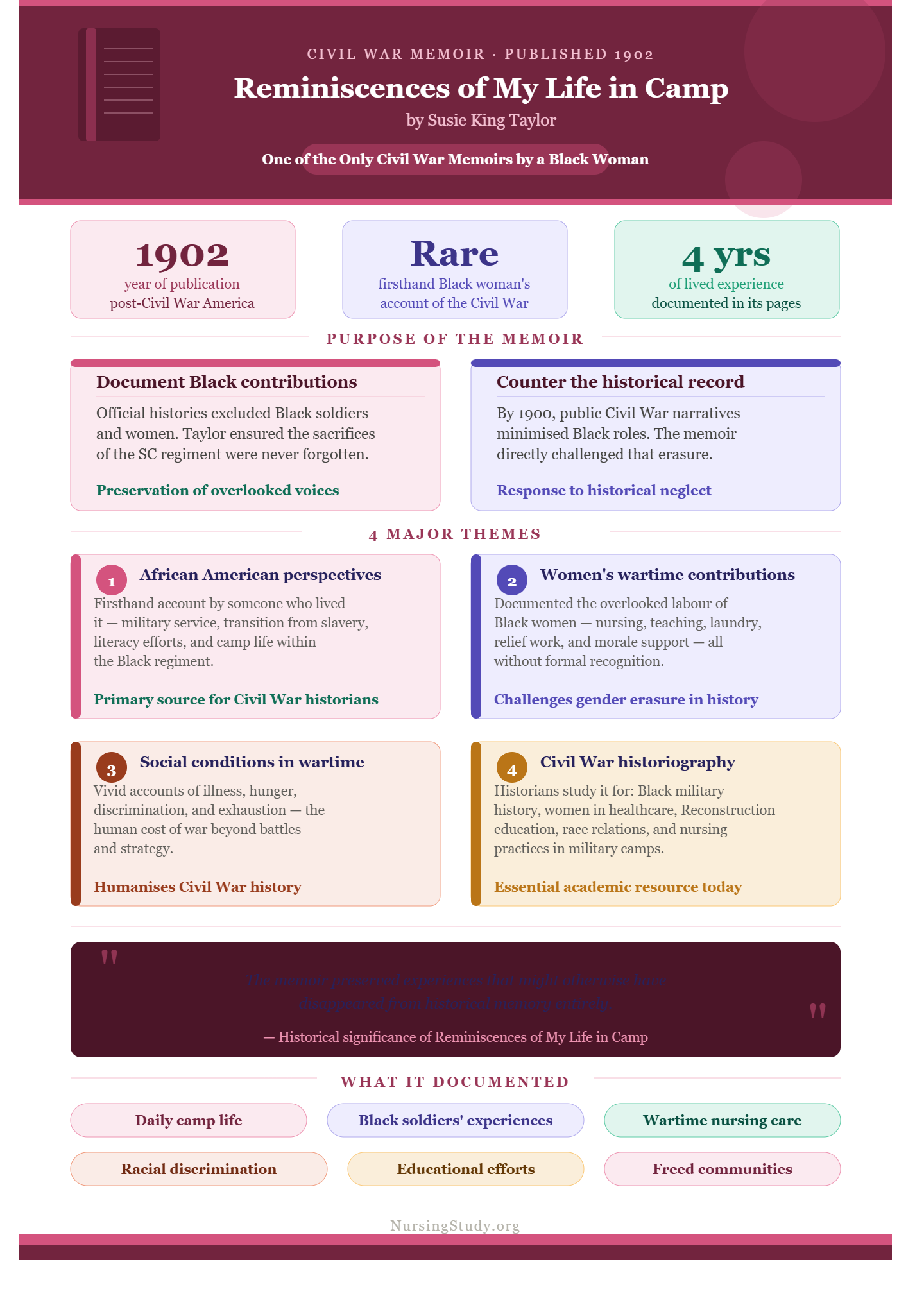
Contributions to Nursing and African American Education
One of the most significant aspects of the legacy of Susie King Taylor is her contribution to both nursing and African American education during and after the Civil War. Her work demonstrated how caregiving and education became interconnected forms of service within African American communities struggling against slavery, war, and discrimination.
Contributions to Nursing
Susie King Taylor is widely recognized as the first Black army nurse because of the caregiving responsibilities she carried out while serving alongside the 1st South Carolina Volunteers and later the 33d United States Colored Troops. Although she did not possess formal nursing credentials, her wartime service reflected many of the foundational principles associated with modern nursing practice, including compassion, patient advocacy, adaptability, and commitment to community care.
During the Civil War, healthcare systems were extremely limited. Military camps frequently lacked:
- Adequate sanitation
- Sufficient medical supplies
- Trained healthcare workers
- Proper hospital facilities
- Effective infection control methods
Disease outbreaks often spread rapidly among soldiers because overcrowded camp conditions created serious public health risks. Within these difficult environments, nurses and caregivers became essential to military survival.
The caregiving work performed by Susie King Taylor included:
- Assisting sick and wounded soldiers
- Supporting hygiene and sanitation efforts
- Providing emotional comfort and encouragement
- Helping distribute supplies and food
- Assisting with daily camp healthcare needs
Her experiences highlighted the critical role African American women played in wartime healthcare systems despite receiving little formal recognition during the nineteenth century.
Modern nursing history increasingly acknowledges that the foundations of nursing were shaped not only by formally trained professionals but also by women who provided practical caregiving under difficult circumstances. The work of Susie King Taylor demonstrated how African American women contributed significantly to healthcare delivery during the Civil War even while facing racial and gender discrimination.
Her story also remains important because it expanded historical understanding of diversity within nursing history. For many years, discussions of Civil War nursing focused primarily on white women such as Florence Nightingale internationally or Clara Barton within the United States. Although these figures made important contributions, the experiences of African American women were often overlooked in mainstream nursing narratives.
Today, the recognition of Susie King Taylor helps provide a more complete and inclusive understanding of nursing history by acknowledging the contributions of Black women who served in caregiving roles during wartime.
Contributions to African American Education
Education represented another major part of the legacy of Susie King Taylor. Her commitment to literacy reflected the importance African American communities placed on education both during and after slavery.
As a child in Savannah, she attended secret schools taught by Black women despite laws prohibiting the formal education of African Americans. These experiences shaped her lifelong belief that literacy was essential for freedom, independence, and social advancement.
During the Civil War, Susie King Taylor taught African American soldiers within the South Carolina regiment how to read and write. Many of these soldiers had previously been denied educational opportunities while enslaved.
Her educational work served several important purposes:
- Promoting literacy among formerly enslaved individuals
- Supporting soldiers’ independence and communication skills
- Encouraging civic participation after emancipation
- Strengthening African American communities through education
After the war ended, she continued establishing schools for freedmen and African American children in Georgia. These schools became part of the larger Reconstruction-era effort to expand literacy throughout African American communities across the South.
The educational contributions of Susie King Taylor were historically significant because African American education during Reconstruction faced enormous challenges, including:
- Limited funding and supplies
- Violence and intimidation from white supremacist groups
- Shortages of teachers and school buildings
- Economic instability within freed communities
Despite these obstacles, African American educators remained committed to building educational opportunities for future generations.
The legacy of Susie King Taylor within African American education therefore reflects broader themes involving resistance, empowerment, and community development. Her work demonstrated that literacy was not only an academic skill but also a powerful form of social and political empowerment.
Influence on Civil War and Nursing History
The influence of Susie King Taylor on Civil War and nursing history remains especially important because her memoir preserved firsthand accounts of experiences that might otherwise have disappeared from historical memory.
Influence on Civil War History
Reminiscences of My Life in Camp occupies a unique place in Civil War historiography because it is one of the few published wartime narratives written by an African American woman. Through her memoir, Susie King Taylor documented the realities of military camp life, African American military service, wartime healthcare, and educational efforts during the Civil War.
Her writings provided historians with valuable insight into:
- The daily lives of Black soldiers
- Conditions within Union military camps
- The role of African American women during the war
- Interactions between soldiers and freed communities
- Racial inequalities within the military system
Unlike official military reports that focused heavily on battles and military leadership, her memoir emphasized the human experiences of ordinary individuals living within wartime environments.
The influence of her memoir is particularly important because African American perspectives were often excluded from early Civil War histories. Many nineteenth-century historical narratives minimized the role African Americans played in Union victory and emancipation.
By documenting her experiences directly, Susie King Taylor challenged these incomplete narratives and helped preserve the contributions of African American soldiers and support workers.
Her memoir also contributed to broader historical discussions involving:
- Slavery and emancipation
- African American military participation
- Women’s wartime labor
- Reconstruction-era social change
- The relationship between race and citizenship
Modern historians continue using her writings as important primary source material when studying African American history, women’s history, military history, and Civil War society.
Influence on Nursing History
The legacy of Susie King Taylor within nursing history extends beyond her wartime caregiving responsibilities. Her experiences helped demonstrate how nursing has historically involved advocacy, resilience, adaptability, and service to marginalized populations.
Modern nursing scholarship increasingly recognizes the importance of diverse historical perspectives within healthcare history. The story of Susie King Taylor contributes to this effort by highlighting the role African American women played in shaping caregiving traditions despite institutional discrimination.
Her experiences also illustrate several broader themes that remain relevant within nursing today:
Holistic Caregiving
Her service involved not only physical healthcare but also emotional support, teaching, sanitation work, and community assistance. This reflects modern concepts of holistic nursing care that address multiple aspects of patient well-being.
Healthcare in Resource-Limited Environments
Civil War camps often lacked proper medical infrastructure, forcing caregivers to adapt under difficult conditions. The ability of Susie King Taylor to provide care within these environments demonstrates flexibility and problem-solving skills associated with effective nursing practice.
Advocacy and Social Justice
Throughout her life, she advocated for African American education, veteran recognition, and historical preservation. These efforts align with modern nursing values emphasizing patient advocacy, equity, and community engagement.
Representation and Diversity in Healthcare History
The recognition of Susie King Taylor helps broaden public understanding of who contributed to the development of healthcare systems in the United States. Her story encourages more inclusive discussions about race, gender, and historical representation within nursing education.
Today, historians, educators, nurses, and scholars continue studying the life of Susie King Taylor because her experiences connect multiple areas of American history, including slavery, emancipation, military service, healthcare, education, and African American activism.
Her life demonstrated extraordinary perseverance during periods marked by violence, discrimination, and social upheaval. Despite beginning life under slavery in 1848, she became an educator, caregiver, published author, and historical witness whose writings continue shaping modern understanding of the Civil War era.
Ultimately, the legacy of Susie King Taylor reflects the broader resilience of African American women who contributed to national progress despite systemic barriers. Through nursing, teaching, writing, and advocacy, she left a lasting influence on American history that continues to inspire scholarship and recognition today.
Feeling stressed about writing a detailed nursing paper?
Let us produce a thorough, high-quality document.
Conclusion
The life and legacy of Susie King Taylor provide a powerful and deeply important perspective on the interconnected histories of nursing, education, African American resistance, and the Civil War. Born into slavery in Savannah, Georgia, in 1848, she overcame enormous social and legal barriers to become a nurse, educator, humanitarian, and author during one of the most turbulent periods in American history. Her experiences demonstrate not only the hardships faced by African Americans during the nineteenth century but also the resilience, determination, and leadership that emerged within Black communities despite slavery and racial discrimination.
Throughout the Civil War, Susie King Taylor served alongside the 1st South Carolina Volunteers and later the 33d United States Colored Troops, where she worked as a nurse, laundress, relief worker, and teacher. In military camps marked by disease outbreaks, poor sanitation, exhausting labor, and limited medical resources, she provided essential care and support to African American soldiers fighting for freedom and equality. Her caregiving responsibilities reflected the broader role African American women played in sustaining wartime healthcare systems even when their work received little formal recognition.
Equally significant was her dedication to education. Having risked punishment to attend secret schools during childhood, she understood the transformative power of literacy and later devoted herself to teaching freedmen, soldiers, and African American children during and after the war. Her educational efforts reflected the determination of formerly enslaved communities to pursue learning, independence, and social advancement during Reconstruction.
One of the most enduring aspects of her legacy remains Reminiscences of My Life in Camp, her groundbreaking memoir published in 1902. The book preserved firsthand accounts of African American military service, camp life, wartime nursing, and the experiences of Black communities during the Civil War. At a time when African American voices—especially those of Black women—were often excluded from historical records, her memoir ensured that these perspectives would remain part of American history.
The story of Susie King Taylor also highlights the broader contributions of African American women whose labor, leadership, and advocacy shaped the nation during and after the Civil War. Her life challenged racial and gender stereotypes while demonstrating that caregiving, education, and community support were essential components of survival and progress during periods of conflict and social change.
Today, Susie King Taylor continues to hold lasting importance in nursing history, African American history, military history, and educational studies. Her experiences provide valuable insight into the realities of slavery, emancipation, wartime healthcare, and Reconstruction while also reminding modern readers of the enduring importance of resilience, literacy, compassion, and historical memory. Through her service, teaching, and writing, she left behind a legacy that continues to educate and inspire future generations.
Frequently Asked Questions
What was Susie King Taylor known for?
Susie King Taylor was known as the first Black army nurse during the American Civil War. She also served as a teacher, laundress, and relief worker with the 1st South Carolina Volunteers and the 33d United States Colored Troops. In addition, she became one of the first African American women to publish a Civil War memoir through Reminiscences of My Life in Camp.
Did Susie King Taylor remarry?
Yes. After the death of her first husband, Sergeant Edward King, historical accounts indicate that Susie King Taylor later married Russell Taylor.
How old was Susie King Taylor when she died?
Susie King Taylor was born in 1848 and died in 1912, making her approximately 64 years old at the time of her death.
When did Susie King Taylor marry Russell Taylor?
The exact date of Susie King Taylor’s marriage to Russell Taylor is not clearly documented in most historical records. However, the marriage occurred after the death of her first husband, Edward King, during her later postwar years.
