

What Does UAP Mean? Understanding UAPs, UFOs, UAP Sightings, Unidentified Anomalous Phenomena, NASA Findings, Pentagon Reports, and Alien Spacecraft Claims
Understanding UAPs and their broader implications has become an increasingly important topic in both scientific inquiry and governmental investigations. At its core, UAP Meaning refers to the identification and analysis of objects or phenomena in the sky that cannot be readily explained through conventional observation, natural atmospheric phenomena, or known human-made technologies. Just as clinical assessments in nursing rely on structured observation and evidence, the study of UAPs depends on careful documentation, sensor data, and methodical verification to distinguish between commonplace occurrences and anomalous phenomenon. Far from being purely speculative, investigations into UAPs involve rigorous protocols, including reports from military pilots, radar and sensor confirmation, and analysis by specialized agencies such as the All-domain Anomaly Resolution Office (AARO) and independent study teams.
The concept of UAP Meaning encompasses a wide range of incidents, from sightings of unidentified aerial phenomena to encounters documented in videos or sensor readings that remain unexplained. Historical reports, from early 20th-century accounts to the modern documentation of UAP sightings, illustrate the evolving nature of the investigation, highlighting patterns that suggest a need for systematic study. Agencies such as NASA, the Department of Defense, and the Pentagon have developed structured research frameworks to evaluate these phenomena, often collaborating with independent study teams to maintain scientific rigor. This process mirrors the systematic approach in healthcare, where multidisciplinary input and evidence-based assessment are used to guide conclusions.
Understanding UAP Meaning also requires distinguishing between different categories of aerial objects. Terms such as UFO, alien spacecraft, and airborne object often appear in media or popular culture, but official investigations focus on measurable, documented events. Sightings initially attributed to weather balloons, drones, or natural phenomena are subjected to verification using advanced sensor technology, flight pattern analysis, and expert consultation from military personnel. Similarly, unexplained aerial phenomena that cannot be identified after thorough investigation are cataloged, studied, and reported, often prompting further research into their nature, origin, and potential implications.
This guide provides a comprehensive exploration of UAP Meaning, delving into its formal definitions, the processes behind sighting verification, NASA’s research initiatives, Pentagon reports, and the role of independent study teams. It examines historical and contemporary sightings, outlines investigative methodologies, and considers the broader implications for science, national security, and public understanding. By presenting UAPs as structured phenomena for scientific and governmental inquiry rather than mere speculation, this article offers readers a grounded perspective on a topic that blends observation, evidence, and ongoing research.
Defining UAP and Related Terms
What is a UAP and How Does It Relate to the Term UAP
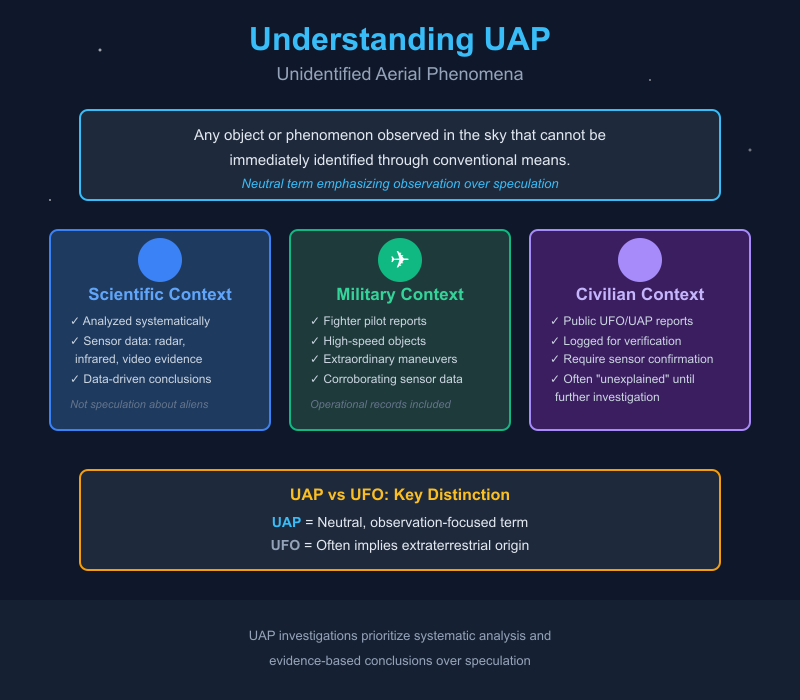
Understanding UAP Meaning begins with recognizing that the term UAP, or Unidentified Aerial Phenomena, represents any object or phenomenon observed in the sky that cannot be immediately identified through conventional means. The significance of the term lies in its neutrality: unlike “UFO,” which often implies extraterrestrial origin, UAP emphasizes the observed phenomenon itself, regardless of origin.
Key aspects of UAP include:
- Scientific Context:
- UAPs are analyzed systematically using sensor UFO sightings, radar, infrared, and video evidence.
- Investigations prioritize data-driven conclusions rather than speculation about extraterrestrial involvement or alien spacecraft.
- Military Context:
- Military pilots and fighter pilots often report high-speed objects performing maneuvers beyond conventional aircraft capabilities.
- UAP documentation from military sources includes corroborating sensor data and operational records, which differentiates official UAP cases from casual sightings.
- Civilian and Public Context:
- Civilians may report sightings of UFOs or UAPs, which are logged for verification.
- Reports lacking sensor confirmation are often classified as unexplained aerial phenomena until further investigation is conducted.
For example, a UAP sighting recorded in 2022 over a U.S. military installation was accompanied by infrared video and radar confirmation, categorizing it as a verified UAP incident rather than a mere UFO observation.
The Official Definition of Unidentified Anomalous Phenomena and UAP
Organizations such as NASA, the Department of Defense, and independent research bodies like the UAP Independent Study Team have formalized definitions to standardize investigations:
- Definition by NASA: NASA refers to UAPs as objects or phenomena in the sky that cannot currently be explained by known human-made or natural causes, assessed using a scientific, evidence-based approach. The 2022 NASA Unidentified Anomalous Phenomena independent study established frameworks for investigating these occurrences systematically.
- Department of Defense Definition: The DoD, through offices such as the All-domain Anomaly Resolution Office (AARO) and the UAP Task Force, classifies UAPs as incidents that cannot be identified after evaluation of multiple sensors and intelligence sources, often with potential national security implications.
- Independent Study Teams: These teams provide peer-reviewed analysis, contributing to the catalog of officially recognized UAPs, guiding scientific inquiry, and separating natural phenomena from unexplained aerial events.
Key criteria for an event to be officially classified as a UAP include:
- Verified observation by reliable sources (military or scientific personnel).
- Corroborating evidence from radar, infrared, or optical sensors.
- Elimination of known explanations such as drones, weather balloons, aircraft, or atmospheric phenomena.
- Persistent unexplained behavior despite investigation.
Differences Between UAP, Unidentified Flying Object, and UFO
Understanding the distinction between these terms is crucial for clarity in research and reporting:
- UFO (Unidentified Flying Object):
- Historically the most common term, popularized in media and popular culture.
- Often associated with speculation about alien spacecraft or extraterrestrial life.
- Examples include Kenneth Arnold’s 1947 “flying disc” sighting, which became the origin of the modern UFO phenomenon.
- Unidentified Flying Object:
- A more formal variation of UFO, used in early government and military reports.
- Focuses on the object being unidentifiable but does not specify its nature.
- UAP (Unidentified Aerial Phenomena):
- Emphasizes a neutral, scientific description.
- Includes UAP sightings, sensor UFO sightings, and unexplained aerial phenomena.
- Prioritizes measurement, documentation, and investigation over speculation about extraterrestrial origin.
- Examples: Objects tracked by military aircraft in 2021–2023 that defied conventional aerodynamics but were recorded and analyzed scientifically.
This semantic shift reflects a broader trend in scientific inquiry and policy: by using UAP instead of UFO, organizations like NASA, the Department of Defense, and the Pentagon emphasize evidence-based research rather than cultural assumptions.
When a Sighting Qualifies as an Anomalous Phenomenon Rather Than a Natural Event
A sighting is classified as an anomalous phenomenon when it cannot be explained through conventional means. Investigators typically follow a systematic process:
- Observation and Reporting:
- Reports can come from military personnel, civilians, or scientific observers.
- Detailed information is collected, including time, location, environmental conditions, and visual characteristics.
- Verification Using Technology:
- Tools such as radar, infrared sensors, and optical imaging help confirm the presence of the object.
- UAP videos and multi-angle recordings increase the credibility of sightings.
- Elimination of Known Causes:
- Common explanations such as drones, balloons, weather balloons, military aircraft, or natural atmospheric phenomena are systematically excluded.
- Classification as Anomalous:
- If the object or event remains unexplained after investigation, it is recorded as an anomalous phenomenon.
- This ensures that only incidents with verified, unexplained characteristics are categorized under UAP Meaning.
Example: In 2023, a reported UAP incident over a U.S. naval vessel involved multiple radar tracks and visual confirmation. After eliminating all conventional explanations, including drones, balloons, and atmospheric anomalies, the case was classified as a verified anomalous phenomenon by the UAP Task Force.
UAP and UFO Sightings
Comparing UFOs, UFOS, and UAP Reports
Historical and contemporary reports of aerial phenomena reveal significant differences in documentation, credibility, and sources. Understanding these differences is essential to contextualize UAP Meaning and the evolution of sightings over time.
- Historical Sightings:
- Early UFO reports, such as the Kenneth Arnold sightings in 1947, describe “flying discs” and introduced the concept of unidentified flying objects into public consciousness.
- These sightings were often anecdotal, with limited photographic evidence and high reliance on eyewitness accounts.
- Civilian reports historically dominate, but documentation standards were inconsistent, often leaving UFO phenomena open to speculation.
- Modern UAP Reports:
- Contemporary UAP sightings are characterized by advanced sensor verification, including radar, infrared imaging, and UAP videos captured from military aircraft or satellites.
- Reports by military pilots and fighter pilots are prioritized due to their expertise in identifying aircraft and aerial anomalies.
- Modern cases, such as those investigated in 2021–2023 by the Pentagon and the UAP Task Force, provide cross-referenced evidence from multiple sources, increasing credibility.
- Documentation Differences:
- Civilian UFO reports are often limited to photographs, videos, or visual accounts, which may suffer from observational errors.
- UAP reports, in contrast, include sensor data, radar tracking, and structured incident logs. For example, a 2022 UAP incident recorded over a naval vessel included radar data, pilot testimony, and infrared video, qualifying it as a verified UAP case rather than an unverified UFO sighting.
By analyzing both UFOS and UAP reports, researchers can trace trends, such as increased sightings in areas near military installations, and distinguish anecdotal reports from scientifically verified data.
Criteria for Classifying a UFO Sighting Versus a UAP Sighting
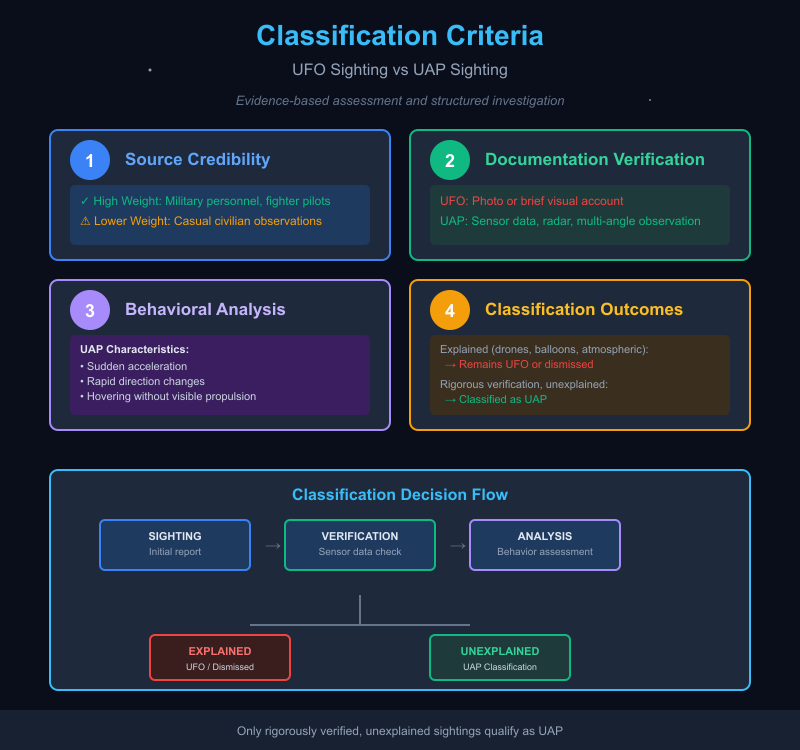
Classifying a sighting as a UFO or a UAP requires a structured investigative framework. The distinction emphasizes evidence-based assessment and consistency in reporting:
- Source Credibility:
- Reports from trained observers, such as military personnel, fighter pilots, or sensor operators, carry higher weight than casual civilian observations.
- Documentation and Verification:
- A UFO sighting may only include a photograph or a brief visual account, whereas a UAP sighting requires sensor verification, radar tracking, and ideally multi-angle observation.
- Behavioral Analysis:
- UAPs are often characterized by maneuvers that defy conventional aircraft capabilities, such as sudden acceleration, rapid direction changes, or hovering without propulsion.
- UFOs in popular culture are sometimes depicted performing similar actions, but without sensor corroboration, they remain speculative.
- Classification Outcomes:
- If a sighting can be explained through conventional means—such as drones, balloons, or natural atmospheric phenomena—it remains a UFO observation or is dismissed.
- Only sightings meeting rigorous verification standards, after eliminating known explanations, are classified as UAPs or included in unidentified anomalous phenomena studies.
Example: A UFO sighting over Nevada in 2021 was initially reported by civilians as a “fast-moving light.” Military radar later confirmed multiple objects performing erratic maneuvers, leading to its classification as a UAP incident by the All-domain Anomaly Resolution Office (AARO).
Common Explanations for UAP Sightings: Weather Balloons, Drones, or Natural Phenomena
Many UAP or UFO reports are eventually attributed to conventional causes, highlighting the importance of scientific inquiry and investigative rigor:
- Weather Balloons and Balloons:
- Often misidentified due to reflective surfaces, altitude, and unusual movement patterns.
- Example: A reported 2022 UAP over a military base was later confirmed as a weather balloon by cross-referencing flight schedules and meteorological data.
- Drones:
- Civilian and commercial drones can mimic behaviors attributed to unexplained aerial phenomena.
- Investigators compare flight patterns and object size to distinguish between drones and true UAPs.
- Natural Phenomena:
- Atmospheric events such as temperature inversions, lightning sprites, or meteorological anomalies can appear as luminous objects or lights in the sky.
By systematically eliminating these conventional explanations, authorities ensure that only unexplained aerial phenomena are formally classified under UAP Meaning.
How Civilians and Researchers Report UAP Incidents for Accurate Investigation
Accurate reporting is critical to differentiate casual UFO observations from verified UAPs. Researchers and agencies have developed best practices for civilians and scientific observers:
- Detailed Observation:
- Record the time, location, environmental conditions, and direction of the sighting.
- Note size, shape, color, movement, and duration.
- Use of Technology:
- Capture UAP videos, photographs, or radar readings when possible.
- Multiple viewpoints enhance verification and reduce the likelihood of misinterpretation.
- Submission to Authorities:
- Reports should be submitted to recognized organizations, such as the UAP Task Force, Department of Defense, or independent study teams.
- Structured reporting ensures incidents are cataloged for further analysis and potential inclusion in NASA Unidentified Anomalous Phenomena studies.
- Collaboration with Experts:
- Civilian observers can collaborate with UFO researchers, military personnel, and scientific teams to validate sightings.
- Expert evaluation helps distinguish between conventional objects and true UAP incidents.
Example: In 2023, a civilian pilot’s report of a fast-moving light near a U.S. military installation included GPS coordinates, infrared video, and corroboration by nearby fighter pilots, which allowed the UAP Independent Study Team to include it as a verified UAP report.
Investigation and Verification of UAPs
How UAP Sightings and UAP Videos Are Investigated
Investigating UAP sightings and UAP videos is a meticulous process that blends scientific methodology, technological tools, and expert evaluation. The goal is to distinguish between conventional explanations—such as drones, weather balloons, or natural phenomena—and genuinely unexplained events.
- Initial Collection and Documentation:
- Every sighting is first documented with time, location, and environmental conditions.
- Observers are encouraged to capture photos or UAP videos, noting altitude, size, color, and movement.
- Civilian and military witnesses submit reports to agencies like the UAP Task Force, All-domain Anomaly Resolution Office (AARO), or independent research teams.
- Preliminary Review:
- Experts assess whether the incident may be explained by conventional aerial objects such as drones, balloons, or military aircraft.
- Metadata from videos and images, such as timestamps, lens data, and flight trajectory, are examined to ensure authenticity.
- Corroboration and Multi-source Analysis:
- Investigators compare reports with radar, infrared sensors, and satellite data to verify the sighting.
- Multiple independent witnesses or sensor confirmations increase the credibility of the UAP report.
Example: A 2021 sighting off the U.S. East Coast included a UAP video taken by a Navy pilot. The footage, combined with radar tracks and sensor data, allowed investigators to confirm that the observed object was not a conventional aircraft or drone, leading to its classification as a verified UAP.
Sensors, Radar, and Evidence Used to Confirm UAP Incidents
Technological verification is critical to distinguishing unexplained aerial phenomena from conventional explanations. The following tools are commonly employed:
- Radar Systems:
- Track speed, altitude, and flight trajectory of objects.
- Provide cross-validation of visual sightings.
- Infrared Sensors and Thermal Imaging:
- Detect heat signatures and identify propulsion methods.
- Useful for observing airborne objects at night or in obscured conditions.
- Satellite Imagery:
- Provides geospatial context and multi-angle confirmation of the event.
- Enables correlation with atmospheric or environmental factors, ruling out natural atmospheric phenomena.
- Multisensor Integration:
- Combining radar, infrared, and optical data allows for a comprehensive analysis of speed, shape, and maneuverability.
- Helps eliminate false positives caused by sensor errors or optical illusions.
Example: In a 2022 case over a military installation, multiple sensors, including infrared cameras and radar, captured anomalous objects performing sudden acceleration and directional changes. After eliminating drones, balloons, and atmospheric effects, the objects were classified as UAPs.
Contributions of Military Pilots and Fighter Pilot Reports to UAP Investigations
Military personnel and fighter pilots are often among the most reliable observers due to their training and expertise in aerial identification. Their reports contribute significantly to UAP investigations:
- Expert Observation:
- Pilots can distinguish between conventional aircraft, commercial drones, and anomalies in flight patterns.
- Detailed descriptions of shape, speed, and maneuvers provide essential data.
- Sensor Correlation:
- Military pilots often operate aircraft equipped with advanced radar and infrared sensors, enabling simultaneous video and sensor capture.
- These recordings provide objective evidence to corroborate visual reports.
- Flight Pattern Analysis:
- Fighter pilots document maneuvers, acceleration, and hovering behavior that may defy known aerodynamics, assisting investigators in distinguishing anomalous phenomenon from conventional aerial objects.
Example: In 2023, reports from Navy pilots of objects seen over the Atlantic involved high-speed, sudden directional changes. The combination of pilot testimony and sensor data allowed the UAP Independent Study Team to classify the incidents as verified UAP encounters.
The Role of the All-domain Anomaly Resolution Office (AARO) and Task Forces
Specialized government teams play a central role in coordinating the investigation and verification of UAPs:
- All-domain Anomaly Resolution Office (AARO):
- Coordinates investigations across multiple branches of the military and government agencies.
- Ensures that UAP incidents are thoroughly documented, evaluated, and categorized.
- UAP Task Forces:
- Conduct in-depth analysis of sensor data, visual reports, and corroborating evidence.
- Work with independent study teams and NASA Unidentified Anomalous Phenomena research initiatives to maintain scientific rigor.
- Evaluation and Classification:
- Determine whether UAPs pose national security risks or remain scientifically unexplained but non-threatening.
- Classify incidents for future research, policy development, and public reporting.
Example: The 2021 establishment of the UAP Task Force under the Department of Defense allowed the systematic review of over 140 reports of UAPs. Using data from military pilots, radar, and infrared sensors, the task force was able to differentiate incidents explainable by conventional means from truly unexplained phenomena.

NASA’s Role in UAP Research
NASA’s Approach to UAP Research and the Unidentified Anomalous Phenomena Independent Study
NASA’s involvement in UAP research marks a significant shift toward systematic, evidence-based investigation of unexplained aerial phenomena. Recognizing the growing number of credible UAP sightings reported by military personnel, civilians, and researchers, NASA initiated the NASA Unidentified Anomalous Phenomena independent study in 2022. This effort emphasizes scientific rigor, structured methodology, and transparency.
Key aspects of NASA’s approach include:
- Structured Methodology:
- NASA applies standardized protocols for collecting and evaluating UAP videos, radar data, and sensor readings.
- The process ensures that every report is assessed consistently, reducing errors due to observational bias or misinterpretation.
- Scientific Protocols:
- Investigators prioritize multi-sensor verification, including optical, infrared, radar, and satellite imagery.
- Reports are cross-checked against known flight paths, military aircraft, commercial drone activity, and natural atmospheric phenomena to eliminate conventional explanations.
- Independent Study Framework:
- The Unidentified Anomalous Phenomena independent study operates separately from military or intelligence assessments, allowing for an impartial scientific evaluation.
- Experts in physics, atmospheric science, aerospace engineering, and data analysis collaborate to classify sightings as conventional, anomalous, or unexplained.
- Data Transparency and Public Engagement:
- NASA emphasizes the publication of findings in peer-reviewed formats, enhancing the credibility and reproducibility of research.
- Civilian contributions, including verified UAP reports and UAP videos, are incorporated into studies when properly documented.
Example: A 2023 report analyzed multiple UAP incidents recorded by fighter pilots over the Pacific. Using infrared imaging, radar cross-referencing, and trajectory modeling, NASA scientists could rule out drones, balloons, and natural atmospheric phenomena, categorizing the encounters as verified unexplained events.
Findings from NASA Unidentified Anomalous Phenomena Reports
NASA’s investigations provide valuable insights into the nature and characteristics of unexplained aerial phenomena. Key findings from the Unidentified Anomalous Phenomena independent study include:
- Unexplained Sensor Data:
- Numerous incidents involve sensor readings that defy conventional explanations, such as objects moving at extreme speeds or performing abrupt directional changes beyond known aircraft capabilities.
- These data points are carefully documented and analyzed, contributing to the scientific understanding of UAPs.
- Anomalous Flight Behaviors:
- Verified cases often display flight characteristics inconsistent with known propulsion technologies, including sudden acceleration, rapid deceleration, and hovering without visible propulsion systems.
- Such behaviors are central to distinguishing true UAP encounters from casual UFO sightings.
- Insights into Spacecraft-like Objects:
- Some reports include evidence of objects with metallic or reflective surfaces and aerodynamic shapes resembling spacecraft.
- While NASA does not assume extraterrestrial life, these observations guide research into potential aerospace technologies and the limits of known physics.
Example: In 2022, the NASA study reviewed a series of UAP videos captured by Navy aircraft over the Atlantic. The objects exhibited rapid lateral movement and altitude changes inconsistent with conventional aircraft or drones, remaining classified as anomalous phenomena pending further investigation.
Coordination Between NASA, the Department of Defense, and the Director of National Intelligence
NASA’s research is enhanced by collaboration with military and intelligence agencies. Interagency coordination ensures that UAP investigations are thorough, credible, and consistent:
- Data Sharing and Analysis:
- NASA works with the Department of Defense and the Director of National Intelligence (ODNI) to access classified or sensitive sensor data from military aircraft, satellites, and radar installations.
- This collaboration allows NASA to confirm civilian UAP sightings or UAP videos with high-confidence data from multiple sources.
- Joint Evaluation of UAP Incidents:
- Coordinated efforts ensure that each UAP encounter is evaluated for potential national security implications, technological significance, or scientific interest.
- Multi-agency review reduces the likelihood of misclassification and enhances the accuracy of public reporting.
- Informing Policy and Research Priorities:
- Findings from NASA studies contribute to broader government policy on UAP research, including guidance for the UAP Task Force and the AARO.
- Collaborative research helps prioritize cases that may require further scientific investigation, resource allocation, or national defense assessment.
Example: In 2021, NASA coordinated with the Department of Defense to analyze UAP encounters captured near military training zones. The combination of civilian reports, fighter pilot testimony, and radar analysis allowed the agencies to categorize certain objects as unexplained aerial phenomena, forming the basis for subsequent research and UAP study protocols.
Pentagon and Government Involvement
The Pentagon’s Role in UAP Reporting and Investigations
The Pentagon has taken a central role in managing, investigating, and standardizing reports of UAP sightings and unidentified anomalous phenomena. Recognizing the potential implications for national security and aviation safety, the Department of Defense (DoD) has established a structured approach to cataloging and evaluating these incidents.
Key elements of the Pentagon’s approach include:
- Centralized Reporting:
- All credible UAP reports from military personnel, fighter pilots, and other observers are submitted to a centralized system managed by the UAP Task Force and All-domain Anomaly Resolution Office (AARO).
- This ensures uniform documentation, reduces duplication, and enhances data integrity.
- Systematic Evaluation:
- Each UAP incident is assessed using multiple data sources, including radar, infrared sensors, visual confirmation, and UAP videos.
- Experts analyze flight behavior, trajectory, and potential interaction with military aircraft to determine whether the objects pose any national defense risks.
- Integration with Intelligence Agencies:
- The Pentagon coordinates with the Director of National Intelligence to access classified data from satellites, reconnaissance aircraft, and other intelligence sources.
- This allows a comprehensive understanding of the nature of UAPs, including potential foreign technological threats.
Example: A 2021 UAP incident reported by Navy pilots over the East Coast involved high-speed aerial objects performing abrupt maneuvers. The Pentagon evaluated radar data, sensor UFO sightings, and pilot testimony to determine that the objects could not be identified as conventional aircraft or drones, highlighting the need for continued monitoring.
Conclusions from Department of Defense and Pentagon Reports on UAPs
The Pentagon’s official reports provide insights into the prevalence, characteristics, and potential risks associated with UAP incidents.
- Patterns in Unexplained Aerial Phenomena:
- A significant number of reported UAP sightings remain unexplained, even after thorough investigation.
- The majority of verified incidents exhibit anomalous flight behavior, including sudden acceleration, hovering, and maneuvers inconsistent with known aircraft.
- Assessment of Potential Threats:
- While some UAPs are determined to have benign origins, the Pentagon emphasizes vigilance due to possible national security implications.
- Foreign or adversarial technological capabilities could mimic UAP-like behavior, making evaluation essential.
- Documented Case Studies:
- The 2022 Pentagon UAP report reviewed 144 sightings from 2004 to 2021. About 80% of these incidents cannot be identified conclusively.
- These findings underscore the complexity of separating natural phenomena, drones, balloons, and unidentified objects from genuine anomalous phenomena.
Example: A UAP detected near a military installation in 2022 demonstrated erratic flight patterns and no visible propulsion system. Pentagon analysis concluded that the object could not be explained by conventional means, marking it as an unexplained aerial phenomenon.
How the UAP Task Force and Independent Study Team Influence Policy and National Security
The UAP Task Force and the UAP Independent Study Team are critical in translating investigative findings into policy and strategic planning:
- Policy Development:
- Findings from verified UAP incidents guide regulations for reporting, observation, and military training protocols.
- The Task Force ensures that incidents near military installations or sensitive airspace are properly monitored and investigated.
- Risk Assessment:
- Each UAP encounter is evaluated for potential threats to aviation safety, military operations, and national defense.
- The teams classify UAPs into categories such as identified, likely conventional, or unexplained, facilitating strategic decision-making.
- Strategic Planning and Coordination:
- Recommendations from the independent study team inform interagency coordination, enabling joint investigations with NASA, the Department of Defense, and the Director of National Intelligence.
- Ensures that data on anomalous aerial phenomena contributes to research, defense readiness, and technology assessment.
Example: In 2021, the UAP Task Force provided recommendations that led to improved sensor coverage at key naval training areas, ensuring that subsequent UAP encounters could be documented more accurately and efficiently.
Differentiating National Security Concerns from Unexplained but Nonthreatening UAP Encounters
Not all verified UAP encounters pose a national security risk. The Pentagon uses a structured approach to differentiate:
- Indicators of Potential Threat:
- Incidents that occur near military installations, restricted airspace, or national defense assets.
- UAPs exhibiting advanced propulsion or maneuverability that could challenge U.S. technological superiority.
- Nonthreatening Anomalous Phenomena:
- Sightings that remain unexplained but do not interact with critical infrastructure, personnel, or airborne object identification and management systems.
- These are scientifically interesting and included in UAP research, but pose no immediate defense concerns.
- Evaluation Criteria:
- Evidence from UAP videos, sensor UFO sightings, and radar data.
- Flight patterns, altitude, and proximity to strategic locations.
- Corroboration from multiple observers, including military pilots and radar operators.
Example: A 2023 UAP encounter observed over open ocean exhibited anomalous flight behavior but posed no threat to nearby military assets. After analysis, it was classified as an unexplained phenomenon of scientific interest, not a national security concern.
UAPs, Alien Spacecraft, and Popular Culture
Are UAPs Evidence of Extraterrestrial Life or Alien Spacecraft?
The question of whether UAPs constitute evidence of extraterrestrial life or alien spacecraft is one of the most debated topics in both scientific and public discourse. While sensationalized narratives often dominate media coverage, scientific investigation requires a careful distinction between evidence-based analysis and speculation.
- Scientific Perspective on UAPs:
- Agencies like NASA, the Department of Defense, and independent study teams treat UAP sightings as unexplained anomalous phenomena until verified by rigorous analysis.
- Most documented UAP incidents involve data that cannot conclusively point to extraterrestrial origins but do warrant further scientific inquiry.
- Evidence Considered:
- Credible UAP videos captured by military pilots sometimes show objects with unconventional flight patterns, sudden acceleration, or hovering without visible propulsion.
- Radar, infrared, and satellite sensor data may confirm anomalies but do not inherently indicate alien technology.
- Separating Fact from Speculation:
- While the possibility of alien spacecraft is popular in speculation, no verifiable evidence currently confirms extraterrestrial visitation.
- Scientists emphasize understanding natural phenomena, experimental aircraft, or advanced human-made technology before considering extraterrestrial hypotheses.
Example: In 2022, a series of UAPs observed near U.S. naval training exercises exhibited extraordinary maneuverability. Analysis by the UAP Independent Study Team confirmed anomalous behavior but could not attribute it to extraterrestrial origin, illustrating the distinction between observed phenomena and speculation about alien life.
How UFO Phenomena in Popular Culture Shape Public Perception and Expectations
Popular culture plays a critical role in shaping how the public perceives UFOs or UAPs, often influencing both reporting and interpretation of sightings.
- Media Influence:
- Television shows, films, and online content frequently depict alien spacecraft or extraterrestrial visitation, creating expectations that all unexplained aerial sightings are of alien origin.
- High-profile cases, such as the 1947 Kenneth Arnold flying disc sighting, were sensationalized in newspapers and contributed to the public fascination with UFO phenomena.
- Myths and Misconceptions:
- Popular culture often conflates UAP sightings with evidence of aliens, leading to exaggerated reporting or misidentification of conventional objects such as drones, balloons, or military aircraft.
- Social media has amplified the spread of unverified UAP videos, sometimes undermining rigorous scientific investigation.
- Impact on Reporting:
- Public expectation of extraterrestrial involvement may increase the number of reports, but not all sightings are credible.
- Conversely, heightened attention can also motivate better documentation and more detailed data collection, aiding scientific and military investigation.
Example: The release of declassified UAP videos by the Pentagon in 2020 generated a global surge in reported sightings, with many civilian UAP sightings inspired by media coverage rather than direct observation of anomalous phenomena.
Percentage of UAP Incidents That Remain Unexplained and Its Implications
Despite decades of reporting, a significant portion of UAP incidents remain unexplained, prompting ongoing scientific and policy interest.
- Statistical Overview:
- According to the 2022 Pentagon UAP report and follow-up studies, roughly 20–25% of documented UAP sightings could not be identified after investigation.
- These incidents are classified as anomalous phenomena and continue to be analyzed by the UAP Task Force, NASA, and independent study teams.
- Scientific Implications:
- Unexplained UAPs present opportunities for advancing research into atmospheric physics, aeronautical engineering, and sensor technology.
- They challenge investigators to improve sensor accuracy, refine investigative methodologies, and explore novel hypotheses for anomalous flight behavior.
- Policy and Research Directions:
- Unexplained UAPs inform national security planning, particularly in determining whether new aerial technologies may be adversarial in origin.
- Independent study teams recommend increased funding for UAP research, better civilian reporting systems, and enhanced interagency data sharing.
Example: In 2021, of 144 UAP incidents reviewed by the Pentagon, 80% remained unexplained. While this does not confirm alien visitation, it highlights the complexity of anomalous phenomena and underscores the importance of continued scientific investigation.
Best Practices for Reporting and Understanding UAPs
How Civilians and Organizations Can Report UAP Sightings Accurately
Accurate reporting of UAP sightings is essential for advancing scientific understanding, supporting national security, and distinguishing between conventional objects and true anomalous phenomena. Whether an individual is a civilian observer, a researcher, or part of an organization, adhering to structured reporting practices ensures that UAP videos, radar detections, and eyewitness accounts are credible and actionable.
Key steps for reporting UAPs accurately include:
- Document the Sighting Immediately:
- Record the exact date, time, and location of the UAP encounter.
- Note environmental conditions such as weather, visibility, and any nearby sources of light or reflection that could affect perception.
- Capture Supporting Evidence:
- Use cameras, smartphones, or other recording devices to document the UAP video or imagery.
- Include multiple angles if possible, and avoid altering the footage to preserve authenticity for investigators.
- Describe the Observation in Detail:
- Include the object’s size, shape, color, movement patterns, altitude, and duration of visibility.
- Record any sounds, lights, or unusual effects noted during the sighting.
- Identify Potential Conventional Explanations First:
- Compare the observation against known aircraft, drones, weather balloons, satellites, or natural atmospheric phenomena.
- Note any known nearby events that could account for the sighting.
- Report Through Credible Channels:
- Submit reports to recognized authorities such as local aviation authorities, the UAP Task Force, NASA’s reporting portals, or relevant research organizations.
- For organizations, maintain a standardized reporting template to ensure consistency across multiple sightings.
Example: In 2022, a civilian group in California recorded a series of unexplained objects performing unusual maneuvers over the coastline. By documenting the sightings with timestamps, GPS coordinates, and environmental conditions, the UAP independent study team was able to corroborate the data with radar and military pilot reports, classifying the events as unexplained aerial phenomena rather than drones or balloons.
Key Information That Helps Investigators Separate Drones, Balloons, or Natural Causes from Unexplained Cases
Effective investigation of UAP incidents relies on collecting precise and detailed information. This allows experts to differentiate between ordinary objects, atmospheric anomalies, and truly unexplained phenomena.
- Timing and Duration:
- Record the exact start and end times of the sighting.
- Note patterns of movement, such as hovering, acceleration, or sudden changes in direction, which may indicate unconventional behavior beyond drones or weather balloons.
- Location and Environment:
- Provide GPS coordinates or detailed location information.
- Include environmental factors such as cloud cover, precipitation, or light conditions that may influence visibility.
- Physical Characteristics of the Object:
- Document size, shape, color, and any distinguishing features.
- Note reflective surfaces, lights, or unique flight behavior that cannot be explained by conventional aircraft.
- Sensor Verification:
- When possible, supplement visual observation with data from radar, infrared, or other sensors.
- This enhances credibility and allows cross-referencing with other reports, including fighter pilot sightings or military aircraft observations.
- Witness Reliability and Corroboration:
- Include multiple independent witnesses if available.
- Record professional observers, such as military personnel or trained aviation experts, as their testimony can provide higher confidence in classification.
Example: A 2023 UAP report involved multiple witnesses observing a metallic, disc-shaped object hovering over a restricted military training zone. Detailed observations, combined with radar confirmation, enabled investigators to rule out drones, weather balloons, and natural atmospheric phenomena, leaving the encounter classified as a verified unexplained aerial phenomenon.
Conclusion
Understanding the UAP meaning requires a careful balance between scientific rigor, national security awareness, and thoughtful interpretation of eyewitness reports. Over the years, the terms UAP, UFO, and unidentified anomalous phenomena have evolved from sensationalized notions of alien spacecraft to structured categories used by government agencies, researchers, and organizations worldwide. By examining historical and modern UAP sightings, analyzing data from military pilots and fighter pilots, and leveraging tools such as radar, infrared sensors, and UAP videos, investigators can differentiate between conventional explanations—such as drones, weather balloons, or natural atmospheric phenomena—and encounters that remain truly unexplained.
Government agencies, including the Department of Defense, the UAP Task Force, and NASA through its Unidentified Anomalous Phenomena independent study, have formalized procedures for investigating, documenting, and assessing UAP incidents. These efforts ensure that phenomena are evaluated with consistency, transparency, and attention to both scientific inquiry and national security considerations. While a significant percentage of UAP reports remain unexplained, ongoing studies highlight the importance of rigorous data collection, corroboration from multiple sources, and careful analysis of flight behaviors and sensor evidence.
Moreover, the intersection of UAP research and popular culture underscores how public perception can shape reporting, influence expectations, and occasionally blur the line between speculation and verified phenomena. Yet, the structured methodologies applied by experts, combined with best practices for reporting, provide a pathway to separate myth from reality and contribute to credible scientific understanding.
Ultimately, the study of UAPs—whether conducted by NASA, military personnel, or civilian observers—offers valuable insights into the limits of current technology, the challenges of observational science, and the possibilities inherent in exploring unidentified aerial phenomena. By approaching UAPs with an evidence-based, systematic mindset, society can advance both scientific knowledge and national security preparedness, while fostering a clearer understanding of one of the most intriguing aspects of the skies above.
The ongoing investigation into UAPs reinforces that the UAP meaning extends beyond speculation—it encompasses structured observation, critical analysis, and a commitment to distinguishing the anomalous phenomenon from the explainable, ultimately bridging curiosity, science, and policy in the pursuit of knowledge.
Frequently Asked Questions
Why do they say UAP instead of UFO?
The term UAP (Unidentified Anomalous Phenomena) is used instead of UFO because it is more neutral, scientific, and precise. While “UFO” historically carried connotations of alien spacecraft and popular culture speculation, UAP emphasizes that the object is simply unidentified, focusing on observed behavior and characteristics without implying extraterrestrial origin.
What does anomalous phenomenon mean?
An anomalous phenomenon refers to an event or object that deviates from what is normally expected, unexplained by conventional science or known natural or human-made processes. In the context of UAPs, it describes aerial objects exhibiting unusual movement, speed, or behavior that cannot be readily explained.
What is the meaning of UAP?
UAP meaning refers to an Unidentified Anomalous Phenomenon—any aerial or airborne object or event that cannot be immediately identified, classified, or explained using standard observations, sensors, or scientific knowledge. It is a term widely adopted by military, NASA, and independent study teams for systematic investigation.
What are some common explanations for UFO sightings?
Many reported UFO sightings are later attributed to conventional causes, such as:
- Drones or remote-controlled aircraft
- Weather balloons or experimental balloons
- Natural atmospheric phenomena, like clouds, meteors, or unusual light refraction
- Military or civilian aircraft seen under unusual lighting or perspective
- Optical illusions or human perception errors
While these explanations account for a majority of sightings, some UAP incidents remain truly unexplained, warranting further scientific investigation.
