

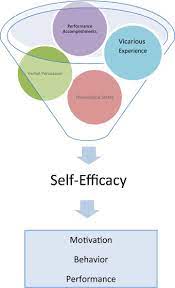
Self-Efficacy Theory: Albert Bandura’s Guide to Academic Self-Efficacy in Nursing
Self-Efficacy Theory is one of the most influential psychological theories for understanding how people develop confidence in their ability to learn, perform, and achieve desired outcomes. Developed by Albert Bandura, the theory shifted attention away from viewing knowledge and skills as the sole determinants of success. Instead, it emphasized that an individual’s belief in their ability to organize and execute courses of action required to accomplish a specific task often determines whether they will attempt the task, persist when challenges arise, and ultimately succeed. This perspective has had a profound influence on psychology, education, healthcare, leadership, and organizational development, making Self-Efficacy Theory one of the most widely applied theories of human behavior.
Within nursing, Self-Efficacy Theory provides an important framework for understanding why individuals with similar levels of knowledge and technical competence may perform differently in academic, clinical, and professional settings. Nursing requires far more than memorizing concepts or mastering psychomotor skills. It demands critical thinking, sound clinical judgment, effective communication, adaptability, emotional resilience, and the confidence to make decisions in complex healthcare environments. The concept of self-efficacy helps explain how these abilities develop over time and why confidence often influences learning, performance, and professional growth as much as knowledge itself.
According to Bandura’s Social Cognitive Theory, self-efficacy is a person’s belief in their capability to successfully organize and perform behaviors necessary to achieve a specific outcome. This definition highlights an important distinction between possessing ability and believing that one can apply that ability effectively. A person may have the knowledge required to complete a procedure, solve a clinical problem, or pass an examination, yet hesitate because of doubts about their own capabilities. Conversely, individuals with high self-efficacy are generally more willing to embrace challenges, invest greater effort, demonstrate persistence, and recover from setbacks because they possess confidence in their capacity to overcome obstacles.
The importance of Self-Efficacy Theory extends far beyond confidence alone. Research has consistently demonstrated that self-efficacy beliefs influence numerous aspects of human behavior, including:
- Motivation and willingness to begin challenging tasks.
- The amount of effort invested in achieving goals.
- Persistence when difficulties or failures occur.
- Decision-making under pressure.
- Emotional reactions such as anxiety, confidence, and optimism.
- Long-term learning, skill development, and professional growth.
These relationships explain why Self-Efficacy Theory has become an essential framework in nursing education and healthcare practice. Whether learning a new clinical skill, communicating with patients, participating in simulation exercises, or managing complex patient conditions, a person’s perceived self-efficacy often shapes how effectively they apply their knowledge in real-world situations.
One of the defining strengths of Bandura’s theory of self-efficacy is that it explains how efficacy beliefs develop rather than simply describing their effects. Psychologist Albert Bandura proposed that confidence is not an innate characteristic that individuals either possess or lack. Instead, it develops gradually through experiences that influence a person’s sense of self-efficacy over time. These experiences include:
- Mastery experiences, which build confidence through successful performance.
- Vicarious experience, gained by observing others perform similar tasks successfully.
- Verbal persuasion, where encouragement and constructive feedback strengthen confidence.
- Physiological and emotional states, including how individuals interpret stress, anxiety, fatigue, and other emotional responses during performance.
Together, these four sources of self-efficacy information explain why confidence can strengthen, weaken, or change throughout life depending on an individual’s experiences and environment.
The influence of Self-Efficacy Theory can be seen across numerous disciplines. In education, it helps explain academic achievement and lifelong learning. In healthcare, it supports patient education, behavior change, rehabilitation, and chronic disease management. In leadership and organizational psychology, it informs strategies for improving workplace performance and professional development. The theory has also become a central concept in sport and exercise psychology, where researchers examine how confidence influences athletic performance, resilience, and competitive success. Despite these diverse applications, the underlying principle remains the same: people are more likely to successfully perform challenging tasks when they possess a strong belief in their capabilities.
In nursing education, academic self-efficacy has become increasingly important because of the demanding nature of nursing curricula and clinical training. Nursing learners must continually integrate theoretical knowledge with practical application while adapting to changing patient conditions, evolving healthcare technologies, and evidence-based practice. Self-Efficacy Theory provides educators with a framework for understanding how confidence influences learning behaviors, clinical competence, and professional identity. It also helps explain why some individuals remain resilient in the face of academic and clinical challenges while others experience low self-efficacy, avoid difficult learning opportunities, or struggle to translate knowledge into effective practice.
This guide provides a comprehensive exploration of Self-Efficacy Theory and its relevance to nursing. It examines the development of the original theory, its relationship to Social Cognitive Theory, the principles that shape self-efficacy beliefs, and the four primary sources through which confidence develops. The discussion also explores academic self-efficacy, evidence-based strategies for improving self-efficacy, practical applications in nursing education and clinical practice, insights from sport and exercise psychology, and findings from contemporary self-efficacy research. By understanding these concepts, readers will gain a deeper appreciation of how confidence, learning, and performance interact, and why Self-Efficacy Theory continues to serve as one of the most influential frameworks for promoting competence, resilience, and lifelong professional development in nursing.
Understanding Self-Efficacy Theory
Self-Efficacy Theory is one of the most widely recognized theories in psychology for explaining how an individual’s beliefs influence learning, motivation, decision-making, and performance. Developed by Albert Bandura, the theory proposes that people do not rely solely on their knowledge, intelligence, or technical skills when approaching a challenge. Instead, their belief in their ability to organize and execute courses of action required to complete a specific task plays a significant role in determining whether they will begin the task, how much effort they will invest, how long they will persist when obstacles arise, and how they interpret success or failure.
Unlike theories that focus primarily on external rewards or innate ability, Self-Efficacy Theory emphasizes the power of personal beliefs. It suggests that two individuals with comparable knowledge and skills may achieve very different outcomes because of differences in their self-efficacy beliefs. One individual may approach a challenge with confidence, determination, and resilience, while another may hesitate, avoid the task altogether, or give up after encountering minor setbacks. These differences are often explained not by actual competence but by differences in perceived self-efficacy.
Within nursing, this perspective is particularly valuable because competence develops through repeated practice, clinical exposure, and reflective learning. Nursing professionals are expected to apply theoretical knowledge in rapidly changing clinical environments where decisions often have immediate consequences for patient safety. In these situations, Self-Efficacy Theory helps explain why confidence and competence develop together and why strengthening a person’s sense of self-efficacy is essential for long-term professional growth.
Several characteristics distinguish Self-Efficacy Theory from general discussions of confidence or self-esteem:
- It focuses on confidence related to performing a specific task, not overall personality.
- It explains how beliefs influence behavior before, during, and after performance.
- It recognizes that self-efficacy may change over time as individuals gain experience.
- It demonstrates that confidence can be developed through structured learning experiences rather than being an inborn personality trait.
- It provides practical strategies for improving self-efficacy in educational, healthcare, workplace, and personal settings.
These principles have made Self-Efficacy Theory one of the most influential frameworks for understanding learning and professional development across numerous disciplines.
Definition of Self-Efficacy
The term defined self-efficacy refers to an individual’s judgment regarding their capability to organize and perform the actions necessary to achieve a desired outcome. According to psychologist Albert Bandura, self-efficacy is a person’s belief in their capacity to successfully perform behaviors required to accomplish particular goals. In simple terms, it reflects an individual’s belief in your capabilities rather than the actual skills or knowledge they possess.
This distinction is important because having the necessary ability does not always guarantee effective performance. Likewise, believing in one’s capabilities does not mean that success is guaranteed. Instead, Self-Efficacy Theory argues that people are more likely to use their existing knowledge effectively when they possess confidence in their ability to apply it under real-world conditions.
For example, consider two newly graduated nurses who have received identical education and clinical training.
- Nurse A possesses higher self-efficacy. Before inserting an intravenous catheter, the nurse carefully reviews the procedure, remains focused, and confidently performs the skill. If the first attempt is unsuccessful, the nurse analyzes the mistake, seeks guidance if necessary, and tries again until competence improves.
- Nurse B has lower self-efficacy despite having similar technical knowledge. Before performing the same procedure, the nurse becomes overwhelmed by self-doubt, worries excessively about failure, hesitates during the procedure, and may avoid future opportunities to practice.
The difference between these two individuals is not necessarily intelligence or technical competence. Rather, it lies in each person’s belief in their ability to apply what they know effectively.
One of the most important principles of Self-Efficacy Theory is that efficacy is task-specific. A person can demonstrate strong self-efficacy in one area while experiencing uncertainty in another.
For instance, a nursing student may:
- Feel highly confident when communicating with patients.
- Experience anxiety while interpreting arterial blood gas results.
- Excel during classroom discussions.
- Lack confidence when administering medications independently.
This illustrates that self-efficacy for a particular activity develops through experience and should not be confused with general self-confidence.
According to Bandura’s theory, self-efficacy judgments influence several important behaviors, including:
- Whether individuals attempt challenging tasks.
- The goals they choose to pursue.
- The effort invested in learning.
- Their willingness to continue after setbacks.
- Emotional responses such as confidence, optimism, or fear.
- Overall motivation and achievement.
Consequently, Self-Efficacy Theory has become a valuable framework for explaining why some individuals continue striving toward excellence while others withdraw despite having comparable abilities.
Albert Bandura and the Development of Self-Efficacy Theory
The development of Self-Efficacy Theory is closely associated with the pioneering work of Albert Bandura, one of the most influential psychologists of the twentieth century. Albert Bandura’s research fundamentally changed the understanding of human learning by demonstrating that behavior results from continuous interactions among cognitive processes, environmental influences, and personal experiences.
Before introducing the theory of self-efficacy, many psychological models emphasized external reinforcement as the primary explanation for learning. According to these earlier perspectives, individuals learned mainly through rewards, punishments, and repeated conditioning. While reinforcement remained important, Albert Bandura argued that human beings are active participants in their own learning rather than passive recipients of environmental influences.
His research demonstrated that people constantly evaluate:
- Their strengths and weaknesses.
- Previous successes and failures.
- Available resources.
- Environmental challenges.
- Their own individual’s belief about whether they can successfully complete future tasks.
These internal evaluations shape person’s self-efficacy, which in turn influences future behavior.
One of Albert Bandura’s most influential contributions involved demonstrating that individuals can learn simply by observing others, even without direct reinforcement. This discovery eventually became the foundation for the original theory and later evolved into a broader explanation of human learning and behavior.
As research on self-efficacy expanded, Bandura demonstrated that efficacy beliefs affect nearly every aspect of performance, including:
- Academic achievement.
- Clinical competence.
- Leadership development.
- Workplace performance.
- Health behavior change.
- Rehabilitation outcomes.
- Athletic performance.
- Emotional resilience.
His work also showed that confidence develops through repeated interactions between personal experiences and environmental influences rather than remaining fixed throughout life.
Today, Bandura’s theory of self-efficacy continues to influence numerous disciplines because it provides practical explanations for how individuals develop competence, overcome challenges, and maintain long-term motivation.
Within nursing, Self-Efficacy Theory helps educators understand why structured clinical experiences, simulation laboratories, mentoring relationships, constructive feedback, and reflective practice contribute to professional growth. Rather than assuming confidence develops automatically with knowledge, the theory recognizes that both competence and confidence must be cultivated together.
Self-Efficacy Theory Within Social Cognitive Theory
To fully appreciate Self-Efficacy Theory, it is essential to understand its relationship with Social Cognitive Theory. Bandura’s Social Cognitive Theory explains that human behavior is shaped through the continuous interaction of three interconnected factors:
- Personal factors, including thoughts, emotions, and beliefs.
- Behavioral factors, including previous actions and experiences.
- Environmental factors, including family, education, workplace culture, and social influences.
This dynamic interaction is often described as reciprocal determinism, meaning that individuals both influence and are influenced by their environment. Rather than viewing behavior as determined solely by external circumstances or internal characteristics, Bandura’s framework recognizes that people actively shape their own learning experiences.
Within this broader model, Self-Efficacy Theory serves as one of the central mechanisms explaining why people behave differently under similar conditions. An individual’s efficacy beliefs influence how they interpret challenges, respond to obstacles, regulate emotions, and decide whether they can cope with difficult situations.
For example, consider two nursing professionals assigned to care for a critically ill patient for the first time.
Although both possess similar educational preparation, their responses may differ considerably.
The nurse with high self-efficacy is more likely to:
- Remain calm while assessing the patient.
- Seek additional information when necessary.
- Collaborate effectively with colleagues.
- Make informed clinical decisions.
- Learn from mistakes without losing confidence.
In contrast, people with low self-efficacy may:
- Experience excessive self-doubt.
- Become feeling anxious or stressed before beginning patient care.
- Avoid making independent decisions.
- Depend heavily on reassurance.
- Interpret minor setbacks as evidence of personal incompetence.
These contrasting responses demonstrate how person’s belief in their ability influences performance beyond technical knowledge alone.
Within Bandura’s Social Cognitive Theory, efficacy beliefs also affect how people interpret outcomes. Individuals with high self-efficacy generally attribute setbacks to factors such as limited experience, insufficient preparation, or temporary obstacles. Because they believe improvement is possible, they remain motivated to continue learning.
Conversely, people with low self-efficacy are more likely to interpret the same setbacks as proof that they lack the ability to succeed. This perception often reduces motivation, weakens personal efficacy, and contributes to avoidance behaviors that further limit opportunities for growth.
For nursing education, this relationship has profound implications. Clinical instructors and educators do more than teach technical skills; they also shape learners’ students’ self-efficacy through supportive learning environments, constructive feedback, realistic simulations, and opportunities for independent practice. As confidence develops alongside competence, learners become better prepared to adapt to increasingly complex healthcare environments while maintaining safe, evidence-based practice.
Ultimately, Self-Efficacy Theory occupies a central position within Social Cognitive Theory because it explains the cognitive processes that connect learning with behavior. By understanding how self-efficacy beliefs influence motivation, performance, emotional regulation, and professional development, nursing educators and healthcare professionals can create learning experiences that foster lifelong competence, resilience, and excellence in patient care.
Core Principles of Self-Efficacy Theory
At the heart of Self-Efficacy Theory is the idea that human behavior is shaped not only by what individuals know or can do but also by what they believe they are capable of accomplishing. According to Albert Bandura, people continually evaluate their one’s capabilities before deciding whether to undertake a challenge, invest effort, or persist when obstacles arise. These evaluations form the basis of efficacy beliefs, which influence nearly every aspect of learning, performance, and decision-making.
One of the defining features of Bandura’s theory of self-efficacy is that it views people as proactive rather than reactive. Instead of simply responding to environmental events, individuals actively interpret experiences, assess their strengths and limitations, and make choices based on their individual’s belief in their ability to achieve success. Consequently, behavior is influenced as much by perception as by actual competence.
The original theory emphasizes several key principles that explain how efficacy shapes behavior:
- Self-efficacy is task-specific.
Confidence varies depending on the activity being performed. An individual may possess strong confidence in one area while feeling uncertain in another. For example, an experienced emergency nurse may confidently manage trauma patients but initially feel less confident when transitioning to a neonatal intensive care unit. Likewise, a nursing student may excel at patient communication yet lack confidence when interpreting electrocardiograms or administering intravenous medications. - Beliefs influence actions before performance begins.
Before attempting any activity, individuals subconsciously evaluate whether they believe they can successfully perform the required behaviors. These self-efficacy judgments influence whether they accept or avoid challenges long before actual performance occurs. - Self-efficacy changes over time.
Unlike personality traits that remain relatively stable, Self-Efficacy Theory proposes that confidence develops through experience. Positive learning experiences, successful task completion, constructive feedback, and supportive environments contribute to the development of self-efficacy, while repeated failures without guidance or encouragement may contribute to lower self-efficacy. - Behavior is influenced by cognitive, emotional, and environmental factors.
Consistent with Bandura’s Social Cognitive Theory, efficacy develops through continuous interaction between personal beliefs, previous experiences, emotions, and the surrounding environment. Clinical instructors, mentors, peers, healthcare organizations, and learning environments all play important roles in shaping a person’s confidence in one’s ability.
These principles explain why Self-Efficacy Theory has become an essential framework for nursing education. Nursing competence involves much more than acquiring technical knowledge. Learners must also develop confidence to apply that knowledge in unpredictable clinical situations where effective judgment, communication, and adaptability directly influence patient outcomes.
Self-Efficacy Beliefs and Human Behavior
One of the most significant contributions of Self-Efficacy Theory is its explanation of how self-efficacy beliefs influence everyday behavior. Rather than determining what people are objectively capable of doing, these beliefs determine what they are willing to attempt, how they approach challenges, and how they respond when difficulties arise.
According to Albert Bandura, a person’s behavior is guided by continuous cognitive evaluations of their own abilities. Before undertaking a task, individuals ask themselves questions such as:
- Can I perform this procedure correctly?
- Do I have the necessary knowledge?
- Am I capable of solving this problem?
- What are my chances of success?
- How will I respond if I encounter difficulties?
The answers to these internal questions shape person’s self-efficacy, which subsequently influences behavior.
Individuals with strong perceived self-efficacy generally demonstrate behaviors such as:
- Seeking new learning opportunities.
- Approaching unfamiliar situations with curiosity rather than fear.
- Investing greater effort in difficult activities.
- Demonstrating resilience after setbacks.
- Viewing mistakes as opportunities for improvement.
- Maintaining confidence during complex decision-making.
Conversely, individuals experiencing low self-efficacy often display different behavioral patterns, including:
- Avoiding unfamiliar or challenging tasks.
- Hesitating before making decisions.
- Becoming discouraged after minor setbacks.
- Underestimating their own capabilities.
- Reducing effort when difficulties arise.
- Experiencing increased anxiety before performance.
These behavioral differences become especially apparent in healthcare settings.
Example: Clinical Simulation
Imagine two nursing students participating in their first cardiac arrest simulation.
Although both students possess similar theoretical knowledge, their reactions differ because of differences in efficacy beliefs.
Student A, with stronger student self-efficacy, volunteers to assess the patient, communicates clearly with teammates, and performs cardiopulmonary resuscitation according to established protocols. Even after making minor mistakes, the student remains focused and continues learning throughout the simulation.
Student B, experiencing lower self-efficacy, hesitates before participating, worries excessively about making mistakes, and relies heavily on classmates for reassurance. Following the simulation, the student focuses primarily on perceived failures rather than recognizing opportunities for improvement.
This example illustrates an important principle of Self-Efficacy Theory: confidence influences behavior before ability can fully be demonstrated.
Another important aspect of the theory is that self-efficacy beliefs affect emotional regulation. Individuals who possess confidence in their abilities are more likely to remain composed during demanding situations, whereas those with weaker efficacy beliefs may become overwhelmed by self-doubt or excessive worry. These emotional responses subsequently influence learning, decision-making, and future performance.
High Self-Efficacy vs. Low Self-Efficacy
One of the central concepts within Self-Efficacy Theory is the distinction between high self-efficacy and low self-efficacy. These represent opposite ends of a continuum describing the strength of an individual’s belief in their ability to accomplish a particular task.
It is important to recognize that high self-efficacy does not imply perfection or the absence of failure. Instead, it reflects confidence that challenges can be managed through effort, learning, and persistence. Similarly, low self-efficacy does not necessarily indicate limited ability. Rather, it reflects uncertainty regarding one’s capacity to apply existing knowledge and skills effectively.
The following comparison illustrates these differences.
| Individuals with High Self-Efficacy | People with Low Self-Efficacy |
|---|---|
| View difficult tasks as opportunities for growth. | View difficult tasks as threats to avoid. |
| Demonstrate greater persistence after setbacks. | Give up more quickly following failure. |
| Focus on solving problems. | Focus on avoiding mistakes. |
| Maintain confidence while learning new skills. | Doubt their abilities despite adequate preparation. |
| Accept constructive criticism as an opportunity to improve. | Interpret feedback as evidence of personal inadequacy. |
| Adapt more effectively to changing environments. | Become discouraged when circumstances become challenging. |
These differences become highly relevant in nursing practice.
For example, consider a newly employed registered nurse learning to manage critically ill patients in an intensive care unit.
A nurse with higher self-efficacy is likely to:
- Ask questions when uncertain.
- Seek mentorship from experienced colleagues.
- Continue practicing unfamiliar procedures.
- Reflect on mistakes constructively.
- Develop competence steadily through continued learning.
By comparison, people with low self-efficacy may:
- Avoid volunteering for unfamiliar procedures.
- Delay decision-making because of fear of failure.
- Become excessively feeling anxious or stressed during clinical responsibilities.
- Question their professional competence despite possessing adequate knowledge.
- Miss valuable learning opportunities because they underestimate their abilities.
Importantly, Bandura’s work demonstrates that these differences are not permanent. Because self-efficacy may increase through experience, supportive instruction, successful performance, and positive feedback, individuals can gradually strengthen their confidence over time.
Self-Efficacy, Motivation, and Goal Achievement
Among the most important contributions of Self-Efficacy Theory is its explanation of the relationship between confidence, motivation and achievement, and long-term success. Rather than simply influencing emotions, efficacy beliefs determine how individuals set goals, regulate effort, overcome obstacles, and evaluate progress.
According to Bandura’s theory, motivation is influenced by a person’s expectation that their actions will produce meaningful results. Individuals who possess confidence in their ability to achieve a specific outcome are generally more motivated to invest time and energy into learning because they believe their efforts will lead to success.
This relationship influences several important aspects of human performance.
Goal Selection
People with stronger personal efficacy are more likely to establish ambitious yet realistic goals. They view challenging objectives as opportunities for growth rather than as potential sources of failure.
In contrast, individuals experiencing lower self-efficacy often select easier goals or avoid challenging opportunities altogether because they doubt their likelihood of success.
Effort and Persistence
One of the defining characteristics of individuals with high self-efficacy is sustained effort. Even when progress is slow, they continue working because they believe improvement is possible.
For example, a nursing learner preparing for the NCLEX may initially struggle with pharmacology questions. Rather than concluding that success is impossible, the learner revises study strategies, practices additional questions, and seeks guidance until mastery improves. This willingness to continue reflects the belief in your ability to improve through sustained effort.
Conversely, individuals who doubt their abilities may abandon their preparation prematurely after several poor practice test scores, assuming they lack the capacity to succeed.
Response to Failure
Failure is inevitable in complex learning environments. What distinguishes successful learners is often how they interpret setbacks.
According to Self-Efficacy Theory:
- Strong efficacy beliefs encourage individuals to view setbacks as temporary learning experiences.
- Weaker efficacy beliefs encourage individuals to interpret setbacks as confirmation that they lack ability.
For example, after making a medication calculation error during simulation, one learner may carefully review the mistake and strengthen future performance. Another may become discouraged and avoid participating in future simulations because confidence has diminished.
Long-Term Achievement
Over time, repeated changes in self-efficacy influence educational and professional development. Strong efficacy beliefs encourage continuous learning, adaptability, resilience, and lifelong professional growth.
Within nursing, this relationship contributes to:
- Improved clinical competence.
- Greater willingness to adopt evidence-based practice.
- Enhanced critical thinking.
- Increased leadership potential.
- Better communication within multidisciplinary teams.
- Stronger commitment to continuing professional education.
Ultimately, Self-Efficacy Theory demonstrates that achievement depends not only on intelligence, technical knowledge, or previous experience but also on the individual’s belief in their ability to learn, adapt, and grow. By strengthening self-efficacy beliefs, nursing educators and healthcare organizations can foster professionals who are motivated to embrace challenges, successfully complete complex responsibilities, and provide safe, high-quality patient care throughout their careers.
The Four Sources of Self-Efficacy
One of the most influential contributions of Albert Bandura to psychology and education was identifying the four primary sources of self-efficacy information that shape an individual’s confidence over time. According to Bandura’s theory of self-efficacy, people are not born with fixed levels of confidence. Instead, their sense of self-efficacy develops gradually through experiences that influence how they interpret their own capabilities and future performance.
These four sources explain the development of self-efficacy and why confidence may strengthen, weaken, or change throughout life. They also demonstrate that Self-Efficacy Theory is practical rather than merely theoretical because each source can be intentionally strengthened through education, coaching, mentorship, and real-world experience.
According to Bandura, the four sources are:
- Mastery experiences
- Vicarious experiences
- Verbal persuasion
- Physiological and emotional states
These sources do not operate independently. Instead, they interact continuously to influence a person’s efficacy beliefs, perceived self-efficacy, and ultimately their willingness to undertake challenging tasks. In nursing education, all four sources contribute to developing clinical competence, critical thinking, professional confidence, and lifelong learning.
Mastery Experiences
Among the four sources, mastery experiences are considered the most powerful predictor of self-efficacy beliefs. According to Albert Bandura, the strongest way to develop confidence is through repeated personal success. Every time individuals successfully perform a challenging activity, they strengthen their belief in their ability to accomplish similar tasks in the future.
A mastery experience occurs when an individual successfully completes a task through personal effort rather than luck or external assistance. These successful experiences provide concrete evidence that one possesses the knowledge, skills, and determination necessary to overcome future challenges.
For example, a nursing student who successfully performs wound dressing using sterile technique for the first time gains more than technical competence. That successful performance strengthens person’s self-efficacy, making the individual more confident when performing the procedure in future clinical settings.
Similarly, an experienced nurse who effectively manages a patient experiencing septic shock develops greater confidence in recognizing early warning signs and initiating evidence-based interventions during future emergencies.
According to Self-Efficacy Theory, successful experiences influence future behavior by encouraging individuals to:
- Approach increasingly difficult tasks with confidence.
- Develop stronger personal efficacy.
- Demonstrate greater persistence when difficulties arise.
- View mistakes as learning opportunities rather than evidence of incompetence.
- Continue improving through deliberate practice.
Importantly, mastery does not imply flawless performance. In fact, Bandura’s work emphasizes that overcoming manageable challenges often strengthens confidence more effectively than repeated easy successes. Individuals learn that mistakes, setbacks, and temporary failures are natural components of skill development rather than indicators of inability.
Consider the following example.
A nursing learner struggles during the first attempt at urinary catheter insertion. With guidance from a clinical instructor, the learner reviews the procedure, practices in the simulation laboratory, receives feedback, and later performs the skill successfully in a supervised clinical setting.
This sequence creates a meaningful mastery experience because the learner develops confidence through perseverance and improvement rather than immediate success. The experience reinforces the understanding that competence develops through practice and continuous learning.
Educators often create opportunities for mastery experiences by:
- Using simulation laboratories before clinical placement.
- Providing progressively challenging clinical responsibilities.
- Encouraging repeated practice of psychomotor skills.
- Offering structured debriefing after simulations.
- Allowing learners to apply classroom knowledge in authentic patient care situations.
Because successful performance provides direct evidence of competence, mastery experiences remain the most influential source of self-efficacy information within Self-Efficacy Theory.
Vicarious Experiences
Although personal success is highly influential, individuals also develop confidence by learning from others. Vicarious experiences occur when people strengthen their belief in their capabilities by observing others successfully complete similar tasks.
Within Bandura’s Social Cognitive Theory, learning frequently occurs through observation. Rather than relying solely on direct experience, individuals carefully watch how others approach challenges, solve problems, communicate, and respond to adversity. These observations provide valuable information about what is possible and how success can be achieved.
The effectiveness of a vicarious experience depends largely on the perceived similarity between the observer and the model. When individuals observe someone with comparable education, experience, or ability succeeding, they are more likely to believe they can achieve similar success.
For example, imagine a first-year nursing student observing a senior student confidently perform a comprehensive patient assessment during clinical placement. By watching each step of the assessment, listening to therapeutic communication, and seeing how the senior student responds professionally to unexpected findings, the novice learner begins developing confidence that these same skills can be mastered through practice.
This process illustrates why observing others is such an important learning strategy in nursing education.
Vicarious experiences contribute to the development of self-efficacy by helping individuals:
- Learn effective problem-solving strategies.
- Observe professional behaviors in real clinical settings.
- Reduce fear associated with unfamiliar procedures.
- Develop realistic expectations regarding performance.
- Increase confidence before attempting new tasks independently.
Clinical education provides numerous opportunities for vicarious learning, including:
- Shadowing experienced nurses.
- Watching instructors demonstrate clinical procedures.
- Participating in simulation demonstrations.
- Observing interdisciplinary teamwork.
- Learning from peer presentations and clinical discussions.
For example, before independently administering intravenous medications, nursing learners often observe experienced clinicians perform patient identification, medication verification, dosage calculations, patient education, and documentation. These vicarious experiences help reduce uncertainty while providing a clear model for safe clinical practice.
However, Self-Efficacy Theory also recognizes that ineffective role models can negatively influence self-efficacy. Observing repeated failure, unsafe practice, or negative attitudes may reduce confidence, particularly among inexperienced learners. Consequently, educators should intentionally provide positive role models who demonstrate evidence-based practice, professionalism, and resilience.
Verbal Persuasion
The third source of self-efficacy information is verbal persuasion, which involves strengthening confidence through encouragement, constructive feedback, guidance, and supportive communication.
According to Albert Bandura, individuals are more likely to attempt challenging tasks when trusted mentors, educators, supervisors, or peers express confidence in their capabilities. Effective social persuasion does not involve unrealistic praise or false reassurance. Instead, it provides credible encouragement based on observed strengths and specific opportunities for improvement.
Constructive verbal persuasion helps individuals develop confidence because it encourages them to view challenges as achievable rather than overwhelming.
Examples of effective verbal encouragement include statements such as:
- “Your patient assessment was thorough. Continue practicing your prioritization skills.”
- “You correctly identified the patient’s deterioration. With more experience, your response will become even more efficient.”
- “You have demonstrated excellent preparation. Trust your clinical reasoning.”
These statements acknowledge progress while motivating continued learning.
In nursing education, verbal persuasion occurs through many formal and informal interactions, including:
- Clinical instructor feedback.
- Mentorship and coaching.
- Faculty guidance.
- Peer encouragement.
- Simulation debriefing.
- Performance evaluations.
Consider a nursing student who is hesitant to perform the first medication administration independently. A clinical instructor reviews the student’s preparation, confirms that safety checks have been completed correctly, and provides reassurance before the procedure begins. This supportive communication strengthens the student’s belief in your ability to successfully perform the procedure while reducing unnecessary anxiety.
Despite its importance, Bandura’s theory emphasizes that verbal persuasion alone cannot create lasting confidence if it is not supported by successful experiences. Encouragement is most effective when it motivates individuals to engage in activities that eventually produce meaningful mastery experiences.
Effective educators therefore combine constructive feedback with opportunities for practice, allowing learners to transform encouragement into genuine competence.
Physiological and Emotional States
The fourth source identified in Self-Efficacy Theory involves the interpretation of physiological and emotional arousal. According to Albert Bandura, people continuously evaluate physical sensations and emotional reactions when judging their own capabilities. These interpretations influence whether individuals approach challenges confidently or perceive themselves as incapable.
Importantly, the theory does not suggest that emotions directly determine performance. Rather, it proposes that the way people interpret their emotional and physiological responses affects their self-efficacy judgments.
For example, before a high-stakes clinical assessment, a nursing learner may experience:
- Increased heart rate.
- Sweaty palms.
- Rapid breathing.
- Muscle tension.
- Heightened alertness.
These responses represent normal physiological and emotional arousal associated with challenging situations.
However, two individuals may interpret these sensations differently.
A learner with higher self-efficacy may think:
“I’m nervous because this assessment is important, but I’ve prepared well and can handle it.”
By contrast, a learner experiencing low self-efficacy may interpret identical sensations as evidence of impending failure:
“My heart is racing. I must not be capable of doing this.”
Although both individuals experience similar physiological reactions, their interpretations lead to very different behavioral outcomes.
Within nursing practice, these emotional responses frequently occur during situations such as:
- Performing unfamiliar procedures.
- Responding to deteriorating patients.
- Participating in emergency resuscitation.
- Taking licensing examinations.
- Beginning employment in a new clinical specialty.
Healthcare professionals often encounter circumstances that leave them feeling anxious or stressed. Self-Efficacy Theory explains that these emotions do not necessarily reduce performance. Instead, confidence depends on whether individuals interpret emotional arousal as a sign of readiness or a sign of inadequacy.
Educators can help strengthen this source of efficacy by teaching learners strategies that regulate emotional responses before they interfere with performance. Examples include:
- Simulation-based exposure to high-pressure clinical scenarios.
- Reflective practice following difficult experiences.
- Mindfulness and controlled breathing techniques.
- Structured debriefing sessions.
- Stress management and resilience training.
- Progressive exposure to increasingly complex clinical responsibilities.
Over time, repeated exposure to challenging but supportive learning experiences helps individuals reinterpret stress as a normal component of professional growth rather than evidence of limited ability.
Taken together, mastery experiences, vicarious experiences, verbal persuasion, and physiological and emotional states provide a comprehensive explanation for how Self-Efficacy Theory accounts for the development of self-efficacy. Rather than viewing confidence as an innate personality trait, Albert Bandura’s framework demonstrates that efficacy develops through continuous interaction between personal experiences, social influences, and emotional responses. For nursing education and clinical practice, understanding these four sources enables educators, mentors, and healthcare organizations to design learning environments that cultivate resilient, competent professionals who possess both the skills and the confidence required to deliver safe, high-quality patient care.
Academic Self-Efficacy in Nursing Education
Nursing education is intellectually demanding and professionally rigorous, requiring learners to integrate theoretical knowledge with clinical reasoning, technical skills, ethical decision-making, and compassionate patient care. Success in this environment depends on far more than intelligence or the ability to memorize information. It also depends on an individual’s confidence in applying knowledge, solving unfamiliar problems, and adapting to increasingly complex clinical situations. This is where academic self-efficacy becomes particularly important.
Within Self-Efficacy Theory, academic self-efficacy refers to a learner’s confidence in their ability to successfully complete academic and clinical tasks associated with their education. It influences how learners approach coursework, prepare for examinations, participate in laboratory sessions, communicate during clinical placements, and respond to both success and failure.
According to Albert Bandura, learners who possess stronger self-efficacy beliefs are generally more willing to embrace difficult learning experiences because they believe they can overcome challenges through effort, persistence, and continuous improvement. Conversely, those experiencing lower self-efficacy may underestimate their abilities, avoid challenging opportunities, or become discouraged even when they possess the knowledge and skills needed to succeed.
For nursing education, this distinction is especially significant because healthcare professionals are expected to perform accurately under pressure while continually expanding their knowledge throughout their careers. Developing academic self-efficacy therefore becomes an essential component of preparing competent, confident, and resilient nurses.
What Is Academic Self-Efficacy?
Academic self-efficacy is the belief in your ability to organize, manage, and successfully complete educational activities and achieve desired learning outcomes. According to Bandura’s theory, these beliefs are task-specific and reflect confidence in performing academic responsibilities rather than general self-confidence or personality traits.
In nursing, academic self-efficacy extends across numerous learning activities, including:
- Understanding complex scientific concepts such as anatomy, physiology, pharmacology, and pathophysiology.
- Developing critical thinking and clinical reasoning skills.
- Applying classroom knowledge during simulation and clinical practice.
- Completing assignments, research projects, and care plans.
- Performing psychomotor skills safely and accurately.
- Communicating effectively with patients, instructors, and multidisciplinary healthcare teams.
- Preparing for competency assessments and licensing examinations.
A learner with strong students’ self-efficacy approaches these responsibilities with confidence that challenges can be managed through preparation, practice, and continuous learning. This confidence does not eliminate mistakes or difficulties; rather, it encourages learners to persist until competence improves.
For example, consider two nursing learners preparing for a comprehensive pharmacology examination.
The first learner possesses higher self-efficacy and believes that consistent study, practice questions, and review sessions will improve performance. Although the material is challenging, the learner creates a structured study schedule, seeks clarification from instructors when necessary, and remains committed to learning.
The second learner demonstrates low self-efficacy. Despite having access to the same educational resources, the learner doubts their ability to understand pharmacological concepts, postpones studying because the material appears overwhelming, and interprets every incorrect practice question as confirmation that success is unattainable.
Both learners possess similar opportunities and resources, yet differences in self-efficacy beliefs produce markedly different learning behaviors and academic outcomes.
An important principle of Self-Efficacy Theory is that academic self-efficacy does not measure actual intelligence or academic ability. Instead, it reflects an individual’s confidence in using their existing knowledge and skills to successfully complete educational tasks.
For this reason, nursing educators increasingly recognize that fostering confidence is just as important as teaching content. Learners who believe they can improve are generally more willing to engage in active learning, seek assistance when needed, and embrace constructive feedback as part of professional development.
Factors That Influence Academic Self-Efficacy
According to Self-Efficacy Theory, academic self-efficacy develops gradually through interactions between personal experiences, educational environments, and social influences. Rather than being fixed, person’s self-efficacy evolves continuously as learners encounter new academic and clinical challenges.
Several factors contribute to the development of self-efficacy in nursing education.
Previous Learning Experiences
Past experiences strongly shape future expectations. Learners who repeatedly experience success often develop stronger confidence because previous accomplishments demonstrate that future challenges can also be overcome.
Positive experiences such as:
- Passing difficult examinations.
- Successfully performing clinical procedures.
- Completing simulation exercises.
- Receiving positive clinical evaluations.
reinforce belief in their ability to manage increasingly demanding academic responsibilities.
Conversely, repeated failures without adequate support may contribute to lower self-efficacy, particularly when learners begin attributing setbacks to a lack of ability rather than temporary learning challenges.
Quality of Clinical Education
Clinical placements represent one of the most influential components of nursing education because they allow learners to apply theoretical knowledge in authentic healthcare settings.
Supportive clinical environments help influence self-efficacy by providing opportunities to:
- Practice clinical skills under supervision.
- Apply evidence-based decision-making.
- Develop professional communication.
- Receive constructive guidance from experienced nurses.
- Reflect on patient care experiences.
For example, a learner who gradually progresses from observing medication administration to independently performing the procedure under supervision gains confidence through authentic clinical experience.
By contrast, unsupportive learning environments characterized by limited supervision, excessive criticism, or inconsistent feedback may weaken academic self-efficacy despite adequate academic preparation.
Feedback From Educators and Mentors
Constructive feedback plays a central role in strengthening efficacy beliefs.
Effective educators provide feedback that:
- Recognizes improvement.
- Identifies specific strengths.
- Explains areas requiring additional practice.
- Encourages continued effort.
- Reinforces realistic confidence.
For example, instead of saying, “You need to improve your assessment skills,” an instructor might explain:
“Your cardiovascular assessment was systematic and accurate. Continue practicing respiratory assessments using the same structured approach.”
This type of verbal persuasion provides meaningful guidance while reinforcing confidence in continued improvement.
Learning Environment
The educational environment itself significantly affects student self-efficacy.
Learning environments that encourage:
- Active participation.
- Collaboration.
- Reflection.
- Psychological safety.
- Respectful communication.
- Evidence-based practice.
allow learners to ask questions without fear of embarrassment or failure.
When learners feel supported, they become more willing to attempt unfamiliar procedures, participate in discussions, and develop independent clinical reasoning.
Personal Characteristics
Individual characteristics also contribute to academic self-efficacy, including:
- Previous educational experiences.
- Learning strategies.
- Self-regulation.
- Time management.
- Emotional resilience.
- Adaptability.
Learners who effectively organize their study schedules, evaluate their own progress, and seek assistance proactively often develop stronger confidence in one’s ability to meet academic expectations.
However, Bandura’s theory emphasizes that these characteristics interact continuously with environmental influences rather than determining success independently.
Emotional and Physiological Responses
Academic learning frequently involves situations that produce physiological and emotional arousal, including examinations, simulation exercises, clinical evaluations, and presentations.
Learners who interpret these reactions as normal responses to challenging situations generally maintain stronger perceived self-efficacy.
Others may become feeling anxious or stressed, interpreting normal nervousness as evidence that they are unprepared or incapable.
Teaching stress-management techniques, reflective practice, and resilience therefore becomes an important strategy for improving self-efficacy throughout nursing education.
The Impact of Academic Self-Efficacy on Nursing Student Success
The influence of academic self-efficacy extends far beyond examination performance. According to Self-Efficacy Theory, confidence shapes how learners think, behave, make decisions, solve problems, and continue developing throughout their professional education.
Research consistently demonstrates that learners with stronger self-efficacy beliefs are more likely to demonstrate positive academic behaviors that support long-term success.
These include:
- Greater classroom engagement.
- Improved critical thinking.
- Increased willingness to participate during clinical placements.
- Better problem-solving abilities.
- More effective self-directed learning.
- Stronger motivation and achievement.
- Greater academic resilience.
For example, during a high-fidelity simulation involving a patient experiencing respiratory distress, learners with strong self-efficacy are more likely to:
- Perform systematic patient assessments.
- Communicate effectively with team members.
- Prioritize interventions appropriately.
- Remain calm while making clinical decisions.
- Reflect constructively following the simulation.
These behaviors contribute not only to improved academic performance but also to safer future clinical practice.
Conversely, people with low self-efficacy often experience challenges that extend beyond grades alone.
These challenges may include:
- Avoiding difficult learning opportunities.
- Delaying assignments.
- Reduced participation during clinical experiences.
- Increased examination anxiety.
- Limited confidence during patient interactions.
- Difficulty transferring classroom knowledge into practice.
Importantly, these outcomes are not inevitable. Because Self-Efficacy Theory views confidence as a learned capability rather than a fixed characteristic, educational interventions can strengthen academic self-efficacy over time.
The benefits of stronger academic self-efficacy extend into professional nursing practice. Learners who develop confidence during their education often transition more successfully into clinical roles because they are better prepared to:
- Adapt to unfamiliar healthcare environments.
- Apply evidence-based practice confidently.
- Communicate effectively with interdisciplinary teams.
- Continue learning throughout their careers.
- Demonstrate leadership and accountability.
- Cope with difficult situations while maintaining patient safety.
Ultimately, academic self-efficacy represents far more than confidence in passing examinations or completing coursework. Within Self-Efficacy Theory, it is a dynamic psychological resource that influences learning behaviors, clinical competence, resilience, and lifelong professional development. By intentionally cultivating students’ self-efficacy through supportive teaching, meaningful clinical experiences, constructive feedback, and opportunities for progressive skill development, nursing educators help prepare practitioners who are not only knowledgeable but also confident in their ability to deliver safe, compassionate, and evidence-based patient care.
Improving Self-Efficacy Among Nursing Students
Developing competent nurses requires more than delivering high-quality instruction or providing opportunities for clinical practice. It also requires intentionally improving self-efficacy, because learners who believe in their capabilities are more likely to embrace challenges, persist through setbacks, and apply their knowledge effectively in real clinical situations. According to Self-Efficacy Theory, confidence is not an innate trait possessed by only a few individuals. Rather, it is a dynamic psychological resource that can be strengthened through carefully designed educational experiences.
The process of improving self-efficacy is particularly important in nursing because learners are continually exposed to unfamiliar procedures, complex patient conditions, high academic expectations, and emotionally demanding clinical environments. Without adequate support, these experiences may contribute to lower self-efficacy, reducing motivation and limiting opportunities for growth. Conversely, when educators intentionally create learning environments that strengthen self-efficacy beliefs, learners become more willing to participate, take initiative, solve problems, and continue learning despite temporary failures.
Within Bandura’s theory of self-efficacy, four educational approaches consistently promote stronger confidence:
- Creating meaningful mastery experiences.
- Encouraging learning through vicarious experience and peer modeling.
- Providing constructive verbal persuasion through effective feedback.
- Helping learners manage physiological and emotional arousal during challenging situations.
When these strategies are integrated throughout nursing education, they foster both academic success and long-term professional competence.
Creating Meaningful Mastery Experiences
According to Albert Bandura, mastery experiences are the most powerful strategy for improving self-efficacy because they provide direct evidence that individuals can overcome challenges through effort, preparation, and practice. Every successful accomplishment strengthens a learner’s belief in their ability to handle similar situations in the future.
In nursing education, meaningful mastery is not achieved simply by repeating procedures. Instead, it develops through carefully structured learning experiences that gradually increase in complexity while allowing learners to build confidence at each stage.
For example, rather than expecting learners to independently perform complex wound care immediately, educators may use a progressive learning approach:
- Introduce the theoretical principles of wound assessment and infection prevention.
- Demonstrate the procedure using evidence-based techniques.
- Allow learners to practice repeatedly in a simulation laboratory.
- Provide supervised practice during clinical placement.
- Encourage independent performance once competence has been demonstrated.
Each successful step becomes a mastery experience, strengthening person’s self-efficacy and preparing learners for increasingly complex responsibilities.
Simulation-based education is an excellent example of how Self-Efficacy Theory can be applied in nursing programs. High-fidelity simulations allow learners to assess deteriorating patients, administer medications, communicate with interdisciplinary teams, and make clinical decisions within a controlled environment where mistakes become valuable learning opportunities rather than threats to patient safety.
Consider a learner participating in a simulated cardiac arrest scenario for the first time. Initially, the learner may hesitate while performing chest compressions or coordinating team communication. After repeated practice, guided reflection, and successful participation in multiple scenarios, the learner begins to successfully perform the required interventions with greater confidence. These repeated successes gradually strengthen perceived self-efficacy, making the transition to real clinical settings less intimidating.
Importantly, educators should recognize that mastery experiences involve overcoming manageable challenges rather than avoiding difficulty altogether. Tasks that are excessively simple contribute little to confidence because they fail to demonstrate genuine capability. Likewise, tasks that are overwhelmingly difficult may produce repeated failure, discouragement, and low self-efficacy. Effective instruction therefore balances challenge with appropriate support, enabling learners to experience meaningful success through sustained effort.
Learning Through Observation and Peer Modeling
Although personal success is the strongest source of self-efficacy information, Bandura’s Social Cognitive Theory demonstrates that people also develop confidence by learning from others. This process occurs through vicarious experiences, in which individuals strengthen their belief in their capabilities by observing others perform similar tasks successfully.
Peer modeling is especially valuable in nursing education because learners frequently encounter unfamiliar procedures before they have sufficient experience to perform them independently. Watching competent clinicians, instructors, or fellow learners provides practical demonstrations of effective performance while reducing uncertainty about what successful practice looks like.
For example, before independently inserting a urinary catheter, a learner may first observe an experienced nurse:
- Explain the procedure to the patient.
- Maintain sterile technique.
- Communicate calmly throughout the procedure.
- Respond appropriately to unexpected challenges.
- Complete accurate documentation afterward.
These vicarious experiences allow the observer to mentally rehearse the sequence of actions before attempting the procedure personally. As confidence grows, the learner becomes more willing to perform the skill independently.
Peer modeling is particularly effective when learners observe individuals with similar educational backgrounds or experience levels. For instance, a first-year nursing learner may find it easier to relate to a senior student who recently mastered a challenging clinical skill than to an expert clinician with decades of experience. Seeing someone with comparable abilities succeed reinforces the idea that similar success is achievable through practice and persistence.
Educational strategies that promote vicarious learning include:
- Demonstrations by clinical instructors.
- Shadowing experienced nurses.
- Peer-assisted learning sessions.
- Collaborative simulation exercises.
- Bedside teaching during clinical placements.
- Reflective discussions following observed procedures.
Peer learning also encourages collaboration rather than competition. When learners share knowledge, discuss clinical reasoning, and support one another during practical sessions, they strengthen not only individual confidence but also collective efficacy—the shared belief that a group can successfully accomplish common objectives. In nursing, collective efficacy is particularly important because patient care depends on effective teamwork, communication, and mutual trust among healthcare professionals.
However, educators should ensure that learners observe evidence-based practice and professional behavior. Negative role models who demonstrate unsafe techniques, poor communication, or ineffective problem-solving can undermine confidence and inadvertently influence self-efficacy in undesirable ways.
Providing Constructive Feedback and Encouragement
Feedback is one of the most influential educational tools for strengthening self-efficacy beliefs when delivered appropriately. According to Bandura’s theory, verbal persuasion helps individuals develop confidence by reinforcing their potential for success and encouraging continued effort.
Constructive feedback differs significantly from simple praise. Effective social persuasion is:
- Specific rather than general.
- Honest rather than exaggerated.
- Focused on behaviors rather than personal characteristics.
- Balanced by recognizing strengths while identifying areas for improvement.
- Designed to encourage continued learning rather than discourage performance.
For example, compare the following feedback statements.
Less effective feedback
“Good job.”
Although positive, this statement provides little guidance for future improvement.
More effective feedback
“Your patient assessment was systematic, and your communication with the patient was clear. Continue practicing your prioritization of abnormal findings, and your clinical reasoning will become even stronger.”
The second example reinforces competence while providing realistic direction for continued growth.
Constructive verbal persuasion is particularly valuable during:
- Clinical supervision.
- Simulation debriefings.
- Skills laboratory practice.
- Case study discussions.
- Performance evaluations.
- Mentorship meetings.
For instance, after a learner successfully completes a comprehensive head-to-toe assessment but overlooks one important finding, an instructor can acknowledge the learner’s strengths while encouraging additional practice in focused assessment techniques. This approach reinforces belief in your ability while emphasizing that competence develops through continuous improvement rather than perfection.
Peer encouragement is equally valuable. Study groups, simulation teams, and collaborative learning environments provide opportunities for learners to motivate one another, share successful strategies, and normalize the challenges associated with nursing education. Such supportive interactions reinforce confidence while reducing unnecessary self-doubt.
It is important to recognize, however, that verbal persuasion alone cannot sustain long-term confidence. Encouragement becomes most effective when combined with authentic opportunities for learners to apply feedback and experience success through practice. In other words, words inspire confidence, but successful performance solidifies it.
Managing Stress and Building Emotional Resilience
Nursing education frequently exposes learners to demanding situations that trigger physiological and emotional arousal. High-stakes examinations, simulation exercises, first clinical placements, emergency scenarios, and patient interactions can all produce emotional responses that influence self-efficacy judgments.
According to Self-Efficacy Theory, these reactions are not inherently harmful. Instead, what matters is how individuals interpret them. A learner with higher self-efficacy may recognize nervousness before a clinical assessment as a normal response to an important responsibility. Another learner with low self-efficacy may interpret the same physical sensations as evidence that they are incapable of succeeding.
Common physiological responses experienced during nursing education include:
- Increased heart rate.
- Muscle tension.
- Sweating.
- Rapid breathing.
- Difficulty concentrating.
- Temporary mental blocks.
Emotionally, learners may experience:
- Fear of making mistakes.
- Performance anxiety.
- Self-doubt.
- Frustration after setbacks.
- Feeling overwhelmed by academic demands.
- Feeling anxious or stressed before clinical evaluations.
Helping learners understand that these responses are normal is an important step in improving self-efficacy. Rather than attempting to eliminate stress entirely, educators should equip learners with strategies that promote emotional regulation and resilience.
Effective approaches include:
Reflection and Debriefing
Structured reflection encourages learners to examine both successes and challenges objectively. After simulations or clinical experiences, guided debriefing helps learners identify what went well, recognize areas for improvement, and appreciate how their skills are progressing over time.
Gradual Exposure to Complex Clinical Situations
Introducing increasingly challenging scenarios in a progressive manner allows learners to adapt without becoming overwhelmed. This gradual progression strengthens confidence while minimizing unnecessary anxiety.
Stress-Management Techniques
Evidence-based approaches such as deep breathing, mindfulness, guided relaxation, physical activity, and effective time management help learners regulate emotional responses before they interfere with performance.
Building Resilience Through Supportive Learning Communities
Supportive relationships with instructors, mentors, classmates, and clinical preceptors encourage learners to discuss challenges openly and seek assistance without fear of judgment. These environments reinforce the understanding that temporary setbacks are expected components of professional growth rather than indicators of failure.
Encouraging a Growth Mindset
Learners benefit from viewing competence as something that develops through effort, reflection, and experience. This perspective aligns closely with Self-Efficacy Theory, which emphasizes that changes in self-efficacy occur as individuals gain new knowledge, overcome obstacles, and continue practicing challenging skills.
For example, a learner who initially struggles to prioritize care for multiple patients during clinical placement may feel discouraged after receiving corrective feedback. With additional supervised practice, reflection, and progressively increasing responsibility, the learner gradually develops stronger clinical judgment and greater confidence. The initial stress associated with complex patient care eventually becomes manageable because repeated success strengthens person’s belief in their ability to cope with similar situations in the future.
Applications of Self-Efficacy Theory in Nursing
The practical value of Self-Efficacy Theory extends far beyond psychology classrooms and educational research. Since its development by Albert Bandura, the theory has become an important framework for understanding how confidence influences performance in real-world settings, particularly in healthcare. Nursing is a profession characterized by continuous learning, rapid decision-making, technical competence, and compassionate patient care. In each of these areas, a nurse’s belief in their ability to perform effectively can influence both personal performance and patient outcomes.
Unlike many professions that rely primarily on routine tasks, nursing requires practitioners to adapt to constantly changing clinical situations. Nurses must assess patients, interpret complex clinical information, prioritize interventions, communicate effectively with interdisciplinary teams, educate patients and families, and respond appropriately during emergencies. These responsibilities demand not only knowledge and technical competence but also strong self-efficacy beliefs that encourage confidence, initiative, and resilience.
According to Bandura’s Social Cognitive Theory, person’s self-efficacy influences how healthcare professionals:
- Approach unfamiliar clinical situations.
- Respond to stressful environments.
- Solve complex patient problems.
- Learn new procedures and technologies.
- Collaborate with healthcare teams.
- Adapt to organizational changes.
- Continue developing professionally throughout their careers.
As healthcare continues to evolve through technological advancements, evidence-based practice, and increasingly complex patient needs, Self-Efficacy Theory provides a valuable framework for preparing nurses who are capable of adapting confidently while maintaining high standards of patient care.
Clinical Skills Development
Developing clinical competence is one of the primary goals of nursing education, and Self-Efficacy Theory provides important insight into how learners acquire, refine, and confidently apply clinical skills. Technical competence alone is insufficient if individuals lack the confidence to perform procedures accurately in real patient-care settings.
According to Bandura’s theory of self-efficacy, learners develop confidence through repeated opportunities to practice, receive feedback, reflect on performance, and gradually assume greater responsibility. This process strengthens perceived self-efficacy, enabling individuals to approach increasingly complex procedures with greater confidence.
Clinical skill development involves far more than memorizing procedural steps. It requires learners to:
- Integrate theoretical knowledge with practical application.
- Demonstrate psychomotor competence.
- Communicate effectively with patients.
- Maintain patient safety.
- Adapt procedures to individual patient needs.
- Evaluate outcomes and modify interventions when necessary.
Each successful performance reinforces the learner’s sense of self-efficacy, increasing confidence for future clinical responsibilities.
For example, consider the progression involved in learning intravenous (IV) cannulation.
Initially, a learner may:
- Study the anatomy of veins.
- Learn infection prevention principles.
- Observe experienced clinicians.
- Practice on simulation models.
Although this theoretical preparation is essential, confidence develops most effectively when the learner begins successfully performing the procedure under supervision. Each successful insertion becomes a mastery experience, strengthening person’s belief in their ability to repeat the procedure in future clinical situations.
The same principle applies across numerous nursing skills, including:
- Comprehensive patient assessment.
- Medication administration.
- Wound care.
- Urinary catheterization.
- Intravenous therapy.
- Cardiopulmonary resuscitation.
- Documentation and electronic health record management.
Importantly, Self-Efficacy Theory emphasizes that competence develops progressively. Expecting learners to independently perform advanced procedures before they have acquired sufficient experience may contribute to lower self-efficacy, unnecessary anxiety, and reduced confidence. Conversely, structured learning experiences that gradually increase complexity allow learners to build competence while continuously strengthening their efficacy beliefs.
Simulation laboratories have become particularly valuable because they allow learners to repeatedly successfully perform clinical procedures in realistic environments without jeopardizing patient safety. High-fidelity simulations also encourage critical thinking, teamwork, and reflective practice, making them powerful tools for enhancing both competence and confidence.
Clinical Decision-Making and Patient Care
While technical skills are essential, nursing practice also requires sound clinical judgment. Nurses frequently encounter situations where there is no single correct answer, requiring them to analyze patient information, prioritize interventions, anticipate complications, and collaborate with other healthcare professionals. In these situations, Self-Efficacy Theory helps explain how confidence influences clinical reasoning and decision-making.
According to Albert Bandura, individuals who possess stronger belief in your capabilities are generally more willing to analyze complex situations, make independent decisions, and assume responsibility for patient care. Confidence encourages active engagement rather than hesitation.
Clinical decision-making typically involves several interconnected processes:
- Collecting accurate patient information.
- Interpreting assessment findings.
- Identifying priority nursing problems.
- Selecting evidence-based interventions.
- Evaluating patient responses.
- Modifying care plans when necessary.
Throughout each stage, self-efficacy judgments influence how confidently nurses apply their knowledge.
Consider a scenario involving a postoperative patient who suddenly develops shortness of breath, decreasing oxygen saturation, and chest discomfort.
A nurse with high self-efficacy is more likely to:
- Recognize early signs of clinical deterioration.
- Perform a focused respiratory assessment.
- Notify the healthcare provider promptly.
- Initiate appropriate nursing interventions within their scope of practice.
- Communicate effectively with the interdisciplinary team.
- Continue monitoring the patient’s response.
These actions demonstrate confidence supported by clinical competence rather than overconfidence.
In contrast, people with low self-efficacy may hesitate before acting, question their interpretation of assessment findings, or delay communicating concerns because they lack confidence in their clinical judgment. Even when they possess the necessary knowledge, uncertainty regarding their own capabilities may interfere with timely intervention.
It is important to recognize that Self-Efficacy Theory does not encourage reckless independence. Instead, it promotes informed confidence grounded in evidence-based knowledge, clinical experience, and professional accountability. Nurses with strong personal efficacy understand their limitations, seek assistance appropriately, and collaborate effectively with colleagues while maintaining confidence in their ability to contribute meaningfully to patient care.
The theory is equally relevant to patient education. Nurses frequently help individuals manage chronic illnesses such as diabetes, hypertension, heart failure, and asthma. Applying the principles of Bandura’s theory allows nurses to strengthen patients’ confidence in their ability to perform self-care activities.
For example, a patient newly diagnosed with diabetes may initially feel overwhelmed by blood glucose monitoring and insulin administration. Rather than simply providing written instructions, the nurse can:
- Demonstrate the procedure.
- Supervise repeated practice.
- Offer constructive encouragement.
- Address concerns about mistakes.
- Celebrate successful performance.
These interventions strengthen the patient’s belief in their ability to independently manage their condition after discharge, illustrating how Self-Efficacy Theory improves both nursing practice and patient outcomes.
Nursing Education and Professional Development
The influence of Self-Efficacy Theory extends throughout a nurse’s professional journey, from entry into nursing school to advanced clinical practice and leadership. Healthcare is continually evolving as new technologies, treatments, research findings, and clinical guidelines emerge. Consequently, nurses must remain committed to lifelong learning and continuous professional development.
Within this context, Self-Efficacy Theory explains why some professionals actively seek opportunities for growth while others hesitate to expand their responsibilities despite possessing comparable knowledge and experience.
Nurses with stronger self-efficacy beliefs are generally more likely to:
- Participate in continuing education programs.
- Pursue specialty certifications.
- Enroll in graduate nursing education.
- Assume leadership responsibilities.
- Engage in quality improvement initiatives.
- Participate in nursing research.
- Mentor junior colleagues.
- Adopt evidence-based practice.
Their confidence encourages them to view new responsibilities as opportunities for development rather than threats to competence.
For example, an experienced medical-surgical nurse considering certification in critical care nursing may initially recognize significant knowledge gaps. However, a nurse with strong self-efficacy is more likely to create a study plan, seek mentorship, attend educational workshops, and prepare systematically for certification because they believe improvement is achievable through sustained effort.
Conversely, a nurse experiencing low self-efficacy may avoid pursuing certification despite possessing adequate clinical experience, assuming that advanced practice is beyond their capabilities.
Professional development also depends heavily on reflective practice. Reflection allows nurses to analyze clinical experiences, evaluate decision-making, identify strengths, and recognize opportunities for improvement. Through this process, practitioners gradually strengthen confidence in one’s ability to manage increasingly complex patient situations.
Healthcare organizations also play an important role in improving self-efficacy among nursing staff by creating environments that support learning and professional growth. Effective organizational strategies include:
- Comprehensive orientation programs for newly employed nurses.
- Clinical mentorship and preceptorship.
- Continuing professional education.
- Simulation-based competency training.
- Leadership development initiatives.
- Recognition of professional achievements.
- Opportunities to participate in interdisciplinary collaboration.
These strategies not only strengthen individual confidence but also promote collective efficacy, enabling nursing teams to function more effectively during routine care and high-pressure clinical situations.
For example, during a mass casualty incident or public health emergency, no individual nurse can provide optimal care independently. Success depends on the team’s shared confidence in its ability to communicate effectively, coordinate interventions, and respond efficiently. This shared confidence represents collective efficacy, an extension of Bandura’s work that highlights the importance of teamwork in achieving common goals.
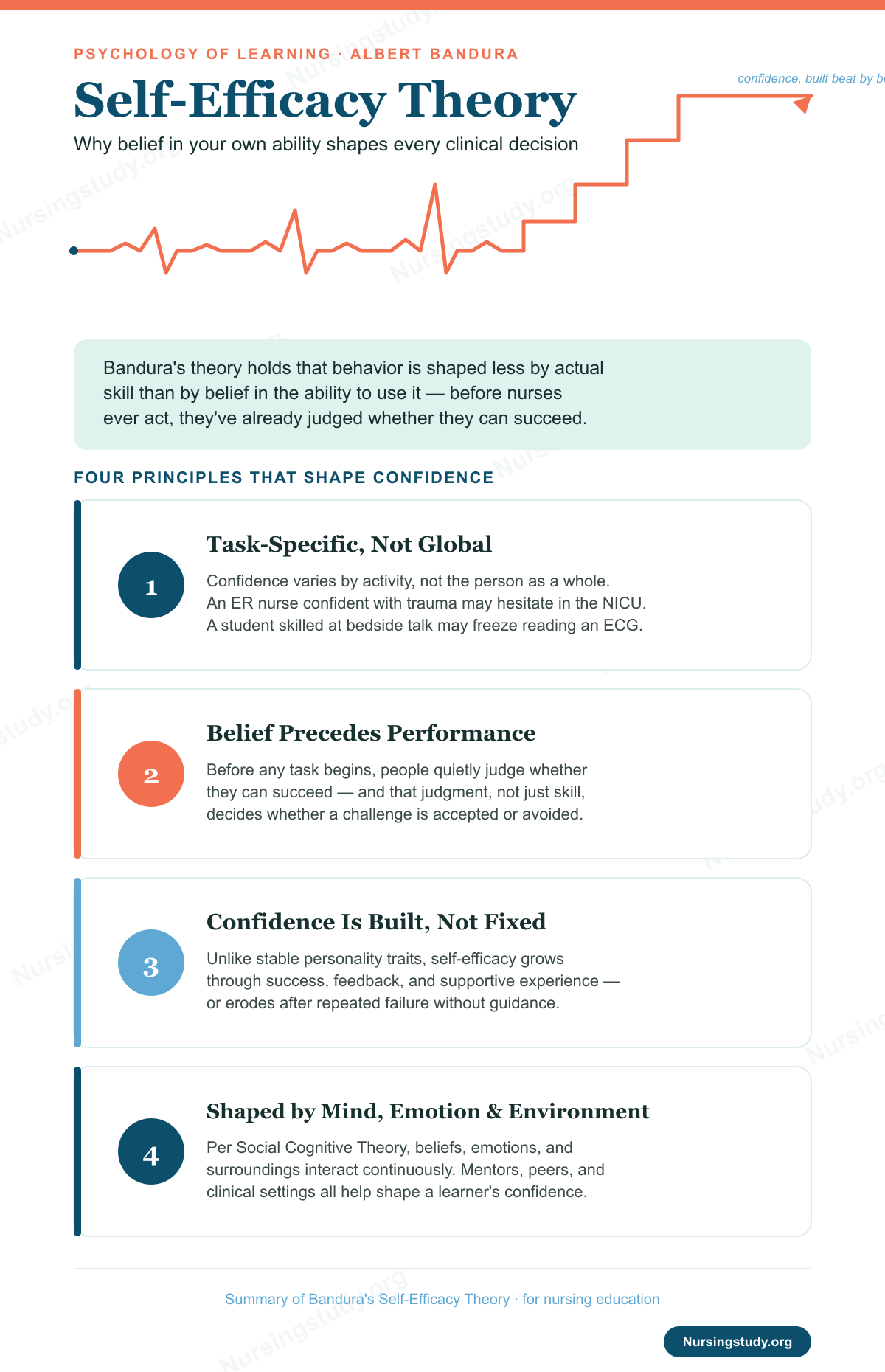
Sport and Exercise Psychology and Self-Efficacy
Although Self-Efficacy Theory is widely recognized for its contributions to education and healthcare, its influence extends into many other disciplines, including sport and exercise psychology. Athletes, coaches, exercise scientists, and performance psychologists have long relied on Albert Bandura’s work to understand why some individuals consistently perform well under pressure while others struggle despite possessing comparable physical ability and technical skill.
The principles that explain success in competitive sports closely resemble those required for success in nursing. In both settings, individuals must perform complex tasks in demanding environments, make rapid decisions, remain composed under pressure, and recover from setbacks without losing confidence. Whether a nurse is managing a deteriorating patient or an athlete is competing in a championship event, performance is influenced not only by knowledge and skill but also by belief in their ability to perform effectively when it matters most.
Within sport and exercise psychology, Bandura’s theory of self-efficacy has helped researchers explain how confidence influences motivation, performance, persistence, emotional regulation, and long-term achievement. These findings provide valuable lessons for nursing education because both professions emphasize continuous practice, resilience, teamwork, and lifelong improvement.
Understanding how Self-Efficacy Theory is applied in athletic performance allows nursing educators to adopt evidence-based strategies that strengthen confidence, improve learning outcomes, and prepare healthcare professionals to perform effectively in challenging clinical environments.
Self-Efficacy in Sport and Exercise Psychology
Sport and exercise psychology examines the psychological factors that influence athletic performance, physical activity, and overall well-being. One of its central concepts is self-efficacy, which explains how confidence affects an individual’s willingness to participate, train consistently, overcome obstacles, and achieve desired performance goals.
According to Albert Bandura, athletes who possess stronger self-efficacy beliefs are generally more likely to:
- Set challenging performance goals.
- Maintain focus during competition.
- Demonstrate greater persistence during training.
- Recover more effectively from poor performances.
- Adapt to changing competitive situations.
- Remain motivated despite setbacks.
By contrast, athletes experiencing low self-efficacy often:
- Avoid highly challenging competitions.
- Lose confidence after mistakes.
- Become discouraged following defeats.
- Reduce training effort.
- Experience increased performance anxiety.
- Question their own capabilities despite adequate preparation.
Consider two marathon runners preparing for the same race.
Both runners have completed similar training programs and possess comparable physical fitness. However, one runner possesses higher self-efficacy, believing they can successfully manage fatigue, maintain their pace, and finish the race despite discomfort. During difficult stages of the competition, this confidence encourages continued effort and effective problem-solving.
The second runner experiences lower self-efficacy and begins doubting their ability when fatigue develops. Although physically capable of completing the race, negative thoughts reduce confidence, leading to slower performance and an increased likelihood of withdrawing from the competition.
This example illustrates an important principle of Self-Efficacy Theory: performance depends not only on actual ability but also on the individual’s belief in their ability to apply that ability effectively under demanding conditions.
Research in sport and exercise psychology consistently demonstrates that perceived self-efficacy influences:
- Athletic performance.
- Learning of new motor skills.
- Rehabilitation following injury.
- Exercise adherence.
- Stress management.
- Competitive confidence.
- Team performance.
These findings closely mirror observations in nursing education, where confidence influences clinical competence, communication, and decision-making.
Another important lesson from sports is that elite performers rarely develop confidence through talent alone. Instead, they repeatedly strengthen their sense of self-efficacy through structured practice, realistic performance goals, constructive coaching, reflection, and repeated mastery experiences. These same principles can be effectively applied to nursing education.
Applying Performance Psychology Principles to Nursing Education
Although healthcare and athletics appear to be very different professions, both require individuals to perform accurately under pressure while maintaining confidence, concentration, and emotional control. For this reason, many principles from sport and exercise psychology complement Self-Efficacy Theory and can enhance nursing education.
Performance psychology emphasizes systematic preparation rather than relying on natural ability. Similarly, nursing competence develops through deliberate practice, reflective learning, continuous feedback, and progressively challenging experiences.
Several evidence-based principles from performance psychology can strengthen academic self-efficacy and clinical performance in nursing.
Deliberate Practice
Elite athletes improve by practicing individual skills repeatedly until they become automatic. Rather than attempting to master every aspect of performance simultaneously, they focus on specific components that require improvement.
The same principle applies in nursing education.
For example, instead of expecting learners to immediately master comprehensive patient assessments, educators can divide the skill into manageable stages, such as:
- Building therapeutic communication.
- Performing vital sign assessments.
- Conducting systematic physical examinations.
- Recognizing abnormal findings.
- Developing clinical reasoning.
Each successful stage becomes a mastery experience, strengthening belief in your capabilities while preparing learners for increasingly complex responsibilities.
Goal Setting
Athletes frequently establish measurable short-term and long-term goals that guide training and maintain motivation.
Similarly, nursing learners benefit from setting structured educational objectives such as:
- Successfully inserting five intravenous cannulas under supervision.
- Improving medication calculation accuracy.
- Developing stronger clinical documentation skills.
- Increasing confidence during simulation exercises.
Achieving these milestones reinforces person’s self-efficacy, encouraging continued learning and professional growth.
Mental Rehearsal and Visualization
Many athletes use visualization techniques before competition, mentally rehearsing successful performance before the event begins.
Comparable strategies can be valuable in nursing education.
Before performing an unfamiliar procedure, learners may mentally rehearse:
- Equipment preparation.
- Patient communication.
- Infection prevention measures.
- Procedural steps.
- Post-procedure documentation.
Mental rehearsal reduces uncertainty while strengthening confidence before actual performance.
Reflection After Performance
Elite athletes routinely review both successful and unsuccessful performances to identify strengths and areas for improvement.
Similarly, reflective practice is fundamental to nursing education.
Following clinical simulations or patient care experiences, structured reflection encourages learners to:
- Evaluate clinical decisions.
- Identify effective interventions.
- Analyze mistakes objectively.
- Develop action plans for future improvement.
Reflection transforms experience into learning while reinforcing self-efficacy beliefs through continuous improvement.
Managing Performance Pressure
Competitive athletes learn strategies to regulate physiological and emotional arousal before important competitions.
Nursing learners face comparable situations during:
- Objective Structured Clinical Examinations (OSCEs).
- Medication competency assessments.
- Clinical placements.
- Licensing examinations.
- Emergency simulations.
Teaching breathing techniques, mindfulness, positive self-talk, and emotional regulation enables learners to interpret nervousness as normal preparation rather than evidence of incompetence. This shift strengthens perceived self-efficacy and improves performance under pressure.
Building Individual and Collective Confidence
One of the most valuable concepts shared by Self-Efficacy Theory and sport and exercise psychology is that confidence exists at both individual and group levels. While individual confidence influences personal performance, effective teamwork depends on collective efficacy—the shared belief that a group can successfully achieve common goals.
In competitive sports, championship teams rarely succeed because every athlete is equally talented. Instead, success often depends on mutual trust, coordinated communication, clearly defined roles, and confidence that the entire team can respond effectively to difficult situations.
Healthcare environments operate in much the same way.
Safe patient care depends on collaboration among:
- Nurses.
- Physicians.
- Pharmacists.
- Respiratory therapists.
- Physiotherapists.
- Laboratory professionals.
- Other members of the interdisciplinary healthcare team.
When healthcare teams possess strong collective efficacy, they communicate more effectively, coordinate interventions efficiently, solve problems collaboratively, and adapt more successfully during emergencies.
For example, consider a hospital responding to a patient experiencing cardiac arrest.
A nursing team with strong collective efficacy demonstrates confidence in its shared ability to manage the emergency by:
- Immediately recognizing clinical deterioration.
- Communicating clearly using standardized protocols.
- Assigning responsibilities efficiently.
- Performing cardiopulmonary resuscitation effectively.
- Coordinating medication administration.
- Supporting one another throughout the resuscitation effort.
Each team member trusts not only their own abilities but also the competence of their colleagues, allowing the team to function cohesively during high-pressure situations.
By comparison, teams with weaker collective efficacy may experience hesitation, unclear communication, duplication of responsibilities, delayed interventions, and reduced confidence during emergencies.
Building both individual confidence and collective efficacy requires intentional educational strategies. Nursing educators can strengthen these qualities by:
- Incorporating team-based simulation exercises.
- Encouraging collaborative problem-solving.
- Using peer-assisted learning activities.
- Promoting respectful communication.
- Facilitating interdisciplinary education.
- Conducting structured debriefings after simulations and clinical experiences.
- Recognizing both individual achievements and effective teamwork.
Another important lesson from sport and exercise psychology is that confidence should remain realistic. Excessive confidence unsupported by competence may lead to complacency, poor decision-making, and unnecessary risk. Conversely, insufficient confidence may prevent capable individuals from applying their knowledge effectively. Self-Efficacy Theory therefore emphasizes developing confidence that is grounded in preparation, evidence-based practice, reflection, and continuous learning.
Research, Measurement, and Future Directions
Since its introduction by Albert Bandura, Self-Efficacy Theory has become one of the most extensively researched psychological frameworks across education, healthcare, organizational behavior, rehabilitation, and sport and exercise psychology. Decades of self-efficacy research have consistently demonstrated that an individual’s belief in their ability influences learning, motivation, decision-making, resilience, and performance across a wide range of settings.
The continued popularity of Bandura’s theory of self-efficacy lies in its practical value. Rather than simply describing human behavior, the theory explains why people respond differently to similar challenges and provides evidence-based strategies for strengthening confidence through learning and experience. As healthcare systems become increasingly complex, the ability to understand and develop self-efficacy beliefs has become even more important for preparing competent healthcare professionals and improving patient outcomes.
Research in nursing education continues to demonstrate that Self-Efficacy Theory provides valuable insight into how learners develop clinical competence, respond to educational interventions, and transition successfully into professional practice. At the same time, advances in educational technology, simulation-based learning, and competency-based education continue to create new opportunities for applying the theory in innovative ways.
Measuring Self-Efficacy
One of the strengths of Self-Efficacy Theory is that perceived self-efficacy can be measured systematically. Although confidence is a psychological construct, it is not considered vague or immeasurable. Instead, Albert Bandura emphasized that self-efficacy judgments can be assessed using carefully developed instruments that evaluate an individual’s confidence in performing specific tasks.
A fundamental principle of Bandura’s theory is that self-efficacy for a particular activity should be measured in relation to that activity rather than as a general personality characteristic. For example, confidence in administering medications differs from confidence in communicating with patients, interpreting laboratory results, or leading a healthcare team.
For this reason, researchers often develop assessment tools that focus on particular domains of performance.
Examples include instruments designed to measure confidence in:
- Clinical skills.
- Academic learning.
- Medication administration.
- Communication with patients.
- Evidence-based practice.
- Leadership and management.
- Chronic disease self-management.
- Health behavior change.
These instruments typically ask respondents to rate how confident they are in completing specific activities using numerical rating scales. Instead of asking whether a learner is generally confident, they assess belief in your capabilities within clearly defined situations.
For example, a nursing learner may be asked to indicate their level of confidence in their ability to:
- Perform a comprehensive patient assessment.
- Identify abnormal clinical findings.
- Prioritize nursing interventions.
- Communicate with patients experiencing emotional distress.
- Successfully perform cardiopulmonary resuscitation.
- Collaborate effectively with members of the healthcare team.
These responses provide educators with valuable information regarding learners’ efficacy beliefs, helping identify areas where additional instruction, supervised practice, or mentorship may be beneficial.
Characteristics of Effective Self-Efficacy Measurement
According to Bandura’s recommendations, effective measurement should:
- Focus on specific rather than general abilities.
- Assess confidence before performance rather than after outcomes are known.
- Reflect realistic clinical or educational situations.
- Consider varying levels of task difficulty.
- Evaluate changes over time rather than relying on a single assessment.
These principles allow educators and researchers to monitor the development of self-efficacy as learners gain experience.
For example, nursing programs frequently evaluate confidence before and after simulation exercises. A learner who initially reports uncertainty about managing a patient experiencing septic shock may demonstrate significantly stronger perceived self-efficacy after completing multiple simulation scenarios and structured debriefing sessions.
Monitoring these changes in self-efficacy enables educators to determine whether educational interventions are strengthening confidence alongside clinical competence.
Importantly, self-efficacy assessments should complement—not replace—objective evaluations of knowledge and performance. A learner may possess strong confidence but still require additional technical training, while another learner with excellent clinical skills may underestimate their abilities because of low self-efficacy. Combining objective competency assessments with measures of confidence provides a more complete understanding of learner development.
Research Supporting Self-Efficacy Theory
Over the past several decades, research on self-efficacy has provided substantial evidence supporting the central principles of Self-Efficacy Theory. Studies conducted in education, psychology, nursing, medicine, rehabilitation, and public health consistently demonstrate that self-efficacy beliefs influence both learning processes and performance outcomes.
One of the most consistent findings is that individuals with high self-efficacy generally demonstrate:
- Greater willingness to undertake difficult tasks.
- Higher levels of academic engagement.
- Increased persistence during challenging activities.
- Better problem-solving abilities.
- Greater resilience following setbacks.
- More effective emotional regulation.
- Improved long-term performance.
Conversely, people with low self-efficacy are more likely to:
- Avoid unfamiliar challenges.
- Experience greater performance anxiety.
- Invest less effort in demanding tasks.
- Abandon goals following initial failure.
- Underestimate their own capabilities.
- Limit opportunities for professional growth.
These findings have been replicated across numerous educational settings, including nursing education.
Evidence From Nursing Education
Within nursing, self-efficacy research has demonstrated positive relationships between stronger academic self-efficacy and outcomes such as:
- Improved academic achievement.
- Enhanced clinical reasoning.
- Greater confidence during simulation training.
- Better communication with patients.
- Increased participation during clinical placements.
- Higher levels of self-directed learning.
- Greater readiness for professional practice.
For example, learners who report stronger confidence before participating in simulation exercises often engage more actively, communicate more effectively during emergencies, and demonstrate greater willingness to assume leadership responsibilities within healthcare teams.
Research has also shown that educational strategies based on Self-Efficacy Theory contribute to improved learning outcomes.
These strategies include:
- High-fidelity simulation.
- Structured mastery experiences.
- Peer-assisted learning.
- Clinical mentoring.
- Reflective practice.
- Constructive verbal persuasion.
- Progressive skills training.
Collectively, these interventions strengthen both competence and confidence, illustrating the practical value of Bandura’s theory in nursing education.
Evidence Beyond Nursing
The influence of Self-Efficacy Theory extends well beyond healthcare.
Research has demonstrated its relevance in:
- Education and lifelong learning.
- Leadership development.
- Business and organizational psychology.
- Public health promotion.
- Chronic disease management.
- Mental health interventions.
- Physical rehabilitation.
- Sport and exercise psychology.
For example, patients with stronger person’s belief in their ability to manage chronic illnesses are generally more likely to adhere to treatment plans, monitor symptoms appropriately, maintain healthy behaviors, and communicate effectively with healthcare professionals.
Similarly, athletes possessing stronger perceived self-efficacy often demonstrate greater resilience, sustained motivation, and improved competitive performance.
The broad application of Self-Efficacy Theory across multiple disciplines reinforces its importance as a comprehensive explanation of human learning and behavior.
The Continuing Relevance of Self-Efficacy Theory in Nursing
Healthcare continues to evolve rapidly as technological innovation, evidence-based practice, demographic changes, and increasingly complex patient needs reshape the nursing profession. Despite these changes, the principles of Self-Efficacy Theory remain highly relevant because confidence continues to influence how healthcare professionals learn, adapt, and deliver patient care.
Modern nursing requires practitioners to:
- Integrate rapidly expanding scientific knowledge.
- Master new technologies.
- Provide culturally competent care.
- Collaborate within interdisciplinary teams.
- Adapt to changing healthcare policies.
- Respond effectively during public health emergencies.
- Commit to lifelong professional learning.
These responsibilities require more than technical competence. They also require confidence in one’s ability to learn continuously, adapt successfully, and make informed clinical decisions.
For nursing education, Self-Efficacy Theory continues to influence curriculum design by encouraging educators to create learning experiences that strengthen both competence and confidence.
Examples include:
- Competency-based education.
- Simulation-centered instruction.
- Clinical mentorship programs.
- Reflective learning activities.
- Team-based learning.
- Technology-enhanced education.
- Virtual simulation and digital learning platforms.
These approaches recognize that learners develop confidence most effectively when they actively participate in meaningful learning experiences rather than passively receiving information.
The theory also remains highly relevant to workforce development. Newly graduated nurses frequently encounter challenging transitions from academic environments to independent clinical practice. Organizations that provide supportive orientation programs, structured mentorship, progressive clinical responsibilities, and constructive feedback help strengthen self-efficacy beliefs, reducing transition-related stress while improving professional confidence.
Another emerging area involves the application of Self-Efficacy Theory to patient-centered care. Nurses increasingly recognize that successful treatment extends beyond providing clinical interventions. Patients must also develop confidence in their own ability to manage medications, monitor symptoms, adopt healthy behaviors, and participate actively in healthcare decisions.
For example, when educating a patient with chronic heart failure, nurses can strengthen the patient’s confidence by:
- Demonstrating self-monitoring techniques.
- Supervising return demonstrations.
- Providing realistic encouragement.
- Setting achievable self-care goals.
- Reinforcing successful progress over time.
These interventions strengthen the patient’s belief in their ability to manage their condition independently after discharge, illustrating how Bandura’s Social Cognitive Theory continues to improve nursing practice as well as patient outcomes.
Looking toward the future, emerging technologies such as virtual reality simulation, artificial intelligence–assisted education, adaptive learning platforms, and remote clinical training offer new opportunities to support the development of self-efficacy. These innovations can provide learners with repeated practice, immediate feedback, personalized learning experiences, and progressively challenging clinical scenarios that reinforce confidence alongside competence.
Conclusion
Self-Efficacy Theory remains one of the most influential and enduring frameworks for understanding how people learn, develop skills, and achieve meaningful goals. Developed by Albert Bandura, the theory shifted the focus from simply asking whether individuals possess the ability to succeed to examining whether they believe they can successfully apply that ability in specific situations. This distinction has transformed education, psychology, healthcare, leadership, and sport and exercise psychology, providing a practical explanation for why people with similar knowledge and abilities often produce very different outcomes.
In nursing, the importance of Self-Efficacy Theory cannot be overstated. The profession demands far more than technical competence; it requires confidence to make sound clinical decisions, communicate effectively, adapt to rapidly changing patient conditions, and continue learning throughout a professional career. Strong academic self-efficacy encourages learners to embrace challenging coursework, engage actively in clinical experiences, seek constructive feedback, and persist when faced with setbacks. Rather than avoiding difficult situations, individuals with strong self-efficacy beliefs view challenges as opportunities to develop greater competence and resilience.
A key strength of Bandura’s theory of self-efficacy is its recognition that confidence is neither fixed nor determined solely by personality. Instead, it develops through meaningful mastery experiences, vicarious experiences, verbal persuasion, and the interpretation of physiological and emotional states. This means educators, mentors, healthcare organizations, and even learners themselves can intentionally cultivate stronger confidence through supportive learning environments, structured practice, reflective learning, and constructive feedback.
As healthcare continues to evolve through technological innovation, evidence-based practice, interdisciplinary collaboration, and increasingly complex patient needs, the principles of Self-Efficacy Theory remain highly relevant. Nursing professionals must continually acquire new knowledge, refine clinical skills, adapt to emerging healthcare challenges, and support patients in developing confidence to manage their own health. The theory provides a practical roadmap for achieving these goals by emphasizing that competence and confidence develop together through continuous learning and purposeful experience.
Ultimately, Self-Efficacy Theory reminds us that professional excellence is not defined solely by what individuals know but also by their confidence in applying that knowledge effectively. By fostering strong self-efficacy beliefs, nursing education prepares practitioners who are not only clinically competent but also resilient, reflective, adaptable, and committed to lifelong learning. These qualities enable nurses to deliver safe, compassionate, and evidence-based care while inspiring confidence in the patients, families, and communities they serve.
Frequently Asked Questions
What is Bandura’s self-efficacy theory in nursing?
Bandura’s Self-Efficacy Theory in nursing explains that a nurse’s or nursing student’s confidence in their ability to perform specific clinical and academic tasks influences their learning, decision-making, motivation, and performance. Nurses with high self-efficacy are more likely to embrace challenges, persist through difficulties, and provide safe, evidence-based patient care. The theory is widely used in nursing education to improve clinical competence, critical thinking, and professional development.
What is self-efficacy theory Bandura 1997?
In his 1997 book Self-Efficacy: The Exercise of Control, Albert Bandura expanded his theory by describing self-efficacy as a person’s belief in their ability to organize and execute the actions required to achieve desired outcomes. He emphasized that these beliefs affect motivation, emotional responses, resilience, and performance. Bandura also identified four primary sources of self-efficacy: mastery experiences, vicarious experiences, verbal persuasion, and physiological and emotional states.
What is Bandura’s concept of self-efficacy (1977)?
In 1977, Albert Bandura introduced the concept of self-efficacy as part of his groundbreaking paper Self-Efficacy: Toward a Unifying Theory of Behavioral Change. He defined self-efficacy as an individual’s belief in their capability to successfully perform behaviors necessary to achieve a specific goal. Bandura proposed that people with stronger self-efficacy are more likely to take on challenging tasks, persist when facing obstacles, and recover from setbacks.
What is Bandura’s academic self-efficacy?
Bandura’s academic self-efficacy refers to a student’s belief in their ability to successfully complete academic tasks, such as studying, solving problems, participating in class, completing assignments, and passing examinations. In nursing education, academic self-efficacy influences motivation, learning strategies, clinical performance, and overall academic success. Students with high academic self-efficacy are generally more engaged, persistent, and confident in achieving their educational goals.
