

12 Nurse Symbols Every Nursing Student Should Know: From the Caduceus to the True Medical Symbol That Represents Nursing and Its Historical Roots for Healthcare Professionals
Nurse symbols have played a central role in shaping the identity and traditions of the nursing profession throughout history. These symbols, ranging from the iconic lamp of Florence Nightingale to the caduceus and the rod of Asclepius, carry rich historical roots that span ancient civilizations, mythology, and the development of modern medicine. Beyond their visual appeal, nurse symbols serve as enduring representations of the values, responsibilities, and ethical standards that define nursing practice, reflecting the profession’s commitment to patient care, clinical excellence, and professional integrity.
The origins of many nurse symbols reveal deep connections to history and mythology. The caduceus, associated with Hermes in Greek mythology, and the rod of Asclepius, linked to the god of medicine and healing, illustrate how ancient imagery became intertwined with healthcare symbolism. Other icons, such as the oil lamp, nurse cap, and nursing pin, highlight the evolution of nursing education, professional recognition, and ceremonial traditions, tracing a line from the pioneering work of Florence Nightingale to the practices and rituals of contemporary nursing. Each symbol embodies a story—whether the serpent entwined around a rod as a representation of healing, the red cross as a mark of humanitarian aid, or the star of life as an emblem of emergency healthcare—that communicates the responsibilities, knowledge, and ethos of nursing.
Understanding nurse symbols provides insight into the historical, cultural, and professional dimensions of healthcare. These symbols not only represent nursing in a tangible form but also reinforce core principles such as patient care, clinical judgment, and professional accountability. They bridge the past and present, demonstrating how traditions and iconography continue to influence modern nursing practice, ceremonial observances, and professional identity.
This article offers a detailed exploration of twelve essential nurse symbols, examining their origins, meanings, and relevance within the nursing and healthcare professions. From the caduceus and rod of Asclepius to the oil lamp, nurse cap, nursing pin, and other recognized emblems, each section highlights how these symbols encapsulate the history, values, and responsibilities of nursing. By tracing the historical roots and understanding the significance of these icons, readers gain a deeper appreciation for the visual and ceremonial language that defines the nursing profession and its enduring role in healthcare.
Understanding the Caduceus and Its Connection to Nursing
Origins of the Caduceus in Greek Mythology and Hermes
The caduceus is one of the most widely recognized nurse symbols, often depicted as a short staff entwined by two snakes, topped with wings. Its origins lie in Greek mythology:
- Association with Hermes:
- Hermes, the Greek god of commerce, travelers, and communication, carried the staff as a symbol of peace, negotiation, and swiftness.
- The pair of wings at the top of the caduceus represents speed and mobility, reflecting Hermes’ role as a messenger.
- The entwined two snakes symbolize balance and duality rather than healing.
- Historical Context:
- In ancient Greece, the caduceus was not connected to medicine or patient care.
- The staff was a symbol of authority, negotiation, and divine protection in mythology, not healing.
- Cultural Transmission:
- Over centuries, as European societies studied Greek mythology, the caduceus symbol was adopted into art, literature, and eventually emblems, bridging ancient symbolism with modern institutional use.
The Caduceus vs. Rod of Asclepius: Distinguishing the True Symbol of Medicine
A critical distinction in nursing practice and the medical field lies between the caduceus and the rod of Asclepius:
- Rod of Asclepius:
- Composed of a single rod entwined by a single serpent, it is directly tied to medicine and healing.
- Represents Asclepius, the Greek god of medicine and healing, revered in ancient Greece for guiding patient care and medical practice.
- The serpent symbolizes renewal, rebirth, and healing, inspired by its natural behavior to shed its skin, making it a symbol of medicine recognized globally.
- Caduceus vs. Rod of Asclepius:
- Caduceus: Two snakes, wings, associated with Hermes, commerce, and negotiation.
- Rod of Asclepius: One snake, no wings, directly symbolizes medical practice and healing.
- Misuse of the caduceus as a medical emblem arose in the early 20th century, especially in U.S. military medical corps, creating a long-standing misconception.
Overwhelmed with multiple nursing deadlines?
Let us write your papers efficiently and accurately
Misconceptions: Why the Caduceus Is Often Mistaken for a Medical Symbol
The caduceus symbol is frequently confused with the true symbol of medicine due to historical and institutional factors:
- Military Adoption:
- In 1902, the United States Army Medical Corps adopted the caduceus as its insignia.
- The choice was likely due to its visual appeal and the confusion with the rod of Asclepius.
- Visual Recognition:
- The entwined snakes and wings at the top make the caduceus striking and easily recognizable, encouraging its use in medical jewelry, nursing pins, and emblems.
- Institutional Reinforcement:
- Hospitals, nursing schools, and professional associations adopted the caduceus over time.
- Its widespread visibility reinforced the association with nursing and the medical profession, even if historically inaccurate.
Modern Usage: Caduceus Jewelry and Emblems Among Healthcare Professionals
Despite its origins in mythology, the caduceus remains a significant healthcare symbol today, particularly in nursing and medical professions:
- Nursing Pins and Emblems:
- Many nurse symbols used in nursing uniforms, nursing pins, and emblems incorporate the caduceus to signal professional identity and commitment to patient care.
- Ceremonial and graduation pins in some nursing schools feature the caduceus, blending tradition with modern professional symbolism.
- Medical Jewelry:
- Necklaces, lapel pins, and bracelets with the caduceus symbol are worn by registered nurses and healthcare professionals as visible indicators of affiliation with the nursing profession and the medical field.
- Institutional Logos:
- Hospitals, clinics, and healthcare institutions often use the caduceus in logos and signage, communicating professionalism and alignment with healthcare services.
- While it is technically not the true symbol of medicine, its widespread recognition makes it a practical symbol of healthcare in contemporary settings.
The Rod of Asclepius: The True Symbol of Medicine in Nursing
Historical Background of Asclepius / Aesculapius as God of Medicine
The rod of Asclepius is universally recognized as the true symbol of medicine, distinguishing itself from the caduceus, which is often misattributed to healthcare. Its significance is deeply rooted in history and mythology:
- Asclepius – Greek God of Medicine
- In ancient Greece, Asclepius (also called Aesculapius in Roman culture) was revered as the god of healing and medicine.
- He was believed to possess the power to cure disease and restore health, often invoked by medical personnel and early healers.
- Temples dedicated to Asclepius, known as Asclepieia, served as healing centers where patients sought cures through rituals, herbal treatments, and therapeutic practices—early forms of patient care that predate modern nursing and medicine.
- The Rod and the Serpent
- The rod of Asclepius features a single serpent entwined around a staff, a design symbolic of healing, renewal, and rebirth.
- The serpent’s natural behavior of shedding its skin became a metaphor for the restorative power of medicine and healing, a concept that continues to inform modern symbols in nursing.
- The rod is also associated with wisdom, discipline, and the ethical responsibilities of healthcare providers, making it a fitting emblem for the nursing profession.
- Cultural and Mythological Influence
- The figure of Asclepius permeated both Greek and Roman culture, shaping the medical field and early concepts of clinical practice.
- The rod of Asclepius became a symbol for medicine, linking mythology to tangible practices in nursing practice, healthcare institutions, and medical education.
How the Rod of Asclepius Became a Recognized Nursing Symbol
Over time, the rod of Asclepius evolved from a mythological emblem to a central nurse symbol recognized globally:
- Adoption in Nursing Emblems and Pins
- Many nursing pins incorporate the rod of Asclepius as a core design element, emphasizing the nurse’s role in healing and patient care.
- The rod conveys the ethical, medical, and caregiving responsibilities of registered nurses and healthcare professionals, distinguishing it from purely ceremonial or decorative symbols.
- Integration into Nursing Ceremonies and Traditions
- The rod appears in pinning ceremonies, graduation emblems, and professional badges, linking historical symbolism with modern nursing identity.
- Ceremonies often emphasize the ethical duty of nurses to care for patients, reinforcing the rod of Asclepius as a symbol of medicine and healthcare rather than a commercial or mythological motif like the caduceus.
- Global Recognition
- The rod of Asclepius is widely recognized by medical and nursing organizations worldwide as the legitimate emblem of healing.
- Unlike the caduceus, which has been misinterpreted in some countries, the rod maintains historical and professional legitimacy, making it a preferred symbol in formal healthcare contexts.
Why Nursing Schools and Emblems Favor the Rod of Asclepius
The preference for the rod of Asclepius in nursing schools and emblems is grounded in its symbolism, historical roots, and professional clarity:
- Direct Representation of Healing and Medicine
- The rod conveys the essence of nursing practice, emphasizing patient care, clinical knowledge, and professional responsibility.
- Nursing schools adopt it in pins, emblems, and logos to visually communicate the commitment of graduates to healthcare and ethical practice.
- Distinction from Misinterpreted Symbols
- By choosing the rod over the caduceus, institutions avoid confusion between mythology-based commerce symbols and legitimate symbols of medicine and healing.
- This ensures that the emblem represents nursing authentically and aligns with historical and professional standards.
- Integration into Education and Ceremonial Tradition
- In nursing schools, the rod of Asclepius often appears in textbooks, classroom materials, and ceremonial pins.
- For example, a pin featuring the rod symbolizes a student’s transition to a registered nurse, connecting modern nursing to its historical roots and the legacy of ethical medical practice.
- Universal Recognition in Healthcare
- The rod of Asclepius is understood across cultures as a medical emblem, making it suitable for use in international nursing standards, emblems, and healthcare organizations.
- Its adoption reinforces the nurse’s professional identity and signals dedication to patient care, medicine and healing, and the broader healthcare profession.
Classic Nursing Symbols That Inspire Modern Nursing Practice
The Oil Lamp: Florence Nightingale’s Legacy and Its Meaning in Nursing
The oil lamp is perhaps the most iconic of all nurse symbols, deeply rooted in the history of nursing and still widely recognized today. Its significance is closely tied to Florence Nightingale, often referred to as the founder of modern nursing.
- Historical Context:
- During the Crimean War, Nightingale carried an oil lamp while tending to wounded soldiers, earning her the nickname “the Lady with the Lamp”.
- The lamp became a visual representation of dedication, compassion, and vigilance in patient care, embodying the principles of modern nursing practice.
- Symbolic Meaning:
- The lamp symbolizes knowledge, guidance, and hope, reflecting the nurse’s role as both caregiver and educator.
- In modern nursing, the oil lamp is a symbol of professional integrity, inspiring ethical practice, clinical competence, and lifelong learning.
- Contemporary Usage:
- Many nursing schools feature the oil lamp in logos, emblems, and graduation ceremonies, linking the profession’s history to present-day practice.
- Nursing pins often incorporate the lamp, reinforcing the connection between tradition and the nursing profession.
- For example, some institutions hold candlelight ceremonies, where graduates carry an oil lamp to honor the legacy of Nightingale and the principles of compassionate patient care.
Nurse Cap and Uniform: Historical Use and Modern Adaptations
The nurse cap and nursing uniforms are enduring symbols that communicate professionalism, authority, and the identity of healthcare providers.
- Historical Background:
- The nurse cap originated in the 19th century, designed to cover the hair for hygiene and present a professional appearance.
- Early uniforms and caps were also used to distinguish nurses from other healthcare personnel, emphasizing the specialized role of the registered nurse.
- Symbolism:
- The cap and uniform symbolize discipline, service, and commitment to nursing practice.
- They represent the nursing profession’s ethical standards, reinforcing trust and professionalism in patient interactions.
- Modern Adaptations:
- While traditional caps are rarely used in daily practice today, nursing schools may still feature them in pinning ceremonies or historical displays.
- Modern nursing uniforms and scrubs often retain symbolic elements of the cap, such as color coding, badges, and institutional logos, signaling professional status and identity.
- For example, some hospitals maintain ceremonial white uniforms for graduations or special events to honor the legacy of the nurse’s cap while adhering to contemporary infection control standards.
Nursing Emblems and Symbols in Nursing Schools
Nursing emblems serve as formalized representations of the nursing profession, connecting history, education, and professional identity.
- Purpose of Nursing Emblems:
- Emblems function as visual symbols of nursing values, including compassion, knowledge, patient advocacy, and ethical responsibility.
- They often combine several classic nurse symbols, such as the oil lamp, rod of Asclepius, and nurse cap, into a cohesive design that communicates professional identity.
- Integration in Education:
- Nursing schools use emblems in curricula, graduation materials, and ceremonial pinning ceremonies to reinforce the history and standards of the profession.
- Emblems serve as educational tools, reminding students of their ethical and clinical responsibilities as they transition into professional roles.
- Examples and Symbolic Representations:
- Some emblems depict the oil lamp atop a rod, combining Nightingale’s legacy with the rod of Asclepius to merge compassion with medical authority.
- Others incorporate the nurse cap to symbolize discipline and formal training, while integrating the nursing pin design for ceremonial purposes.
- Across global nursing schools, these symbols communicate a shared professional identity while respecting regional historical roots.
Nursing Pins and Pinning Ceremonies: Tradition Meets Professional Identity
History and Significance of the Nursing Pin
The nursing pin is one of the most recognizable nurse symbols, carrying both historical and professional significance in modern nursing.
- Origins of the Nursing Pin:
- The tradition of the nursing pin dates back to the founder of modern nursing, Florence Nightingale, who emphasized formal training, discipline, and ethical patient care.
- Originally, pins served as certificates of completion for nursing students, representing successful graduation from a nursing school.
- Over time, the pin evolved into a symbol of professional identity, denoting a nurse’s commitment to the nursing profession, patient care, and ethical practice.
- Symbolic Meaning:
- A nursing pin embodies the principles of modern nursing: compassion, knowledge, integrity, and service.
- Designs often incorporate classic nurse symbols, such as the oil lamp, rod of Asclepius, or nurse cap, to connect graduates to the historical roots of nursing.
- For example, a pin featuring the oil lamp symbolizes guidance and dedication to patients, while a rod of Asclepius emphasizes commitment to healing and the medical field.
- Professional Recognition:
- Beyond ceremonial value, nursing pins are often worn on uniforms or scrubs as a symbol of professional pride, signaling a nurse’s education, competency, and ethical responsibility.
- Hospitals and professional associations may recognize the pin as part of a nurse’s credentials, reinforcing its significance as a recognized nursing symbol.
How Pinning Ceremonies Connect to the Founder of Modern Nursing
Pinning ceremonies are formal events where nursing students transition to the role of a registered nurse, deeply connected to the legacy of Florence Nightingale:
- Historical Background:
- Nightingale established the first professional nursing school, the Nightingale Training School for Nurses in London, in 1860.
- Graduates received a medallion or badge, which served as an early form of the nursing pin, symbolizing professional readiness and dedication to patient care.
- Ceremonial Significance:
- Pinning ceremonies honor the values set forth by the founder of modern nursing, emphasizing ethical practice, compassion, and professional responsibility.
- During the ceremony, each graduate is presented with a nursing pin, often accompanied by a reading of the Nightingale Pledge or similar ethical affirmation.
- The event serves as both a rite of passage and a visual reinforcement of professional identity, linking graduates to centuries of nursing tradition.
- Educational and Cultural Impact:
- By incorporating historical symbols like the oil lamp, nurse cap, or nursing emblem, pinning ceremonies educate new nurses about the foundational principles of the nursing profession.
- This connection strengthens the nurse’s sense of belonging to a global community of healthcare professionals committed to high standards of patient care.
Wearing Nursing Pins vs. Medical Jewelry: Symbols in Nursing Identity
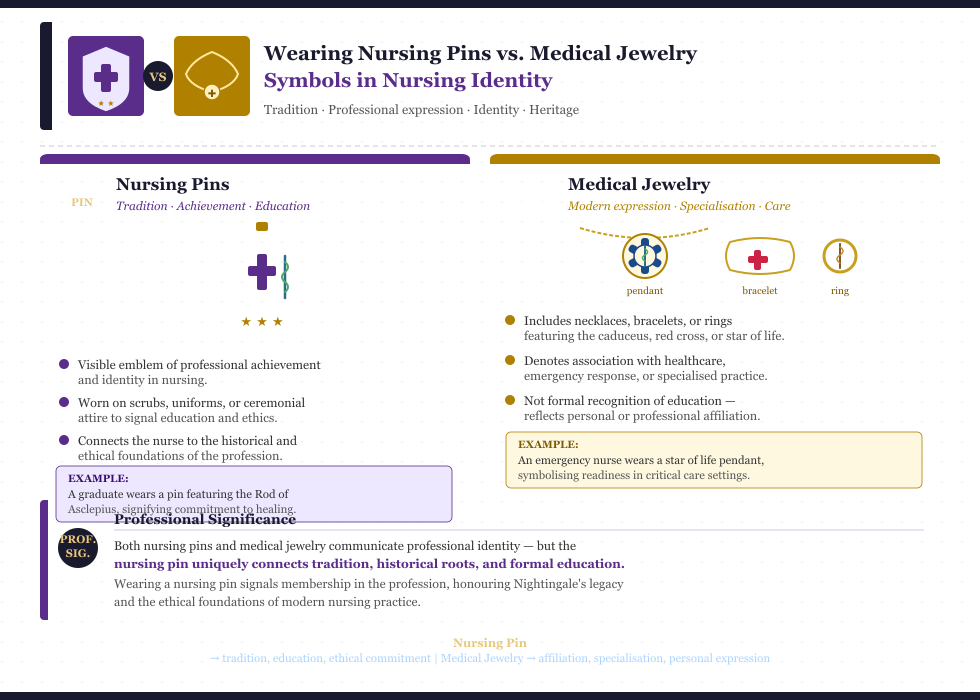
The choice between nursing pins and medical jewelry reflects both tradition and modern professional expression:
- Nursing Pins:
- Serve as a visible emblem of professional achievement and identity.
- Often incorporated into scrubs, nursing uniforms, or ceremonial attire to signal a nurse’s education and adherence to ethical practice.
- Example: A graduate may wear a pin featuring the rod of Asclepius, emphasizing commitment to healing and the medical profession.
- Medical Jewelry:
- Includes necklaces, bracelets, or rings featuring symbols like the caduceus, red cross, or star of life.
- These items often denote association with healthcare, emergency response, or specialized practice areas rather than formal recognition of nursing education.
- Example: A nurse working in emergency medicine may wear a star of life pendant, symbolizing readiness and competence in critical care.
- Professional Significance:
- While both nursing pins and medical jewelry communicate professional identity, the nursing pin uniquely connects tradition, historical roots, and formal education.
- Wearing a nursing pin signals membership in the nursing profession, honoring the legacy of Nightingale and the ethical foundations of modern nursing practice.
- In contrast, medical jewelry is more associated with general healthcare symbolism and personal expression within the medical field.
Medical Symbols Associated with Nursing and Healthcare Professionals
The Red Cross: Symbol of Medical Aid vs. Nursing
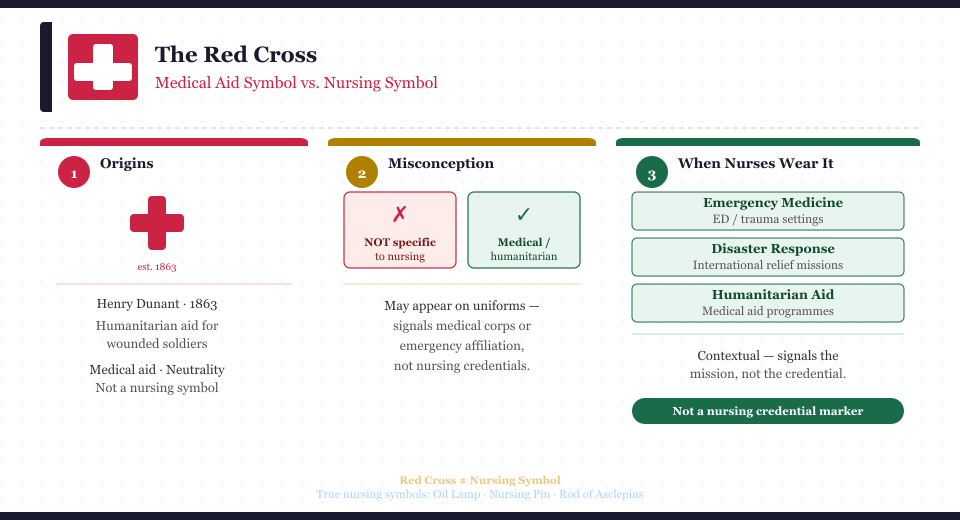
The red cross is one of the most globally recognized healthcare symbols, but its relationship to nursing is often misunderstood:
- Origins and Purpose:
- The red cross was established by Henry Dunant in 1863 as part of the International Red Cross, a humanitarian organization dedicated to medical aid for wounded soldiers.
- It serves as a symbol for medicine, protection in conflict zones, and international neutrality, rather than specifically representing nursing.
- Misconceptions in Nursing:
- While the red cross appears on some nursing emblems or uniforms, it does not inherently symbolize nursing.
- Its presence may reflect affiliation with medical corps, emergency care, or humanitarian aid rather than professional nursing credentials.
- Professional Relevance:
- Nurses working in emergency medicine, disaster response, or humanitarian missions may display the red cross to signify participation in medical aid programs.
- Example: A nurse volunteering for the Red Cross Society may wear the emblem on a uniform to denote service, reinforcing the connection between nursing practice and broader healthcare symbols.
Star of Life: Usage in Emergency Nursing and Healthcare
The star of life is another critical healthcare symbol, particularly in emergency and prehospital care:
- Design and Meaning:
- The star of life features a six-pointed blue star with a rod of Asclepius in the center.
- Each point represents a key function of emergency medical services: detection, reporting, response, on-scene care, care in transit, and transfer to definitive care.
- The rod of Asclepius at the center emphasizes healing, medicine, and patient care, connecting emergency response to the broader medical profession.
- Relevance in Nursing:
- Nurses working in emergency departments, ambulance services, or disaster management often encounter the star of life in protocols, signage, and uniforms.
- Example: A registered nurse trained in emergency nursing may wear a badge or patch featuring the star of life to indicate specialization and readiness to provide critical care.
- Educational Implications:
- Nursing schools include the star of life in courses on emergency care, first aid, and disaster preparedness, linking the symbol to modern nursing practice.
- It serves as a visual reminder of the nurse’s role in patient care during acute and urgent situations.
When and How Nurses Display These Symbols in Practice
The appropriate use of healthcare symbols in nursing is essential for professional identity, safety, and clarity:
- Nursing Pins and Emblems vs. Public Symbols:
- Red cross and star of life are primarily public or institutional symbols, used on scrubs, badges, medical jewelry, or signage.
- Nursing pins and emblems integrate historical nurse symbols such as the oil lamp or rod of Asclepius, emphasizing education, ethical practice, and professional identity.
- Professional Context:
- Red cross: Displayed in humanitarian, emergency, or medical aid settings.
- Star of life: Displayed in emergency nursing, ambulance services, and healthcare facilities that provide acute care.
- Nurses may combine these symbols with nursing pins, scrubs, and nursing uniforms to simultaneously communicate specialization and professional identity.
- Ceremonial and Educational Use:
- Symbols are used in training, simulation exercises, and pinning ceremonies to teach nurses about historical roots, ethical responsibilities, and patient care standards.
- Example: During an emergency preparedness drill, a nursing student may wear a patch with the star of life, signifying role clarity and readiness in simulated patient care scenarios.
- Global Recognition and Standardization:
- Both the red cross and star of life are internationally recognized, ensuring that healthcare professionals can communicate effectively in multi-national or disaster response settings.
- Displaying these symbols appropriately reinforces professional credibility, patient trust, and institutional standards.
Additional Symbols That Represent Nursing and the Registered Nurse Role
The Serpent and Other Symbols of Medicine in Modern Nursing Identity
The serpent, often entwined around the rod of Asclepius or other medical staffs, remains a core nurse symbol, reflecting the historical roots of healthcare and the ethical responsibilities of nurses:
- Symbolism of the Serpent
- The serpent symbolizes healing, rejuvenation, and wisdom, derived from ancient Greece where snakes were associated with the god of healing, Asclepius.
- Its ability to shed its skin has long represented rebirth and renewal, connecting to the nurse’s role in restoring patient health.
- Integration in Nursing Identity
- The serpent is featured in nursing emblems, pins, and medical jewelry, reinforcing the nurse’s dedication to medicine and healing.
- Example: Modern nursing school emblems often combine the serpent with the oil lamp to symbolize both knowledge and clinical care, bridging historical tradition with modern nursing practice.
- Other Common Symbols in Nursing
- Bronze serpent: Sometimes used in institutional seals to indicate medical authority and ethical practice.
- Medical emblem or staff motifs: Highlight the nurse’s role in the broader medical field, including clinical decision-making and emergency response.
- Caduceus elements (wings or two snakes): While sometimes seen in medical jewelry, these are more commonly associated with general medicine rather than nursing specifically, emphasizing the need to distinguish nurse symbols from broader healthcare symbols.
How Nursing Emblems, Scrubs, and Uniforms Signal Professional Status
Nursing emblems, scrubs, and uniforms function as visible markers of professional identity, conveying expertise, ethical commitment, and organizational affiliation:
- Nursing Emblems and Pins
- Incorporate classic nurse symbols like the oil lamp, rod of Asclepius, or nurse cap, connecting graduates and practicing nurses to the historical roots of nursing.
- Serve as certificates of education and ethical responsibility, signaling to patients and colleagues that the wearer is a registered nurse trained in patient care and modern nursing practice.
- Scrubs and Nursing Uniforms
- Color-coded scrubs and uniforms often indicate roles, departments, or levels of seniority, helping patients and healthcare professionals navigate clinical environments.
- Patches, embroidered nursing emblems, or pins on uniforms reinforce professional identity and specialization.
- Example: A critical care nurse may wear navy scrubs with an embroidered rod of Asclepius, while emergency nurses may display the star of life, combining nursing symbols with functional identifiers.
- Signaling Professional Status
- Uniforms and emblems communicate competence, authority, and trustworthiness, providing reassurance to patients and families.
- They also visually reinforce the nursing profession’s ethical and educational standards, distinguishing nurses from other medical personnel.
Recognized Nursing Symbols Worldwide vs. Regional or Historical Variations
While some nurse symbols enjoy global recognition, others vary by region or carry historical significance:
- Globally Recognized Symbols
- Rod of Asclepius: Universally accepted as the true symbol of medicine, used in nursing pins, emblems, and educational materials worldwide.
- Oil lamp: Recognized across continents as a symbol of knowledge, compassion, and Nightingale’s legacy.
- Nursing pin: Functions internationally as a marker of graduation, ethical commitment, and professional identity.
- Regional or Historical Variations
- Nurse cap: Still used ceremonially in some countries, but largely replaced by modern scrubs and uniforms in daily practice.
- Local nursing emblems: Some schools integrate national symbols, colors, or regional motifs into pins or badges while maintaining traditional elements like the oil lamp or rod of Asclepius.
- Cultural adaptations: In countries with strong traditional medicine practices, additional symbols may appear on emblems to reflect regional approaches to patient care and nursing education.
- Balancing Tradition and Modern Practice
- Modern nursing globally maintains a core set of recognized symbols to ensure consistency in professional identity and patient recognition.
- At the same time, regional or historical adaptations highlight the diverse heritage of nursing, illustrating how the profession blends tradition, culture, and modern healthcare practice.
Overwhelmed with multiple nursing deadlines?
Let us write your papers efficiently and accurately
Conclusion
Nursing is a profession steeped in history, tradition, and symbolism, where every emblem, pin, and uniform element carries profound meaning. From the caduceus—often mistaken but widely recognized—to the rod of Asclepius, the oil lamp, and the nurse cap, each symbol reflects centuries of dedication to patient care, healing, and ethical practice. Together, these nurse symbols provide a visual narrative of the nursing profession, connecting modern practitioners to the founder of modern nursing, Florence Nightingale, and the broader historical roots of healthcare.
Beyond their aesthetic or ceremonial value, symbols like the nursing pin, red cross, and star of life serve as markers of professional identity, competency, and specialization, signaling to patients and colleagues alike the nurse’s role within the medical profession. They also remind nurses of the ethical responsibilities inherent in nursing practice, fostering a sense of pride, continuity, and connection to a global community of healthcare professionals.
Understanding the meaning behind these symbols enriches the nursing experience, ensuring that nursing students, graduates, and practicing professionals appreciate the legacy they uphold. By recognizing the interplay of tradition and modern practice, nurses can wear these symbols with intention, knowing they embody both historical significance and a commitment to excellence in patient care.
Ultimately, nurse symbols are more than decorative icons—they are enduring representations of the profession’s values, its ethical foundations, and the unwavering dedication of those who serve in the healing arts. For any nurse, embracing these symbols is both a tribute to the past and a statement of professional identity in the evolving landscape of modern nursing.
Frequently Asked Questions
What are the symbols used in nursing?
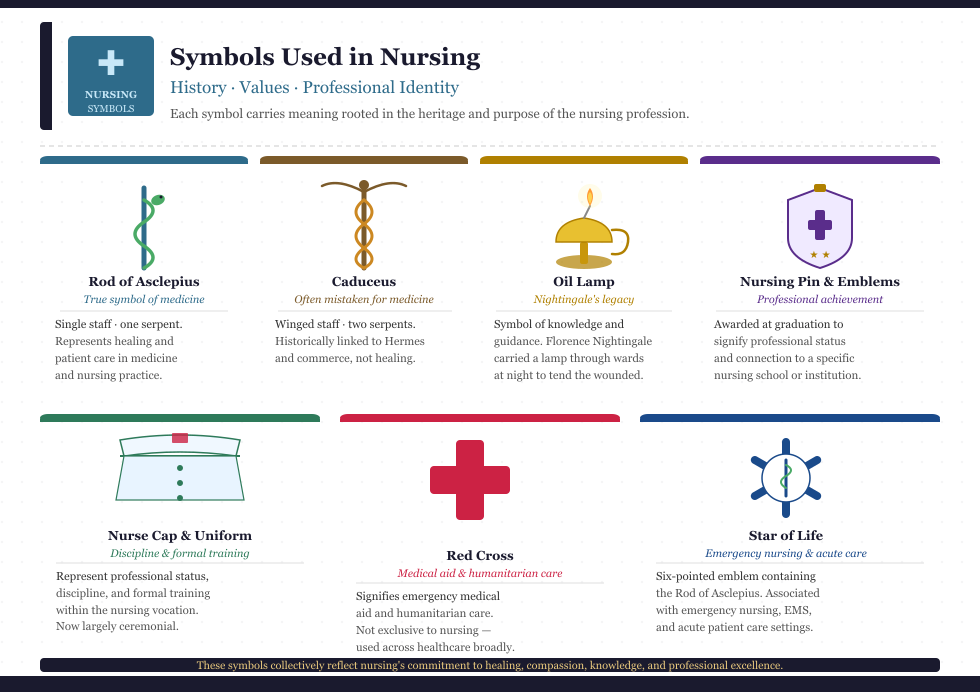
Nursing has a variety of symbols that represent its history, values, and professional identity. Key nurse symbols include:
- Rod of Asclepius: The true symbol of medicine, representing healing and patient care.
- Caduceus: Often mistaken for medicine, historically associated with Hermes and commerce.
- Oil Lamp: Represents knowledge, guidance, and Florence Nightingale’s legacy.
- Nursing Pin and Emblems: Denote professional achievement and connection to nursing schools.
- Nurse Cap and Uniform: Indicate discipline, professional status, and formal training.
- Red Cross: Signifies medical aid and humanitarian care (not specific to nursing).
- Star of Life: Associated with emergency nursing and acute patient care.
What is the standard 12 in nursing?
The “standard 12” in nursing often refers to the 12 most recognized nurse symbols that every nurse or nursing student should know, which typically include:
- Caduceus
- Rod of Asclepius
- Oil Lamp
- Nurse Cap
- Nursing Pin
- Nursing Emblem
- Red Cross
- Star of Life
- Serpent
- Cap and Uniform
- Bronze Serpent
- Nursing Lamp
These symbols collectively convey professional identity, history, ethics, and commitment to patient care.
What are the 4 pillars of nursing?
The 4 pillars of nursing define the core foundations of the profession:
- Patient Care – Delivering safe, compassionate, and evidence-based care.
- Knowledge and Education – Continuous learning, clinical competence, and professional development.
- Ethics and Advocacy – Upholding moral principles and advocating for patient rights.
- Professionalism – Maintaining accountability, integrity, and a commitment to the nursing profession.
These pillars guide both modern nursing practice and the ethical use of nurse symbols.
What is the best symbol for a nurse?
The best symbol for a nurse is widely considered the oil lamp, due to its deep connection to Florence Nightingale and the founder of modern nursing. It embodies:
- Knowledge and education
- Compassion and dedication to patient care
- Guidance and vigilance in nursing practice
However, the rod of Asclepius is also highly significant, representing the nurse’s role in healing, medicine, and clinical responsibility. Together, these symbols encapsulate the essence of the nursing profession.
