

Lawrence Kohlberg Theory of Moral Development: Understanding the Stages of Moral Development and Theories of Moral Reasoning
The Lawrence Kohlberg Theory of Moral Development is one of the most influential psychological frameworks for explaining how individuals develop the ability to distinguish right from wrong, evaluate ethical situations, and make reasoned moral decisions. Rather than defining morality by a person’s actions alone, the theory emphasizes the thinking process behind those actions. According to Lawrence Kohlberg, people do not simply inherit moral values or learn them by memorizing rules; instead, they progress through increasingly sophisticated levels of moral reasoning as their cognitive development and life experiences expand. This perspective transformed the study of moral development by shifting attention from what people decide to why they make those decisions.
Unlike many earlier theories of moral behavior that focused primarily on rewards, punishments, or social expectations, the Lawrence Kohlberg Theory of Moral Development presents morality as a developmental process. It argues that individuals advance through a predictable sequence of development, with each moral stage representing a more complex understanding of justice, fairness, responsibility, and human rights. While people may not always reach the highest stages of moral development, the theory suggests that moral growth occurs through continuous reflection, exposure to challenging experiences, and engagement with ethical problems.
Understanding this developmental perspective is particularly important because moral decisions influence nearly every aspect of personal and professional life. Individuals regularly encounter situations that require them to balance competing values, consider the rights of others, and evaluate the consequences of their actions. Whether deciding how to respond to a conflict, resolving a professional ethical issue, or addressing a complex moral dilemma, the reasoning process behind the decision often reveals an individual’s level of moral development more accurately than the decision itself.
The Lawrence Kohlberg Theory of Moral Development has become a cornerstone of moral psychology, education, philosophy, and healthcare because it provides a structured explanation of how ethical thinking evolves over time. It has influenced:
- Moral education, by helping educators understand how ethical reasoning develops and how learning experiences can promote moral growth.
- Developmental psychology, by expanding knowledge of the relationship between child development, human development, and ethical thinking.
- Professional ethics, by providing a framework for analyzing ethical conflicts in fields such as nursing, medicine, law, business, and public service.
- Research on moral reasoning, where numerous studies investigating moral reasoning have examined how people justify their decisions across different cultures, professions, and age groups.
For healthcare professionals, morality extends far beyond following institutional policies or professional codes of conduct. Clinical practice requires the ability to evaluate situations in which ethical principles may conflict. For example, healthcare providers frequently face questions such as:
- Should a patient’s wishes always be respected, even if the healthcare team disagrees?
- How should limited medical resources be allocated fairly?
- What is the most ethical course of action when patient autonomy conflicts with beneficence?
- How should professionals respond when legal requirements differ from what they believe is morally right?
These questions cannot be answered solely by memorizing ethical principles. They require thoughtful moral reasoning, careful evaluation of competing values, and the ability to justify moral decisions using sound ethical principles. The Lawrence Kohlberg Theory of Moral Development offers a systematic approach for understanding how individuals reason through such complex situations.
One of the theory’s most significant contributions is its distinction between moral behavior and moral reasoning. Two individuals may arrive at the same decision yet do so for entirely different reasons. For example, two nurses may both maintain patient confidentiality:
- One nurse may do so primarily because violating hospital policy could lead to disciplinary action.
- Another nurse may protect confidentiality because respecting patient autonomy and dignity is viewed as a fundamental ethical obligation.
Although the observable behavior is identical, according to Kohlberg moral judgments are evaluated based on the reasoning behind the decision rather than the outcome alone. This emphasis on reasoning has made the Lawrence Kohlberg Theory of Moral Development one of the most widely studied stage theories in psychology.
The theory also builds upon earlier research in developmental psychology, particularly Jean Piaget’s theory of moral judgment. While Piaget demonstrated that children’s understanding of rules changes as they mature, Lawrence Kohlberg’s theory of moral expanded this work by proposing that the process of moral development continues throughout adolescence and adulthood. Through extensive research involving hypothetical stories involving moral conflicts, Kohlberg studied moral reasoning by presenting participants with carefully designed ethical scenarios. Rather than asking whether an action was right or wrong, he asked participants to explain why they believed a particular action was justified. These explanations formed the foundation for his comprehensive stage theory of moral development.
This guide provides a detailed exploration of the Lawrence Kohlberg Theory of Moral Development, beginning with the life and contributions of Lawrence Kohlberg, followed by the core principles of the theory and the six stages of moral development. It also examines how moral reasoning develops across different stages, explores applications in nursing and healthcare, discusses the measurement of moral development, compares Kohlberg’s work with other influential developmental theories, and evaluates both the strengths and criticisms of his ideas. Together, these topics provide a comprehensive understanding of one of the most enduring and influential theories of moral development and its continued relevance to ethical decision-making in modern healthcare.
Overwhelmed with multiple nursing deadlines?
Let us write your papers efficiently and accurately
Introduction to Lawrence Kohlberg and the Theory of Moral Development
The Lawrence Kohlberg Theory of Moral Development is one of the most widely recognized frameworks for understanding how people develop the capacity to think about ethical issues, resolve moral dilemmas, and make responsible moral decisions. Unlike theories that define morality solely by behavior or obedience to rules, Kohlberg proposed that true moral maturity is reflected in the quality of an individual’s moral reasoning. In other words, the reasons people give for their choices are often more important than the choices themselves.
The theory has had a lasting influence on psychology, education, philosophy, law, and healthcare because it provides a structured explanation of the process of moral development throughout human development. It suggests that moral thinking develops progressively through identifiable stages rather than appearing suddenly or remaining fixed throughout life. As individuals encounter increasingly complex social interactions, personal experiences, and ethical challenges, they gradually develop more sophisticated ways of evaluating right and wrong.
In healthcare, where professionals regularly balance competing ethical principles, the Lawrence Kohlberg Theory of Moral Development offers valuable insight into how nurses and other clinicians approach ethical decision-making. Whether addressing patient autonomy, confidentiality, informed consent, end-of-life care, or resource allocation, understanding the reasoning behind ethical choices helps professionals provide care that is both clinically sound and ethically responsible.
Who Was Lawrence Kohlberg?
Lawrence Kohlberg (1927–1987) was an American psychologist whose pioneering research transformed the modern understanding of moral psychology and ethical development. His work focused on explaining how people develop increasingly sophisticated forms of moral reasoning from childhood through adulthood. Rather than studying whether individuals behaved morally, Kohlberg sought to understand why they believed certain actions were right or wrong.
Kohlberg completed his doctoral studies at the University of Chicago, where he expanded upon Jean Piaget’s theory of moral judgment. Piaget had demonstrated that children’s moral understanding changes as their cognitive abilities mature. Kohlberg agreed with this developmental perspective but believed that development of moral thinking extended well beyond childhood. His research eventually led to the creation of one of the most influential stage theory of moral development models in psychology.
A defining feature of Kohlberg’s research methodology was his use of hypothetical ethical situations. He studied moral reasoning by presenting participants with carefully constructed stories involving difficult ethical choices rather than asking simple questions about right and wrong. This approach became known as the Moral Judgment Interview, one of the earliest systematic methods for the measurement of moral development.
Instead of asking participants whether a particular action was morally acceptable, Kohlberg asked them to explain the reasoning behind their decisions. This distinction allowed him to identify patterns in how individuals justified their choices.
For example, participants might be presented with a scenario such as:
A husband considers stealing an expensive medication that he cannot afford in order to save his dying wife.
Rather than evaluating whether stealing was correct, Kohlberg asked questions such as:
- Why should the husband steal—or not steal—the medication?
- Is preserving life more important than obeying the law?
- Does the pharmacist have ethical responsibilities beyond making a profit?
- Would your answer change if the person needing the medication were a stranger?
Through responses to these and similar hypothetical stories involving moral conflict, Kohlberg observed consistent differences in moral reasoning across individuals of different ages and developmental levels.
These observations led him to conclude that people move through a predictable sequence of development, progressing toward increasingly advanced forms of ethical thinking. This work ultimately became known as Kohlberg’s stages of moral development, which continue to influence education, psychology, ethics, and healthcare worldwide.
Some of Kohlberg’s most significant contributions include:
- Establishing one of the most comprehensive theories of moral development in psychology.
- Demonstrating that moral reasoning develops progressively rather than appearing all at once.
- Showing that cognitive development and ethical thinking are closely connected.
- Introducing systematic methods for the measurement of moral development.
- Expanding the understanding of moral education by emphasizing discussion and reflection rather than memorization of rules.
- Inspiring decades of research, including numerous studies investigating moral reasoning across cultures, professions, and educational settings.
Today, Lawrence Kohlberg’s theory of moral development remains one of the foundational frameworks used to study ethical thinking in both academic and professional environments.
Core Principles of the Theory of Moral Development
The Lawrence Kohlberg Theory of Moral Development is built upon several fundamental principles that explain how ethical thinking develops over time. Together, these principles form a comprehensive stage theory of moral growth and provide the foundation for understanding Kohlberg’s stages.
1. Moral Development Occurs Through Sequential Stages
The central idea of the theory is that individuals progress through an organized sequence of development consisting of three levels and six stages of moral development. Each moral stage represents a qualitatively different way of thinking about ethical issues.
Progression through the stages follows several important characteristics:
- Individuals generally move forward rather than backward.
- Each new stage builds upon the reasoning developed in previous stages.
- Higher stages involve increasingly complex ethical principles.
- Not everyone reaches the highest stages during adulthood.
This progressive nature distinguishes the Lawrence Kohlberg Theory of Moral Development from theories that view morality as a collection of learned behaviors.
2. Moral Reasoning Is More Important Than Moral Behavior
A defining characteristic of Kohlberg’s theory is its emphasis on moral reasoning rather than observable moral behavior.
Two individuals may perform exactly the same action while relying on completely different reasoning.
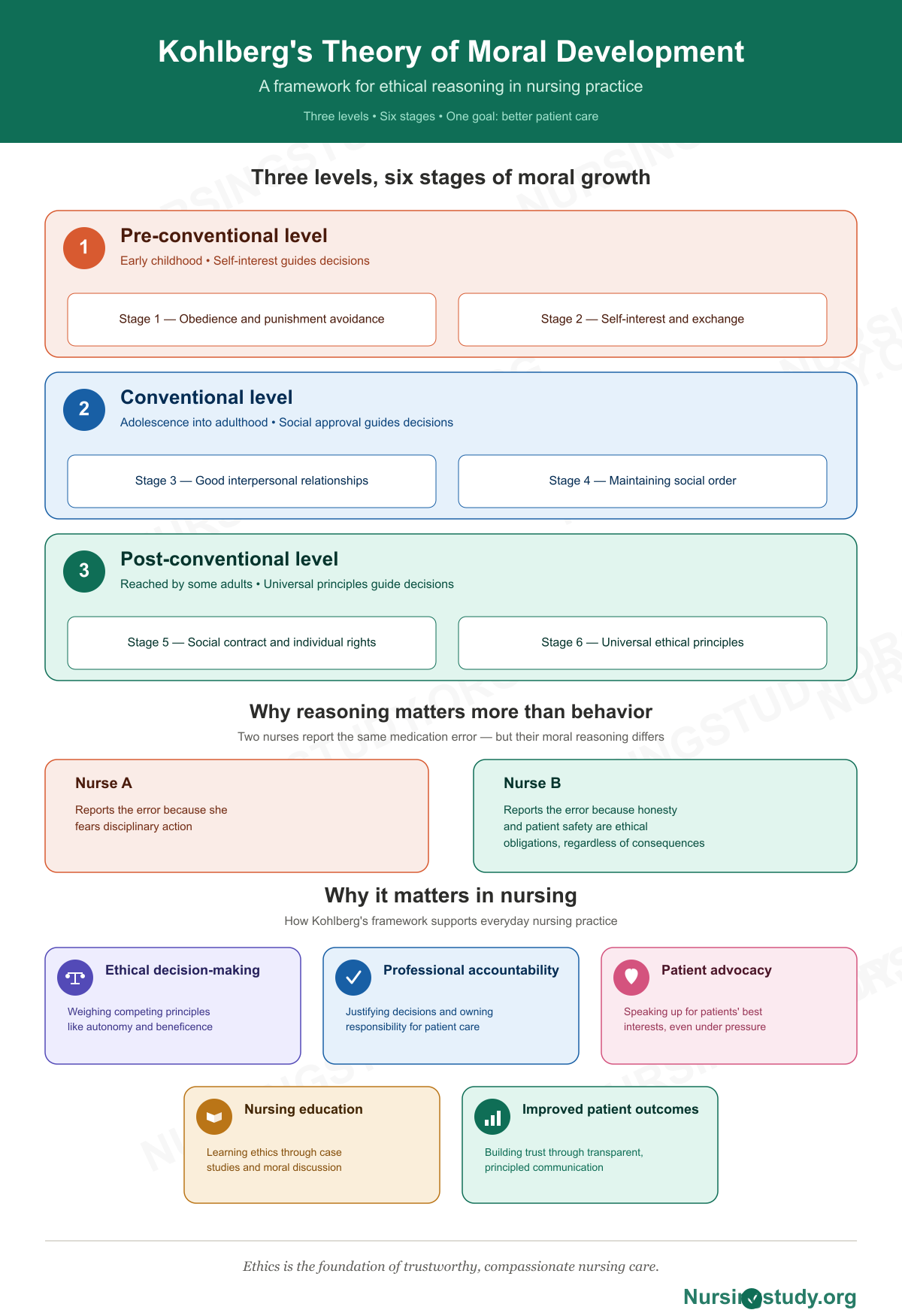
For example, two nursing students may both report a medication error.
Student A reports the error because they fear disciplinary action.
Student B reports the error because patient safety, honesty, and professional accountability are ethical obligations regardless of personal consequences.
Although both students display identical behavior, according to Kohlberg moral judgments differ because the ethical reasoning behind the decision differs.
This distinction illustrates why the theory focuses on how individuals think rather than simply what they do.
3. Cognitive Development Supports Moral Growth
Kohlberg argued that moral maturity cannot develop independently of intellectual maturity. As cognitive development advances, individuals become capable of understanding increasingly abstract concepts such as justice, equality, rights, and social responsibility.
However, cognitive ability alone does not guarantee moral maturity.
Instead, moral growth requires individuals to:
- encounter challenging ethical situations,
- reflect on competing viewpoints,
- participate in moral discussion,
- justify their decisions logically,
- reconsider previous assumptions.
This relationship explains why reasoning and moral development are closely interconnected throughout human development.
4. Moral Development Is Stimulated by Ethical Conflict
People rarely advance their ethical thinking without being challenged.
According to Kohlberg, encountering a moral dilemma encourages individuals to examine assumptions, consider opposing viewpoints, and develop more sophisticated reasoning.
Examples include:
- respecting a patient’s refusal of life-saving treatment,
- balancing confidentiality with patient safety,
- allocating limited ICU beds during emergencies,
- deciding whether to disclose a colleague’s unsafe practice.
Each situation requires professionals to respond to a moral dilemma by weighing competing ethical principles rather than relying on simple rules.
5. Higher Stages Reflect Universal Ethical Principles
As individuals progress toward the higher stages of moral reasoning, decisions become increasingly guided by universal concepts such as:
- justice,
- equality,
- respect for human dignity,
- individual rights,
- fairness,
- social responsibility.
The third level of moral development emphasizes these broader ethical principles rather than personal interests or social approval. Individuals who use higher stages of moral reasoning evaluate situations according to internal ethical principles even when external rules or expectations suggest a different course of action.
Why the Theory Matters in Nursing and Healthcare
Ethics is an essential component of nursing practice. Every day, nurses make decisions that affect patient safety, dignity, autonomy, and quality of care. The Lawrence Kohlberg Theory of Moral Development helps explain how healthcare professionals analyze these decisions and why different individuals may approach the same ethical situation differently.
Unlike many professions, nursing combines scientific knowledge with continuous ethical judgment. Clinical competence alone is insufficient; nurses must also demonstrate sound moral reasoning when caring for patients, collaborating with healthcare teams, and advocating for vulnerable populations.
The theory is particularly valuable in nursing because it helps explain:
Ethical Decision-Making
Nurses routinely encounter situations where ethical principles conflict.
Examples include:
- respecting advance directives,
- obtaining informed consent,
- protecting confidential information,
- balancing beneficence with patient autonomy,
- addressing cultural differences in healthcare decisions.
Understanding Kohlberg’s theory of moral development enables nurses to analyze these situations systematically instead of relying solely on intuition or emotion.
Professional Accountability
Professional nursing requires more than compliance with institutional policies.
Ethically accountable nurses:
- justify clinical decisions,
- recognize ethical conflicts,
- accept responsibility for their actions,
- advocate for patients even under challenging circumstances.
The Lawrence Kohlberg Theory of Moral Development provides a framework for understanding how these professional responsibilities develop over time.
Patient Advocacy
Patient advocacy often requires nurses to challenge decisions that may not serve the patient’s best interests.
For example, a nurse may advocate for:
- additional pain management,
- culturally sensitive care,
- respect for patient preferences,
- protection of vulnerable individuals,
- equitable access to healthcare resources.
These actions involve thoughtful moral decision making rather than simple adherence to routine procedures.
Nursing Education
The theory has also influenced moral education within nursing curricula.
Rather than teaching ethics as a list of rules, many nursing programs encourage learners to:
- analyze complex case studies,
- participate in ethical debates,
- engage in structured moral discussion,
- examine multiple viewpoints,
- reflect on their own reasoning processes.
These learning strategies support progress in moral reasoning, preparing future nurses to manage increasingly complex ethical situations throughout their careers.
Improving Patient Outcomes
Ethically informed decision-making contributes directly to high-quality patient care.
Healthcare professionals who demonstrate advanced moral reasoning are better equipped to:
- communicate transparently,
- resolve ethical conflicts collaboratively,
- respect patient values,
- maintain professional integrity,
- build trusting therapeutic relationships.
Lawrence Kohlberg’s Stages of Moral Development
At the heart of the Lawrence Kohlberg Theory of Moral Development is the idea that individuals progress through a predictable stage theory of moral development in which ethical thinking becomes increasingly sophisticated over time. Rather than viewing morality as a collection of fixed beliefs or behaviors, Lawrence Kohlberg’s theory of moral development explains that people gradually develop more advanced forms of moral reasoning as they mature intellectually and gain broader social experiences.
One of the defining characteristics of Kohlberg’s stages of moral development is that they focus on how people reason about ethical issues rather than what decision they ultimately make. According to Kohlberg, two individuals may reach the same conclusion when faced with a moral dilemma, yet their level of moral development may differ significantly because their reasoning is based on different ethical principles.
For example, consider the following clinical situation:
A nurse discovers that a colleague unintentionally administered the wrong medication dose but did not report the incident.
Different nurses might respond differently depending on their moral stage:
- One nurse may insist on reporting the incident because hospital policy requires it.
- Another may report it primarily to avoid disciplinary consequences.
- A third may report it because honesty, patient safety, and professional accountability are ethical obligations that outweigh personal relationships.
Although all three nurses choose to report the error, according to Kohlberg moral judgments differ because each nurse arrives at the decision through a different pattern of moral reasoning.
Another important characteristic of Kohlberg’s stages is that progression occurs gradually rather than abruptly. Individuals do not suddenly move from one stage to another. Instead, advancement occurs through continuous reflection, education, social interaction, and exposure to increasingly complex ethical situations. Encountering difficult moral dilemmas, participating in moral discussion, and considering multiple perspectives all contribute to progress in moral reasoning.
Kohlberg also argued that people generally move through the stages in the same order. Although individuals progress at different rates and not everyone reaches the highest stages, the overall sequence of development remains consistent across cultures and societies. Each new stage builds upon earlier ways of thinking, creating a progressively more sophisticated understanding of justice, rights, fairness, and responsibility.
Overview of the Three Levels and Six Stages of Moral Development
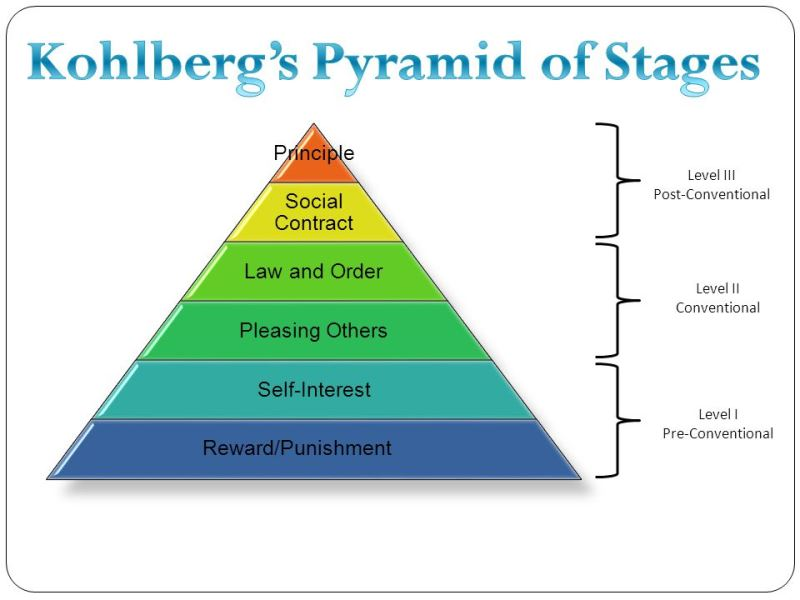
The Lawrence Kohlberg Theory of Moral Development organizes ethical thinking into three major levels, each containing two stages, for a total of six stages of moral development. These levels reflect increasingly advanced approaches to moral reasoning, beginning with decisions based primarily on self-interest and progressing toward reasoning guided by universal ethical principles.
The three levels are:
- Preconventional Level of Moral Development
- Conventional Level of Moral Development
- Postconventional Level of Moral Development
Each level represents a distinct approach to ethical decision-making rather than a person’s age or educational background. While younger children typically function within the early levels due to ongoing cognitive development, adults may reason at different levels depending on their experiences, education, reflection, and opportunities for moral growth.
The following table provides an overview of Kohlberg’s stages of moral development.
| Level | Stages | Primary Focus of Moral Reasoning |
|---|---|---|
| Preconventional | Stage 1: Obedience and Punishment Stage 2: Individualism and Exchange | Avoiding punishment and pursuing personal interests |
| Conventional | Stage 3: Good Interpersonal Relationships Stage 4: Maintaining Social Order | Gaining social approval and respecting laws, rules, and responsibilities |
| Postconventional | Stage 5: Social Contract and Individual Rights Stage 6: Universal Ethical Principles | Protecting justice, human rights, and ethical principles regardless of external rules |
Several important principles characterize these levels:
- Each stage represents a qualitatively different way of thinking.
- Movement through the stages follows a consistent sequence of development.
- Individuals typically cannot skip stages.
- Higher stages involve increasingly abstract and principled moral reasoning.
- Ethical maturity depends on the reasoning used rather than the final decision.
This framework explains why people often disagree when confronted with the same ethical problem. Differences frequently arise not because individuals possess different values, but because they reason from different levels of moral development.
Preconventional Level of Moral Development
The Preconventional Level of Moral Development represents the earliest level in Kohlberg’s stages of moral development. At this level, decisions are primarily influenced by personal consequences rather than broader ethical principles. Individuals focus on avoiding punishment, obtaining rewards, and satisfying their immediate needs.
This level is commonly observed during child development, although some adolescents and adults may continue to rely on this type of reasoning in certain situations.
Stage 1: Obedience and Punishment Orientation
The first stage is characterized by obedience to authority in order to avoid punishment.
Individuals at this stage believe that actions are wrong primarily because they lead to negative consequences.
Typical characteristics include:
- Following rules because authority figures demand compliance.
- Avoiding punishment rather than understanding ethical principles.
- Viewing morality in absolute terms.
- Limited consideration of other people’s perspectives.
Example
A nursing student follows infection control protocols only because failure to comply may result in disciplinary action during clinical placement. The primary concern is avoiding punishment rather than protecting patient safety.
Stage 2: Individualism and Exchange
At Stage 2, individuals recognize that others also have needs, but decisions remain largely based on self-interest and reciprocal benefit.
Reasoning often follows the principle of:
“If I help you today, you may help me tomorrow.”
Characteristics include:
- Pursuing personal interests.
- Recognizing mutual benefit.
- Viewing fairness as equal exchange.
- Evaluating situations based on personal gain.
Example
A student volunteers to assist classmates during a group assignment primarily because they expect similar assistance when they need help later.
In healthcare, this reasoning may appear when professionals prioritize cooperation mainly because it improves their own workload or professional evaluations.
Although this level represents the beginning of ethical awareness, decision-making remains largely centered on personal consequences rather than broader societal or professional responsibilities.
Conventional Level of Moral Development
The Conventional Level of Moral Development represents a significant advancement in moral reasoning. Individuals begin placing greater importance on social relationships, professional responsibilities, and maintaining order within society.
Many adolescents and adults function primarily within this level, particularly in workplace environments.
Stage 3: Good Interpersonal Relationships
Stage 3 emphasizes maintaining positive relationships and earning the approval of others.
Individuals seek to be viewed as trustworthy, caring, responsible, and cooperative.
Characteristics include:
- Valuing interpersonal relationships.
- Seeking social acceptance.
- Demonstrating empathy.
- Acting according to expectations of family, peers, or professional groups.
Example
A nurse spends additional time comforting an anxious patient because compassionate care reflects the qualities of a caring healthcare professional.
Here, ethical behavior is motivated by the desire to meet professional and interpersonal expectations.
Stage 4: Maintaining Social Order
Stage 4 shifts attention from individual relationships to the functioning of society as a whole.
Individuals believe that laws, institutional policies, and professional standards exist to maintain fairness, stability, and public trust.
Characteristics include:
- Respecting laws and regulations.
- Supporting institutional rules.
- Recognizing civic and professional responsibilities.
- Prioritizing order and consistency.
Example
A nurse accurately documents every medication administration, even during an exceptionally busy shift, because complete documentation protects patient safety, ensures continuity of care, and fulfills legal and professional responsibilities.
At this stage, moral decisions are guided by respect for established systems rather than personal relationships alone.
Within nursing, much professional conduct—including adherence to ethical codes, licensing standards, and organizational policies—reflects reasoning commonly associated with the Conventional Level.
Postconventional Level of Moral Development
The Postconventional Level of Moral Development represents the highest and most abstract level within the Lawrence Kohlberg Theory of Moral Development. At this stage, individuals recognize that laws and social rules are important but understand that they should ultimately serve justice, human dignity, and the protection of fundamental rights.
Reasoning becomes guided by internal ethical principles rather than external authority.
Not everyone reaches this third level of moral development, and those who do may not consistently reason at this level in every situation.
Stage 5: Social Contract and Individual Rights
Individuals recognize that laws should promote the welfare of society while protecting individual rights.
Characteristics include:
- Balancing legal requirements with ethical principles.
- Respecting human rights.
- Supporting democratic decision-making.
- Recognizing that laws may require revision when they become unjust.
Example
A nurse advocates for a patient’s right to refuse treatment even when family members strongly disagree, recognizing that patient autonomy is a fundamental ethical principle.
Here, professional judgment extends beyond simple compliance with authority.
Stage 6: Universal Ethical Principles
The final stage represents the highest level of moral reasoning proposed in Kohlberg’s theory.
Ethical decisions are guided by universal principles such as:
- Justice.
- Equality.
- Respect for human dignity.
- Compassion.
- Human rights.
- Integrity.
Individuals at this stage are willing to defend ethical principles even when doing so involves personal risk or conflict with existing laws or institutional expectations.
Example
A nurse reports unsafe practices that place patients at serious risk despite knowing that doing so may result in workplace conflict or professional retaliation. The decision is based on protecting patient welfare and upholding ethical principles rather than preserving personal comfort.
Progression Across the Three Levels
The movement through Kohlberg’s stages of moral development reflects increasing sophistication in ethical thinking.
| Level | Primary Motivation | Typical Ethical Focus |
|---|---|---|
| Preconventional | Personal consequences | Avoid punishment and obtain rewards |
| Conventional | Social expectations | Maintain relationships, follow rules, fulfill responsibilities |
| Postconventional | Universal ethical principles | Protect justice, rights, dignity, and fairness |
For nurses and other healthcare professionals, understanding these stages of moral development provides valuable insight into how ethical thinking evolves over time. Recognizing that individuals may reason differently—even when making similar clinical decisions—promotes greater empathy, strengthens interdisciplinary collaboration, and supports more thoughtful responses to complex moral dilemmas. As healthcare environments become increasingly complex, the Lawrence Kohlberg Theory of Moral Development remains an important framework for understanding the progression of ethical thinking and fostering reflective, principled decision-making in clinical practice.
Moral Reasoning and Ethical Decision-Making in Lawrence Kohlberg’s Theory
The central contribution of the Lawrence Kohlberg Theory of Moral Development lies in its explanation of moral reasoning—the mental process individuals use to determine what is right, fair, and ethically appropriate in a given situation. While many psychological theories focus on observable moral behavior, Lawrence Kohlberg’s theory of moral development emphasizes that the quality of ethical thinking is a better indicator of moral maturity than the behavior itself.
This distinction is important because identical actions can be motivated by very different reasons. A healthcare professional may follow a hospital policy simply to avoid disciplinary action, while another follows the same policy because it protects patient dignity, promotes justice, and aligns with professional ethical principles. Although the behavior is identical, the reasoning behind it reflects different levels of moral development.
According to Kohlberg’s theory, ethical decision-making develops gradually through increasingly sophisticated forms of reasoning. Individuals move from making decisions based primarily on personal consequences toward reasoning grounded in justice, fairness, individual rights, and universal ethical principles. This process of moral development enables people to evaluate increasingly complex ethical issues rather than relying solely on rules or authority figures.
Within nursing and healthcare, moral reasoning plays a fundamental role because professionals regularly encounter situations where ethical principles compete with one another. Clinical decisions often involve balancing:
- Patient autonomy versus beneficence.
- Confidentiality versus patient safety.
- Justice versus limited healthcare resources.
- Professional responsibilities versus personal beliefs.
- Institutional policies versus individualized patient care.
These situations cannot be resolved through technical knowledge alone. Instead, they require thoughtful analysis, ethical reflection, and sound moral decision making. The Lawrence Kohlberg Theory of Moral Development provides a structured framework for understanding how individuals approach these decisions and why different healthcare professionals may respond differently to the same ethical challenge.
How Moral Reasoning Develops Across the Stages
One of the defining features of the Lawrence Kohlberg Theory of Moral Development is that moral reasoning evolves progressively rather than remaining fixed throughout life. As individuals mature intellectually and socially, their understanding of justice, responsibility, rights, and ethical obligations becomes increasingly sophisticated.
Kohlberg proposed that progression occurs through a predictable sequence of development, with each moral stage representing a qualitatively different way of thinking. Advancement is not determined simply by age but by continued cognitive development, exposure to challenging experiences, education, and opportunities for reflection.
The progression can be understood as a gradual shift in the primary focus of ethical thinking.
Early Moral Reasoning: Self-Interest and Personal Consequences
At the Preconventional Level of Moral Development, individuals evaluate ethical situations primarily according to personal consequences.
Typical questions include:
- Will I be punished?
- What will I gain?
- How will this affect me?
Reasoning is largely self-centered, with limited consideration of broader ethical principles or the perspectives of others.
Example
A nursing student completes required documentation because failure to do so may result in a poor clinical evaluation. The motivation is avoiding negative consequences rather than recognizing documentation as an essential component of patient safety.
Developing Moral Reasoning: Social Expectations and Responsibility
As individuals progress into the Conventional Level of Moral Development, ethical thinking expands beyond personal interests.
Questions become more socially oriented:
- What is expected of me?
- How will my actions affect others?
- Am I fulfilling my professional responsibilities?
At this level, individuals recognize the importance of trust, cooperation, institutional rules, and maintaining positive relationships.
Example
A registered nurse carefully follows medication administration protocols because accurate practice maintains patient safety, supports teamwork, and fulfills professional obligations.
Reasoning now reflects concern for both individuals and the broader healthcare system.
Advanced Moral Reasoning: Ethical Principles and Justice
The Postconventional Level of Moral Development represents the highest level of moral reasoning proposed in Lawrence Kohlberg’s theory of moral development.
Individuals begin asking more abstract ethical questions such as:
- Is this action just?
- Does it respect human dignity?
- Does it protect fundamental rights?
- Is the existing rule ethically appropriate?
Rather than accepting laws or institutional policies without question, individuals evaluate whether those rules align with broader ethical principles.
Example
A nurse advocates for a patient’s right to refuse treatment despite pressure from family members or healthcare providers. The decision is guided by respect for patient autonomy and informed consent rather than by social approval.
This progression illustrates an important principle of Kohlberg’s stages of moral development: ethical maturity is reflected not by reaching a particular conclusion but by increasingly sophisticated reasoning.
Progression Is Continuous Rather Than Automatic
Although Lawrence Kohlberg proposed that individuals move through the stages sequentially, advancement is neither automatic nor guaranteed.
Several important characteristics define progression:
- Individuals cannot typically skip stages.
- Earlier stages provide the foundation for later reasoning.
- Growth occurs gradually through experience and reflection.
- People may reason differently depending on the complexity of the situation.
- Many adults function primarily within the Conventional Level, while relatively few consistently demonstrate reasoning characteristic of the highest stages.
This explains why two experienced healthcare professionals may approach the same ethical situation differently despite having similar clinical knowledge.
Moral Judgments and Responses to Moral Dilemmas
A central aspect of the Lawrence Kohlberg Theory of Moral Development is understanding how individuals form moral judgments when confronted with challenging ethical situations. Kohlberg believed that moral maturity becomes most visible when people must respond to a moral dilemma—a situation in which competing ethical values make every available option difficult.
A moral dilemma differs from an ordinary problem because there is often no perfect solution. Instead, individuals must balance conflicting responsibilities, rights, and ethical principles.
Healthcare professionals encounter such dilemmas regularly.
Examples include:
- Respecting a competent patient’s refusal of life-saving treatment.
- Balancing patient confidentiality with the duty to protect others from harm.
- Deciding how limited ICU beds should be allocated during emergencies.
- Determining whether life-sustaining treatment should be continued.
- Reporting a colleague whose unsafe practice may endanger patients.
These situations require much more than memorized ethical rules. They demand careful moral reasoning, critical thinking, empathy, and professional judgment.
How Moral Judgments Differ Across Developmental Stages
According to Kohlberg moral judgments differ because individuals rely on different reasoning processes rather than different facts.
Consider the following scenario.
A nurse discovers that another nurse intentionally altered a patient’s documentation.
Possible responses might include:
Preconventional reasoning
“I should report this because I might get into trouble if I don’t.”
The focus is avoiding punishment.
Conventional reasoning
“I should report this because professional standards require honesty, and accurate documentation protects patients.”
The focus is fulfilling professional responsibilities.
Postconventional reasoning
“I should report this because patients have a fundamental right to safe and truthful healthcare regardless of personal consequences.”
The focus is protecting universal ethical principles.
Although each response reaches the same conclusion, the underlying reasoning differs considerably.
The Role of Moral Discussion
Kohlberg argued that individuals develop stronger ethical thinking through active moral discussion.
Discussing ethical cases encourages individuals to:
- examine multiple viewpoints,
- justify their reasoning,
- challenge personal assumptions,
- appreciate conflicting ethical values,
- develop increasingly sophisticated moral thinking.
This principle explains why nursing education frequently incorporates:
- ethics seminars,
- case-based learning,
- simulation exercises,
- interdisciplinary discussions,
- clinical debriefings.
These activities encourage learners to move beyond memorizing ethical principles toward developing advanced moral reasoning.
Factors That Influence Moral Development
Although the Lawrence Kohlberg Theory of Moral Development proposes a universal sequence of development, Kohlberg acknowledged that progression through the stages is influenced by numerous biological, cognitive, educational, and social experiences.
Moral development is not determined by age alone. Instead, it results from the interaction of multiple factors that shape an individual’s ability to reason ethically.
1. Cognitive Development
Cognitive development provides the intellectual foundation necessary for increasingly sophisticated ethical thinking.
As abstract reasoning improves, individuals become better able to:
- analyze complex situations,
- consider multiple perspectives,
- evaluate competing ethical principles,
- understand justice and human rights.
Without sufficient cognitive maturity, progression into higher stages becomes difficult.
2. Child Development and Early Social Experiences
Early childhood experiences significantly influence the development of moral thinking.
Children begin learning concepts such as:
- fairness,
- honesty,
- responsibility,
- empathy,
- cooperation,
- respect for others.
Parents, caregivers, teachers, and peers all contribute to the early formation of children’s moral understanding.
However, Lawrence Kohlberg’s theory of moral development emphasizes that moral growth continues throughout adolescence and adulthood.
3. Education and Moral Education
Education plays a critical role in promoting moral education and ethical reflection.
Learning environments encourage progress in moral reasoning by exposing individuals to:
- ethical debates,
- case studies,
- diverse viewpoints,
- critical thinking exercises,
- reflective practice.
Professional education, particularly in nursing, strengthens the ability to analyze increasingly complex ethical situations.
4. Social and Cultural Experiences
Interactions with people from different backgrounds broaden ethical understanding.
Exposure to diverse cultures, beliefs, and life experiences encourages individuals to:
- appreciate multiple perspectives,
- question assumptions,
- recognize social justice issues,
- develop empathy.
Although Kohlberg proposed universalizing patterns of moral development, researchers continue to explore how cultural values influence ethical reasoning.
5. Professional Experience
Clinical practice provides continuous opportunities for ethical growth.
Healthcare professionals regularly encounter situations involving:
- patient advocacy,
- end-of-life care,
- informed consent,
- resource allocation,
- confidentiality,
- professional accountability.
Repeated exposure to these situations encourages reflection and strengthens moral decision making.
6. Reflection and Ethical Dialogue
Individuals who regularly reflect on their experiences often demonstrate greater moral growth.
Reflection may occur through:
- journaling,
- mentorship,
- ethics committees,
- peer discussions,
- continuing professional education.
These activities help individuals evaluate previous decisions, recognize biases, and refine their ethical reasoning over time.
Applying Lawrence Kohlberg’s Stages of Moral Development in Nursing Practice
The Lawrence Kohlberg Theory of Moral Development extends far beyond psychology classrooms and academic discussions. Its greatest value lies in its practical application to professions that require frequent ethical decision-making, particularly nursing. Every day, nurses make choices that influence patient safety, dignity, quality of care, and health outcomes. While clinical knowledge and technical competence are essential, they are often insufficient when healthcare professionals encounter situations where ethical principles conflict. In these moments, advanced moral reasoning becomes just as important as clinical expertise.
Nursing is unique because many clinical decisions involve competing obligations rather than clear right-or-wrong answers. A nurse may need to balance respect for patient autonomy with the duty to prevent harm, advocate for a vulnerable patient while maintaining professional relationships, or allocate limited healthcare resources fairly during emergencies. These situations require nurses to carefully analyze ethical principles, consider multiple perspectives, and justify their decisions using sound reasoning.
The Lawrence Kohlberg Theory of Moral Development provides a structured framework for understanding how nurses approach these complex situations. Rather than encouraging blind adherence to policies, Kohlberg’s theory of moral development promotes reflective thinking by asking healthcare professionals to examine why they believe a particular course of action is ethically appropriate. This emphasis on reasoning helps nurses move beyond routine decision-making toward thoughtful, patient-centered ethical practice.
Applying Lawrence Kohlberg’s stages of moral development in nursing also supports lifelong professional growth. As nurses gain clinical experience, participate in ethics education, and encounter increasingly complex patient situations, they have opportunities to strengthen their moral reasoning, refine their ethical judgment, and develop greater confidence in addressing difficult moral dilemmas.
Some of the key areas where the Lawrence Kohlberg Theory of Moral Development contributes to nursing practice include:
- Strengthening ethical decision-making in patient care.
- Improving communication with patients, families, and interdisciplinary teams.
- Promoting patient advocacy and respect for individual rights.
- Enhancing professional accountability and integrity.
- Supporting leadership and ethical decision-making within healthcare organizations.
- Encouraging reflective practice and continuous moral growth.
Ultimately, the theory reminds nurses that excellent patient care depends not only on what decisions are made but also on the ethical reasoning used to arrive at those decisions.
Ethical Decision-Making in Patient Care
Ethical decision-making is one of the most important responsibilities of professional nurses. Every clinical setting—whether an emergency department, intensive care unit, pediatric ward, psychiatric facility, or community health clinic—presents situations in which ethical principles must be carefully balanced. The Lawrence Kohlberg Theory of Moral Development provides a valuable framework for understanding how nurses analyze these situations and justify their moral decisions.
Ethical decision-making involves more than choosing between right and wrong. In many healthcare situations, several ethical principles are equally important, yet they may conflict with one another. Nurses must therefore evaluate available options, anticipate potential consequences, and determine which course of action best promotes patient well-being while respecting legal and professional obligations.
Common ethical principles that influence nursing decisions include:
- Autonomy – Respecting a patient’s right to make informed decisions about their care.
- Beneficence – Acting in the patient’s best interests.
- Nonmaleficence – Avoiding actions that may cause harm.
- Justice – Providing fair and equitable care to all patients.
- Fidelity – Honoring professional commitments and maintaining trust.
- Veracity – Communicating honestly and truthfully with patients.
When these principles conflict, nurses must rely on well-developed moral reasoning rather than personal opinions or emotions alone.
Example: Respecting Patient Autonomy
A competent patient with advanced cancer refuses further chemotherapy despite understanding the potential consequences.
A nurse functioning primarily from a lower level of moral reasoning might focus on following physician recommendations without questioning the patient’s wishes.
A nurse demonstrating more advanced moral reasoning based on Kohlberg’s principles recognizes that respecting patient autonomy is a fundamental ethical responsibility. Instead of attempting to persuade the patient, the nurse:
- Confirms that the patient understands the available treatment options.
- Assesses decision-making capacity.
- Ensures informed consent has been obtained.
- Supports the patient’s right to make personal healthcare decisions.
- Communicates the patient’s wishes to the healthcare team.
Although this decision may be emotionally difficult, it reflects ethical reasoning grounded in respect for individual rights rather than external authority.
Ethical Decision-Making Requires Critical Reflection
The Lawrence Kohlberg Theory of Moral Development encourages nurses to critically examine every ethical situation by asking questions such as:
- What ethical principles are involved?
- Who may be affected by this decision?
- Are institutional policies consistent with patient rights?
- Does the proposed action promote justice and fairness?
- Would I be able to justify this decision professionally and ethically?
These questions encourage reflective practice rather than automatic responses.
Professional Codes Complement Moral Reasoning
Nursing codes of ethics provide important guidance, but they cannot anticipate every clinical situation.
For example:
- A hospital policy may recommend one course of action.
- A patient’s cultural beliefs may suggest another.
- Family members may advocate for something different.
- The patient’s own wishes may conflict with all of the above.
In such situations, Kohlberg’s theory helps nurses thoughtfully evaluate competing responsibilities rather than relying solely on institutional rules.
Applying the Theory to Clinical Moral Dilemmas
Healthcare professionals routinely encounter situations where there is no perfect solution. These situations are known as moral dilemmas because they involve competing ethical obligations, making every available option carry both benefits and disadvantages.
The Lawrence Kohlberg Theory of Moral Development is particularly valuable because it helps nurses understand how ethical reasoning influences responses to these dilemmas.
Rather than asking:
“What is the correct answer?”
Kohlberg encourages healthcare professionals to ask:
- Why is this decision ethically justified?
- Which ethical principles support this choice?
- Whose rights are affected?
- What reasoning best protects patient dignity and welfare?
This approach promotes thoughtful moral decision making instead of simplistic rule-following.
Clinical Moral Dilemma 1: Confidentiality Versus Patient Safety
A teenage patient tells a nurse that they intend to harm another individual but asks the nurse not to disclose the information.
The nurse faces competing ethical responsibilities:
- Respect patient confidentiality.
- Protect potential victims from harm.
- Follow legal reporting requirements.
- Maintain therapeutic trust.
Using Lawrence Kohlberg’s stages of moral, the nurse carefully weighs competing obligations before determining that protecting human life may ethically justify breaching confidentiality.
Clinical Moral Dilemma 2: Limited Healthcare Resources
An intensive care unit has only one available ventilator, yet two critically ill patients require mechanical ventilation.
The healthcare team must consider:
- Clinical prognosis.
- Fairness.
- Resource allocation.
- Institutional guidelines.
- Ethical principles of justice.
The Lawrence Kohlberg Theory of Moral Development encourages decisions based on transparent ethical reasoning rather than personal preference or emotional attachment.
Clinical Moral Dilemma 3: End-of-Life Care
A patient’s advance directive states that they do not wish to receive life-sustaining treatment, but family members insist that “everything possible” should be done.
The nurse must balance:
- Patient autonomy.
- Family concerns.
- Legal documentation.
- Professional ethical standards.
- Compassionate communication.
Rather than focusing solely on external pressures, advanced moral reasoning considers the patient’s previously expressed wishes while supporting respectful dialogue with family members.
Benefits of Applying Kohlberg’s Theory in Clinical Practice
When nurses consistently apply Kohlberg’s theory, they become better able to:
- Analyze complex ethical situations systematically.
- Recognize competing ethical principles.
- Communicate ethical reasoning clearly.
- Support patient-centered care.
- Advocate effectively for vulnerable patients.
- Collaborate respectfully with interdisciplinary teams.
- Reflect on personal biases and assumptions.
These skills strengthen both professional practice and patient outcomes.
Case Examples for Nursing Students
Case studies provide valuable opportunities to observe how the Lawrence Kohlberg Theory of Moral Development can be applied in realistic healthcare situations. They encourage learners to examine multiple viewpoints and develop stronger moral reasoning through reflection and discussion.
Case Study 1: Medication Error
During a clinical placement, a nursing student notices that another student administered medication thirty minutes later than scheduled. The supervising nurse has not yet noticed the error.
Possible responses include:
Preconventional reasoning
“I should report the error because I could get into trouble if someone discovers that I knew.”
Conventional reasoning
“I should report the error because nurses have a professional responsibility to document medication incidents honestly.”
Postconventional reasoning
“I should report the error because patient safety and professional integrity outweigh concerns about upsetting a classmate.”
Although the action is identical, the underlying moral reasoning differs substantially.
Case Study 2: Respecting Cultural Beliefs
A patient declines a recommended blood transfusion because of deeply held religious beliefs.
The nurse should:
- Assess the patient’s understanding of the situation.
- Confirm decision-making capacity.
- Respect informed refusal.
- Provide emotional support.
- Collaborate with the healthcare team to explore acceptable alternatives.
Using the Lawrence Kohlberg Theory of Moral Development, the nurse recognizes that respecting patient autonomy and human dignity is an essential component of ethical practice.
Case Study 3: Reporting Unsafe Practice
A newly employed nurse observes a senior colleague repeatedly bypassing infection-control procedures to save time.
Possible responses include:
- Remaining silent to avoid conflict.
- Reporting the issue immediately.
- Speaking privately with the colleague first.
- Escalating concerns if unsafe practice continues.
Applying Kohlberg’s stages of moral development, the nurse evaluates the ethical implications of each option by considering patient safety, professional accountability, justice, and responsibility rather than workplace hierarchy alone.
Measurement of Moral Development
The measurement of moral development is an important aspect of the Lawrence Kohlberg Theory of Moral Development because it provides researchers, educators, and healthcare professionals with a systematic way to evaluate how individuals think about ethical issues. While Kohlberg proposed that people progress through predictable stages of moral development, he also recognized that these stages could not simply be identified by observing a person’s actions. Instead, assessment requires understanding the reasoning that supports an individual’s moral decisions.
One of the defining characteristics of Kohlberg’s theory of moral development is its distinction between moral behavior and moral reasoning. A person may perform an ethical action for many different reasons. For example, two nurses may both maintain patient confidentiality:
- One nurse protects confidential information because hospital policy requires it and violating the policy could result in disciplinary action.
- Another nurse protects confidentiality because respecting patient autonomy, dignity, and trust is viewed as a fundamental ethical obligation.
Although the observable behavior is identical, the two nurses demonstrate different levels of moral reasoning. This is why according to Kohlberg moral judgments should be evaluated based on the reasoning process rather than the final decision alone.
The meaning and measurement of moral development therefore focus on understanding how individuals analyze ethical situations, justify their choices, and balance competing values. Rather than asking whether an answer is simply right or wrong, researchers examine:
- The principles individuals use to justify their decisions.
- The consistency of their ethical reasoning.
- Their ability to consider multiple perspectives.
- Their understanding of justice, fairness, rights, and responsibility.
- The sophistication of their moral thinking.
This approach has contributed significantly to the study of moral development, allowing psychologists, educators, and ethics researchers to investigate how ethical reasoning evolves across different ages, cultures, educational backgrounds, and professions.
In healthcare, the measurement of moral development has practical importance because ethical competence directly influences patient care. Nursing educators, for example, may use structured ethical discussions, simulations, reflective writing, and case analyses to evaluate how learners approach moral dilemmas. Although these educational activities may not formally assign a Kohlberg stage, they help instructors assess the progression of students’ moral reasoning, identify areas for improvement, and encourage continued ethical development throughout professional practice.
Methods Used in the Measurement of Moral Development
Over the years, researchers have developed several methods for assessing moral development based on the principles established by Lawrence Kohlberg’s theory of moral development. While these methods differ in format and scoring procedures, they all attempt to evaluate the reasoning individuals use when confronted with challenging ethical situations rather than measuring simple knowledge of ethical rules.
Some assessment methods are used primarily in psychological research, while others have been adapted for education, healthcare training, leadership development, and professional ethics.
1. Moral Judgment Interview (MJI)
The Moral Judgment Interview (MJI) is the original assessment tool developed by Kohlberg and remains one of the best-known approaches to the measurement of moral development.
The interview consists of a series of carefully designed hypothetical stories involving moral conflict. Participants are asked not only to choose a course of action but, more importantly, to explain the reasoning behind their decisions.
One of the most widely known scenarios is the Heinz Dilemma, in which a man considers stealing an expensive medication that could save his dying wife.
Rather than asking:
“Should Heinz steal the drug?”
the interviewer asks follow-up questions such as:
- Why should he steal—or not steal—the medication?
- Is preserving human life more important than obeying the law?
- Does property ownership outweigh the value of life?
- Would your answer change if the person needing the medication were a stranger?
These additional questions encourage participants to explain their reasoning in detail, allowing evaluators to determine the individual’s level of moral development.
The moral judgment interview is particularly valuable because it examines the reasoning process rather than focusing solely on final answers.
2. Structured Moral Dilemma Discussions
Many educational programs use structured discussions involving realistic ethical scenarios instead of formal interviews.
Participants may analyze situations involving:
- Patient confidentiality.
- End-of-life care.
- Allocation of scarce healthcare resources.
- Informed consent.
- Professional misconduct.
- Cultural conflicts in healthcare.
Facilitated discussion allows educators to observe how learners:
- justify ethical choices,
- evaluate competing values,
- recognize alternative viewpoints,
- demonstrate moral reasoning,
- revise their opinions after discussion.
This method aligns closely with Kohlberg’s belief that moral discussion promotes progress in moral reasoning.
3. Written Case Analysis
Healthcare education frequently incorporates written ethical analyses as part of professional training.
Students receive detailed patient scenarios and are asked to:
- identify the ethical issues,
- explain competing principles,
- recommend an appropriate course of action,
- justify their decision using ethical reasoning.
These exercises help educators evaluate both clinical judgment and ethical reasoning simultaneously.
4. Standardized Assessment Instruments
Since Kohlberg’s original work, researchers have developed several standardized instruments inspired by the Lawrence Kohlberg Theory of Moral Development.
Examples include:
- the Defining Issues Test (DIT),
- revised versions such as the DIT-2,
- profession-specific ethics assessments.
Unlike the original interview, these instruments use standardized scoring systems that make them more practical for large-scale educational and research settings.
Although they differ from the original moral judgment interview, they continue to measure similar aspects of moral reasoning and ethical judgment.
5. Observation in Professional Practice
Formal testing is not the only way to evaluate ethical development.
Clinical instructors often assess students through observation during patient care by examining how they:
- communicate with patients,
- protect confidentiality,
- respond to ethical conflicts,
- advocate for vulnerable patients,
- collaborate with healthcare teams,
- justify clinical decisions.
Although observational methods cannot directly determine an individual’s moral stage, they provide valuable insight into how ethical reasoning is translated into professional practice.
Assessing Moral Reasoning and Moral Judgment
Assessing moral reasoning involves much more than determining whether a decision is ethically correct. Instead, evaluators seek to understand the thinking process that leads to a particular conclusion.
This emphasis distinguishes the Lawrence Kohlberg Theory of Moral Development from many earlier approaches to morality that focused primarily on behavior.
When assessing ethical reasoning, evaluators typically examine several dimensions.
Quality of Ethical Justification
Individuals are asked to explain:
- Why they chose a particular action.
- Which ethical principles influenced their decision.
- How they balanced competing obligations.
- Whether alternative solutions were considered.
The sophistication of these explanations often reflects the person’s level of moral development.
Recognition of Multiple Perspectives
Advanced moral reasoning involves recognizing that ethical situations often affect multiple individuals.
For example, a nurse considering whether to disclose confidential information may evaluate the perspectives of:
- the patient,
- family members,
- healthcare providers,
- hospital administrators,
- society as a whole.
Considering multiple viewpoints reflects increasingly sophisticated ethical thinking.
Consistency of Moral Thinking
Ethical maturity also involves applying similar principles across different situations.
Individuals demonstrating advanced reasoning generally evaluate diverse ethical problems using consistent principles such as:
- justice,
- fairness,
- human dignity,
- respect for rights,
- professional responsibility.
Consistency indicates that decisions are guided by stable ethical principles rather than temporary emotions or external pressures.
Ability to Defend Ethical Decisions
Strong moral reasoning requires individuals to defend their conclusions logically.
For example, during an ethics committee meeting, a nurse may explain why honoring a patient’s advance directive better protects autonomy than complying with family wishes.
The ability to justify decisions using coherent ethical arguments is an important indicator of mature reasoning.
Application to Nursing Practice
Assessment of ethical reasoning has become increasingly important in nursing education because clinical competence includes both technical skill and ethical judgment.
Educators may evaluate learners through:
- simulation exercises,
- reflective journals,
- ethics presentations,
- patient case analyses,
- group discussions,
- clinical debriefings.
These activities help determine how effectively future nurses integrate ethical principles into patient care and moral decision making.
Strengths and Limitations of Moral Development Assessment
Like all psychological assessment methods, the measurement of moral development offers valuable insights while also presenting important limitations. Understanding both the strengths and weaknesses of these assessment approaches allows educators, researchers, and healthcare professionals to interpret results more accurately.
Strengths of Moral Development Assessment
The assessment methods inspired by the Lawrence Kohlberg Theory of Moral Development offer several important advantages.
1. Provides a Structured Framework for Evaluating Ethical Thinking
One of the greatest strengths is that assessment focuses on the reasoning behind decisions rather than simply judging whether answers are correct.
This provides a more meaningful understanding of ethical maturity.
2. Supports Moral Education
Assessment results help educators identify opportunities to strengthen moral education.
Students who demonstrate limited ethical reasoning can benefit from:
- additional ethics instruction,
- structured moral discussion,
- reflective practice,
- case-based learning,
- interdisciplinary collaboration.
These experiences encourage continued moral growth.
3. Encourages Reflective Practice
Completing ethical assessments often prompts individuals to reconsider their assumptions, recognize biases, and examine alternative viewpoints.
Reflection itself becomes an important learning experience that supports continued ethical development.
4. Promotes Professional Development
In nursing, evaluating ethical reasoning helps prepare future professionals for situations involving:
- patient advocacy,
- informed consent,
- end-of-life care,
- resource allocation,
- cultural competence,
- professional accountability.
These skills contribute directly to safer and more ethical patient care.
Limitations of Moral Development Assessment
Despite its many contributions, the measurement of moral development also has several limitations that should be considered.
1. Reasoning Does Not Always Predict Behavior
One of the most significant criticisms is that individuals may demonstrate sophisticated moral reasoning while failing to act ethically in real-world situations.
Knowledge of ethical principles does not always translate into ethical behavior.
Factors such as stress, organizational culture, fear of retaliation, fatigue, and time pressure may influence clinical decisions.
2. Cultural Differences
Kohlberg proposed universalizing patterns of moral development, but researchers have questioned whether ethical reasoning develops identically across all societies.
Different cultures may place varying levels of importance on:
- community responsibilities,
- family obligations,
- individual rights,
- religious values,
- social harmony.
These differences can influence how individuals justify ethical decisions.
3. Complexity of Scoring
The original moral judgment interview requires extensive interviewer training and detailed scoring procedures.
As a result:
- assessments are time-consuming,
- scoring may be subjective,
- widespread clinical use becomes difficult.
This limitation contributed to the development of more standardized assessment tools.
4. Ethical Development Is Multifaceted
The Lawrence Kohlberg Theory of Moral Development primarily evaluates moral reasoning, but ethical behavior is also influenced by numerous additional factors, including:
- emotional intelligence,
- empathy,
- personality,
- organizational culture,
- leadership,
- previous experiences,
- situational pressures.
Consequently, no single assessment can fully capture an individual’s overall ethical competence.
5. Professional Context Matters
Healthcare professionals often make decisions within environments shaped by legal regulations, institutional policies, interdisciplinary collaboration, and limited resources. These external influences may affect decision-making independently of an individual’s moral stage.
For this reason, assessment results should be interpreted as one indicator of ethical development rather than a definitive measure of professional competence.
Comparing Lawrence Kohlberg’s Theory with Other Theories of Moral Development
The Lawrence Kohlberg Theory of Moral Development has profoundly influenced the study of ethics, psychology, and education, but it did not emerge in isolation. Kohlberg built upon earlier developmental research while also inspiring new perspectives that challenged and expanded his ideas. Comparing Lawrence Kohlberg’s theory of moral development with other influential theories of moral development helps explain both its enduring significance and its limitations.
Two of the most important comparisons involve Jean Piaget’s theory of moral judgment, which laid the intellectual foundation for Kohlberg’s work, and Carol Gilligan’s ethics of care perspective, which questioned several of Kohlberg’s assumptions about moral development. Together, these theories have shaped modern moral psychology, educational practice, and healthcare ethics by offering complementary perspectives on how individuals develop ethical reasoning and make moral decisions.
For nurses and other healthcare professionals, understanding these theories provides a broader appreciation of ethical decision-making. While Kohlberg’s stages of moral development emphasize justice, rights, and principled reasoning, other theories highlight the importance of relationships, empathy, context, and compassion. Integrating these perspectives enables healthcare professionals to approach ethical challenges with greater balance and sensitivity.
Lawrence Kohlberg and Jean Piaget
The relationship between Lawrence Kohlberg and Jean Piaget is one of the most important connections in developmental psychology. In many respects, Lawrence Kohlberg’s theory of moral development can be viewed as an extension of Piaget’s theory of moral judgment. While Piaget introduced the idea that children’s understanding of morality changes as they mature, Kohlberg expanded this concept into a detailed stage theory of moral development that extends from childhood into adulthood.
Jean Piaget’s Theory of Moral Judgment
Swiss psychologist Jean Piaget was among the first researchers to systematically examine children’s moral development. Through observations of children’s games, interactions, and rule-following behaviors, he concluded that moral understanding develops alongside cognitive development.
According to Piaget’s theory of moral judgment, children do not simply memorize rules. Instead, their understanding of fairness, justice, and authority changes as their thinking becomes more sophisticated.
Piaget proposed two broad stages of moral understanding:
- Heteronomous Morality (Moral Realism)
- Typically observed in younger children.
- Rules are viewed as fixed and unchangeable.
- Authority figures determine what is right and wrong.
- Consequences are considered more important than intentions.
- Autonomous Morality (Moral Relativism)
- Usually develops later in childhood.
- Rules are recognized as agreements that can be modified.
- Intentions become more important when judging behavior.
- Fairness and cooperation receive greater emphasis.
Piaget’s research demonstrated that moral thinking develops gradually rather than appearing fully formed during childhood.
How Lawrence Kohlberg Expanded Piaget’s Work
Although Kohlberg agreed with Piaget’s developmental approach, he believed that moral growth continued well beyond childhood. His research sought to explain how ethical thinking develops throughout adolescence and adulthood.
Several important advances distinguish the Lawrence Kohlberg Theory of Moral Development from Jean Piaget’s theory of moral judgment.
1. Greater Developmental Detail
Piaget described two major developmental stages.
Kohlberg proposed:
- Three levels of moral development.
- Six stages of moral development.
- A more detailed explanation of the sequence of development.
This expanded framework provided a more comprehensive understanding of lifelong moral growth.
2. Greater Emphasis on Moral Reasoning
Piaget focused primarily on how children understand rules.
Kohlberg shifted attention toward moral reasoning, asking participants to explain why they believed an action was morally justified.
This emphasis became the defining characteristic of Kohlberg’s theory.
3. Use of Moral Dilemmas
Rather than observing games and social interactions, Kohlberg studied moral reasoning by presenting participants with hypothetical stories involving moral conflict.
These carefully designed scenarios allowed him to investigate the reasoning individuals used when they respond to a moral dilemma.
The famous Heinz Dilemma remains one of the best-known examples.
4. Formal Measurement
Kohlberg introduced the moral judgment interview, providing a structured approach to the measurement of moral development.
This represented a major advancement in the scientific study of moral development, enabling researchers to systematically compare ethical reasoning across individuals and populations.
Similarities Between Piaget and Kohlberg
Despite their differences, both theorists shared several important assumptions.
Both believed that:
- Cognitive development influences ethical thinking.
- Moral understanding develops gradually.
- Development follows an organized sequence of development.
- Individuals become capable of increasingly sophisticated ethical reasoning.
- Education and social interaction promote development of moral thinking.
These shared principles established developmental psychology as the dominant approach to understanding ethical growth.
Key Differences
| Jean Piaget | Lawrence Kohlberg |
|---|---|
| Focused primarily on children’s moral development | Examined moral development across the lifespan |
| Proposed two broad developmental stages | Proposed three levels and six stages of moral development |
| Studied children’s games and rule-following | Used structured moral dilemmas and interviews |
| Emphasized understanding of rules | Emphasized moral reasoning behind decisions |
| Focused mainly on childhood | Extended development into adolescence and adulthood |
For nursing professionals, Piaget’s work helps explain how patients and children understand rules and authority, while the Lawrence Kohlberg Theory of Moral Development provides a richer framework for understanding ethical reasoning in adolescents, adults, and healthcare professionals.
Lawrence Kohlberg and Carol Gilligan
Although the Lawrence Kohlberg Theory of Moral Development remains highly influential, it has also received important criticism. One of the most significant challenges came from psychologist Carol Gilligan, whose work broadened the understanding of ethical decision-making by emphasizing the importance of relationships, empathy, and care.
Gilligan argued that Kohlberg’s model focused predominantly on justice-based reasoning while giving insufficient attention to the moral significance of compassion and interpersonal relationships.
Gilligan’s Ethics of Care
Gilligan proposed that ethical reasoning often develops through an approach to moral decision-making centered on care rather than justice.
Her perspective emphasizes questions such as:
- How will this decision affect relationships?
- Who may be harmed?
- How can suffering be minimized?
- What responsibilities exist toward vulnerable individuals?
Rather than viewing justice and care as opposing concepts, Gilligan argued that both are essential components of mature ethical thinking.
Gilligan’s Critique of Kohlberg
Gilligan identified several concerns regarding Kohlberg’s theory of moral development.
1. Gender Representation
Gilligan argued that Kohlberg’s original research relied heavily on male participants.
As a result, she questioned whether the theory fully represented the ways women reason through ethical situations.
2. Justice Versus Care
Kohlberg’s framework emphasizes:
- justice,
- rights,
- fairness,
- universal ethical principles.
Gilligan argued that many individuals also prioritize:
- compassion,
- empathy,
- relationships,
- responsibility toward others,
- interconnectedness.
Both perspectives can influence ethical decision-making.
3. Context Matters
Gilligan believed that ethical decisions cannot always be evaluated independently of relationships and social circumstances.
Healthcare provides numerous examples.
A nurse caring for a terminally ill patient may simultaneously consider:
- patient autonomy,
- family dynamics,
- emotional well-being,
- cultural values,
- compassion,
- justice.
These factors often interact rather than functioning independently.
Relevance to Nursing Practice
Gilligan’s work is particularly valuable in nursing because compassionate care depends upon both ethical reasoning and interpersonal relationships.
For example, when discussing end-of-life decisions, nurses must balance:
- respect for patient autonomy,
- compassion for family members,
- professional responsibilities,
- legal requirements,
- emotional support.
Combining Kohlberg’s justice-oriented reasoning with Gilligan’s ethics of care provides a more comprehensive approach to ethical nursing practice.
Rather than viewing the theories as competitors, many educators consider them complementary.
Lasting Contributions to Moral Psychology and Nursing Education
Few psychological theories have had an impact as enduring as the Lawrence Kohlberg Theory of Moral Development. Decades after its introduction, it continues to influence moral psychology, ethics education, leadership training, professional development, and healthcare practice.
Its greatest contribution lies in demonstrating that ethical thinking develops progressively through identifiable stages and that the quality of moral reasoning can be studied scientifically.
Contributions to Moral Psychology
The Lawrence Kohlberg Theory of Moral Development transformed moral psychology in several important ways.
It:
- established one of the most influential theories of moral development,
- demonstrated that moral reasoning follows a developmental progression,
- encouraged numerous studies investigating moral reasoning across cultures and professions,
- stimulated research into the relationship between cognitive development and ethical thinking,
- advanced the scientific measurement of moral development.
These contributions continue to shape contemporary research on ethical decision-making.
Contributions to Nursing Education
Nursing education increasingly recognizes that technical competence alone does not ensure high-quality patient care. Ethical reasoning is equally important.
The Lawrence Kohlberg Theory of Moral Development has influenced nursing curricula by encouraging instructional strategies that promote critical reflection rather than memorization of ethical rules.
Examples include:
- ethics case studies,
- simulation-based learning,
- reflective journaling,
- structured moral discussion,
- ethics committee observations,
- interdisciplinary learning activities.
These approaches strengthen students’ ability to analyze complex ethical situations and justify professional decisions.
Supporting Clinical Judgment
The theory also contributes to the development of sound clinical judgment by encouraging nurses to evaluate:
- competing ethical principles,
- patient rights,
- professional responsibilities,
- legal obligations,
- long-term consequences,
- social justice considerations.
This systematic reasoning supports safer and more ethically responsible patient care.
Criticisms and Modern Perspectives on Lawrence Kohlberg’s Theory
The Lawrence Kohlberg Theory of Moral Development has significantly shaped the fields of developmental psychology, ethics, education, and healthcare. Its explanation of how moral reasoning develops through progressive stages has influenced generations of researchers and educators, making it one of the most widely recognized theories of moral development. Despite its influence, however, the theory has not been without criticism. Since its introduction in the 1950s and 1960s, psychologists, educators, sociologists, and healthcare researchers have questioned several of its assumptions, research methods, and applicability across different cultures and populations.
Importantly, these criticisms do not invalidate Kohlberg’s theory of moral development. Instead, they have encouraged researchers to refine, expand, and reinterpret many of its concepts. Modern perspectives recognize that ethical decision-making is influenced not only by logical reasoning but also by emotions, empathy, culture, relationships, lived experiences, and social environments. Consequently, contemporary approaches often integrate Kohlberg’s ideas with newer findings from moral psychology, neuroscience, education, and behavioral science to provide a more comprehensive understanding of moral development.
For nursing professionals, understanding both the strengths and limitations of the Lawrence Kohlberg Theory of Moral Development is essential. Nurses care for individuals from diverse cultural, religious, and socioeconomic backgrounds, each bringing unique values and beliefs into clinical decision-making. Appreciating the criticisms of the theory enables nurses to apply it thoughtfully while recognizing that ethical decisions are often influenced by factors extending beyond moral reasoning alone.
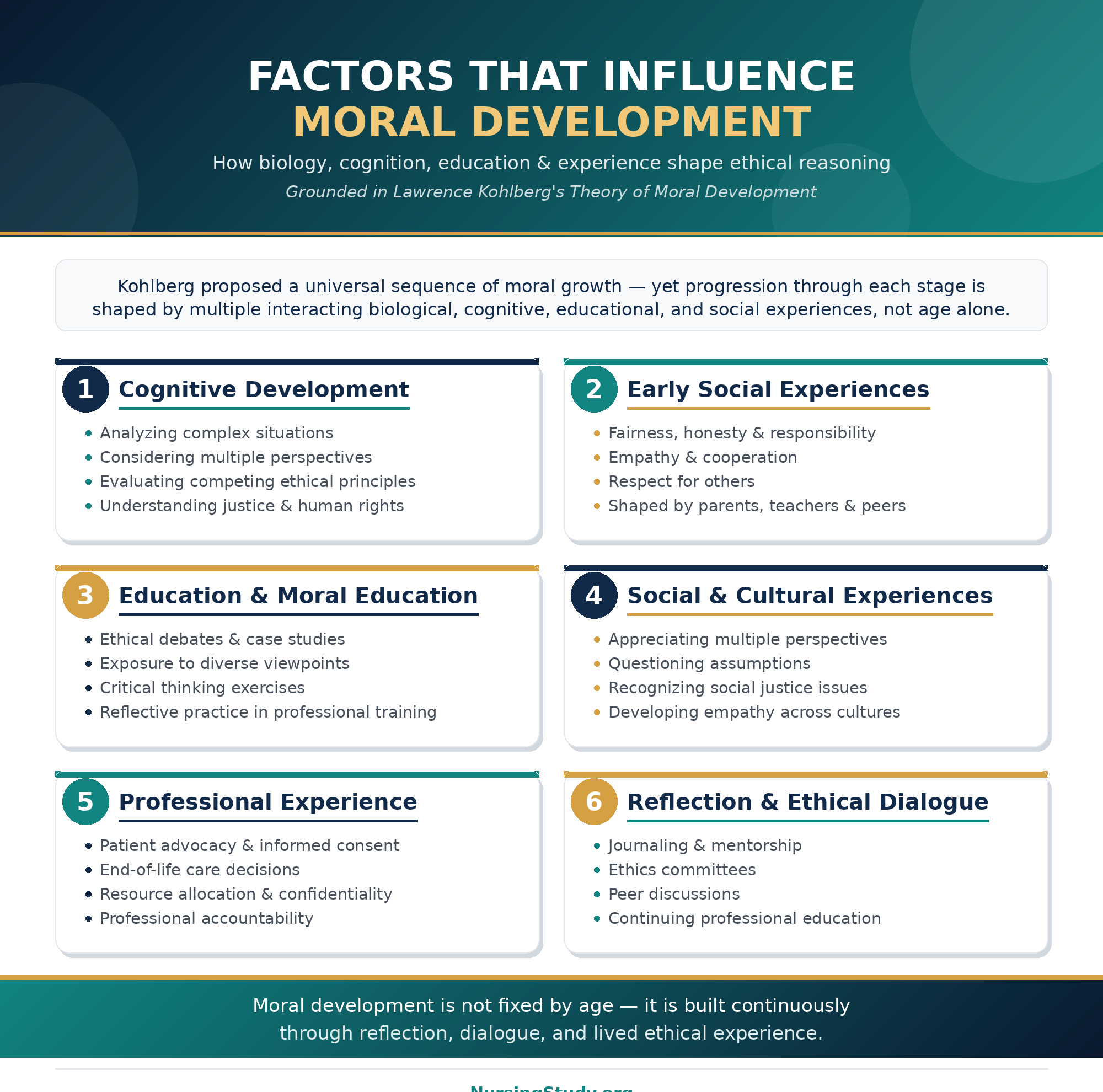
Major Criticisms of the Theory
Although the Lawrence Kohlberg Theory of Moral Development remains highly influential, several major criticisms have emerged over decades of research. These critiques have helped broaden the understanding of ethical development and encouraged more inclusive approaches to studying morality.
1. Overemphasis on Moral Reasoning Rather Than Moral Behavior
One of the most frequently discussed criticisms is that Kohlberg’s theory primarily evaluates moral reasoning instead of actual moral behavior.
According to the theory, an individual demonstrating sophisticated ethical reasoning is considered more morally developed than someone relying on simpler reasoning. However, critics argue that knowing what is ethically correct does not necessarily mean a person will act accordingly.
For example:
- A nurse may clearly explain why patient confidentiality is ethically important yet accidentally disclose confidential information due to stress or poor communication.
- A healthcare professional may understand the importance of patient advocacy but fail to speak up because of fear of retaliation or workplace hierarchy.
These examples illustrate that ethical behavior is influenced by factors beyond reasoning alone, including:
- emotions,
- workplace culture,
- organizational policies,
- personal courage,
- stress,
- fatigue,
- time constraints,
- interpersonal relationships.
Modern researchers therefore distinguish between moral reasoning, moral decision making, and actual moral action, recognizing that each represents a different aspect of ethical competence.
2. Limited Consideration of Emotions
The Lawrence Kohlberg Theory of Moral Development primarily emphasizes logical analysis when individuals respond to a moral dilemma. Critics argue that this approach underestimates the role of emotions in ethical decision-making.
Healthcare professionals frequently rely on:
- empathy,
- compassion,
- emotional intelligence,
- cultural sensitivity,
- therapeutic relationships.
For example, when caring for a grieving family following the death of a loved one, a nurse’s response is influenced not only by ethical principles but also by empathy and emotional understanding.
Modern moral psychology suggests that emotions and reasoning work together rather than functioning as separate processes.
3. Cultural Bias
Another significant criticism concerns the assumption that universalizing patterns of moral development apply equally across all societies.
Kohlberg proposed that individuals progress through the same sequence of development, eventually reaching higher stages of moral reasoning centered on universal ethical principles such as justice and individual rights.
However, researchers have found that different cultures may prioritize different values.
For example:
Individualistic cultures often emphasize:
- personal autonomy,
- individual rights,
- independence,
- justice.
Collectivist cultures may place greater emphasis on:
- family obligations,
- community welfare,
- harmony,
- social responsibility,
- respect for authority.
A healthcare professional practicing in one cultural context may therefore justify ethical decisions differently from someone practicing elsewhere, even when both demonstrate sophisticated ethical thinking.
This criticism suggests that cultural context influences reasoning and moral development more than Kohlberg originally proposed.
4. Gender Critique
One of the most influential criticisms came from psychologist Carol Gilligan, who argued that Kohlberg’s research emphasized justice-oriented reasoning while giving less attention to care, compassion, and interpersonal relationships.
Gilligan suggested that ethical thinking often involves questions such as:
- Who may be harmed?
- How can relationships be preserved?
- What responsibilities exist toward vulnerable individuals?
Rather than replacing Kohlberg’s work, Gilligan expanded the understanding of ethical reasoning by demonstrating that care-based reasoning is equally valuable in many situations.
This perspective has been especially influential in nursing, where compassionate relationships are central to professional practice.
5. Stage Progression May Be Less Rigid Than Originally Proposed
Kohlberg argued that individuals move through a fixed sequence of development and generally cannot skip stages.
Contemporary research suggests that ethical reasoning is often more flexible.
Individuals may reason differently depending on:
- the complexity of the situation,
- professional responsibilities,
- emotional involvement,
- personal experiences,
- cultural influences,
- organizational expectations.
For example, an experienced nurse may demonstrate advanced ethical reasoning when advocating for a patient’s rights but rely on institutional policies during emergency situations where rapid decisions are required.
This variability suggests that ethical reasoning is dynamic rather than permanently fixed within one moral stage.
6. Limited Attention to Situational Influences
The original Lawrence Kohlberg Theory of Moral Development focuses primarily on internal reasoning processes.
Modern researchers emphasize that ethical decisions are also shaped by external factors, including:
- organizational culture,
- leadership,
- healthcare policies,
- legal regulations,
- available resources,
- interdisciplinary collaboration.
These influences may significantly affect how healthcare professionals make ethical decisions in practice.
Contemporary Research and Revisions
Rather than rejecting the Lawrence Kohlberg Theory of Moral Development, contemporary scholars have expanded and refined many of its concepts. Advances in psychology, neuroscience, education, and healthcare ethics have produced a more comprehensive understanding of how ethical thinking develops throughout human development.
Integration of Emotion and Reasoning
One of the most important developments has been recognizing that ethical decisions involve both rational analysis and emotional understanding.
Current research suggests that effective moral reasoning is strengthened—not weakened—by qualities such as:
- empathy,
- compassion,
- emotional intelligence,
- perspective-taking,
- reflective practice.
This integrated perspective is especially relevant in nursing, where ethical care depends upon balancing evidence-based reasoning with compassionate patient-centered communication.
Expanded Understanding of Moral Development
Contemporary researchers recognize that the process of moral development continues throughout adulthood and may be influenced by:
- higher education,
- professional experience,
- mentorship,
- reflective learning,
- exposure to ethical challenges,
- continuing professional development.
Rather than viewing moral development as ending after adolescence, modern perspectives emphasize lifelong moral growth.
Advances in Moral Psychology
Recent developments in moral psychology have explored additional influences on ethical reasoning, including:
- neuroscience,
- cognitive science,
- social psychology,
- behavioral economics,
- organizational ethics.
Researchers now recognize that ethical decision-making results from interactions among:
- cognitive development,
- emotional processing,
- social learning,
- environmental influences,
- previous experiences.
This broader understanding complements rather than replaces Kohlberg’s theory.
Continued Research on Moral Reasoning
Since Kohlberg introduced his theory, numerous studies investigating moral reasoning have examined ethical thinking across:
- different cultures,
- healthcare professions,
- educational systems,
- age groups,
- religious traditions,
- leadership settings.
Although findings sometimes challenge aspects of the original model, they consistently support the importance of studying ethical reasoning as part of professional development.
New Educational Approaches
Modern moral education has moved beyond traditional lectures toward active learning strategies that encourage ethical reflection.
Common approaches include:
- ethics simulations,
- interdisciplinary case conferences,
- structured moral discussion,
- reflective journaling,
- patient case analysis,
- ethics committee participation.
These educational methods encourage learners to develop increasingly sophisticated moral reasoning while preparing them for real clinical practice.
Relevance of Lawrence Kohlberg’s Theory in Modern Nursing
Despite decades of debate and revision, the Lawrence Kohlberg Theory of Moral Development remains highly relevant to modern nursing because ethical decision-making is an integral component of professional practice. Every day, nurses face situations that require balancing competing ethical principles, advocating for patients, collaborating with interdisciplinary teams, and making complex moral decisions under conditions of uncertainty.
The theory continues to provide a valuable framework for understanding how nurses analyze ethical issues and justify their decisions.
Supporting Ethical Clinical Practice
Nurses regularly encounter situations involving:
- informed consent,
- patient confidentiality,
- end-of-life care,
- cultural diversity,
- allocation of limited healthcare resources,
- professional accountability.
The Lawrence Kohlberg Theory of Moral Development encourages nurses to examine not only what decision should be made but also why that decision is ethically justified.
Strengthening Reflective Practice
Reflection is an essential component of nursing professionalism.
Using Kohlberg’s stages of moral development, nurses can evaluate their own reasoning by asking questions such as:
- Which ethical principles guided my decision?
- Did I adequately consider the patient’s perspective?
- Was my reasoning influenced by institutional policies alone?
- Could another ethical approach have been justified?
This reflective process promotes continuous ethical improvement.
Enhancing Patient Advocacy
Patient advocacy remains one of nursing’s defining responsibilities.
Advanced moral reasoning enables nurses to:
- protect vulnerable patients,
- respect patient autonomy,
- challenge unsafe practices,
- promote equitable care,
- defend patients’ rights.
These responsibilities require thoughtful ethical analysis rather than simple compliance with authority.
Preparing Future Nurses
Nursing education increasingly recognizes that ethical competence develops through continuous learning and practical experience.
The Lawrence Kohlberg Theory of Moral Development supports educational strategies that include:
- ethics simulations,
- clinical debriefings,
- interdisciplinary learning,
- case-based discussions,
- reflective writing,
- mentorship.
These approaches encourage students and practicing nurses alike to strengthen their ethical judgment throughout their careers.
Overwhelmed with multiple nursing deadlines?
et us write your papers efficiently and accurately.
Conclusion
The Lawrence Kohlberg Theory of Moral Development remains one of the most influential frameworks for understanding how individuals develop ethical thinking and make increasingly sophisticated moral decisions throughout life. By outlining the stages of moral development, Lawrence Kohlberg demonstrated that morality is not simply a matter of knowing right from wrong but a developmental process shaped by cognitive development, experience, education, and reflection. His work shifted the focus of moral psychology from evaluating outward moral behavior to examining the quality of moral reasoning that underlies ethical choices.
For nursing professionals, the value of Kohlberg’s theory of moral development extends far beyond academic study. Every day, nurses encounter complex moral dilemmas involving patient autonomy, confidentiality, informed consent, end-of-life care, cultural diversity, and the fair allocation of healthcare resources. These situations rarely have simple answers, making the ability to analyze ethical issues thoughtfully and justify decisions using sound moral reasoning an essential professional competency. Understanding Lawrence Kohlberg’s stages of moral development equips nurses with a structured approach to navigating these challenges while promoting patient-centered, compassionate, and ethically responsible care.
Although the theory has been criticized for placing greater emphasis on reasoning than on emotion, relationships, or cultural influences, its enduring relevance lies in the foundation it provides for ethical reflection and professional growth. Contemporary perspectives have expanded Kohlberg’s ideas by integrating insights from neuroscience, ethics of care, cultural competence, and modern moral education, creating a more holistic understanding of how ethical decision-making develops. Rather than replacing the Lawrence Kohlberg Theory of Moral Development, these advancements strengthen its practical application by acknowledging that ethical practice is influenced by both rational analysis and human experience.
Ultimately, ethical competence is not achieved by memorizing professional codes or mastering a single theory. It develops through continuous learning, reflective practice, clinical experience, and meaningful engagement with real-world ethical challenges. By understanding the Lawrence Kohlberg Theory of Moral Development and applying its principles alongside other ethical frameworks, nurses can cultivate stronger critical thinking, exercise sound professional judgment, advocate more effectively for their patients, and contribute to a healthcare system grounded in integrity, justice, compassion, and respect for human dignity.
Frequently Asked Questions
What is Kohlberg’s theory of moral development?
Lawrence Kohlberg’s Theory of Moral Development is a psychological theory that explains how people’s moral reasoning develops over time. Kohlberg proposed that individuals progress through a series of stages, moving from decisions based on avoiding punishment and seeking rewards to reasoning guided by social rules, justice, and universal ethical principles. The theory emphasizes why people make moral decisions rather than the decisions themselves.
What are the 3 levels and 6 stages of Kohlberg’s theory?
Kohlberg organized moral development into three levels with six stages:
1. Preconventional Level
- Stage 1: Obedience and Punishment Orientation
- Stage 2: Individualism and Exchange (Self-Interest)
2. Conventional Level
- Stage 3: Good Interpersonal Relationships (Good Boy/Good Girl Orientation)
- Stage 4: Maintaining Social Order (Law and Order Orientation)
3. Postconventional Level
- Stage 5: Social Contract and Individual Rights
- Stage 6: Universal Ethical Principles
What are the 7 steps of moral development?
Strictly speaking, Kohlberg did not propose seven steps of moral development. His model includes six stages organized into three levels.
If you encounter references to “7 steps,” they are usually adaptations created by educators or ethical decision-making models rather than Kohlberg’s original theory. Kohlberg’s original framework ends with Stage 6: Universal Ethical Principles.
What is Stage 4 of Lawrence Kohlberg’s theory?
Stage 4, known as the Maintaining Social Order or Law and Order Orientation, belongs to the Conventional Level of moral development.
At this stage, individuals believe that laws, rules, and authority should be respected because they maintain social order and protect society. Moral decisions are based on fulfilling duties, following established rules, and contributing to the well-being of the community.
Example: A nurse follows medication administration protocols not only because they are hospital policy but because doing so ensures patient safety, maintains professional standards, and supports an effective healthcare system.
