

How to Write a Reaction Paper: Format, Examples, Thesis and Tips for Effective Reaction Paper Writing
In nursing education, reflection and critical thinking are fundamental to professional growth, and one of the most effective ways to develop these skills is through writing a reaction paper. A reaction paper allows nursing students to engage deeply with learning materials—whether it’s a research article, clinical scenario, documentary, or lecture—and articulate both understanding and personal insight. Rather than merely summarizing content, the paper challenges you to connect theory with experience, bridging classroom knowledge and clinical application.
Writing a reaction paper helps nursing students practice evidence-based reasoning and self-reflection—two competencies central to quality patient care. It encourages you to identify the main ideas presented in the material, evaluate their relevance to nursing practice, and express how they shape your professional perspective. In doing so, you demonstrate your ability to analyze complex information, form a thesis, and support your reaction with thoughtful examples and arguments.
Throughout this guide, you will learn how to write a reaction paper effectively—from understanding its purpose and structure to mastering the correct format and writing process. Each section provides a step-by-step approach to developing your paper, crafting a clear thesis statement, and supporting your points with academic reasoning. You’ll also explore sample reaction paper examples, tips for organizing your thoughts, and practical writing strategies that align with professional nursing standards.
By the end, you’ll have the knowledge and tools to create a strong, well-organized reaction paper that demonstrates not only your comprehension of the material but also your growth as a reflective and analytical nursing professional.
What is a Reaction Paper?
A reaction paper (sometimes called a response paper) is a short academic assignment that asks you to engage personally and critically with a piece of material — for example, a research article, clinical case study, lecture, documentary, or patient simulation. The task has two parts: (1) a concise summary of the material so your reader understands the context, and (2) your reaction — an analytical, evidence-based account of how the material affected you, what you think about its arguments or findings, and why. The emphasis is on interpretation and reasoning, not only on personal feelings; you must explain and support your responses, linking them to evidence, theory, or clinical experience.
Example: after reading a qualitative study on nurse-patient communication during handovers, a nursing student might briefly summarize the study’s goals and findings and then react by arguing that the study’s recommendations would improve patient safety on their ward — citing specific examples from clinical placements and comparing findings with hospital handover protocols.
How does a reaction paper differ from other types of essays?
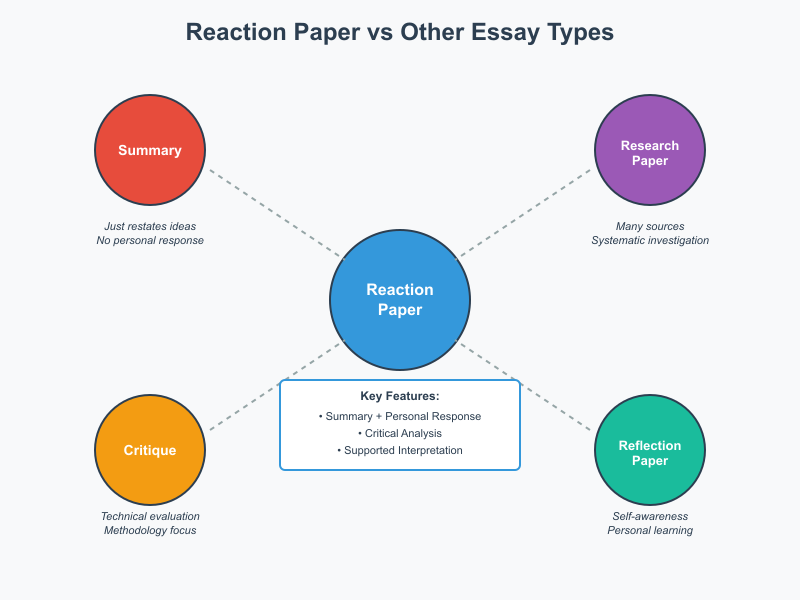
Reaction papers share features with several academic genres (summaries, critiques, reflection papers), but they are distinct in purpose and tone:
- Vs. summary: A summary restates the author’s ideas without personal judgement. A reaction paper includes a summary but extends it with analysis and a personal, supported response.
- Vs. research paper: Research papers report on systematic investigation and make evidence-based arguments supported by many external sources. Reaction papers are usually shorter, require less outside research, and focus on your interpretation of a single work or event.
- Vs. critique or article review: A critique often evaluates methodology and contribution to the field in technical detail; reaction papers can include evaluative comments but tend to foreground how the work affected you and its practical implications (especially useful in clinical education).
- Vs. reflection paper: Reflection papers emphasize learning and the development of self-awareness (what you learned and how you’ll change your practice). Reaction papers combine reflection with critical analysis of the material’s arguments or evidence; in nursing classes you may be asked for either format — check the prompt.
Example: A reflective journal entry after clinical practice might say how a student felt and what they learned. A reaction paper on the same clinical scenario would summarize any accompanying article or guideline, then critically analyze how that guidance aligns with the student’s experience and recommend practice implications.
Why is writing a reaction paper important?
For nursing students, reaction papers develop several essential skills:
- Critical thinking and clinical reasoning. By asking “why” you accept or reject an argument, reaction writing strengthens the analytic habits nurses need to interpret research, protocols, and patient data.
- Evidence-based linking of theory and practice. Reaction papers require you to relate academic material to clinical contexts — for example, testing whether research findings are applicable on your unit. This bridges classroom learning and bedside practice.
- Clear academic writing and argumentation. Crafting a thesis and supporting it with examples teaches organization and the disciplined use of evidence — skills nursing educators and employers value.
- Professional reflection with a purposeful voice. Unlike pure opinion pieces, reaction papers train you to justify personal responses with reasoned argumentation — an important competency in reflective practice and clinical audits.
Example: When you react to an article about pressure-injury prevention, you can show how the recommendations would or would not work in your local ward, cite barriers (staffing, equipment), and suggest pragmatic adaptations — demonstrating both critical thinking and clinical relevance.
What are the common elements of a reaction paper?
Most reaction papers include the following components (organized into a compact structure):
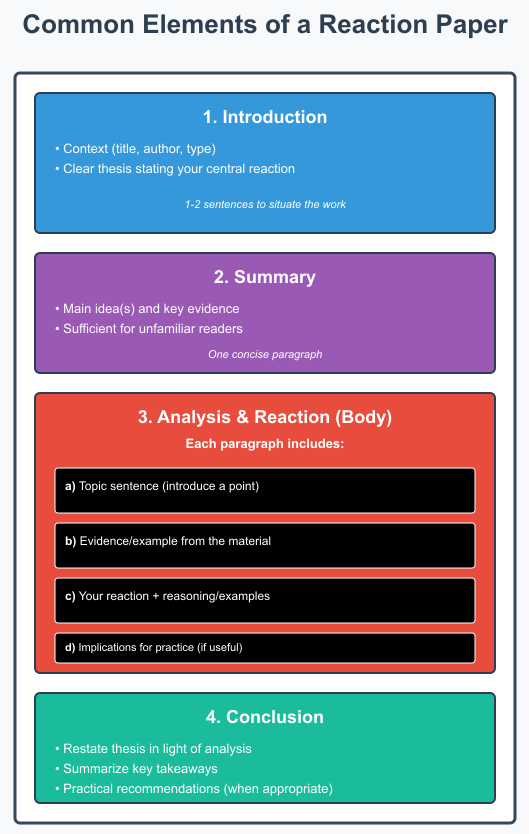
- Brief introduction with context and thesis. One or two sentences to situate the work (title, author, type of material) and a clear thesis that states your central reaction or claim.
Example thesis: “Although Smith’s handover checklist improves information transfer, it underestimates workload constraints on short-staffed medical wards and therefore requires workflow adjustments.” - Concise summary. A paragraph that captures the main idea(s) and key evidence of the original material — sufficient for readers unfamiliar with the work.
- Analysis and reaction (body paragraphs). Each paragraph should: (a) introduce a point (topic sentence), (b) provide evidence or example from the material, (c) give your reaction supported by reasoning, clinical examples, or literature, and (d) (if useful) suggest implications for practice or future study.
- Conclusion. Restate your thesis in light of the analysis, summarize key takeaways, and, when appropriate for nursing assignments, propose practical recommendations or questions for further reflection.
Formatting note: Length and citation requirements vary by instructor; typical reaction papers are 1–3 pages for weekly assignments, or longer when specified. Always check whether APA or MLA style is required for references and quotations.
What is the Proper Format for a Reaction Paper?
A reaction paper is typically a short academic essay, so it should look and read like an organized, formally formatted paper. Most instructors expect:
- A clear title and (when required) a title page with your name, course, instructor, and date. For APA, a student title page is standard; MLA usually places a short heading on page 1 instead.
- Double spacing, 1-inch margins, and a readable 12-point font (e.g., Times New Roman) unless otherwise specified.
- Consistent in-text citations and a reference list formatted in the required style (APA, MLA, Chicago). Even if your reaction is personal, you must credit ideas and quotations from the source you’re responding to.
Note: If your instructor asks for APA, include a student title page and list the clinical article you reacted to in the References. If they request MLA, omit the title page and follow MLA header rules.
What are the essential components of a reaction paper?
Most reaction papers include four essential parts. Treat each as purposeful and concise:
- Introduction (with context and thesis).
- Identify the work (title, author, type of material) and provide one or two sentences of context (purpose, audience, and main idea).End the introduction with a thesis statement that expresses your central reaction or claim — not just “I liked it,” but a debatable, focused assertion that the rest of the paper will support.
- Concise summary.
- One short paragraph that captures the main points or findings of the material so readers who haven’t read it can follow your response. Aim for brevity; the summary sets context for your analysis.
- Body (analysis + reaction).
- Usually 2–4 paragraphs. Each paragraph should begin with a topic sentence that states one main point of reaction, then: (a) reference or quote the original material, (b) analyze or evaluate that point, and (c) connect it to clinical practice, coursework, or theory with specific examples. Use scholarly support where helpful.
- Conclusion.
- Restate your thesis in light of the discussion, summarize the most important reactions, and — for nursing students — suggest practical implications, changes in practice, or questions for further study. Do not introduce new evidence here.
How should you structure your reaction paper?
A well-structured reaction paper follows a clear, logical order that allows the reader—often your clinical instructor—to easily follow your ideas and reasoning. The standard structure is:
Title (and title page if required) → Introduction with a clear thesis → Summary paragraph → Body paragraphs (each focusing on one reaction or analysis) → Conclusion → References.
Each part serves a distinct purpose. The introduction presents the topic and your thesis statement, outlining your main argument or reaction. The summary paragraph provides essential background information or a brief overview of the material you are responding to. The body paragraphs develop your analysis in detail, each beginning with a clear topic sentence that presents one main point. Use transitions and signposting phrases such as “in contrast,” “for example,” or “this finding suggests” to maintain flow and clarity.
Within the body, make sure each paragraph connects directly to your thesis and demonstrates critical thinking by explaining why you agree or disagree with the author’s main ideas. Use specific examples from nursing practice, research studies, or classroom materials to support your reaction. Finally, the conclusion should restate your thesis in a fresh way, summarize key points, and, where appropriate, discuss implications for nursing education or clinical practice.
Before you begin writing, it helps to create a brief outline—for example, a one-sentence thesis followed by three supporting points. Outlining your ideas keeps your writing focused, prevents unnecessary repetition, and ensures that your reaction paper remains concise and coherent from introduction to conclusion.
What formatting styles can be used for a reaction paper?
Choice of style depends on instructor or discipline. The three most common:
- APA (7th ed.) — Widely used in nursing and health sciences. Student papers often require a title page, page number top right, double spacing, and an APA-formatted References list. Use author-date in-text citations (Smith, 2020). Purdue OWL and the official APA site provide sample papers.
- MLA (9th ed.) — Common in humanities. No separate title page (unless requested); include an MLA header on page 1 and Works Cited. In-text citations use author-page format (Smith 23). Check your instructor’s preference.
- Chicago/Turabian — Less common for short reaction papers, used in some social sciences; includes notes/bibliography or author-date options.
Practical rule: Follow the style your instructor specifies. If none is given, default to APA for nursing assignments. Use official style guides or university writing-center resources for precise formatting details.
How to Analyze the Material for Your Reaction Paper?
Analyzing material for a reaction paper means moving beyond comprehension to evaluation — identifying the author’s main argument, assessing the evidence and assumptions, and deciding what the work means for your practice or learning. For nursing students this is especially important: analysis connects research or theory to bedside realities and shows your ability to translate evidence into care decisions. A disciplined approach — active reading, focused note-taking, and targeted questioning — makes the analysis manageable and keeps your reaction evidence-based rather than merely emotional.
What should you consider when reading the material?
When you read, treat the text as data to be interrogated. Key lenses to use:
- Purpose and thesis. What is the author trying to argue or demonstrate? Distill the main idea into one sentence. This becomes the anchor for your own thesis in the reaction paper.
- Audience and scope. Who is the intended reader (researchers, clinicians, policy makers, students)? Scope affects language, assumptions, and applicability to nursing settings.
- Methods and evidence quality (for research articles). What study design, sample, measures, and analysis were used? Weak methods limit how far you can generalize findings to your clinical context.
- Assumptions and bias. What does the author take for granted? Are there unstated value judgments or conflicts of interest? Consider where claims exceed the evidence.
- Relevance and implications for practice. Ask: Would this work change how care is delivered on my ward? What barriers (staffing, equipment, policy) might block implementation? This is where your clinical examples and recommendations will carry weight.
Nursing example: reading a study that claims a new skin-assessment tool reduces pressure injuries — check who used the tool (experienced wound nurses vs. novices), how often assessments occurred, and whether the clinical setting resembles your hospital before claiming it will work on your ward.
How can you take effective notes for your reaction paper?
Good notes turn reading into usable evidence for your paragraphs. Try this multi-layered approach:
- First pass — gist notes. Read once quickly and write one-sentence summary (title + main idea). This prevents over-quoting and keeps your reaction focused.
- Second pass — annotation and margin notes. Mark key passages, underline claims, and write short margins: “evidence weak — small sample” or “useful protocol idea for handover”. Use question marks where you’re unsure. Active annotation forces critical thinking.
- Third pass — organized notes (separate page or digital file). Convert annotations into structured notes:
- Citation header: full reference (author, year, title) so you never lose the source.
- Summary (2–3 lines).
- Key quotes / page numbers (copy short excerpts, <25 words if you’ll quote).
- Reaction bullets: your critiques, clinical examples, ideas for practice.
- Possible thesis angles: one-line statements you might use as your claim.
- Use a consistent method. Cornell notes, a simple 3-column sheet (quote / summary / reaction), or an annotated PDF combined with a Word document work well. If you use digital tools (reference managers, note apps), keep the source metadata with the notes.
Practical tip: record direct quotations with page numbers and surround them with your immediate comment. Later you’ll paraphrase most material and only use short quotes that you explain — this keeps the voice of the paper yours.
What questions should you ask yourself while analyzing?
Below is a compact checklist to run after your second or third read. These prompts will feed paragraph topic sentences and help you build a strong thesis and structured body:
- What is the author’s main argument or thesis? (Can you state it in one sentence?)
- What evidence supports the claim? (Strong, mixed, or weak?)
- What assumptions underlie the argument? (What is taken for granted?)
- Who benefits from or is harmed by the conclusions? (Consider patient groups, staff workload, resources.)
- How does this align or conflict with other sources or guidelines? (Compare to class readings, hospital policy, or recent reviews.)
- What surprised you or challenged your preconceptions? (This is a good hook for a paragraph.)
- What are the practical implications for your clinical setting? (Be specific: training, documentation change, pilot testing.)
- What would you change if you were the author? (Method improvement, broaden sample, address bias.)
- What further questions does the work raise? (Good for conclusion and suggestions for practice or research.)
Applied example: If analyzing an article proposing a 15-minute bedside handover to improve safety, you’d ask: Was the study carried out on units with similar patient acuity? Did the authors measure actual safety outcomes (falls, medication errors) or only perceived communication quality? What staffing levels were assumed? These answers shape whether you support or qualify the claim in your reaction paragraph.
How to Craft Your Reaction Paper?
Crafting a strong reaction paper means moving from notes and impressions to a tightly argued, evidence-based short essay. Think of the paper as three working parts that fit together: a focused introduction (with a clear thesis), a well-developed body (each paragraph doing one job), and a purposeful conclusion. Throughout, your aim is to explain your reaction — not only to state it — and to link it to nursing practice, policy, or theory where appropriate.
Below I break each part down, provide step-by-step writing advice, and give sample paragraphs you can adapt to clinical course assignments.
What should be included in the introduction?
The introduction does three things:
(1) orients the reader to the work you’re reacting to,
(2) signals the importance or context for nursing students, and
(3) closes with a single, specific thesis statement that tells the reader exactly what your overall reaction/argument will be.
Essential elements
- Identification and context — one sentence: title, author, type of material (article/lecture/video) and why it matters to nursing.
- Short summary hook — 1–2 sentences that state the author’s main idea or findings (don’t over-summarize).
- Thesis statement — one clear, arguable sentence that states your main reaction and frames the paper (this is the line the whole paper defends).
Practical tips
- Keep the introduction compact (about 3–6 sentences for a short reaction paper).
- Make the thesis debatable and specific (avoid vague lines like “I liked this”).
- For nursing assignments, orient the thesis toward practice (patient outcomes, workflow, ethics, education).
Sample introduction (nursing example)
In “Reducing Hospital-Acquired Pressure Injuries through Bedside Skin Checks” (Smith, 2024), the authors report that twice-daily skin assessments reduced pressure ulcer incidence on a 28-bed medical ward. While the study’s findings are promising, the implementation assumptions—adequate staffing and daily electronic charting—limit applicability in many clinical settings. I argue that, although routine skin checks improve detection, the intervention as described would be difficult to sustain on short-staffed units without modifications to workflow and documentation processes.
(That last sentence is the thesis: a claim you will support with analysis.)
How do you develop the body of your reaction paper?
The body is where you prove your thesis. Treat each paragraph as a mini-essay with a clear role: introduce one point, support it with evidence, analyze it, and link back to your thesis and nursing practice.
Paragraph structure (recommended)
- Topic sentence — states one claim that supports your thesis.
- Evidence from the text — short paraphrase or a brief quotation (with citation).
- Analysis / reaction — explain why the evidence matters, note strengths/weaknesses, and interpret.
- Clinical connection or example — apply the point to nursing practice or education (specific example, e.g., staffing levels, documentation systems, patient safety implications).
- Mini-conclusion/transition — link back to thesis and lead to the next paragraph.
Number of paragraphs: For a typical 1–3 page reaction paper, 2–4 body paragraphs is appropriate. For longer assignments, expand with subpoints and more evidence.
Analytical approaches to use
- Compare & contrast: how does this work line up with guidelines, other studies, or your clinical experience?
- Strengths & limitations: evaluate methods, sample, and scope (especially for research articles).
- Implications: what does this mean for bedside nursing, policy, or education? Be concrete.
Sample body paragraph (nursing example)
First, the authors’ use of twice-daily skin assessments likely improved early detection (Smith, 2024). However, the study was conducted on a ward with a nurse-to-patient ratio of 1:4 and dedicated wound-care time. In my clinical placement on a busy medical ward where ratios frequently reach 1:6 and electronic charting is delayed, adding two formal skin checks per patient may not be feasible without redistributing tasks or using aids (checklists, delegated support from nursing assistants). Thus, while the intervention has merit, its real-world effectiveness depends on workflow adjustments and staff training.
(Notice: evidence, critique, and practical implication are woven together.)
What should you include in the conclusion?
The conclusion ties everything together and gives the reader closure. It should not introduce new evidence.
Conclusion checklist
- Restate thesis in fresh wording to show how your analysis supported it.
- Summarize key points — 1–3 short sentences highlighting the most important reactions.
- Implications / recommendations — for nursing practice, education, or future research (one or two concrete suggestions).
- Closing thought — a sentence that leaves the reader with a clear take-away or question.
Sample conclusion (nursing example)
In sum, Smith’s twice-daily skin assessment protocol appears effective at increasing detection of early pressure injury, but its practical application is limited by staffing and documentation demands. To implement a similar protocol, units should pilot a modified checklist workflow, provide targeted training for nursing assistants, and evaluate outcomes using actual pressure-injury rates rather than perception surveys. By aligning evidence with realistic workflows, nursing teams can translate promising research into safer patient care.
What are Some Examples of Reaction Papers?
Reaction pieces take different shapes depending on the material you respond to and the assignment’s purpose. Common examples nursing students encounter include:
- Article response (scholarly article → clinical implication). Summarize a research article (e.g., a study on pressure-injury prevention) and react by assessing methods, results, and how the findings would—or would not—work in your clinical setting. (Typical nursing assignment.)
- Reflection on a clinical experience (reflection paper). Respond to a placement, simulation, or patient case by linking the experience to theory and practice—often using a reflective model (Gibbs, Schön) to structure the reaction. These examples emphasize learning and professional growth.
- Response to a lecture or multimedia (video/documentary). Briefly state the content, then critique arguments, evidence, or ethical issues; link to classroom concepts or patient care. Useful when instructors assign media to stimulate discussion.
- Comparative reaction (two or more texts). Evaluate how multiple items (e.g., two guidelines or two studies) agree or conflict, and identify which you find more persuasive for practice. This is closer to a mini-review plus reaction.
What makes a good reaction paper example?
When you read sample reaction papers, look for these hallmarks—the same features your instructor will grade:
- Clear, arguable thesis. Strong examples open with a precise thesis that frames the student’s reaction (not merely “I liked it”). The thesis should guide every body paragraph.
- Concise, accurate summary. A good sample gives just enough context so readers who haven’t seen the original material can follow the analysis; it doesn’t paraphrase the entire work.
- Analytical body paragraphs. Each paragraph contains a topic sentence, reference to the source (paraphrase or short quote), analysis that evaluates strengths/limitations, and a clinical example or implication. Look for explicit links to nursing practice.
- Evidence and citation. Even when the response is personal, the best papers cite the original work and any additional literature used to support claims (APA is common in nursing).
- Practical implications. Particularly in nursing, excellent samples point to real changes—education needs, workflow adaptations, or patient-safety measures—rather than ending with vague feelings.
- Polished writing and correct format. A clean structure, accurate grammar, and adherence to the required citation style (APA, MLA) reflect academic professionalism. Purdue OWL sample papers are a good benchmark.
Quick checklist when judging a sample: Is the thesis explicit? Does each paragraph advance the thesis? Are claims supported with evidence or concrete clinical examples? Is the paper correctly formatted?
How can you learn from sample reaction papers?
Treat samples as models—not templates to copy. Use them to reverse-engineer technique:
- Map the structure. Identify the intro (note how the thesis is phrased), the summary length, how many body paragraphs the student used, and how the conclusion restates the claim. Longwood and Purdue sample sets make this easy to scan.
- Note the balance of summary vs. analysis. Strong examples keep summary short and spend most words analyzing and applying the material—copy that ratio in your own work.
- Study topic sentences and transitions. Good samples use topic sentences that clearly link back to the thesis and use transitions (e.g., “However,” “For example,” “Consequently”) to maintain flow.
- Examine evidence use. Look at how samples paraphrase, when they quote, and how they cite—then emulate those habits (paraphrase mostly; quote sparingly; always cite). Purdue OWL’s sample papers show in-text citation patterns.
- Adapt clinical examples. If a sample uses a specific clinical scenario, note how it links the research claim to nursing practice; plan to insert your own placement examples in the same way.
Practice exercise: pick two strong sample papers, outline each (one-line thesis + three supporting points), then write a 300-word reaction to a short article using the same structure. This trains you to transfer observed patterns into your own writing.
Are there specific formats for different subjects or materials?
Yes—format and emphasis shift depending on discipline and the material type:
- Nursing / health sciences (recommendation: APA 7). Use APA formatting for citations and reference lists; emphasize implications for practice, patient outcomes, and evidence quality. Many nursing instructors expect an APA-style title page and reference list. Purdue OWL is the go-to resource for APA examples.
- Humanities (often MLA). For literature or film reaction essays, MLA may be preferred; these pieces often focus more on interpretation and theoretical frameworks.
- Reflection vs. critique differences. Reflection papers emphasize personal learning and use reflective models (Gibbs, Schon); reaction/response papers emphasize argument and evidence. If your prompt asks for reflection, structure your work around a reflective model; if it asks for reaction, foreground thesis and analysis.
- Media or multimedia responses. When reacting to a video or simulation, include timestamps or scene references as needed, and emphasize ethical or communication issues relevant to nursing.
- Multi-text responses. If asked to react to several sources at once, use comparative organization (group by theme or point of contention).
Rule of thumb: follow the instructor’s specified format; if none is given, default to APA for nursing assignments.
What are Expert Tips for Writing a Great Reaction Paper?
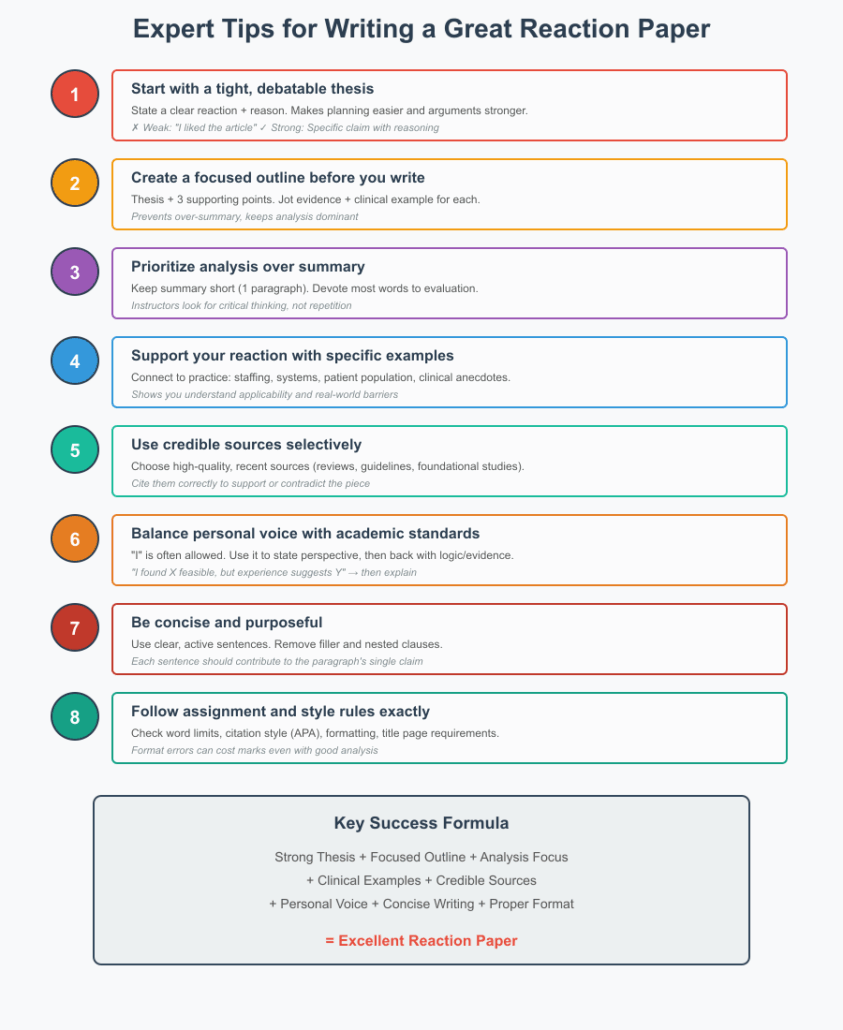
- Start with a tight, debatable thesis.
- Your thesis should state a clear reaction and a reason. Example weak thesis: “I liked the article.” Example strong thesis: “Although the study shows reduced pressure-injury rates after hourly repositioning, its exclusion of high-acuity patients limits generalizability to our ward.”
- A precise thesis makes paragraph planning easier and helps readers follow your argument.
- Create a focused outline before you write.
- Use a one-line thesis + three supporting points outline. For each planned body paragraph, jot one evidence item and one clinical example (or counterpoint). This prevents over-summary and keeps analysis dominant.
- Prioritize analysis over summary.
- Keep the summary short (one focused paragraph) and devote most words to evaluating claims, methods, and implications for nursing practice. Instructors look for critical thinking more than repetition.
- Support your reaction with specific examples.
- Always connect claims to practice: staffing, documentation systems, patient population, or a clinical placement anecdote. Concrete examples show you understand applicability, limitations, and real-world barriers.
- Use credible sources selectively.
- When you bring in external literature to support or contradict the piece you’re reacting to, choose high-quality, recent sources (systematic reviews, clinical guidelines, foundational studies). Cite them correctly.
- Balance the personal voice with academic standards.
- Many instructors allow “I” in reaction/reflective writing. Use it to state perspective, then immediately back it with logic or evidence: “I found the recommendation feasible in theory, but my placement experience suggests staffing barriers” → then explain.
- Be concise and purposeful.
- Prefer clear, active sentences. Remove filler, avoid long, nested clauses, and ensure each sentence contributes to the paragraph’s single claim.
- Follow assignment and style rules exactly.
- Check word limits, required citation style (e.g., APA), page formatting, and whether a title page is needed. Failure to follow simple format requirements can cost marks even if analysis is good.
How can you enhance your writing style?
- Use strong topic sentences.
- Start each paragraph with a sentence that links to the thesis and previews that paragraph’s argument. Example: “The study’s reliance on self-reported compliance reduces confidence in the reported effect size.”
- Prefer active voice and precise verbs.
- Active: “The authors report…” Passive: “It is reported by the authors that…” Active voice reads clearer and more authoritative.
- Vary sentence length for rhythm, but keep clarity first.
- Use short sentences for key claims and slightly longer sentences for explanation. Avoid long chains of clauses.
- Use transitions to show relationships.
- Phrases like “however,” “consequently,” “in contrast,” and “for example” help readers follow your logic.
- Edit in rounds—big to small.
- First revise structure and argument (does each paragraph support the thesis?). Next, polish sentences for clarity and style. Finally, proofread for grammar, punctuation, and formatting.
- Read aloud and get clarity checks.
- Reading sentences aloud reveals awkward phrasing and run-ons you may miss on screen.
What common mistakes should you avoid?
- Too much summary / too little analysis.
- Reaction papers should analyze. If over half your word count paraphrases the source, you’re likely missing the assignment point.
- Vague, unsupported opinions.
- Avoid “I felt” statements without evidence or explanation. Always justify opinions.
- Weak or missing thesis.
- A paper without a clear claim becomes a list of impressions.
- Over-quoting and poor paraphrase.
- Quote only when the author’s exact wording is crucial; otherwise paraphrase and cite. Over-quoting weakens your voice.
- Inaccurate or missing citations (plagiarism risk).
- Always cite direct quotes and paraphrased ideas. When in doubt, cite. Use short quotations (≤25 words for many instructors) and paraphrase most material in your own words.
- Ignoring audience and context.
- Tailor examples to nursing practice when writing for clinical instructors; avoid irrelevant digressions.
- Late-stage structural edits.
- Don’t wait until finishing a draft to rearrange paragraphs; outline first and check that flow early.
How can peer feedback improve your reaction paper?
Peer review is one of the fastest ways to strengthen argument, clarity, and rigor.
How to get useful peer feedback
- Provide a short rubric for reviewers: thesis clarity (yes/no + comment), logical flow (paragraph order makes sense?), evidence use (enough support?), formatting issues, and one sentence on how to improve.
- Ask specific questions: “Is my thesis clear?” “Does paragraph 2 adequately support my main claim?” “Are there places I seem to over-summarize?” Specific prompts yield actionable feedback.
How to give helpful peer feedback
- Use the sandwich method: one strength, one area to improve (with a suggestion), one closing strength.
- Be concrete: cite the paragraph and line number when you point out problems. Suggest alternatives: “Replace this vague sentence with a specific critique about methods (e.g., small sample size).”
How to use feedback effectively
- Prioritize consistent or repeated concerns from multiple reviewers.
- Implement changes with purpose. If you disagree with feedback, note why and consider a compromise.
- Use peer comments to refine the thesis and tighten paragraphs—often a fresh reader spots gaps you can fix quickly.
Peer review checklist (quick)
- Thesis clear and specific?
- Summary concise?
- Each paragraph has one main point and evidence?
- Transitions present?
- APA/MLA formatting correct?
- No obvious grammar or citation errors?
Conclusion
Mastering how to write a reaction paper is an essential skill for nursing students, helping them connect theoretical learning with real-world experiences in patient care and clinical ethics. A reaction paper—also called a response paper or reflection paper—goes beyond mere summary; it reflects personal insight, critical reasoning, and a well-organized interpretation of the material. Whether analyzing a research article, a clinical case, or a documentary on patient advocacy, students use this form of paper writing to demonstrate understanding and professional reflection.
A well-developed reaction essay follows a clear academic format, beginning with an introduction that presents a focused thesis statement, followed by a body that supports it through analysis and evidence, and a conclusion that ties key insights together. Applying these tips on how to write helps students organize thoughts logically and maintain clarity throughout their paper. For instance, when evaluating a film on healthcare leadership, a nursing student might craft a thesis connecting leadership principles to ethical decision-making, supporting it with observations and scholarly references.
Unlike an argumentative essay, which aims to persuade, or an analysis essay, which dissects ideas objectively, a reaction paper integrates personal perspective with academic reflection. This unique blend makes it an invaluable learning tool in nursing education, fostering deeper understanding of professional standards and emotional intelligence.
Ultimately, the ability to write a reaction paper with structure, purpose, and reflection enhances both academic performance and clinical judgment. Through consistent practice, careful organization, and thoughtful engagement with course materials, nursing students can transform each reaction essay into a meaningful exploration of learning and growth—strengthening their analytical mindset and communication skills for future professional practice.
Frequently Asked Questions
How do you start writing a reaction paper?
To start writing a reaction paper, begin by carefully reading or viewing the assigned material and identifying its main idea. Then, draft a short introduction that includes the title of the work, its author or source, and your thesis statement—the central point of your personal reaction. For example, you might start with a sentence like, “After reading the article on patient-centered care, I realized how empathy directly influences clinical decision-making.” This sets the tone for the rest of your reaction essay.
What is an example of a reaction paper?
An example of a reaction paper could be a response paper analyzing a nursing ethics documentary. For instance, after watching The Power of Empathy in Healthcare, a student might discuss how the film reinforced the importance of emotional intelligence in nursing practice. The paper would combine a brief summary of the work, a personal reflection, and evidence-based analysis supported by scholarly sources.
What are the best words to start a reaction paper?
Effective reaction paper writing often begins with transition phrases that show reflection and understanding. Examples include: “After reading…”, “I believe that…”, “This article made me realize…”, or “From my perspective as a nursing student…”. These expressions clearly signal your personal opinion and analytical engagement from the start.
How to get an A+ on an essay?
To earn an A+ on an essay or academic paper, follow a structured writing process: plan with an outline, write a clear thesis, support your points with specific examples, and use correct APA format. Demonstrating critical thinking, organizing your ideas logically, and proofreading for clarity and grammar are essential tips on how to write a strong and polished reaction paper that meets academic expectations.
