

Concept Map in Nursing: A Complete Guide for Nurses and Nursing Students, with Templates and Examples
Concept mapping in nursing is an important approach to organizing clinical knowledge, interpreting patient information, and understanding the relationships between different aspects of health and illness. It provides nurses with a structured visual method of bringing together patient assessment findings, medical conditions, nursing diagnoses, and appropriate nursing interventions. Rather than treating clinical information as isolated facts, a concept map illustrates how different factors influence one another and contribute to a patient’s overall health status. This allows nurses to examine the connections between a patient’s signs and symptoms, underlying disease processes, risk factors, and care needs. By presenting complex information in an organized format, concept mapping supports critical thinking, clinical reasoning, and informed decision-making in different clinical settings.
A concept map is a visual representation of information in which a central concept is connected to related ideas using branches, lines, arrows, and linking phrases. In nursing, the central concept is often a patient’s primary health condition or an identified nursing problem. Related information branches outward to show important details, including:
- Patient information: Relevant medical history, current health condition, risk factors, and other background information.
- Assessment findings: Subjective and objective data, vital signs, clinical manifestations, and other significant patient assessment findings.
- Nursing diagnoses: Actual or potential patient problems identified through the analysis of collected information.
- Goals and expected outcomes: Measurable results that nursing interventions are intended to achieve.
- Nursing interventions: Evidence-based actions designed to address identified patient problems and improve health outcomes.
- Rationales and evaluation: Explanations supporting nursing actions and criteria for determining whether the desired outcomes have been achieved.
The connections between these elements are particularly important because they demonstrate the reasoning behind nursing decisions. For example, when caring for a patient with heart failure, a nurse may connect impaired cardiac function to reduced cardiac output, fluid retention, peripheral edema, and shortness of breath. These findings can then be linked to appropriate nursing diagnoses, such as excess fluid volume or decreased cardiac output, depending on the patient’s assessment data. The nurse can further connect each diagnosis to specific goals, nursing interventions, and evaluation measures. This creates a visual representation of the patient’s condition and the relationships that guide the care plan.
Concept mapping also plays an important role in nursing education by helping learners integrate knowledge from different areas of healthcare. Subjects such as anatomy, physiology, pharmacology, pathophysiology, and medical-surgical nursing are closely related, but their connections may not always be obvious when studied separately. A nursing concept map brings these areas together, allowing the learner to understand how changes in body systems contribute to disease processes, how those changes produce clinical manifestations, and how nursing interventions address the resulting patient needs. Research has also examined the educational value of concept mapping, particularly its contribution to knowledge organization, critical thinking skills, and academic performance in nursing education.
In nursing practice, concept maps can support the assessment and management of patients with complex or multiple health conditions. They help organize large amounts of patient data, distinguish significant clinical cues from less relevant information, and establish relationships between priority problems. This is particularly useful when a patient has several diagnoses, takes multiple medications, or requires interventions involving different body systems. For instance, a patient with diabetes and heart failure may have overlapping concerns involving fluid balance, blood glucose regulation, medication management, nutritional needs, and cardiovascular function. A concept map can bring these concerns together, helping the nurse recognize how they interact and identify areas requiring coordinated care.
Developing an effective Concept Map in Nursing requires more than arranging information in boxes or connecting ideas with arrows. It involves a systematic thought process that combines patient assessment, clinical knowledge, prioritization, and evidence-based decision-making. Nurses must determine which information is relevant, identify relationships between clinical findings, formulate appropriate nursing diagnoses, and connect these diagnoses to realistic outcomes and interventions. The organization of the map should also be clear enough to communicate the patient’s condition and the rationale behind the planned nursing care.
The use of concept maps extends beyond individual patient assignments. They can support case study analysis, clinical rotations, nursing care planning, patient education, and communication among healthcare professionals. Whether developed using a handwritten format or digital tools, a well-structured map provides a practical way to organize clinical information and demonstrate the relationships that influence patient care. Understanding the principles, components, construction process, and applications of concept mapping provides a foundation for using these visual tools effectively in nursing education and clinical practice.
Understanding Concept Mapping in Nursing
Concept mapping is an approach to organizing, connecting, and interpreting information that has important applications in nursing education and clinical practice. Nurses routinely work with large amounts of information, including patient histories, assessment findings, medical diagnoses, laboratory results, medications, risk factors, and treatment plans. These details are often interconnected, meaning that understanding one aspect of a patient’s condition may require examining several other factors. However, when information is presented only through written notes, lists, or separate sections of a care plan, the relationships between different clinical findings may not always be easy to recognize. Concept mapping provides a visual way of bringing this information together, allowing nurses to examine the broader picture of a patient’s health and understand how different problems influence one another.
In nursing, a concept map organizes clinical information around a central topic, such as a patient’s primary medical condition, an identified nursing diagnosis, or a particular health problem. Related concepts are arranged around this central topic and connected through lines, arrows, and linking phrases that explain their relationships. For example, a map developed for a patient with pneumonia may connect the underlying infection to inflammation of the lung tissue, impaired gas exchange, reduced oxygen saturation, shortness of breath, and other clinical manifestations. These findings can then be connected to relevant nursing diagnoses, patient goals, and nursing interventions.
This approach is useful because it encourages nurses to move beyond simply identifying individual patient problems. They must also consider why those problems occur, how they affect other aspects of health, and which nursing actions are appropriate. Concept mapping therefore provides a framework for organizing clinical knowledge while supporting critical thinking, clinical reasoning, and a more comprehensive understanding of patient care.
Definition and Purpose of a Nursing Concept Map
A nursing concept map is a visual diagram that organizes information about a patient, health condition, disease process, or nursing topic by illustrating the relationships between relevant concepts. It uses interconnected nodes, boxes, circles, lines, arrows, and linking phrases to represent information in a structured and meaningful way. Unlike a simple list of clinical findings, a concept map demonstrates how different pieces of information relate to one another, helping nurses understand the connections between patient conditions, contributing factors, clinical manifestations, nursing diagnoses, and appropriate interventions.
The concept mapping approach is based on the idea that knowledge becomes more meaningful when individual concepts are connected rather than learned or interpreted in isolation. This principle is associated with meaningful learning theory, particularly the work of educational psychologist David Ausubel and the subsequent development of concept mapping by Joseph Novak and his colleagues. According to this approach, learners develop a deeper understanding when they connect new information to knowledge they already possess. In nursing, this is particularly relevant because clinical practice requires the integration of knowledge from multiple disciplines to understand a patient’s condition and determine appropriate care.
A concept map is therefore more than a diagram containing related words. It is a structured representation of knowledge that explains relationships between concepts through meaningful statements, also called propositions. A proposition typically consists of two or more concepts connected by a linking phrase. For example:
- Pneumonia → causes → inflammation of lung tissue.
- Inflammation of lung tissue → interferes with → gas exchange.
- Impaired gas exchange → may result in → reduced oxygen saturation.
- Reduced oxygen saturation → requires → appropriate nursing assessment and intervention.
These connections help demonstrate how a disease process can produce specific clinical manifestations and create nursing care needs. The nurse can use this information to understand the patient’s condition, recognize relevant problems, and determine which interventions require attention.
In nursing, a concept map serves several important purposes:
1. Organizing complex patient information: Nurses frequently collect information from different sources, including patient interviews, physical examinations, medical records, laboratory investigations, and diagnostic procedures. A concept map brings relevant findings together in one organized visual representation. This makes it easier to examine the patient’s overall condition rather than concentrating on isolated pieces of information.
2. Identifying relationships between clinical findings: A patient may present with several signs and symptoms that appear unrelated when considered separately but are connected through an underlying disease process. Concept mapping helps illustrate these relationships. For example, a patient with heart failure may experience reduced cardiac output, fluid retention, peripheral edema, and shortness of breath. Connecting these findings helps the nurse understand how impaired cardiac function contributes to the patient’s clinical presentation.
3. Supporting nursing diagnoses: Developing appropriate nursing diagnoses requires nurses to interpret assessment findings and identify actual or potential responses to health conditions. A concept map helps organize the supporting evidence, distinguish related patient problems, and demonstrate how different findings contribute to an identified diagnosis. This can make the reasoning behind nursing decisions more transparent.
4. Guiding nursing interventions: Once patient problems have been identified, the map can connect each nursing diagnosis to appropriate interventions and expected outcomes. For instance, a patient experiencing excess fluid volume may require monitoring of intake and output, daily weight assessment, evaluation of edema, and administration of prescribed medications. The connections show how these actions address the identified patient problem.
5. Supporting clinical reasoning and decision-making: Concept mapping encourages nurses to analyze information, identify patterns, recognize priorities, and evaluate possible relationships between patient problems. Rather than simply recording what they observe, nurses must consider the significance of each finding and how it influences clinical decisions.
6. Promoting meaningful learning: In nursing education, concept maps help integrate theoretical knowledge with clinical situations. A nursing student studying diabetes, for example, can connect insulin deficiency or resistance with impaired glucose regulation, clinical manifestations, potential complications, medication management, and patient education. This makes it easier to understand the disease as an interconnected process rather than memorizing individual facts.
A practical example illustrates how this works in patient care. Consider a patient admitted with heart failure who presents with shortness of breath, bilateral lower-extremity edema, fatigue, and an increased body weight. Instead of recording each finding separately, the nurse can organize the information around heart failure and establish connections between impaired cardiac function, reduced circulation, fluid accumulation, and the patient’s symptoms.
The map may include the following relationships:
- Central condition: Heart failure.
- Underlying problem: Impaired cardiac pumping function.
- Clinical manifestations: Shortness of breath, peripheral edema, fatigue, and weight gain.
- Potential nursing diagnoses: Excess fluid volume and decreased activity tolerance, when supported by assessment findings.
- Nursing interventions: Monitor vital signs, assess respiratory status, measure fluid intake and output, monitor daily weight, and administer prescribed treatment.
- Expected outcomes: Improved respiratory comfort, reduced fluid accumulation, and better tolerance of appropriate activity.
This arrangement allows the nurse to see how the patient’s symptoms, underlying condition, and nursing care are related. It also provides a clearer foundation for identifying priority problems and evaluating whether the interventions are producing the desired results.
It is important to recognize that a nursing concept map does not independently establish a medical diagnosis or determine treatment. The information represented must be based on accurate patient assessment, current clinical evidence, professional judgment, and applicable healthcare protocols. The map supports the nurse’s reasoning process but does not replace clinical assessment, consultation, or established standards of care.
Structure and Organization of Nursing Concepts
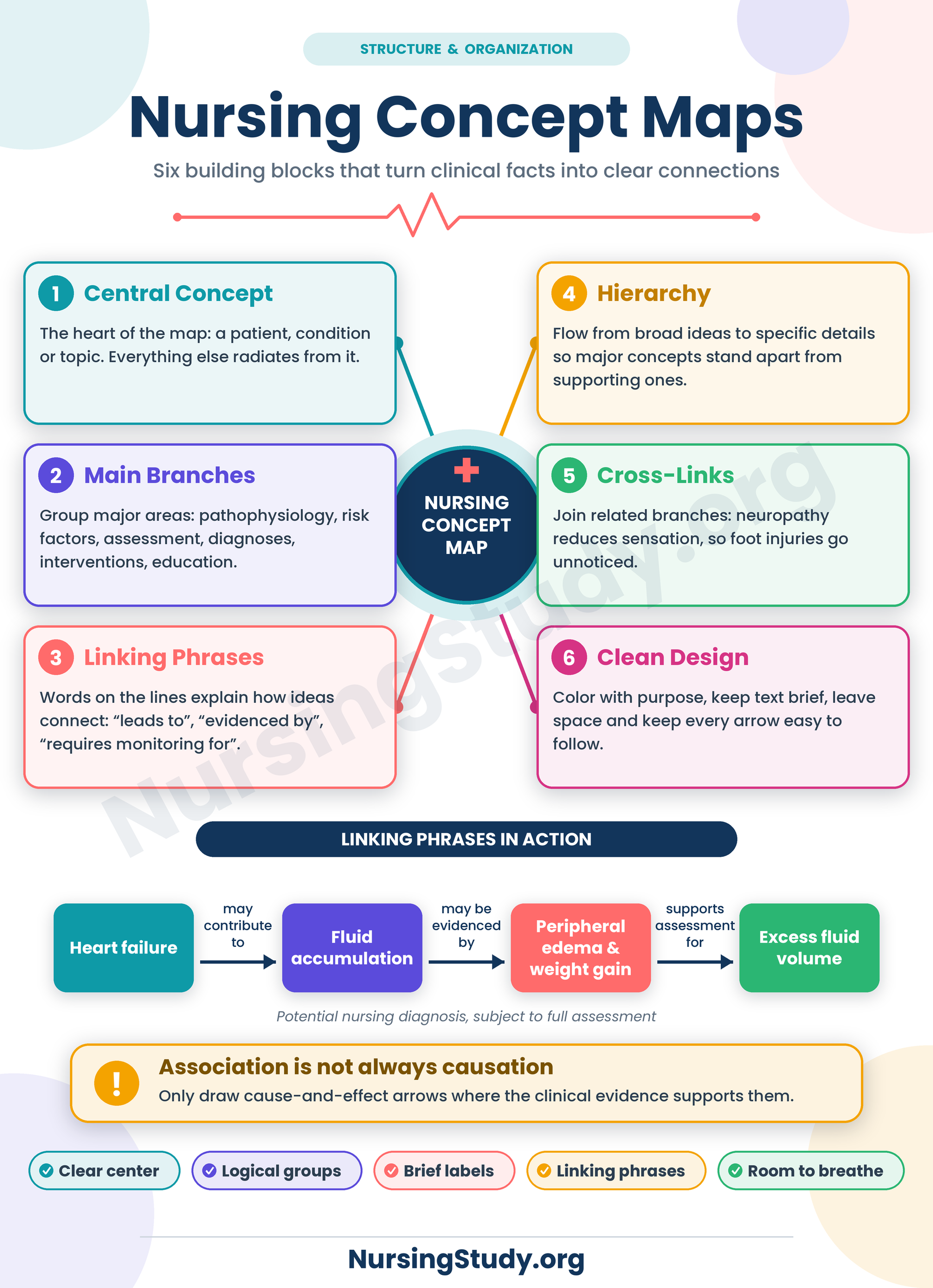
The structure of a concept map determines how information is arranged and how relationships between different ideas are communicated. Although the exact format may vary depending on the purpose of the exercise, most concept maps follow a visual organization in which a central concept is connected to broader categories and more specific details. In nursing, this structure commonly revolves around a patient, medical condition, nursing diagnosis, or clinical topic.
A well-organized map should make it possible to follow the connections between concepts without having to interpret unrelated information or read lengthy explanations. The nurse should be able to identify the central problem, understand the factors associated with it, and recognize how the information supports nursing decisions.
1. The central concept or topic
The central concept is the main subject around which the entire map is developed. It provides a starting point for organizing related information and determines which concepts should be included.
In patient-centered mapping, the central concept is often the patient’s primary medical condition or most significant health problem. For an educational assignment, it may be a particular disease, body system, medication, or nursing concept.
For example, when creating a map for a patient with diabetes mellitus, diabetes can be placed at the center. Related concepts may include:
- Insulin production and function.
- Blood glucose regulation.
- Risk factors and contributing conditions.
- Signs and symptoms of hyperglycemia.
- Potential complications.
- Nursing diagnoses.
- Treatment and nursing interventions.
- Patient education and self-management.
All these concepts relate to the central topic and contribute to a broader understanding of the condition.
2. Main branches and related categories
The main branches extend from the central concept and divide the subject into major areas of information. They help prevent the map from becoming a collection of disconnected facts by grouping related concepts together.
For a patient with pneumonia, the main branches might include:
- Pathophysiology: Infection, inflammation, and changes in lung function.
- Risk factors: Advanced age, smoking, chronic respiratory conditions, and impaired immunity.
- Assessment findings: Fever, cough, sputum production, abnormal breath sounds, and oxygen saturation.
- Nursing diagnoses: Problems identified from the patient’s actual assessment data.
- Nursing interventions: Respiratory assessment, positioning, prescribed oxygen therapy, medication administration, and monitoring.
- Patient education: Medication adherence, hydration where appropriate, respiratory hygiene, and recognition of warning signs.
Each branch can be expanded further to include more specific details. For example, the assessment branch may divide into subjective data, such as reported chest discomfort and difficulty breathing, and objective data, such as elevated temperature, increased respiratory rate, and reduced oxygen saturation.
This arrangement makes complex patient information easier to interpret because related findings are grouped together while their connections to the central condition remain visible.
3. Connecting lines, arrows, and linking phrases
Lines and arrows are used to connect related concepts and indicate the direction or nature of their relationships. However, simply drawing a line between two boxes is not enough to communicate meaningful clinical information. Linking phrases should explain how one concept relates to another.
Common linking phrases used in nursing concept maps include:
- Causes.
- Contributes to.
- Results in.
- Leads to.
- Is associated with.
- Is characterized by.
- Increases the risk of.
- Requires monitoring for.
- Is managed through.
- Is evidenced by.
For example:
Heart failure
Central clinical condition
May contribute to
Fluid accumulation
May be evidenced by
Peripheral edema
Weight gain
Supports assessment for
Excess fluid volume
Potential nursing diagnosis, subject to full assessment
Guides
Appropriate nursing interventions
Fluid monitoring, daily weights, assessment, and prescribed treatment
Illustrative example of how linking phrases establish relationships between clinical concepts.
The use of appropriate linking phrases is particularly important when connecting assessment findings to nursing diagnoses. For example, the phrase “as evidenced by” can connect a supported nursing diagnosis to its defining characteristics. Similarly, “contributes to” can explain how an underlying condition influences a particular patient problem.
Arrows may also indicate the direction of a relationship, such as how a disease process produces a clinical manifestation or how an intervention is intended to influence a patient outcome. However, nurses should avoid presenting every relationship as a direct cause-and-effect connection when the clinical evidence only supports an association.
4. Hierarchical arrangement of information
Many concept maps use a hierarchical structure in which broad concepts appear near the top or center, while more specific information branches outward. This makes it possible to move from general information to detailed clinical explanations.
For example, a map about respiratory disease might begin with a general topic such as impaired respiratory function. Its main branches could include ventilation, oxygenation, respiratory assessment, and interventions. Each branch can then contain more specific concepts, such as respiratory rate, oxygen saturation, breath sounds, oxygen therapy, and positioning.
This arrangement helps nurses distinguish major clinical concepts from supporting details. It also makes the map easier to follow because information is organized according to its relevance and relationship to the central topic.
However, concept maps do not always need to follow a strict top-to-bottom arrangement. Some clinical conditions involve several interconnected problems that cannot be adequately represented through a single hierarchy. In such cases, a more flexible arrangement allows branches to connect with one another.
5. Cross-links between related concepts
Cross-links are connections between concepts located in different branches of a map. They are particularly useful in nursing because patient problems frequently affect multiple body systems and may require several coordinated interventions.
For example, a patient with diabetes may have impaired wound healing, peripheral neuropathy, and an increased risk of infection. These problems may be presented under separate branches, but they are also interconnected.
A cross-link can demonstrate how peripheral neuropathy contributes to reduced sensation, which may delay recognition of foot injuries. Another connection can show how persistent hyperglycemia may interfere with wound healing and increase infection risk.
These relationships are important because they help nurses recognize that patient problems rarely exist independently. A patient may have several health concerns that influence one another, requiring an integrated approach to assessment and nursing care.
6. Visual organization and presentation
The visual appearance of a concept map also influences how easily information can be interpreted. Different shapes, colors, font sizes, and spacing can be used to distinguish categories and highlight important relationships. For example, a nurse may use different colors to identify assessment findings, nursing diagnoses, interventions, and expected outcomes.
However, visual elements should serve an organizational purpose rather than simply decorate the map. Excessive colors, overlapping arrows, lengthy descriptions, and too many branches can make the information difficult to follow.
An effective map should therefore:
- Use a clear central topic.
- Arrange related concepts in logical groups.
- Keep descriptions brief while preserving important clinical meaning.
- Use linking phrases to explain relationships.
- Distinguish major concepts from supporting details.
- Maintain sufficient spacing between branches.
- Ensure that arrows and connecting lines are easy to follow.
The structure should also reflect the purpose of the exercise. A map developed to explain the pathophysiology of a disease may emphasize body systems, disease mechanisms, and clinical manifestations. In contrast, a patient-centered map may place greater emphasis on assessment findings, nursing diagnoses, interventions, and expected outcomes.
A well-structured nursing concept map therefore combines accurate clinical information with meaningful visual relationships. It should provide enough detail to demonstrate clinical understanding without becoming so crowded that the connections between concepts are lost.
Concept Maps vs. Nursing Care Plans and Mind Maps
Concept maps, nursing care plans, and mind maps are all organizational tools that can help nurses arrange information and explore relationships between ideas. However, they differ in their structure, primary purpose, and the type of information they emphasize. Understanding these differences is important because the tools are sometimes used interchangeably, even though they serve distinct functions in nursing education and clinical practice.
A concept map focuses on illustrating relationships between interconnected concepts. A nursing care plan provides a structured framework for identifying patient problems, establishing expected outcomes, selecting nursing interventions, and evaluating the results of care. A mind map, on the other hand, is generally used to brainstorm and organize ideas around a central topic through a branching visual structure.
1. Concept maps vs. nursing care plans
A nursing care plan is a structured document that guides the delivery of individualized nursing care. It is developed using information gathered during patient assessment and follows the nursing process: assessment, diagnosis, planning, implementation, and evaluation.
The care plan typically identifies the patient’s nursing diagnoses, establishes measurable goals, outlines appropriate interventions, and provides criteria for evaluating progress. It helps ensure that nursing actions are organized, purposeful, and directed toward identified patient needs.
A concept map presents much of this information visually, but its primary emphasis is on showing how different concepts and patient problems are connected. Rather than simply listing a diagnosis followed by interventions, it illustrates the relationships between the patient’s condition, contributing factors, assessment findings, nursing diagnoses, and expected outcomes.
Consider a patient admitted with pneumonia.
A conventional nursing care plan may organize the information as follows:
| Care plan element | Example |
|---|---|
| Nursing diagnosis | Impaired gas exchange, when supported by assessment findings |
| Supporting evidence | Reduced oxygen saturation, dyspnea, and abnormal respiratory findings |
| Expected outcome | Patient demonstrates improved oxygenation within the established care period |
| Nursing interventions | Monitor oxygen saturation, assess respiratory status, position appropriately, and administer prescribed oxygen therapy |
| Evaluation | Reassess respiratory findings and compare them with the expected outcomes |
A concept map would represent the same information differently. It would connect pneumonia to lung inflammation, impaired alveolar gas exchange, respiratory manifestations, the relevant nursing diagnosis, and interventions intended to address the problem.
The distinction is that the care plan emphasizes the organized delivery and evaluation of nursing actions, while the concept map emphasizes the relationships between clinical information and nursing decisions.
| Feature | Nursing concept map | Nursing care plan |
|---|---|---|
| Main purpose | Organizes and illustrates relationships between concepts | Guides individualized nursing care |
| Structure | Visual and interconnected | Usually structured and sequential |
| Main focus | Clinical relationships and reasoning | Diagnoses, goals, interventions, and evaluation |
| Information presentation | Boxes, branches, arrows, and linking phrases | Written sections, tables, or electronic documentation |
| Flexibility | Can show multiple interconnected problems | Follows an organized care-planning framework |
| Main application | Understanding complex information and supporting clinical reasoning | Planning, implementing, and evaluating patient care |
The two approaches can complement each other. A nurse may first develop a concept map to understand how a patient’s health problems are related and then use that understanding to formulate a comprehensive care plan. This is particularly helpful when caring for patients with multiple diagnoses or complex needs.
2. Concept maps vs. mind maps
A mind map is a visual brainstorming tool used to organize ideas around a central topic. It typically begins with one main idea positioned in the center of a page, with related ideas extending outward through branches. These branches may divide into smaller categories, creating a structure that resembles a web.
For example, a mind map about diabetes may have diabetes mellitus as its central topic, with branches covering:
- Types of diabetes.
- Causes and risk factors.
- Signs and symptoms.
- Diagnosis.
- Treatment options.
- Complications.
- Prevention and lifestyle management.
This format is useful for brainstorming, summarizing information, planning assignments, and reviewing broad subject areas. It allows a nurse or nursing student to identify different aspects of a topic without necessarily explaining the precise relationships between every concept.
A concept map is more analytical. Although it may also use a central topic and branching structure, it places greater emphasis on the relationships between concepts. Linking phrases are used to explain how one idea connects to another, allowing the reader to interpret the meaning of each connection.
For instance, a mind map about diabetes may simply list hyperglycemia, insulin resistance, neuropathy, and impaired wound healing as related branches. A concept map would explain the connections between these ideas, such as how insulin resistance contributes to elevated blood glucose and how persistent hyperglycemia can contribute to complications affecting peripheral nerves and wound healing.
The main differences can be summarized as follows:
| Feature | Concept map | Mind map |
|---|---|---|
| Primary purpose | Explains relationships between concepts | Organizes and explores related ideas |
| Structure | Hierarchical or interconnected | Usually radial or branching |
| Connections | Uses linking phrases to explain relationships | Often uses simple branches and associations |
| Organization | Focuses on meaningful relationships and propositions | Focuses on brainstorming and categorization |
| Detail | Can represent complex clinical relationships | Usually presents broader ideas and supporting details |
| Nursing application | Patient analysis, clinical reasoning, and care planning | Topic revision, brainstorming, and summarizing |
3. Choosing the appropriate tool in nursing
The choice between a concept map, care plan, and mind map depends on the information being organized and the intended outcome.
- Use a concept map when the goal is to understand how patient conditions, assessment findings, nursing diagnoses, and interventions are interconnected. It is particularly useful for complex clinical scenarios involving several related problems.
- Use a nursing care plan when the goal is to document patient needs, establish measurable outcomes, guide nursing interventions, and evaluate the effectiveness of care.
- Use a mind map when the goal is to brainstorm ideas, summarize a broad nursing topic, or organize information for revision and study.
These tools are not necessarily alternatives to one another. They can be used together to support different aspects of nursing education and patient care. For example, a nursing student may begin with a mind map to explore a disease, develop a concept map to understand its pathophysiology and clinical manifestations, and then prepare a nursing care plan to address the needs of a particular patient.
Similarly, an experienced nurse may use a concept map to analyze a complicated patient presentation before documenting the required nursing care in the appropriate clinical records. The important consideration is to select a tool that matches the purpose of the task, the complexity of the information, and the requirements of the clinical or educational setting.
Benefits of Using Concept Maps in Nursing
Concept maps offer several benefits in nursing education and clinical practice because they provide a structured way to organize information, interpret clinical findings, and understand relationships between different aspects of patient health. Nurses regularly encounter patients with multiple health problems, overlapping symptoms, complex medical histories, and different treatment requirements. Managing this information requires more than memorizing clinical facts or following established procedures. Nurses must be able to interpret assessment findings, recognize patterns, identify priority problems, and determine how different interventions can address a patient’s needs. Concept mapping supports this process by presenting clinical information in a visual format that makes connections between concepts easier to recognize and understand.
One of the main advantages of using concept maps is that they encourage nurses to approach patient problems analytically rather than treating each finding as an isolated concern. By connecting patient assessment data, underlying disease processes, nursing diagnoses, expected outcomes, and interventions, a concept map provides a broader picture of the patient’s condition. This can be particularly valuable when caring for individuals with chronic illnesses, multiple diagnoses, or conditions affecting several body systems.
In nursing education, concept maps also help transform theoretical knowledge into practical clinical understanding. They encourage learners to integrate information from different subjects, examine how diseases affect the body, and understand the rationale behind nursing actions. In clinical practice, the same approach can support clinical reasoning, improve the organization of patient information, and promote more coordinated care. The benefits extend beyond academic learning because the ability to recognize relationships between clinical findings is an essential part of safe and effective nursing practice.
Developing Critical Thinking and Clinical Judgment
Critical thinking and clinical judgment are essential competencies in nursing because patient care involves continuous assessment, interpretation, prioritization, and decision-making. Nurses must evaluate information from multiple sources, recognize changes in patient conditions, determine which findings require immediate attention, and select appropriate nursing interventions. These responsibilities become more demanding when patients present with complex conditions, multiple risk factors, or unexpected clinical changes.
Concept mapping helps develop these abilities by requiring nurses to organize information and explain the relationships between different clinical findings. Instead of simply listing symptoms, medical diagnoses, and interventions, the nurse must examine how the information fits together and what it reveals about the patient’s condition. This process encourages a deeper thought process because each concept included in the map should have a meaningful connection to the central problem or another relevant finding.
1. Encouraging analytical thinking and clinical reasoning
One of the most important ways concept maps support critical thinking is by encouraging nurses to analyze information rather than memorize it. During patient assessment, a nurse may collect numerous findings, but not all of them have the same clinical significance. Some findings may indicate an underlying disease process, others may suggest complications, while some may be unrelated to the patient’s immediate health concerns.
A concept map helps organize these findings into meaningful groups and demonstrate how they relate to one another. This requires the nurse to consider questions such as:
- What is the most significant health problem affecting the patient?
- Which assessment findings support the identified problem?
- What underlying factors may be contributing to the patient’s condition?
- Are there relationships between the patient’s symptoms and existing medical diagnoses?
- Which nursing diagnoses are supported by the available evidence?
- What interventions are most appropriate for the identified patient needs?
- How will the nurse determine whether the interventions are effective?
Considering these questions encourages a systematic approach to clinical reasoning. The nurse is not simply recording information but examining its significance and using it to guide decisions.
For example, consider a patient admitted with shortness of breath, fatigue, bilateral lower-extremity edema, and an increased body weight. A nurse who considers each finding separately may identify respiratory discomfort, swelling, and fatigue as individual concerns. However, when these findings are organized in a concept map, their relationships become clearer.
The map may connect:
- Heart failure: The underlying medical condition affecting cardiac function.
- Reduced cardiac pumping effectiveness: A contributing physiological problem.
- Fluid accumulation: A consequence of altered cardiac function and fluid regulation.
- Peripheral edema and weight gain: Findings that may indicate fluid retention.
- Shortness of breath: A respiratory manifestation that may be associated with pulmonary congestion.
- Nursing diagnoses: Potential problems such as excess fluid volume or decreased activity tolerance, depending on the complete assessment.
By examining these connections, the nurse develops a more comprehensive understanding of the patient’s condition. This helps distinguish the underlying clinical problem from its manifestations and provides a clearer basis for selecting appropriate nursing interventions.
2. Strengthening the ability to recognize patterns and relationships
Clinical reasoning requires nurses to recognize patterns within patient information. A single symptom may have several possible explanations, but a combination of findings may provide stronger indications of a particular health problem. Concept maps make these relationships visible by allowing different assessment findings to connect with shared contributing factors or disease processes.
For instance, a patient with diabetes may present with persistent hyperglycemia, increased thirst, frequent urination, and fatigue. When these findings are placed in a concept map, the nurse can connect them to impaired glucose regulation and understand how elevated blood glucose contributes to the patient’s clinical manifestations.
Similarly, a patient with a wound may have poor circulation, reduced sensation, elevated blood glucose, and delayed tissue healing. A concept map can show how these factors interact and contribute to the risk of wound complications.
This ability to recognize patterns is particularly useful when managing patients with multiple health conditions. It helps nurses identify relationships that might be overlooked when information is documented only in separate sections of a patient’s record.
3. Improving prioritization and clinical decision-making
Nurses often care for patients who have several health problems requiring attention at the same time. However, not every problem has the same level of urgency. Effective nursing practice requires the ability to identify immediate threats, distinguish urgent concerns from less pressing needs, and allocate attention according to patient safety and clinical priorities.
Concept maps support this process by allowing nurses to organize patient problems according to their severity, potential consequences, and relationship to other health concerns.
For example, consider a patient admitted with pneumonia who presents with fever, productive cough, fatigue, reduced oxygen saturation, and difficulty breathing. Although all these findings require attention, impaired oxygenation may represent a more immediate concern than fatigue or reduced appetite.
A concept map can help the nurse organize the patient’s problems by connecting:
- The underlying respiratory infection.
- Inflammation and impaired functioning of lung tissue.
- Reduced efficiency of gas exchange.
- Clinical manifestations such as hypoxemia and respiratory distress.
- The need for prompt respiratory assessment and appropriate interventions.
This visual organization helps the nurse recognize which problems require immediate assessment and which can be addressed as part of ongoing care.
It is important to understand that a concept map does not automatically determine clinical priorities. Nurses must still apply professional judgment, consider the patient’s current condition, follow established prioritization frameworks, and respond to changes in clinical status. However, by organizing information and showing relationships between problems, concept maps can make the reasoning behind prioritization more explicit.
4. Encouraging independent clinical judgment
Clinical judgment involves interpreting patient information, recognizing relevant concerns, deciding on appropriate actions, and evaluating the results of those actions. It requires nurses to combine theoretical knowledge, clinical experience, patient preferences, and available evidence when making decisions.
Concept mapping encourages independent judgment because the nurse must determine which information is relevant, how different findings are connected, and what nursing actions are justified by the assessment.
For example, when caring for a patient with chest discomfort, a nurse should not simply place chest pain at the center of a map and immediately assign a nursing diagnosis. The nurse must consider the characteristics of the pain, associated symptoms, vital signs, medical history, relevant risk factors, and findings from diagnostic investigations. These details help determine which concerns require urgent attention and what further assessment or escalation may be necessary.
This process reinforces the importance of evidence-based decisions rather than assumptions. It also helps identify gaps in knowledge or missing assessment information that may need further investigation.
5. Supporting reflective practice and continuous improvement
Concept maps can also be used to evaluate how clinical decisions are made and identify areas requiring further development. After completing a clinical assignment or caring for a patient, a nurse can review the map to determine whether the identified problems were supported by sufficient assessment data, whether interventions addressed the intended outcomes, and whether important relationships were overlooked.
For example, a nurse may discover that an intervention selected for a patient with impaired mobility did not adequately address the patient’s pain or fear of falling. Reviewing the concept map can help identify these overlooked factors and encourage a more comprehensive approach to future care.
This reflective process is useful in nursing education, where feedback from instructors and clinical supervisors can help learners improve their ability to interpret information and make appropriate decisions.
Overall, concept maps help develop critical thinking by requiring nurses to organize clinical information, recognize patterns, explain relationships, and justify nursing decisions. They encourage a more analytical approach to patient care, helping transform isolated clinical facts into meaningful knowledge that can guide practice.
Improving Knowledge Retention and Understanding
Nursing requires the understanding of a broad range of subjects, including anatomy, physiology, pharmacology, microbiology, pathophysiology, medical-surgical nursing, and patient management. These areas are closely connected, but learning them separately can make it difficult to understand how theoretical knowledge applies to actual patient conditions. Concept mapping helps address this challenge by bringing related information together in a visual structure that demonstrates how different concepts interact.
Unlike conventional note-taking, which often involves recording information in paragraphs or lists, a concept map requires the learner to identify important concepts and establish meaningful connections between them. This active process encourages deeper engagement with the subject matter, making information easier to understand, organize, and recall.
1. Connecting new knowledge with existing understanding
One of the main reasons concept maps support knowledge retention is that they encourage learners to connect new information with concepts they already understand. This is particularly important in nursing because many clinical topics build on knowledge acquired in earlier subjects.
For example, understanding heart failure requires knowledge of cardiac anatomy, normal cardiac function, circulation, fluid balance, and the effects of impaired cardiac pumping. A nursing student who has studied the cardiovascular system can use a concept map to connect these existing concepts with new information about heart failure.
The map may begin with heart failure as the central topic and branch into:
- Cardiac structure and function.
- Causes and contributing risk factors.
- Changes in cardiac output.
- Fluid retention and pulmonary congestion.
- Clinical manifestations.
- Diagnostic findings.
- Pharmacological management.
- Nursing diagnoses and interventions.
- Patient education and lifestyle management.
By connecting these areas, the learner develops a more integrated understanding of the condition. Instead of memorizing individual facts, the learner can explain how impaired cardiac function contributes to reduced circulation, fluid accumulation, and the symptoms experienced by the patient.
This connection between prior knowledge and new information makes learning more meaningful and can improve the ability to recall information when encountering similar clinical situations.
2. Making complex information easier to understand
Some nursing topics involve several processes occurring simultaneously. Disease mechanisms, medication actions, physiological changes, and clinical manifestations may be difficult to understand when explained through lengthy paragraphs or isolated notes.
Concept maps simplify the organization of this information without necessarily reducing the depth of the subject. They divide complex topics into related categories and illustrate how individual concepts contribute to a broader process.
For example, consider the pathophysiology of diabetes mellitus. A concept map can organize the information into a sequence showing how impaired insulin production or insulin resistance affects glucose regulation.
The map may connect:
- Insulin deficiency or resistance: Reduced effectiveness of insulin in regulating blood glucose.
- Impaired glucose uptake: Reduced ability of certain tissues to use glucose effectively.
- Hyperglycemia: Increased blood glucose concentration.
- Clinical manifestations: Increased thirst, frequent urination, fatigue, and other symptoms.
- Potential complications: Cardiovascular disease, kidney damage, neuropathy, and impaired wound healing.
- Management: Medication, blood glucose monitoring, nutrition, physical activity, and patient education.
This structure allows the learner to understand how the disease develops and why different manifestations and complications occur. It also demonstrates how nursing interventions relate to the underlying physiological problem.
3. Supporting visual learning and information recall
Concept maps provide a visual representation of information, which can make it easier to review and retrieve important concepts. The use of shapes, branches, colors, and connecting lines creates an organized visual reference that can be revisited during study or clinical preparation.
For example, a map about the respiratory system may distinguish between ventilation, oxygenation, respiratory assessment, and common respiratory disorders. Each category can contain related information, allowing the learner to review several connected concepts without searching through multiple pages of notes.
The visual structure can also help identify gaps in understanding. If a learner can identify the signs and symptoms of pneumonia but cannot explain how the infection affects gas exchange, the missing connection becomes apparent when developing the map.
This makes concept mapping useful not only for reviewing information but also for identifying areas that require additional study.
4. Encouraging active learning rather than passive memorization
Traditional study methods may involve repeatedly reading textbooks, reviewing lecture notes, or memorizing lists of symptoms and interventions. Although these approaches can be useful, they do not always encourage learners to examine the relationships between concepts.
Concept mapping requires active participation because the learner must:
- Identify the most important information.
- Group related concepts into meaningful categories.
- Determine how different ideas are connected.
- Select appropriate linking phrases.
- Arrange information in a logical visual structure.
- Review the completed map and identify missing or incorrect relationships.
Each of these activities requires the learner to think about the subject rather than simply reproduce information from a textbook.
For example, when creating a map about hypertension, the learner must understand how risk factors, vascular changes, elevated blood pressure, potential complications, and treatment approaches relate to one another. This requires more than memorizing that hypertension can cause cardiovascular disease. The learner must understand the physiological processes involved and how nursing care can help manage the condition.
5. Facilitating the integration of knowledge across nursing subjects
Nursing knowledge is interdisciplinary. A single patient condition may require the application of information from several academic subjects. Concept maps help bring these areas together, making it easier to understand how theoretical concepts contribute to clinical practice.
Consider a patient receiving treatment for a bacterial infection. Developing a concept map may require the learner to integrate:
- Microbiology: The causative microorganism and its characteristics.
- Pathophysiology: How the infection affects the body.
- Pharmacology: The action, indications, and potential adverse effects of prescribed antibiotics.
- Assessment: Relevant signs, symptoms, vital signs, and laboratory findings.
- Nursing practice: Medication administration, monitoring, infection prevention, and patient education.
Bringing these subjects together provides a more complete understanding of the patient’s condition and the nursing responsibilities involved in treatment.
This is particularly valuable when preparing for examinations, completing case studies, or transitioning from classroom learning to clinical rotations. A well-developed map can serve as a revision resource that connects information that might otherwise remain scattered across different subjects.
6. Identifying knowledge gaps and misconceptions
Another important advantage of concept mapping is that it can reveal misunderstandings that may not be obvious when reviewing ordinary notes. When a learner attempts to connect concepts, incorrect assumptions or missing information may become apparent.
For instance, a learner may understand that a patient with diabetes is at increased risk of wound complications but may not fully understand the relationship between persistent hyperglycemia, impaired circulation, peripheral neuropathy, and delayed wound healing.
Attempting to represent these relationships in a concept map may reveal that additional knowledge is needed. The learner can then return to relevant learning materials, clarify the information, and correct the map.
Nurse educators can also use completed maps to assess understanding. Rather than evaluating only whether a learner can recall definitions, instructors can examine whether the learner can explain relationships between disease processes, assessment findings, diagnoses, and interventions.
Concept mapping therefore supports both the acquisition of new knowledge and the development of a deeper understanding of existing information. It provides an organized way to study complex nursing topics, recognize missing connections, and retain information that can be applied in clinical situations.
Supporting Patient-Centered Nursing Care
Patient-centered care is an essential principle of nursing practice. It involves recognizing each patient as an individual with unique health needs, preferences, values, circumstances, and care expectations. Rather than focusing exclusively on a medical diagnosis or a specific symptom, nurses must consider the patient’s physical, psychological, emotional, social, cultural, and functional needs.
Concept maps can support this approach by bringing together different aspects of a patient’s condition in one organized visual representation. They allow nurses to examine how medical problems, assessment findings, risk factors, personal circumstances, and treatment requirements interact. This broader perspective helps ensure that nursing care is not limited to addressing a single clinical problem while overlooking other factors that may influence the patient’s recovery and quality of life.
1. Promoting a holistic understanding of patient needs
A patient’s health condition is rarely influenced by a single factor. Physical symptoms may interact with emotional distress, financial difficulties, limited family support, cultural beliefs, and lifestyle circumstances. These factors can influence how the patient responds to illness, participates in treatment, and manages their health after discharge.
Concept mapping helps nurses organize these different dimensions of patient health and recognize their potential relationships.
For example, consider an older adult admitted with heart failure who also has type 2 diabetes, reduced mobility, and difficulty managing medications independently.
A comprehensive concept map may include:
- Physical needs: Shortness of breath, peripheral edema, fatigue, blood glucose management, and reduced exercise tolerance.
- Psychological needs: Anxiety about the illness, fear of hospitalization, and concerns about losing independence.
- Social needs: Availability of family support, living arrangements, and access to transportation for follow-up appointments.
- Educational needs: Understanding medication schedules, dietary recommendations, symptom monitoring, and warning signs requiring medical attention.
- Functional needs: Assistance with mobility, activities of daily living, and medication organization.
By considering these areas together, the nurse develops a broader understanding of the patient’s circumstances. For instance, difficulty following a medication schedule may not simply reflect poor adherence. It could be related to limited health literacy, impaired vision, memory difficulties, medication costs, or inadequate support at home.
Recognizing these connections helps the nurse identify appropriate interventions that address the actual barriers affecting the patient’s care.
2. Individualizing nursing diagnoses and interventions
Patient-centered care requires nursing interventions to be based on the individual’s assessment findings rather than applying the same approach to every patient with a particular medical condition.
Two patients may have the same medical diagnosis but experience different symptoms, complications, functional limitations, and personal challenges. Consequently, their nursing diagnoses, priorities, and care requirements may differ.
A concept map helps nurses organize individual patient data and connect identified problems to appropriate interventions.
For example, two patients admitted with pneumonia may have different care needs:
- Patient A: An older adult with reduced mobility, productive cough, low oxygen saturation, and difficulty clearing respiratory secretions.
- Patient B: A younger adult with fever, pleuritic chest discomfort, fatigue, and anxiety about the diagnosis.
Although both patients have pneumonia, their assessment findings and nursing priorities are not identical. Patient A may require particular attention to respiratory assessment, secretion management, mobility, and oxygenation. Patient B may require attention to pain management, temperature monitoring, respiratory assessment, and education about the treatment plan.
A concept map allows the nurse to represent these differences and develop appropriate nursing interventions based on each patient’s needs.
3. Improving coordination and continuity of patient care
Patients with complex conditions may require several nursing interventions and contributions from different healthcare professionals. For example, a patient recovering from surgery may need pain management, wound care, mobility assistance, nutritional support, infection prevention, and discharge planning.
Concept mapping can help organize these different care requirements and show how they relate to the patient’s overall recovery.
Consider a patient recovering from abdominal surgery. The map may connect:
- Surgical procedure to postoperative pain and reduced mobility.
- Reduced mobility to increased risk of certain complications.
- Surgical incision to the need for wound assessment and infection prevention.
- Pain and nausea to potential difficulties with eating, drinking, and mobilization.
- Recovery progress to discharge readiness and patient education.
These connections help nurses understand that postoperative care involves several interrelated responsibilities. Addressing pain, for example, may improve the patient’s ability to participate in breathing exercises, mobilize safely, and engage in other recovery activities.
A well-organized map can also provide a useful reference when discussing patient needs with other healthcare professionals. It helps communicate relevant information, identify outstanding care requirements, and support a coordinated approach to treatment.
However, a concept map should complement rather than replace formal clinical documentation, handoff procedures, and established communication protocols.
4. Strengthening patient education and participation in care
Patient education is an important part of nursing because individuals need appropriate information to understand their conditions, participate in treatment decisions, and manage their health beyond the hospital environment.
Concept maps can help nurses organize educational information and identify the specific topics that a patient needs to understand. They can also be adapted into simplified visual teaching materials to explain disease processes, medications, lifestyle modifications, and self-care responsibilities.
For example, a nurse educating a patient with diabetes may develop a map that connects blood glucose regulation with:
- Medication adherence and correct medication administration.
- Blood glucose monitoring.
- Balanced nutrition and meal planning.
- Appropriate physical activity.
- Recognition and management of hypoglycemia.
- Foot care and prevention of complications.
- Regular follow-up and monitoring.
These relationships help organize patient education into manageable topics rather than presenting the patient with a large amount of unrelated information.
The nurse can also use the map to identify areas where the patient needs additional explanation. For example, a patient may understand the importance of taking prescribed medication but may not recognize the relationship between medication adherence, blood glucose control, and the prevention of long-term complications.
Patient education should always be adapted to the individual’s health literacy, language, cultural preferences, cognitive abilities, and learning needs. A complex academic concept map may not be appropriate for direct patient teaching, but a simplified version can provide a useful visual aid.
5. Considering patient preferences, values, and personal circumstances
Patient-centered nursing care involves more than identifying clinical problems and selecting appropriate interventions. It also requires considering what matters to the patient and incorporating their preferences into care decisions whenever possible.
A concept map can include personal and social factors that influence the patient’s ability or willingness to follow a treatment plan. These may include dietary preferences, religious or cultural practices, family responsibilities, financial limitations, work schedules, and beliefs about illness and treatment.
For example, a patient with hypertension may require dietary changes, regular physical activity, and consistent medication use. However, the patient’s food choices may be influenced by cultural traditions, household eating patterns, or limited access to certain foods. Similarly, work responsibilities may make it difficult to attend frequent clinic appointments.
By including these factors in the patient’s concept map, the nurse can identify potential barriers and work with the patient to develop realistic approaches to managing the condition.
This may involve collaborating with a dietitian, arranging appropriate follow-up, simplifying medication instructions where clinically appropriate, or involving family members with the patient’s consent.
6. Supporting safer and more comprehensive patient outcomes
When patient information is organized and relationships between problems are clearly represented, nurses may be better positioned to identify unmet needs, anticipate potential complications, and plan appropriate interventions.
For example, a patient with diabetes, peripheral neuropathy, and reduced mobility may be at increased risk of foot injuries and delayed recognition of wounds. A concept map can connect these concerns to the need for regular foot assessment, skin inspection, mobility support, appropriate footwear education, and monitoring for signs of infection.
Similarly, a patient with heart failure may require monitoring of fluid balance, respiratory status, body weight, medication effects, and dietary practices. Connecting these aspects of care helps the nurse recognize how several interventions contribute to the patient’s overall management.
The map can also be reviewed as the patient’s condition changes. New assessment findings may require additional diagnoses, changes in intervention priorities, or revisions to expected outcomes. This supports an adaptable approach to care rather than relying on a plan that remains unchanged despite changes in patient status.
Concept mapping does not guarantee improved patient outcomes on its own. Its effectiveness depends on the accuracy of patient information, the appropriateness of clinical decisions, the patient’s participation, and the implementation of suitable nursing interventions. Nevertheless, it provides a useful framework for bringing together the different considerations that contribute to individualized and holistic nursing care.
By supporting a broader understanding of patient needs, concept maps help nurses move beyond treating isolated symptoms and focus on the individual as a whole. They encourage the integration of clinical findings, personal circumstances, patient preferences, and evidence-based nursing actions when developing and evaluating care.
Essential Components of a Nursing Concept Map
A well-developed nursing concept map brings together the essential information needed to understand a patient’s health condition, identify actual or potential problems, and plan appropriate care. Rather than presenting clinical information as disconnected notes, a concept map organizes patient data into related sections that show how assessment findings, nursing diagnoses, goals, interventions, and expected outcomes influence one another. Each component contributes to a complete picture of the patient’s needs and helps the nurse explain the reasoning behind clinical decisions.
Although the format may vary depending on the nursing program, clinical setting, assignment requirements, or patient scenario, most maps contain four major elements: patient assessment information, nursing diagnoses and priority problems, goals and nursing interventions, and the rationales and evaluation criteria used to assess care. Understanding these components makes it easier to create a concept map that is accurate, logically organized, and useful in both nursing education and clinical practice.
Patient Information and Assessment Findings
Patient information and assessment findings provide the foundation of a nursing concept map. Before identifying nursing diagnoses or selecting interventions, the nurse must understand who the patient is, why they require care, what their current health condition involves, and which factors may influence their recovery. This information forms the starting point for clinical reasoning and helps ensure that subsequent decisions are based on the patient’s actual needs rather than assumptions.
The patient information section usually contains relevant demographic details, medical history, current health concerns, admission information, and other background factors that may affect care. The amount of information included depends on the purpose of the assignment or clinical exercise. A map should contain enough detail to explain the patient’s condition without becoming overcrowded with information that has little relevance to the central topic.
1. Basic patient information
The first part may include essential details such as:
- Patient’s age and sex, when relevant to the clinical situation.
- Reason for admission or primary health concern.
- Current medical diagnoses and significant comorbidities.
- Relevant past medical and surgical history.
- Known allergies and medication history.
- Current treatment, procedures, or therapies.
- Important social, psychological, cultural, and environmental factors.
For example, a concept map for a patient admitted with pneumonia may identify the patient as an older adult with a history of chronic obstructive pulmonary disease (COPD), hypertension, and previous respiratory infections. These details provide context for interpreting the patient’s symptoms and identifying potential complications. A history of COPD, for instance, may affect respiratory function and influence the nursing assessment, monitoring requirements, and care priorities.
Patient information should remain relevant to the central concept. A nurse does not need to include every detail from the medical record if it does not contribute to understanding the patient’s condition or planning care.
2. Subjective assessment findings
Subjective data consist of information reported by the patient or, when appropriate, a family member or caregiver. These findings describe the patient’s experiences, symptoms, concerns, and perceptions of their health.
Examples include:
- Pain, including its location, severity, duration, and characteristics.
- Shortness of breath or difficulty breathing.
- Nausea, dizziness, fatigue, or weakness.
- Changes in appetite, sleep, or bowel and bladder habits.
- Feelings of anxiety, fear, sadness, or confusion.
- Patient-reported medication adherence and treatment experiences.
- Concerns about mobility, self-care, or managing a chronic condition.
In a pneumonia concept map, a patient might report chest discomfort when coughing, difficulty breathing, fatigue, and reduced appetite. These findings can be connected to respiratory infection, impaired ventilation, discomfort, and nutritional concerns. The nurse should distinguish what the patient reports from what is directly observed or measured.
3. Objective assessment findings
Objective data are measurable or observable findings obtained through physical examination, diagnostic investigations, monitoring equipment, and review of the patient’s clinical record. They help confirm, clarify, or further investigate the concerns identified during the patient interview.
Common objective findings include:
- Vital signs, including temperature, pulse, respiratory rate, blood pressure, and oxygen saturation.
- Physical examination findings, such as abnormal breath sounds, edema, skin changes, or reduced mobility.
- Laboratory results, such as complete blood count, electrolyte levels, blood glucose, and kidney function tests.
- Diagnostic imaging and other investigation results.
- Fluid intake and output.
- Weight changes and nutritional measurements.
- Level of consciousness, orientation, and neurological findings.
- Functional assessments, including gait, balance, and ability to perform daily activities.
For example, the pneumonia patient’s assessment may reveal an elevated temperature, increased respiratory rate, reduced oxygen saturation, productive cough, and crackles on auscultation. These findings provide objective evidence that supports further assessment of respiratory function and the patient’s response to treatment.
A useful nursing concept map separates subjective and objective findings while showing how they relate. For instance:
- Subjective finding: Patient reports shortness of breath.
- Objective finding: Respiratory rate is elevated and oxygen saturation is below the patient’s prescribed target.
- Possible clinical relationship: The findings may indicate impaired oxygenation associated with the respiratory condition.
- Potential nursing concern: Impaired gas exchange, if supported by the complete assessment.
This organization helps the nurse avoid treating a single symptom as sufficient evidence for a nursing diagnosis.
4. Relevant risk factors and clinical cues
In addition to current symptoms and examination findings, the map should identify risk factors that may contribute to the patient’s condition or increase the likelihood of complications. Risk factors may be related to age, medical history, lifestyle, medication use, mobility, nutrition, environment, or existing health conditions.
For example, a patient with diabetes may have several factors that increase the risk of delayed wound healing, including poor blood glucose control, peripheral neuropathy, reduced circulation, and an existing foot injury. These factors can be represented as connected branches to show how they contribute to the patient’s overall health concerns.
Clinical cues are the individual pieces of information that require interpretation. They may include a new symptom, an abnormal laboratory result, a change in vital signs, or a finding that differs from the patient’s baseline. The nurse evaluates these cues together rather than interpreting them in isolation.
5. Organizing assessment information on the map
Assessment findings are usually placed around or beneath the central patient concept, depending on the selected layout. They can be grouped into categories such as respiratory status, cardiovascular function, neurological condition, nutrition, mobility, elimination, skin integrity, and psychosocial needs.
A simplified example for a patient with heart failure may look like this:
Central concept: Patient with heart failure
Respiratory findings
Shortness of breath
Crackles on auscultation
Reduced oxygen saturation
Cardiovascular findings
Peripheral edema
Elevated blood pressure
Rapid weight gain
Functional findings
Fatigue
Reduced activity tolerance
Difficulty with daily activities
Relevant history
Previous heart failure diagnosis
Medication history
Dietary and fluid habits
Illustrative assessment layout. Actual findings and connections must be based on the individual patient’s assessment.
This structure allows the nurse to identify relationships between findings without losing sight of the patient’s overall condition. For instance, peripheral edema and rapid weight gain may be connected to fluid retention, while shortness of breath and crackles may indicate pulmonary congestion. These relationships can then guide the selection of appropriate nursing diagnoses and interventions.
Patient information must also be accurate, current, and confidential. When using real patient scenarios in assignments or electronic concept mapping tools, identifying details should be removed or protected according to institutional privacy requirements.
Nursing Diagnoses and Priority Problems
After collecting and organizing patient information, the next component is identifying nursing diagnoses and determining which patient problems require the greatest attention. This stage transforms assessment findings into clinically meaningful statements that guide the development of a care plan.
A nursing diagnosis is a clinical judgment about an individual’s responses to an actual or potential health condition, life process, or health situation. It differs from a medical diagnosis because it focuses on the patient’s responses and care needs rather than identifying the disease itself.
For example, pneumonia is a medical diagnosis that describes an infection affecting the lungs. A nurse may identify associated nursing diagnoses such as impaired gas exchange, ineffective airway clearance, hyperthermia, or activity intolerance, depending on the patient’s assessment findings. These diagnoses describe problems that nursing care can address through monitoring, interventions, education, and collaboration with the healthcare team.
1. Identifying appropriate nursing diagnoses
Nursing diagnoses should be supported by relevant patient data. The nurse reviews the assessment findings, identifies patterns, and determines which problems are consistent with the patient’s current condition.
A diagnosis should not be selected simply because it commonly occurs in a particular disease. Two patients with the same medical diagnosis may have different symptoms, functional limitations, risk factors, and responses to illness. Their nursing diagnoses should therefore reflect their individual assessment findings.
Common categories include:
- Problem-focused diagnoses: Describe an existing response or health problem supported by defining characteristics. For example, impaired physical mobility may be appropriate when a patient demonstrates reduced movement, difficulty walking, and an inability to perform usual activities independently.
- Risk diagnoses: Identify vulnerability to a problem that has not yet developed. For example, a patient with limited mobility and poor nutritional status may be at increased risk of pressure injury.
- Health-promotion diagnoses: Identify a patient’s readiness or motivation to improve health and well-being, such as readiness for enhanced health management when supported by the patient’s expressed interest and relevant assessment information.
Standardized nursing terminology, including the NANDA International (NANDA-I) classification, can help nurses select and communicate appropriate diagnoses. However, the diagnosis must still be matched to the patient’s actual findings and the terminology required by the relevant nursing program or clinical facility.
2. Connecting diagnoses to assessment findings
Each nursing diagnosis should be linked to the data that support it. This is one of the most important features of a good concept map because it makes the reasoning behind the diagnosis visible.
For a patient with pneumonia, the relationships might be organized as follows:
| Assessment findings | Possible nursing diagnosis |
|---|---|
| Low oxygen saturation, abnormal arterial blood gas results, and respiratory distress | Impaired gas exchange |
| Weak cough, retained secretions, and difficulty clearing mucus | Ineffective airway clearance |
| Elevated temperature and reported chills | Hyperthermia |
| Fatigue and shortness of breath during activity | Activity intolerance |
| Reduced appetite and inadequate nutritional intake | Inadequate nutritional intake, if supported by the assessment |
These are illustrative relationships rather than automatic diagnosis choices. The nurse must assess the full clinical picture and use the current diagnostic definitions and criteria applicable to the situation.
A concept map can use arrows and linking phrases to explain these connections. For example:
- Pneumonia leads to inflammation in the lungs.
- Inflammation may contribute to impaired oxygen exchange.
- Reduced oxygenation may be evidenced by low oxygen saturation and shortness of breath.
- These findings support assessment for impaired gas exchange.
The wording should distinguish between a confirmed relationship and a possible explanation that requires further investigation.
3. Distinguishing actual problems from potential problems
The map should make it clear whether a nursing diagnosis describes an existing problem or a risk that has not yet occurred.
For instance, a patient who already has redness and skin breakdown requires assessment for an existing skin-integrity problem. A patient who has intact skin but is immobile and unable to reposition independently may have a risk for pressure injury.
This distinction matters because the supporting data and nursing interventions differ. An actual problem requires interventions directed toward managing the existing condition, while a risk diagnosis focuses on prevention and reducing contributing factors.
It is also important not to confuse a risk factor with evidence that a complication has already developed. For example, diabetes and peripheral neuropathy increase the risk of foot injury, but they do not by themselves establish that a patient has an existing wound.
4. Prioritizing patient problems
Patients often have several nursing diagnoses at the same time. A nurse must determine which problems require immediate attention, which need ongoing management, and which can be addressed through longer-term education or support.
Priority setting should be guided by the patient’s current condition, the severity of the findings, the possibility of deterioration, and the consequences of delaying intervention. Common approaches include:
- Airway, breathing, and circulation (ABC): Problems affecting airway patency, breathing, or circulation generally require prompt assessment and intervention.
- Immediate safety risks: Conditions such as acute confusion, severe bleeding, falls risk, or rapidly deteriorating vital signs may require urgent attention.
- Actual versus potential problems: Existing serious problems often take priority over risks, although a high-risk situation may demand immediate preventive action.
- Acute versus chronic concerns: New or worsening symptoms may take precedence over stable long-term conditions.
- Patient preferences and needs: The patient’s comfort, goals, values, and ability to participate in care should also influence planning.
For example, consider a patient with pneumonia who has impaired gas exchange, fever, poor appetite, and fatigue. If the patient is experiencing significant respiratory distress and deteriorating oxygenation, the respiratory problem takes priority over nutritional education or general activity planning. Once the immediate concern has been addressed, the nurse can work through the other diagnoses according to the patient’s condition.
Prioritization should not be treated as a fixed ranking that applies to every patient with the same disease. A patient who is stable may have different priorities from one whose condition is deteriorating. The nurse must reassess frequently and revise the map as new clinical cues emerge.
5. Showing relationships between priority problems
A nursing concept map should do more than list diagnoses. It should demonstrate how problems are connected and how one concern may contribute to another.
For example, a patient with heart failure may experience reduced cardiac pumping efficiency, fluid accumulation, pulmonary congestion, shortness of breath, and reduced activity tolerance. These problems can be linked to show how the patient’s underlying condition affects respiratory function and daily activities.
A simplified relationship may be represented as:
Heart failure
May reduce effective cardiac output
Fluid retention and congestion
Pulmonary congestion
Shortness of breath and crackles
Possible nursing concern: impaired gas exchange
Peripheral fluid accumulation
Edema and weight gain
Possible nursing concern: excess fluid volume
Simplified illustration; diagnosis selection depends on the complete patient assessment.
This organization helps the nurse recognize that a patient may have several related problems arising from one underlying condition. It also supports the development of interventions that address the most important patient needs rather than treating every finding as an isolated issue.
Goals, Expected Outcomes, and Nursing Interventions
Once nursing diagnoses and priority problems have been identified, the next component of the nursing concept map is the development of patient-centered goals, expected outcomes, and appropriate nursing interventions. This section explains what the nurse intends to achieve, how improvement will be measured, and which actions will help the patient reach the desired health status.
Goals and expected outcomes are related, but they are not identical. A goal describes the broader result that nursing care aims to achieve, while an expected outcome specifies the observable or measurable change that should occur within a defined period. Nursing interventions are the actions taken to support those outcomes.
1. Establishing patient-centered goals
A goal should address the nursing diagnosis and reflect the patient’s condition, capabilities, and priorities. It should be realistic, relevant, and consistent with the overall treatment plan.
For example, if a patient has impaired gas exchange, a broad goal may be to improve respiratory function and maintain adequate oxygenation. If the diagnosis is impaired physical mobility, the goal may be to improve the patient’s ability to move safely and participate in daily activities.
Goals may be classified as:
- Short-term goals: Intended to be achieved within a relatively brief period, such as during a shift, within 24 hours, or before discharge.
- Long-term goals: Address improvements that may require several days, weeks, or months, such as improved disease management, increased independence, or sustained lifestyle changes.
A patient recovering from pneumonia may have a short-term goal of maintaining oxygen saturation within the prescribed target range during the shift. A longer-term goal may involve demonstrating improved breathing tolerance and understanding the measures required to support recovery after discharge.
The goals should reflect the patient’s individual circumstances. For example, an older adult with limited mobility may need a gradual activity goal rather than an expectation of immediate independence.
2. Writing measurable expected outcomes
Expected outcomes provide specific criteria for determining whether the planned care is effective. They should be clear enough that another nurse can assess the patient and determine whether progress has occurred.
A useful approach is to make outcomes:
- Specific: Clearly describe the intended change.
- Measurable: Include observable findings or numerical indicators where appropriate.
- Achievable: Reflect the patient’s current condition and available resources.
- Relevant: Directly relate to the nursing diagnosis and patient needs.
- Time-bound: Identify when the outcome should be evaluated.
For example, a vague outcome such as “the patient will breathe better” does not provide enough information to guide evaluation. A more useful outcome would be: “The patient will maintain oxygen saturation within the prescribed target range and demonstrate reduced work of breathing during the shift.”
Other examples include:
| Nursing diagnosis | Expected outcome |
|---|---|
| Acute pain | The patient will report pain at an acceptable level within the agreed time after intervention. |
| Impaired physical mobility | The patient will transfer from bed to chair with the prescribed level of assistance by the end of the shift. |
| Inadequate nutritional intake | The patient will consume the agreed proportion of meals and demonstrate improved nutritional intake during the monitoring period. |
| Risk for pressure injury | The patient will maintain intact skin throughout the period of care. |
| Deficient knowledge | The patient will explain the purpose and correct use of prescribed medication before discharge. |
The specific measurement and timeframe should be individualized. A concept map should not assign arbitrary numerical targets or imply that all patients have identical clinical goals.
3. Selecting appropriate nursing interventions
Nursing interventions are the actions performed to prevent complications, relieve symptoms, promote recovery, support independence, and improve patient outcomes. They should directly address the identified diagnosis and contribute to achieving the expected outcomes.
Interventions may be grouped into three main categories:
- Independent nursing interventions: Actions that nurses can initiate within their scope of practice without a separate prescription. Examples include positioning, patient education, routine assessment, promoting safe mobility, and implementing appropriate pressure injury prevention measures.
- Dependent interventions: Actions performed according to an authorized prescription or clinical order, such as administering prescribed medications, providing ordered oxygen therapy, or carrying out specific diagnostic procedures.
- Collaborative interventions: Actions developed with other healthcare professionals, such as coordinating with a respiratory therapist, dietitian, physiotherapist, pharmacist, or medical practitioner.
A concept map should show which interventions relate to each diagnosis. It should also distinguish between actions that can be initiated independently and those that require an order or collaboration.
For example, a patient with impaired gas exchange may require the nurse to:
- Assess respiratory rate, pattern, effort, and oxygen saturation at appropriate intervals.
- Position the patient to support lung expansion, when clinically appropriate.
- Monitor breath sounds and changes in respiratory symptoms.
- Administer prescribed oxygen therapy and monitor the response.
- Encourage appropriate coughing and deep-breathing techniques when indicated.
- Collaborate with the healthcare team regarding worsening respiratory findings.
- Provide education about respiratory care and the importance of following the treatment plan.
These interventions are connected to the desired outcome of improving or maintaining oxygenation and identifying deterioration promptly.
4. Linking interventions to specific diagnoses and outcomes
A strong concept map makes the relationship between diagnoses, goals, and interventions clear. Each intervention should have a clinical purpose and should contribute to at least one expected outcome.
For example, consider a patient with heart failure and excess fluid volume:
| Component | Example |
|---|---|
| Nursing diagnosis | Excess fluid volume, when supported by the assessment |
| Supporting findings | Peripheral edema, rapid weight gain, crackles, and fluid balance changes |
| Goal | Improve fluid balance and reduce manifestations of fluid overload |
| Expected outcome | The patient will demonstrate improved fluid status, reflected by trends in weight, edema, respiratory findings, and intake and output |
| Nursing interventions | Monitor weight, assess edema, monitor intake and output, evaluate respiratory status, implement prescribed fluid or sodium restrictions, and administer prescribed diuretics |
| Evaluation | Compare current findings with baseline and determine whether signs of fluid overload have improved |
This approach prevents the map from becoming a collection of unrelated nursing actions. It also helps explain why each intervention is included and how it contributes to patient care.
5. Individualizing interventions
Nursing interventions should be appropriate for the patient’s age, health status, preferences, functional ability, cultural background, and treatment goals. An intervention that is suitable for one patient may not be appropriate for another.
For instance, a patient with diabetes who has difficulty managing medication may benefit from individualized medication education, a simplified schedule where clinically appropriate, and collaboration with a pharmacist. Another patient with the same diagnosis may require more attention to foot care, dietary habits, or recognizing signs of hypoglycemia.
The nurse should also consider the patient’s ability and willingness to participate. A care plan that depends on actions the patient cannot realistically perform may need to be modified. This is why patient education, shared decision-making, and ongoing assessment are important when selecting interventions.
Rationales and Evaluation Criteria
Rationales and evaluation criteria complete the nursing concept map by explaining why specific interventions are appropriate and determining whether they have achieved the intended results. They connect nursing actions to the underlying clinical knowledge and provide a structured way to assess the effectiveness of care.
Without these elements, a map may identify patient problems and list interventions but fail to explain the reasoning behind those decisions or how the nurse will know whether the patient’s condition has improved.
1. Understanding nursing rationales
A rationale is the clinical explanation for performing a particular nursing intervention. It describes how the action is expected to influence the patient’s condition, reduce a risk, prevent complications, or support recovery.
Rationales draw on knowledge of anatomy, physiology, pathophysiology, pharmacology, and evidence-based nursing practice. They help demonstrate that interventions are selected for a specific purpose rather than included simply because they are common in a particular clinical setting.
For example, a nurse may reposition an immobile patient at appropriate intervals as part of an individualized pressure injury prevention plan. The rationale is that changing position helps redistribute pressure and reduce prolonged loading of vulnerable tissues. The frequency and method should reflect the patient’s skin condition, mobility, support surface, tolerance, and clinical risk.
Other examples include:
| Nursing intervention | Rationale |
|---|---|
| Monitor oxygen saturation in a patient with respiratory impairment. | Helps assess oxygenation trends and identify possible deterioration. |
| Assess pain before and after administering prescribed analgesics. | Establishes a baseline and helps determine the patient’s response to treatment. |
| Monitor blood glucose in a patient with diabetes. | Helps identify abnormal glucose levels and guide appropriate management. |
| Encourage safe mobilization after surgery, when appropriate. | Helps reduce complications associated with prolonged immobility and supports functional recovery. |
| Monitor intake and output in a patient with fluid-balance concerns. | Provides information about fluid intake, losses, and changes in fluid status. |
| Teach a patient how to recognize signs of hypoglycemia. | Supports early recognition and timely action when blood glucose becomes too low. |
Rationales should be specific to the intervention and diagnosis. For example, stating that “monitoring is important for patient safety” is too general. A more useful explanation identifies what is being monitored and why the findings matter for that particular patient.
2. Connecting rationales to clinical knowledge
A nursing concept map allows rationales to be connected to the pathophysiology of a patient’s condition. This helps the nurse explain the relationship between an intervention and the problem it is intended to address.
For example, in a patient with heart failure, reduced cardiac pumping efficiency may contribute to fluid retention and pulmonary congestion. Monitoring respiratory status helps identify changes that may indicate worsening congestion, while monitoring weight and fluid balance helps evaluate trends in fluid accumulation.
Similarly, a patient with diabetes and peripheral neuropathy may have reduced sensation in the feet. Regular foot assessment can help identify injuries that the patient may not feel, allowing early attention to skin changes or wounds.
These connections demonstrate how nursing knowledge informs clinical decision-making. They also help the nurse distinguish between interventions that address the underlying problem, those that manage symptoms, and those that prevent complications.
3. Establishing evaluation criteria
Evaluation criteria are the measurable or observable indicators used to determine whether nursing interventions have produced the desired results. They should be based on the expected outcomes established earlier in the concept map.
Evaluation may involve reviewing:
- Changes in vital signs and other physiological measurements.
- Improvement or worsening of reported symptoms.
- Changes in physical examination findings.
- Laboratory and diagnostic results.
- Functional ability and level of independence.
- Patient knowledge, understanding, and demonstrated skills.
- Adherence to agreed treatment recommendations.
- Occurrence or prevention of complications.
For example, if the expected outcome is that a patient with acute pain will report an acceptable pain level within a specified period, the nurse evaluates the patient’s pain using an appropriate assessment scale after the intervention. The evaluation should also consider functional improvement, adverse effects, and whether additional measures are required.
Similarly, for a patient with impaired physical mobility, evaluation may include the distance the patient can walk, the assistance required, balance, tolerance of activity, and ability to perform relevant daily activities.
4. Determining whether goals have been achieved
The evaluation section should clearly indicate the patient’s progress toward each expected outcome. Common evaluation descriptions include:
- Met: The patient achieved the expected outcome within the stated timeframe.
- Partially met: The patient made progress, but some elements of the expected outcome were not achieved.
- Not met: The expected outcome was not achieved within the specified period.
For example, a patient recovering from pneumonia may have an expected outcome of maintaining oxygen saturation within the prescribed target range during the shift. If the patient maintains the target and demonstrates reduced work of breathing, the outcome may be considered met. If oxygenation improves but respiratory distress persists, the outcome may be partially met. If the patient’s oxygenation deteriorates, the outcome has not been achieved and the nurse must reassess and escalate concerns as appropriate.
The evaluation should include the actual patient findings rather than a general statement that the patient is improving. Documentation such as “oxygen saturation remained within the prescribed target range, respiratory rate decreased, and the patient reported less shortness of breath” provides more useful information than simply writing “condition improved.”
5. Revising the concept map based on evaluation findings
A nursing concept map is not necessarily a fixed document. It should change as the patient’s condition evolves, new information becomes available, and interventions produce different results.
If an expected outcome is not achieved, the nurse should review the relevant assessment findings, nursing diagnosis, priorities, and interventions. The original plan may need modification because the patient’s condition has changed, the intervention was ineffective, the diagnosis requires further assessment, or additional clinical concerns have emerged.
For example, if a patient with heart failure continues to experience worsening shortness of breath despite the initial interventions, the nurse should reassess respiratory status, review relevant fluid-balance findings, and promptly communicate deterioration to the appropriate healthcare professional. The concept map may need to reflect a change in priority, additional collaborative interventions, or revised expected outcomes.
Evaluation also helps identify whether a patient requires further education or support. A patient who cannot explain their medication schedule before discharge may need additional teaching, a different educational approach, or involvement of a caregiver where appropriate.
6. Using evaluation to support continuity of care
Evaluation findings can also guide communication among members of the healthcare team. When a concept map records the patient’s current problems, interventions, responses, and remaining needs, it provides a useful summary of the clinical reasoning behind the care plan.
For example, a patient recovering from surgery may have improved mobility but still require assistance when walking and monitoring for postoperative complications. Documenting these changes helps the next nurse understand which goals have been achieved, which interventions should continue, and which concerns require follow-up.
The rationales and evaluation criteria therefore make the nursing concept map more than a visual summary of patient information. They show the connection between assessment, clinical judgment, nursing action, and patient response, helping the nurse maintain an organized and evidence-based approach to care.
How to Create a Nursing Concept Map: A Step-by-Step Guide
Creating a nursing concept map involves more than placing patient information into boxes and connecting them with arrows. It requires the nurse to collect relevant clinical information, interpret assessment findings, identify nursing diagnoses, establish priorities, and develop appropriate interventions based on the patient’s needs. Each stage builds on the previous one, creating a visual representation of the patient’s condition and the clinical reasoning behind the proposed plan of care.
A systematic approach makes the process easier to follow, particularly when working with complex patient scenarios involving multiple medical conditions, medications, symptoms, and potential complications. Although different nursing schools and healthcare facilities may use different templates, the underlying process remains similar. The following steps explain how to create a concept map that is logically organized, clinically relevant, and useful for nursing assignments and clinical practice.
Step 1: Review the Patient Scenario and Gather Information
The first step in creating a nursing concept map is to carefully review the patient scenario, case study, or available clinical documentation. Before organizing information or selecting nursing diagnoses, the nurse must understand the patient’s current condition, medical history, reason for seeking care, and overall health needs.
This initial review provides the foundation for the entire map. If important patient information is overlooked or misunderstood, subsequent clinical decisions may be inaccurate. Therefore, the nurse should examine the available information systematically and identify details that may influence assessment, diagnosis, prioritization, and nursing interventions.
1. Read the patient scenario carefully
Begin by reading the entire patient scenario rather than immediately focusing on the primary medical diagnosis. Pay attention to the patient’s presenting complaints, symptoms, medical history, current treatment, and any changes in their condition.
For example, consider a patient admitted to a medical ward with worsening shortness of breath and a medical diagnosis of heart failure. The scenario may provide the following information:
- The patient is a 68-year-old adult with a history of hypertension and heart failure.
- The patient reports increasing shortness of breath, particularly when lying flat.
- Physical examination reveals bilateral lower-extremity edema and crackles on lung auscultation.
- The patient has gained weight over the past several days.
- Oxygen saturation is below the prescribed target range.
- The patient takes prescribed cardiovascular medications but reports occasionally missing doses.
- The patient has difficulty following dietary recommendations.
These details provide a starting point for understanding the patient’s condition. The medical diagnosis identifies the underlying disease, while the reported symptoms, examination findings, and lifestyle factors help reveal the patient’s individual nursing needs.
2. Identify the central concept
After reviewing the scenario, determine the main topic around which the concept map will be organized. In a patient-centered map, the central concept is usually the patient and their primary health condition. It may be written as the patient’s medical diagnosis, a major health concern, or a broader clinical problem.
Examples include:
- Patient with heart failure.
- Patient recovering from abdominal surgery.
- Patient admitted with pneumonia.
- Patient with uncontrolled diabetes.
- Patient experiencing an acute asthma exacerbation.
The central concept should be specific enough to guide the organization of the map without unnecessarily restricting the assessment to one symptom or nursing diagnosis.
For example, if the patient has diabetes, hypertension, and a diabetic foot wound, the central topic may be “Patient with Type 2 Diabetes and Foot Ulcer.” This allows the nurse to include related concerns such as blood glucose management, wound healing, peripheral circulation, infection risk, mobility, and patient education.
3. Collect relevant patient information
The next task is to gather all information that may contribute to understanding the patient’s health condition. Depending on the assignment or clinical setting, this may involve reviewing the patient history, nursing assessment, medical record, laboratory investigations, medication chart, and diagnostic reports.
Important information to collect includes:
- Demographic and admission information.
- Primary medical diagnosis and relevant comorbidities.
- Presenting symptoms and reason for admission.
- Past medical and surgical history.
- Current medications and known allergies.
- Vital signs and physical examination findings.
- Laboratory and diagnostic investigation results.
- Nutritional status and dietary habits.
- Mobility and functional abilities.
- Psychological, social, and environmental factors.
- Existing treatment plans and relevant medical orders.
It is important to distinguish between information that is available and information that still needs to be assessed. For example, if a patient reports shortness of breath but the scenario does not provide oxygen saturation, the nurse should recognize that oxygenation requires further assessment rather than inventing a value.
4. Identify the patient’s broader circumstances
A comprehensive patient assessment should consider more than physical symptoms. Social support, financial limitations, health literacy, cultural preferences, living conditions, and access to healthcare may influence how effectively a patient can manage their condition.
For example, a patient with diabetes may understand the importance of medication but struggle to follow the treatment plan because of medication costs or difficulty accessing regular clinical appointments. These circumstances may influence medication adherence, blood glucose control, and the type of patient education or support required.
Similarly, a patient recovering from surgery may have limited family support at home, affecting discharge planning and the ability to manage wound care independently.
Including relevant circumstances helps the nurse develop a more complete understanding of the patient rather than focusing exclusively on the medical diagnosis.
5. Separate known information from missing information
While reviewing the scenario, identify information that is unclear, incomplete, or requires additional assessment. This is particularly important when working with complex patient information or case studies that contain several clinical findings.
For example, a patient with suspected fluid overload may have peripheral edema and weight gain, but the scenario may not provide information about fluid intake and output, kidney function, or recent medication changes. These details may be necessary to understand the patient’s fluid status more completely.
Do not assume that missing information is normal or abnormal. Instead, identify it as an assessment gap and indicate whether additional data would be useful.
By the end of this step, the nurse should have a clear understanding of the patient scenario, the central topic, the available clinical information, and any important gaps requiring further assessment.
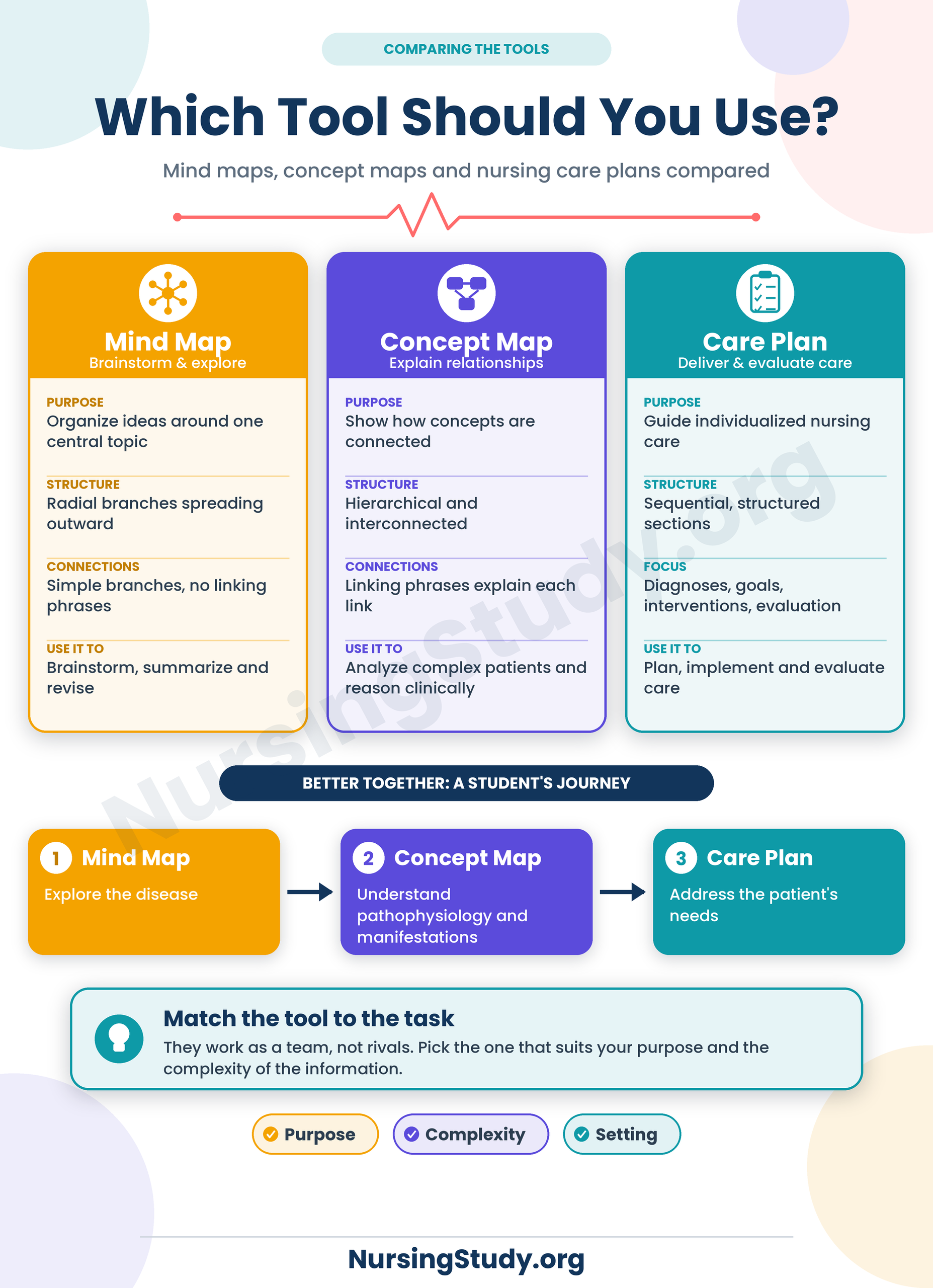
Step 2: Identify and Organize Relevant Assessment Findings
Once the patient scenario has been reviewed, the next step is to identify the assessment findings that are most relevant to the patient’s condition. These findings provide the clinical evidence used to recognize health problems, formulate nursing diagnoses, and establish priorities.
A nursing concept map should not contain every piece of information collected during the initial assessment. Instead, the nurse should select findings that contribute to understanding the central concept and explain the patient’s current health needs. Organizing the information into meaningful categories makes it easier to identify patterns and relationships.
1. Separate subjective and objective data
Begin by distinguishing subjective information from objective assessment findings.
- Subjective data are symptoms, concerns, and experiences reported by the patient or an appropriate caregiver.
- Objective data are measurable or observable findings obtained through examination, monitoring, diagnostic investigations, and clinical documentation.
For example, in a patient with pneumonia:
| Subjective data | Objective data |
|---|---|
| Reports shortness of breath | Increased respiratory rate |
| Complains of chest discomfort when coughing | Crackles heard on auscultation |
| Reports fatigue and weakness | Reduced oxygen saturation |
| Describes chills and feeling feverish | Elevated measured temperature |
| Reports reduced appetite | Documented decrease in food intake |
Separating these findings helps the nurse identify what the patient experiences and what can be independently observed or measured. Both forms of information are important when developing an accurate clinical picture.
2. Group findings according to clinical categories
After identifying the relevant data, organize them into categories that reflect the patient’s different health needs. The categories will depend on the central concept and the patient’s condition.
Common assessment categories include:
- Respiratory: Respiratory rate, oxygen saturation, breath sounds, cough, sputum production, and breathing effort.
- Cardiovascular: Heart rate, blood pressure, peripheral pulses, edema, capillary refill, and relevant cardiac findings.
- Neurological: Level of consciousness, orientation, pupil response, sensation, and motor function.
- Gastrointestinal: Appetite, nausea, vomiting, abdominal discomfort, bowel habits, and nutritional intake.
- Renal and urinary: Urine output, urinary symptoms, fluid balance, and relevant kidney function results.
- Musculoskeletal: Mobility, muscle strength, joint movement, balance, and activity tolerance.
- Integumentary: Skin condition, wounds, pressure areas, temperature, and signs of infection.
- Psychosocial: Anxiety, emotional responses, family support, coping ability, and social circumstances.
For example, when creating a concept map for a patient with heart failure, respiratory and cardiovascular findings may be particularly important. However, nutritional status, mobility, medication management, and psychological well-being should also be considered when they affect the patient’s care.
3. Identify abnormal and significant findings
Not every assessment finding carries the same clinical importance. The nurse should identify abnormalities, changes from baseline, and findings that may indicate deterioration or an increased risk of complications.
Examples include:
- Oxygen saturation below the patient’s prescribed target range.
- New or worsening shortness of breath.
- Sudden changes in blood pressure or heart rate.
- Elevated or unusually low blood glucose.
- Reduced urine output.
- New confusion or changes in consciousness.
- Increasing edema or rapid weight gain.
- Abnormal laboratory results.
- New skin breakdown or signs of wound infection.
The nurse should consider the patient’s baseline condition, clinical history, and current treatment when interpreting these findings. An abnormal value should not be interpreted in isolation because its significance may depend on other assessment results.
For instance, an elevated respiratory rate in a patient with pneumonia may be more concerning when accompanied by reduced oxygen saturation, increased work of breathing, and altered mental status. Together, these findings may indicate worsening respiratory function and require prompt clinical attention.
4. Identify patterns and related clinical cues
Clinical cues are pieces of patient information that may indicate an underlying problem or change in health status. At this stage, the nurse should begin examining how the findings relate to one another.
Consider a patient with diabetes who presents with a foot wound. The assessment may reveal:
- Poorly controlled blood glucose.
- Reduced sensation in the affected foot.
- A wound that has not healed as expected.
- Reduced peripheral pulses.
- Limited mobility due to discomfort.
Rather than treating these findings as separate observations, the nurse can organize them into related groups. Poor glucose control may interfere with normal healing processes, while reduced sensation may make it difficult for the patient to recognize further injury. Reduced circulation may also affect tissue healing.
These relationships help explain why the patient may require wound assessment, glucose monitoring, infection surveillance, mobility support, and education about foot care.
5. Arrange the findings visually
Once the relevant information has been grouped, place it around the central concept in the concept map. The nurse can use branches, boxes, arrows, and linking phrases to show the relationships between assessment categories and individual findings.
For example:
Central concept: Patient admitted with pneumonia
Respiratory findings
Shortness of breath
Crackles
Reduced oxygen saturation
Infection-related findings
Elevated temperature
Chills
Productive cough
Nutritional findings
Reduced appetite
Decreased food intake
Functional findings
Fatigue
Weakness
Reduced activity tolerance
Illustrative organization of assessment findings; actual findings must come from the patient assessment.
This arrangement provides a visual summary of the patient’s condition and prepares the nurse for the next stage: interpreting the clinical cues and formulating nursing diagnoses.
Step 3: Analyze Clinical Cues and Formulate Nursing Diagnoses
After organizing assessment findings, the nurse must interpret the information and determine what it reveals about the patient’s health needs. This stage requires clinical reasoning because the presence of symptoms or abnormal results does not automatically establish a nursing diagnosis.
The nurse must examine the findings collectively, identify patterns, consider possible explanations, and determine which patient responses require nursing attention. The resulting nursing diagnoses provide the foundation for selecting interventions and developing an individualized care plan.
1. Analyze the meaning of each clinical cue
Begin by examining what each important finding may indicate. Consider whether it represents an actual problem, a possible complication, a risk factor, or a change that requires additional assessment.
For example, consider a patient with heart failure who presents with shortness of breath, bilateral lower-extremity edema, rapid weight gain, and crackles on lung auscultation.
These findings may suggest fluid accumulation and congestion. However, the nurse should also review other relevant information, including oxygenation, respiratory effort, fluid balance, medication history, kidney function, and changes from the patient’s baseline.
The purpose of this analysis is to understand the clinical significance of the findings rather than simply placing them on the map.
2. Look for patterns among related findings
Several assessment findings may point toward the same nursing problem. Recognizing these patterns helps the nurse avoid developing diagnoses based on isolated symptoms.
For instance, a patient with impaired mobility may demonstrate:
- Difficulty changing position independently.
- Reduced muscle strength.
- Unsteady gait.
- Limited range of motion.
- Dependence on assistance when performing daily activities.
Together, these findings may support a nursing diagnosis related to impaired physical mobility. The nurse should consider the cause, severity, functional impact, and other relevant information before selecting the diagnosis.
Similarly, a patient with ineffective airway clearance may have a weak cough, retained secretions, abnormal breath sounds, and difficulty expectorating sputum. These findings should be considered together when determining whether the diagnosis is appropriate.
3. Distinguish medical diagnoses from nursing diagnoses
A common challenge when creating a nursing concept map is confusing a medical diagnosis with a nursing diagnosis.
A medical diagnosis identifies a disease or pathological condition, such as pneumonia, heart failure, or diabetes mellitus. A nursing diagnosis describes the patient’s response to that condition, such as impaired gas exchange, excess fluid volume, or ineffective health management, when supported by the assessment.
For example:
- Medical diagnosis: Pneumonia.
- Possible underlying process: Infection and inflammation affecting lung tissue.
- Assessment findings: Productive cough, elevated temperature, crackles, and reduced oxygen saturation.
- Potential nursing diagnosis: Ineffective airway clearance or impaired gas exchange, depending on the patient’s findings.
This distinction is important because nursing interventions are designed to address patient responses and care needs, while medical treatment focuses on managing the disease and its underlying causes. Both aspects must be considered when planning comprehensive patient care.
4. Select appropriate standardized nursing diagnoses
After analyzing the assessment findings, consult the appropriate nursing diagnosis classification and reference materials required by the nursing program or healthcare facility. NANDA International (NANDA-I) is commonly used to support standardized nursing terminology.
When selecting a diagnosis, consider:
- Whether the diagnosis accurately describes the patient’s response or health concern.
- Whether the assessment findings support the diagnosis.
- Whether the diagnosis is current and relevant to the patient’s condition.
- Whether the diagnosis is problem-focused, risk-related, or health-promoting.
- Whether the nurse can identify appropriate interventions and measurable outcomes for it.
For a problem-focused diagnosis, the nurse should identify the defining characteristics and related factors required by the applicable diagnostic framework. A risk diagnosis should be supported by relevant risk factors rather than signs and symptoms of a problem that has already developed.
For example, a patient with reduced mobility, poor nutritional intake, and prolonged bed rest may have risk factors for pressure injury. If the skin remains intact, the map should reflect a risk diagnosis rather than incorrectly documenting an existing pressure injury.
5. Connect each diagnosis to its supporting evidence
A good concept map should make it possible to trace each nursing diagnosis back to the patient assessment. Use arrows and linking phrases to explain the relationship between clinical findings and the selected diagnosis.
For example:
Patient with pneumonia
Assessment findings
- Weak cough
- Retained respiratory secretions
- Difficulty expectorating sputum
- Abnormal breath sounds
Support assessment for
Ineffective airway clearance
Illustrative diagnostic relationship; final diagnosis selection depends on the complete assessment and applicable diagnostic criteria.
This approach makes the thought process visible. It also helps identify diagnoses that lack sufficient supporting evidence and should therefore be reconsidered.
6. Consider other explanations and identify assessment gaps
Clinical findings can have several possible explanations. For example, fatigue may be associated with infection, anemia, poor sleep, medication effects, reduced oxygenation, or other health conditions. The nurse should avoid assuming that one explanation is correct without considering the wider clinical picture.
If the available data are insufficient, further assessment may be necessary. This may include reviewing laboratory findings, conducting a more detailed physical examination, asking additional questions, or consulting the appropriate healthcare professional.
This step is particularly important when the patient has several comorbidities or when the findings are inconsistent. Clinical reasoning involves considering what the evidence supports, what remains uncertain, and what additional information is needed.
Step 4: Prioritize Patient Problems and Establish Relationships
Patients frequently have multiple nursing diagnoses and care needs, but not all problems require the same level of attention. After formulating appropriate diagnoses, the nurse must determine which problems are most urgent and establish how they relate to one another.
This step helps organize the concept map according to clinical importance rather than presenting every diagnosis as equally significant. It also allows the nurse to recognize how one problem may contribute to another or increase the risk of complications.
1. Determine which problems require immediate attention
Begin by reviewing the identified nursing diagnoses and considering the potential consequences of delaying care. The nurse should evaluate the severity of each problem, the patient’s current stability, and the possibility of rapid deterioration.
Common considerations include:
- Airway and breathing: Difficulty maintaining an open airway, respiratory distress, and impaired oxygenation may require immediate attention.
- Circulation: Severe changes in perfusion, signs of shock, or significant bleeding require urgent assessment and intervention.
- Neurological status: Sudden changes in consciousness, new neurological deficits, or acute confusion may indicate serious deterioration.
- Patient safety: Immediate risks involving falls, aspiration, injury, or other preventable harm should be considered.
- Acute changes: New or worsening symptoms may require more urgent attention than stable chronic conditions.
- Patient comfort and function: Pain, immobility, and other problems should also be addressed according to their severity and effect on the patient’s well-being.
For example, a patient with pneumonia may have impaired gas exchange, hyperthermia, inadequate nutritional intake, and activity intolerance. If the patient is experiencing significant respiratory distress, impaired oxygenation becomes a priority because inadequate oxygen delivery can threaten vital organ function. Nutritional support and activity planning remain important but may be addressed after the immediate respiratory concern has been assessed and managed.
2. Use an appropriate prioritization framework
Several approaches can help organize patient problems.
- ABC approach: Airway, breathing, and circulation are considered when identifying potentially life-threatening concerns.
- Maslow’s hierarchy of needs: Physiological needs, such as oxygenation, nutrition, hydration, and elimination, are generally considered before higher-level needs when urgent physiological problems are present.
- Actual and potential problems: Existing problems often require attention before less immediate risks, although a serious risk may also demand urgent preventive action.
- Acute and chronic conditions: New or worsening problems may take priority over stable long-term conditions.
- Safety and risk assessment: Problems that could lead to significant harm should be considered carefully.
- Patient-centered priorities: The patient’s preferences, goals, concerns, and ability to participate in care should influence the plan.
These frameworks support decision-making, but they should not be applied mechanically. A patient’s actual condition and changing clinical findings must guide the final priorities.
3. Identify relationships between nursing diagnoses
After determining the main priorities, examine how the diagnoses are connected. Some problems may arise from the same underlying condition, while others may contribute to the development or worsening of additional problems.
For example, a patient with heart failure may experience excess fluid volume, impaired gas exchange, and activity intolerance. Fluid accumulation may contribute to pulmonary congestion, which can interfere with oxygen exchange and cause shortness of breath. Reduced oxygenation and increased respiratory effort may then limit the patient’s ability to perform physical activities.
The map should show these relationships using arrows and linking phrases such as:
- Contributes to.
- May lead to.
- Results in.
- Is associated with.
- Increases the risk of.
- Is supported by.
- Is evidenced by.
These phrases make the connections more meaningful than using arrows without explanations.
4. Identify direct and indirect relationships
Not all connections in a nursing concept map represent the same type of relationship.
A direct relationship occurs when one clinical factor is closely connected to another. For example, retained respiratory secretions may contribute to ineffective airway clearance.
An indirect relationship occurs when a factor influences another problem through one or more intermediate processes. For example, prolonged immobility may contribute to muscle weakness, which can reduce functional independence and increase the risk of additional complications.
Identifying these connections helps the nurse understand how problems develop and why certain interventions may address more than one patient need.
5. Distinguish priority problems from supporting concerns
A concept map should visually emphasize the most urgent or significant patient problems while retaining other relevant concerns.
For example, a patient recovering from major abdominal surgery may have:
- Acute pain.
- Impaired physical mobility.
- Risk for infection.
- Risk for venous thromboembolism.
- Nausea.
- Difficulty performing self-care.
The nurse should assess the patient’s current condition to determine which problems need the most immediate attention. Significant changes in respiratory status, circulation, or neurological function would require prompt assessment. Other concerns, such as mobility, pain management, and patient education, should be addressed according to the patient’s stability and recovery needs.
The map may place the primary problems closer to the central concept or use a consistent numbering system to show priority. However, the visual arrangement should not replace clinical judgment.
6. Use cross-links to show overlapping problems
Cross-links connect different branches of a concept map and demonstrate relationships that may not be obvious from a simple hierarchical structure.
For example, in a patient with diabetes:
- Poor blood glucose control may affect wound healing.
- Peripheral neuropathy may reduce protective sensation.
- Reduced mobility may make independent foot inspection difficult.
- Limited health knowledge may contribute to ineffective self-management.
These concerns belong to different assessment categories, but they influence one another. Cross-links help the nurse develop a more comprehensive understanding of the patient’s needs and avoid treating each problem in isolation.
Step 5: Develop Expected Outcomes and Nursing Interventions
After identifying and prioritizing the nursing diagnoses, the next step is to determine what the nurse intends to achieve and which actions will support those goals. This stage converts clinical analysis into a practical plan of care.
Expected outcomes describe the changes the nurse hopes to observe, while nursing interventions identify the actions that will help achieve them. Both should be directly connected to the patient’s assessment findings and selected diagnoses.
1. Establish a goal for each priority diagnosis
Begin by reviewing each nursing diagnosis and identifying the desired patient response. Goals should reflect what needs to improve, what should be maintained, or what complication should be prevented.
For example:
| Nursing diagnosis | General goal |
|---|---|
| Impaired gas exchange | Promote adequate oxygenation and effective respiratory function. |
| Excess fluid volume | Improve fluid balance and reduce manifestations of fluid overload. |
| Acute pain | Promote comfort and support participation in recovery activities. |
| Impaired physical mobility | Improve safe movement and functional independence. |
| Inadequate nutritional intake | Support adequate nutritional intake and recovery. |
| Risk for infection | Prevent infection and identify early signs of complications. |
Goals should be patient-centered and realistic. A patient with severe mobility limitations may need gradual improvement rather than an immediate expectation of independent walking.
2. Write measurable expected outcomes
Each goal should be supported by one or more expected outcomes that allow the nurse to evaluate progress.
An effective expected outcome should specify:
- What the patient is expected to demonstrate or achieve.
- How the outcome will be measured.
- The level of improvement or target to be reached.
- The timeframe for evaluation.
For example, for a patient with impaired physical mobility, an outcome might state:
“The patient will transfer from bed to chair with the prescribed level of assistance and demonstrate safe use of the recommended mobility aid by the end of the shift.”
For a patient with acute pain, an outcome might be:
“The patient will report pain at an acceptable level within the agreed period following the prescribed pain management interventions.”
Avoid vague statements such as “the patient will feel better” or “the patient will improve.” These do not provide clear criteria for determining whether the nursing interventions have been effective.
3. Select nursing interventions that address the identified problems
Once the expected outcomes have been established, identify the nursing actions required to achieve them. Interventions should be specific, appropriate to the patient’s condition, and within the nurse’s professional scope of practice.
For example, a patient with impaired gas exchange may require interventions such as:
- Monitor respiratory rate, pattern, effort, and oxygen saturation.
- Assess breath sounds and observe for changes in respiratory status.
- Position the patient to support breathing and lung expansion, as appropriate.
- Administer prescribed oxygen therapy and monitor the response.
- Encourage appropriate breathing and coughing techniques when indicated.
- Report worsening respiratory findings promptly.
- Collaborate with the healthcare team regarding additional respiratory support when necessary.
For a patient with excess fluid volume, appropriate interventions may include:
- Monitor daily weight using a consistent method.
- Assess peripheral edema and respiratory findings.
- Record intake and output as indicated.
- Monitor relevant laboratory results and renal function.
- Implement prescribed fluid or sodium restrictions.
- Administer prescribed diuretics and monitor their effects.
- Educate the patient about the agreed fluid-management plan.
Each intervention should have a clear relationship with the nursing diagnosis and expected outcome.
4. Include independent, dependent, and collaborative interventions
A comprehensive concept map should recognize the different types of nursing actions involved in patient care.
- Independent interventions: Include nursing actions such as assessment, positioning, health education, and promoting safe activity within the nurse’s scope.
- Dependent interventions: Include actions that require an authorized prescription, such as administering prescribed medications or implementing ordered oxygen therapy.
- Collaborative interventions: Include activities involving other healthcare professionals, such as physiotherapy, nutritional support, respiratory therapy, and medication review.
For example, a patient recovering from a stroke may require nursing assessment of swallowing ability, prescribed dietary modifications, collaboration with a speech and language therapist, and assistance from physiotherapy to improve mobility.
Showing these different interventions helps make the map more realistic and reflects how nursing care is delivered in clinical settings.
5. Individualize the plan according to patient needs
Interventions should not be copied automatically from another patient’s concept map, even when the medical diagnoses are similar. They must reflect the patient’s current condition, treatment plan, preferences, and ability to participate in care.
For example, two patients with diabetes may require different interventions. One may need support with medication administration and blood glucose monitoring, while another may require wound management, foot care education, and assessment of peripheral circulation.
Similarly, a patient with limited health literacy may benefit from simple explanations, demonstrations, and teach-back techniques. A patient who is already knowledgeable about their condition may require more focused support with specific challenges affecting self-management.
The concept map should make these individual needs visible so that the resulting care plan is appropriate rather than generic.
6. Connect outcomes and interventions visually
Place the expected outcomes and nursing interventions beneath or beside the diagnoses they address. Use arrows and linking phrases to demonstrate the relationship between each element.
A simplified example for a patient with impaired gas exchange is:
Nursing diagnosis: Impaired gas exchange
Goal
Promote adequate oxygenation
Expected outcome
Patient maintains oxygen saturation within the prescribed target range and demonstrates reduced work of breathing
Nursing interventions
- Assess respiratory status.
- Monitor oxygen saturation.
- Position appropriately.
- Administer prescribed oxygen therapy.
- Report deterioration promptly.
This arrangement helps the nurse trace the plan from the identified problem to the intended patient outcome and the actions required to support it.
Step 6: Add Rationales and Evaluation Measures
After developing the expected outcomes and nursing interventions, add the rationales and evaluation measures. These elements explain why the selected interventions are appropriate and how their effectiveness will be determined.
Including them makes the concept map more than a list of nursing tasks. It demonstrates the clinical reasoning behind the care plan and provides a clear method for assessing patient progress.
1. Provide a rationale for each major intervention
A rationale explains the clinical purpose of an intervention. It should connect the nursing action to the patient’s condition, the underlying pathophysiology, or the prevention of a potential complication.
For example, if a patient has impaired gas exchange, monitoring oxygen saturation helps the nurse identify changes in oxygenation and evaluate the patient’s response to treatment.
Other examples include:
| Nursing intervention | Rationale |
|---|---|
| Assess respiratory rate and breathing effort. | Helps identify changes in respiratory function and possible deterioration. |
| Monitor daily weight in a patient with heart failure. | Helps identify trends that may indicate fluid accumulation or changes in fluid status. |
| Assess pain before and after prescribed analgesia. | Helps evaluate pain severity and the patient’s response to treatment. |
| Assist with repositioning in an immobile patient. | Helps redistribute pressure and reduce prolonged loading of vulnerable tissues. |
| Monitor blood glucose in a patient with diabetes. | Helps identify abnormal glucose levels and guide appropriate management. |
| Encourage safe mobilization after surgery, when appropriate. | Supports functional recovery and reduces complications associated with prolonged immobility. |
Rationales should be specific rather than repetitive. For example, writing “to promote patient health” for every intervention does not explain the clinical reasoning behind the actions.
2. Connect rationales to evidence-based nursing knowledge
The nurse should use relevant knowledge from nursing education, clinical guidelines, institutional protocols, and evidence-based practice when developing rationales.
For example, a patient with diabetes and a foot wound may require regular wound assessment, blood glucose monitoring, and appropriate pressure management. The rationales should explain how these interventions contribute to identifying complications, supporting wound healing, and reducing further injury.
Similarly, a patient with reduced mobility may require assistance with transfers and appropriate mobility aids. The rationale should explain how these actions support safe movement and reduce the risk of falls.
The explanation should also recognize that an intervention may need to be modified according to the patient’s condition. For example, mobilization should be based on the patient’s clinical stability, functional ability, and any relevant postoperative or medical restrictions.
3. Identify measurable evaluation criteria
Evaluation criteria are the specific findings used to determine whether an expected outcome has been achieved. They should correspond directly to the outcomes established in the previous step.
Examples include:
- Vital signs remain within the patient’s prescribed or individualized targets.
- Oxygen saturation remains within the prescribed target range.
- The patient reports reduced pain.
- Edema decreases or does not worsen.
- The patient demonstrates improved mobility.
- Blood glucose readings move toward the agreed treatment targets.
- The patient correctly demonstrates a medication administration technique.
- The patient explains important aspects of their disease-management plan.
- Skin remains intact, or an existing wound shows documented signs of improvement.
For instance, if the goal is to improve mobility, the evaluation should not simply state that the patient is more active. It should identify measurable changes, such as the ability to transfer with less assistance, walk a specified distance when appropriate, or complete selected daily activities more independently.
4. Compare patient progress with the expected outcomes
During evaluation, compare the patient’s actual condition with the expected outcomes. Determine whether each outcome has been met, partially met, or not met.
For example, consider a patient recovering from pneumonia whose expected outcome is to maintain oxygen saturation within the prescribed target range and demonstrate reduced work of breathing during the shift.
The evaluation may indicate:
- Met: Oxygen saturation remained within the prescribed target range, respiratory effort decreased, and the patient reported improved breathing.
- Partially met: Oxygen saturation improved, but the patient continued to experience shortness of breath during activity.
- Not met: Oxygen saturation deteriorated or respiratory distress increased despite the planned interventions.
The nurse should record the actual findings and take appropriate action when the patient’s condition does not improve or begins to deteriorate.
5. Revise interventions when outcomes are not achieved
A concept map should be updated when evaluation findings indicate that the existing plan is ineffective or no longer appropriate.
If the patient does not achieve an expected outcome, consider whether:
- The nursing diagnosis accurately reflects the patient’s current condition.
- Important assessment findings were missed.
- The selected intervention is appropriate and has been implemented correctly.
- The expected outcome is realistic and measurable.
- The patient’s condition has changed.
- Additional assessment or collaborative care is required.
For example, if a patient with heart failure continues to develop worsening edema and shortness of breath, the nurse should reassess fluid status, respiratory function, vital signs, and other relevant clinical findings. Worsening symptoms should be communicated promptly to the appropriate healthcare professional.
The concept map may then require revised priorities, additional interventions, or updated expected outcomes. This process ensures that the care plan remains responsive to the patient’s changing needs.
6. Document evaluation findings clearly
The final evaluation should be specific, objective, and linked to the original expected outcomes. Avoid statements such as “patient is doing well” without supporting evidence.
A more useful entry might state:
“The patient transferred from bed to chair with one-person assistance, tolerated the activity without significant respiratory distress, and reported less fatigue than during the previous assessment.”
This provides clear information about the patient’s progress and helps other members of the healthcare team understand the effectiveness of the interventions.
Step 7: Review and Finalize the Concept Map
The final step is to review the entire nursing concept map to ensure that it is accurate, complete, logically organized, and easy to understand. At this stage, the nurse checks whether the information is clinically relevant, the diagnoses are supported by assessment findings, and the proposed interventions are appropriately connected to expected outcomes.
A map may contain all the required components but still be difficult to interpret if its layout is crowded, its arrows are unclear, or its clinical relationships are inaccurate. Reviewing the completed work helps identify these problems before the map is submitted as an assignment or used as a learning and clinical reasoning tool.
1. Check the accuracy of patient information
Begin by reviewing all patient details and assessment findings. Confirm that the information matches the original patient scenario, clinical documentation, or assessment records.
Check that:
- Vital signs and laboratory values are recorded accurately.
- Subjective and objective findings are distinguished correctly.
- Medical history and current diagnoses are relevant.
- Medication information is accurate.
- No patient findings have been invented or incorrectly interpreted.
- Missing information is not presented as though it has been confirmed.
For example, if a patient scenario provides an elevated temperature but does not mention a white blood cell count, the map should not include an assumed laboratory result. Clinical information should be traceable to the available assessment or clearly identified as requiring further investigation.
2. Verify nursing diagnoses and their supporting evidence
Review each nursing diagnosis and confirm that the selected terminology is appropriate and supported by the patient’s findings.
Ask yourself:
- Does the diagnosis describe a nursing problem or patient response rather than simply repeat the medical diagnosis?
- Are there sufficient assessment findings to support it?
- Are the related factors appropriate?
- Are defining characteristics included where required?
- Have actual problems been distinguished from potential problems?
- Are the diagnoses relevant to the patient’s current condition?
Remove diagnoses that are not supported by the available information. If the evidence is insufficient, additional assessment may be necessary before including the diagnosis.
3. Review the priorities and clinical relationships
Examine the map to ensure that the most important patient problems are clearly identified and that the relationships between concepts make clinical sense.
For example, if a patient has severe respiratory distress, a concept map should not give an unrelated long-term educational concern greater priority without a clear clinical reason.
Also review the connecting arrows and linking phrases. Each connection should explain a meaningful relationship rather than simply indicate that two concepts are present on the same page.
For instance, an arrow connecting reduced mobility to increased pressure injury risk should communicate the relationship clearly. An arrow without a linking phrase may leave the reader uncertain about whether one factor causes, contributes to, or is merely associated with another.
4. Confirm that goals, outcomes, and interventions are aligned
Each nursing diagnosis should have an appropriate goal, measurable expected outcomes, and relevant nursing interventions.
Review the following:
- Does the goal address the identified nursing diagnosis?
- Is the expected outcome specific and measurable?
- Is the timeframe realistic?
- Does each intervention contribute to the intended outcome?
- Are interventions appropriate for the patient’s condition and within the nurse’s scope of practice?
- Have dependent and collaborative actions been identified where necessary?
- Are rationales clinically sound?
- Can the expected outcome be evaluated using the stated criteria?
For example, if the nursing diagnosis concerns impaired physical mobility, an outcome focused only on improved nutritional intake would not directly address the problem. The map should include mobility-related outcomes and interventions, such as safe transfers, appropriate assistance, and activity progression.
5. Improve the visual organization and readability
A concept map should communicate information clearly without overwhelming the reader. Review the layout and make adjustments where necessary.
Useful presentation practices include:
- Place the central concept in a prominent position.
- Arrange major branches in a logical order.
- Group related patient findings together.
- Keep nursing diagnoses close to their supporting assessment findings.
- Position goals and interventions near the diagnoses they address.
- Use arrows and linking phrases consistently.
- Avoid unnecessary crossing lines.
- Use clear labels and readable text.
- Apply colors consistently if they help distinguish categories.
- Remove repeated or irrelevant information.
The map can be organized hierarchically, with the main topic at the top and related concepts branching outward. Alternatively, a patient-centered design may place the patient in the middle, with major assessment categories arranged around the central concept.
The best layout is one that allows the reader to follow the patient’s clinical story without searching through unrelated branches.
6. Check completeness without adding unnecessary details
A comprehensive concept map should include all essential information, but it should not become a copy of the entire patient record. Excessive details can make important clinical relationships difficult to identify.
Review the map and remove information that does not contribute to understanding the central concept, explaining a nursing diagnosis, supporting an intervention, or evaluating an outcome.
For example, a patient’s unrelated historical condition may not need to appear on a map focused on an acute respiratory problem unless it influences current treatment, risk, or nursing care.
At the same time, do not remove information simply to make the map shorter if that information is essential for understanding the patient’s condition.
7. Confirm patient confidentiality and academic requirements
If the map is based on a real patient, ensure that identifying information is protected according to the relevant healthcare facility’s policies and applicable privacy requirements. Avoid including names, addresses, identification numbers, or other unnecessary personal details.
For nursing assignments, check the instructions provided by the nursing faculty or course instructor. Some assignments may require specific nursing diagnosis terminology, a particular concept map template, references to evidence-based sources, or a defined number of nursing interventions.
Digital tools such as Microsoft Word, PowerPoint, Canva, and dedicated diagramming applications can help organize the information. However, the use of a digital template should not replace clinical reasoning. The accuracy and relevance of the content are more important than the visual design.
8. Conduct a final clinical reasoning review
Before considering the map complete, read it from beginning to end as though another nurse were using it to understand the patient.
Ask whether the map clearly explains:
- Who the patient is and why they require care.
- Which assessment findings are most significant.
- What nursing problems have been identified.
- Why certain problems have been prioritized.
- How the different patient problems are connected.
- What outcomes the nurse intends to achieve.
- Which interventions are appropriate and why.
- How the nurse will determine whether the interventions are effective.
A good concept map should tell a coherent clinical story. The reader should be able to trace the progression from patient information and assessment findings to nursing diagnoses, priorities, interventions, and evaluation criteria.
When all these elements are accurate and clearly connected, the concept map becomes a useful representation of the nursing process. It supports the organization of complex patient information, demonstrates clinical reasoning, and provides a structured approach to planning and evaluating patient-centered nursing care.
Nursing Concept Map Examples
Nursing concept map examples help demonstrate how patient information, assessment findings, nursing diagnoses, expected outcomes, and interventions can be organized into a connected visual structure. While the previous sections explain the components and steps involved in creating a map, practical examples show how these elements work together when caring for patients with different health conditions.
A nursing concept map should reflect the individual patient’s needs rather than simply reproduce a standard list of symptoms and interventions associated with a disease. Two patients with the same medical diagnosis may have different assessment findings, complications, and care priorities. Therefore, the examples below illustrate possible ways to organize clinical information while showing how nurses can use clinical reasoning to develop appropriate nursing care.
The three examples focus on pneumonia, diabetes, and heart failure. Each includes a central concept, relevant patient information, assessment findings, possible nursing diagnoses, expected outcomes, interventions, rationales, and evaluation criteria. They can be adapted for nursing assignments, case studies, clinical rotations, and different patient scenarios.
Concept Map Example for Pneumonia
Pneumonia is an infection that causes inflammation of the lung tissue, particularly the alveoli, where oxygen and carbon dioxide are exchanged. The infection may result in fluid and inflammatory material accumulating in the alveoli, interfering with normal gas exchange and respiratory function. Depending on its severity, pneumonia may cause coughing, fever, chest discomfort, difficulty breathing, fatigue, and reduced oxygen saturation.
A nursing concept map for pneumonia should focus primarily on respiratory function, airway clearance, oxygenation, infection management, hydration, nutrition, and the prevention of complications. However, the specific nursing diagnoses and interventions depend on the patient’s age, medical history, symptoms, diagnostic findings, and response to treatment.
1. Central concept and patient information
The central concept may be written as Patient admitted with pneumonia. The map should then branch into relevant assessment categories and nursing concerns.
Consider the following illustrative patient scenario:
A 65-year-old adult is admitted to the medical ward with a diagnosis of community-acquired pneumonia. The patient reports a productive cough, fever, chest discomfort when coughing, and increasing shortness of breath over the previous three days. The patient’s medical history includes hypertension and a previous respiratory infection.
The assessment reveals:
- Temperature: 38.6°C.
- Respiratory rate: 28 breaths per minute.
- Heart rate: 108 beats per minute.
- Blood pressure: 136/82 mmHg.
- Oxygen saturation: 89% on room air.
- Crackles heard over the affected lung region.
- Productive cough with thick sputum.
- Reduced appetite and fatigue.
- Chest imaging findings consistent with pneumonia.
- Elevated white blood cell count.
These findings provide the foundation for identifying the patient’s immediate respiratory needs and other problems requiring nursing attention. The oxygen saturation, increased respiratory rate, and abnormal breath sounds are particularly important because they may indicate impaired respiratory function.
2. Organizing assessment findings
The nurse can organize the patient’s findings into several branches:
| Assessment category | Relevant findings |
|---|---|
| Respiratory | Shortness of breath, productive cough, crackles, respiratory rate of 28 breaths per minute, oxygen saturation of 89% on room air |
| Infection-related | Fever of 38.6°C, elevated white blood cell count, chills if reported |
| Cardiovascular | Heart rate of 108 beats per minute |
| Pain and comfort | Chest discomfort during coughing |
| Nutritional | Reduced appetite and decreased food intake |
| Functional | Fatigue and reduced activity tolerance |
| Diagnostic | Chest imaging findings consistent with pneumonia |
Separating the information into categories makes it easier to identify the relationships between the infection, respiratory symptoms, and the patient’s functional limitations.
3. Identifying nursing diagnoses and priority problems
Based on the illustrative assessment, possible nursing diagnoses include:
- Impaired gas exchange: May be appropriate when assessment findings demonstrate impaired oxygenation or ventilation, such as reduced oxygen saturation, abnormal arterial blood gas results, or other defining characteristics.
- Ineffective airway clearance: May be appropriate when the patient has retained secretions, a weak or ineffective cough, and difficulty clearing mucus from the respiratory tract.
- Hyperthermia: May be considered when the patient’s elevated temperature and other findings support an actual temperature-regulation problem.
- Acute pain: May be appropriate when the patient reports chest discomfort associated with coughing or breathing.
- Activity intolerance: May be considered when fatigue, breathlessness, or other symptoms limit the patient’s ability to perform activities.
The nurse should select diagnoses using the complete assessment and applicable standardized diagnostic criteria. For this patient, impaired gas exchange may be a priority because the oxygen saturation is reduced and the respiratory rate is elevated. The nurse should promptly assess the patient’s respiratory status, verify the measurement where appropriate, and escalate concerning findings according to clinical protocols.
4. Establishing goals and expected outcomes
Each diagnosis should have a corresponding goal and measurable expected outcome.
| Nursing diagnosis | Goal and expected outcome |
|---|---|
| Impaired gas exchange | The patient will maintain oxygen saturation within the prescribed target range and demonstrate improved respiratory effort within the established evaluation period. |
| Ineffective airway clearance | The patient will demonstrate an effective cough and improved ability to clear respiratory secretions. |
| Hyperthermia | The patient’s temperature will move toward the prescribed or expected range, with reduced discomfort. |
| Acute pain | The patient will report pain at an acceptable level following appropriate interventions. |
| Activity intolerance | The patient will gradually tolerate necessary activities with an appropriate level of assistance and without significant respiratory distress. |
The outcomes should be individualized according to the patient’s baseline condition, clinical severity, treatment plan, and prescribed oxygenation targets.
5. Selecting nursing interventions and rationales
The nursing interventions should address the identified problems and support the expected outcomes.
| Nursing diagnosis | Nursing interventions | Rationale |
|---|---|---|
| Impaired gas exchange | Assess respiratory rate, breathing pattern, work of breathing, and oxygen saturation. | Helps identify changes in respiratory function and evaluate the patient’s oxygenation status. |
| Impaired gas exchange | Position the patient to support breathing and lung expansion, as appropriate. | Appropriate positioning may improve respiratory mechanics and comfort. |
| Impaired gas exchange | Administer prescribed oxygen therapy and monitor the response. | Supports oxygenation when supplemental oxygen is clinically indicated. |
| Ineffective airway clearance | Assess cough effectiveness, sputum characteristics, and breath sounds. | Helps determine whether secretions are being cleared and whether respiratory findings are changing. |
| Ineffective airway clearance | Encourage appropriate coughing techniques and hydration when not contraindicated. | May support secretion mobilization and help maintain adequate hydration. |
| Hyperthermia | Monitor temperature and administer prescribed antipyretics when indicated. | Helps assess fever trends and manage discomfort associated with elevated temperature. |
| Acute pain | Assess pain severity and characteristics, provide appropriate comfort measures, and administer prescribed analgesia. | Supports pain relief and may help the patient cough and breathe more comfortably. |
| Activity intolerance | Assist with activities, allow rest periods, and gradually increase activity as tolerated. | Helps prevent excessive exertion while supporting recovery of functional ability. |
Additional interventions may include administering prescribed antimicrobial therapy, monitoring hydration and nutritional intake, observing for signs of sepsis or respiratory deterioration, and collaborating with the healthcare team.
6. Evaluation criteria
The nurse should evaluate the patient’s response to interventions using measurable findings. Examples include:
- Oxygen saturation remains within the prescribed target range.
- Respiratory rate and work of breathing improve.
- Breath sounds and cough effectiveness show improvement.
- The patient demonstrates an improved ability to clear secretions.
- Temperature decreases toward the expected range.
- Chest discomfort becomes more manageable.
- The patient tolerates gradual activity without significant deterioration.
- Nutritional and fluid intake improve where appropriate.
If the patient’s oxygenation worsens, respiratory distress increases, or mental status changes, the nurse must reassess and escalate care promptly. The concept map should be updated to reflect new findings and revised priorities.
7. Illustrative nursing concept map for pneumonia
The following layout brings the major elements together and demonstrates how they can be connected visually.
CENTRAL CONCEPT
Patient with pneumonia
Infection and inflammation of lung tissue
Produces related clinical findings
Respiratory findings
Shortness of breath
Low oxygen saturation
Crackles
Productive cough
Other findings
Fever
Elevated heart rate
Chest discomfort
Fatigue
Support assessment for
Impaired gas exchange
Monitor oxygenation, assess breathing, provide prescribed oxygen therapy
Ineffective airway clearance
Assess secretions, support effective coughing, encourage appropriate hydration
Hyperthermia
Monitor temperature and implement prescribed fever management
Activity intolerance
Assist with activities and allow appropriate rest
Expected patient outcomes
- Improved respiratory function and oxygenation
- More effective secretion clearance
- Reduced fever and discomfort
- Improved tolerance of daily activities
Simplified educational example. Actual diagnoses, priorities, oxygen targets, and interventions must be individualized.
This pneumonia concept map demonstrates how the central medical condition can be connected to assessment findings, nursing diagnoses, and patient outcomes. It also shows why respiratory problems may require greater attention than less urgent concerns when the patient has impaired oxygenation.
Concept Map Example for Diabetes
Diabetes mellitus is a chronic metabolic condition characterized by elevated blood glucose levels resulting from problems with insulin production, insulin action, or both. The condition affects how the body regulates and uses glucose and may lead to complications involving the cardiovascular system, kidneys, eyes, nerves, and blood vessels.
A nursing concept map for diabetes should address blood glucose regulation, medication management, nutrition, physical activity, patient education, and the prevention of acute and long-term complications. The map should also consider the patient’s ability to manage the condition independently and the factors that may affect treatment adherence.
Unlike a concept map for an acute respiratory infection, a diabetes map often includes both immediate clinical concerns and long-term self-management needs. The nurse should consider the patient’s current glucose levels, symptoms, treatment history, lifestyle, knowledge, and risk factors.
1. Central concept and patient information
The central concept may be written as Patient with Type 2 Diabetes Mellitus.
Consider the following illustrative patient scenario:
A 54-year-old adult with a 10-year history of type 2 diabetes is admitted for management of persistently elevated blood glucose levels and a non-healing wound on the right foot. The patient reports increased thirst, frequent urination, fatigue, and difficulty following the recommended dietary plan. The patient also explains that medication is sometimes missed because of a demanding work schedule.
The assessment reveals:
- Blood glucose: 286 mg/dL.
- Hemoglobin A1c: 9.2%.
- Increased thirst and frequent urination.
- A foot wound with delayed healing.
- Reduced sensation in both feet.
- Overweight status.
- Limited understanding of daily foot care.
- Inconsistent medication adherence.
These findings suggest that the patient’s diabetes management requires attention to glycemic control, medication use, wound care, foot protection, and self-management education.
2. Organizing assessment findings
The nurse can organize the available information into several categories.
| Assessment category | Relevant findings |
|---|---|
| Blood glucose regulation | Blood glucose of 286 mg/dL and HbA1c of 9.2% |
| Symptoms | Increased thirst, frequent urination, and fatigue |
| Skin and wound status | Non-healing foot wound |
| Neurological | Reduced sensation in both feet |
| Nutrition and lifestyle | Difficulty following dietary recommendations and overweight status |
| Medication management | Inconsistent adherence to prescribed medication |
| Knowledge and self-management | Limited understanding of foot care and diabetes management |
This organization helps the nurse recognize that the patient’s concerns extend beyond elevated blood glucose. The foot wound, reduced sensation, and difficulty managing treatment may increase the risk of further complications.
3. Identifying nursing diagnoses and priority problems
Depending on the full assessment and applicable diagnostic terminology, possible nursing diagnoses may include:
- Risk for unstable blood glucose level: May be considered when factors such as inconsistent medication use, dietary challenges, and other clinical circumstances increase the likelihood of blood glucose fluctuations.
- Impaired skin integrity: May be appropriate when the foot wound demonstrates an existing disruption of the skin.
- Ineffective health management: May be considered when the patient’s difficulty integrating treatment recommendations into daily life is supported by assessment findings.
- Inadequate nutritional intake or other nutrition-related diagnosis: May be appropriate if the patient’s actual dietary intake and nutritional assessment support it. Excess body weight alone does not establish inadequate nutritional intake.
- Disturbed sensory perception or another relevant sensory diagnosis: May be considered if the patient’s reduced sensation meets the applicable diagnostic criteria.
The nurse should avoid selecting diagnoses simply because the patient has diabetes. Each diagnosis must be supported by the patient’s actual health responses and assessment findings.
The existing foot wound may require particular attention because diabetes-related neuropathy and impaired circulation can contribute to delayed healing and increase the risk of infection. The nurse should assess the wound and evaluate the patient’s overall clinical condition when determining priorities.
4. Establishing goals and expected outcomes
The patient’s goals should address immediate glucose management, wound care, prevention of complications, and the ability to participate in long-term disease management.
| Nursing diagnosis | Goal and expected outcome |
|---|---|
| Risk for unstable blood glucose level | The patient will demonstrate blood glucose readings moving toward the individualized treatment targets during the monitoring period. |
| Impaired skin integrity | The foot wound will show documented progress toward healing without evidence of worsening tissue damage or infection. |
| Ineffective health management | The patient will identify practical ways to follow the agreed treatment plan and demonstrate understanding of medication and monitoring routines. |
| Nutrition-related concern, if diagnosed | The patient will demonstrate improved understanding of dietary choices that support individualized diabetes management. |
| Sensory-related concern, if diagnosed | The patient will demonstrate appropriate foot-protection practices and identify when to report new injuries or skin changes. |
The outcomes should be individualized. Blood glucose targets, wound-healing expectations, and dietary recommendations should be based on the patient’s treatment plan and clinical circumstances.
5. Selecting nursing interventions and rationales
Nursing interventions should support glucose regulation, wound management, patient education, and the prevention of complications.
| Nursing diagnosis | Nursing interventions | Rationale |
|---|---|---|
| Risk for unstable blood glucose level | Monitor blood glucose according to the prescribed schedule and assess for symptoms of hypo- and hyperglycemia. | Helps identify abnormal glucose levels and recognize complications early. |
| Risk for unstable blood glucose level | Administer prescribed antidiabetic medication and monitor the patient’s response. | Supports the prescribed approach to blood glucose management. |
| Impaired skin integrity | Assess the foot wound, including location, size, tissue appearance, drainage, surrounding skin, and signs of infection. | Establishes a baseline and helps identify changes in wound condition. |
| Impaired skin integrity | Provide wound care according to the prescribed treatment plan and relevant clinical protocols. | Supports appropriate wound management and helps reduce the risk of complications. |
| Ineffective health management | Assess barriers to medication adherence and collaborate with the patient to develop a manageable routine. | Addresses practical factors that may interfere with treatment adherence. |
| Nutrition-related concern | Provide individualized nutrition education and collaborate with a dietitian when appropriate. | Supports informed food choices and a realistic approach to glucose management. |
| Sensory-related concern | Educate the patient about daily foot inspection, protective footwear, and reporting new skin changes. | Helps reduce the risk of unnoticed injuries in patients with reduced protective sensation. |
Additional interventions may include monitoring kidney function, reviewing cardiovascular risk factors, assessing peripheral circulation, encouraging appropriate physical activity, and reinforcing the importance of regular follow-up.
6. Evaluation criteria
Evaluation should determine whether the patient is progressing toward the expected outcomes.
Possible criteria include:
- Blood glucose readings move toward individualized treatment targets.
- The patient recognizes signs and symptoms of hypoglycemia and hyperglycemia.
- The patient demonstrates correct medication administration or describes the prescribed medication routine.
- The foot wound shows documented improvement or remains free from new signs of infection.
- The patient demonstrates appropriate foot inspection techniques.
- The patient identifies dietary and lifestyle practices that support diabetes management.
- The patient can explain when to seek medical attention for changes in foot condition or blood glucose.
For example, if the patient can correctly demonstrate blood glucose monitoring, explain when to take prescribed medication, and identify signs of hypoglycemia, the educational outcomes may be considered met. However, improved knowledge should not be treated as proof that blood glucose control or wound healing has already improved. Those outcomes require separate clinical evaluation.
7. Illustrative nursing concept map for diabetes
CENTRAL CONCEPT
Patient with Type 2 Diabetes Mellitus
Impaired glucose regulation and long-term management needs
Glucose findings
Elevated blood glucose
Increased HbA1c
Increased thirst and urination
Foot findings
Non-healing wound
Reduced sensation
Potential infection risk
Lifestyle findings
Dietary challenges
Overweight status
Activity patterns
Self-management
Missed medication
Limited foot-care knowledge
Monitoring needs
Support assessment for
Risk for unstable blood glucose
Monitor glucose, review medication use, provide education
Impaired skin integrity
Assess wound, provide prescribed wound care, monitor healing
Ineffective health management
Identify barriers and develop a practical management routine
Foot protection needs
Promote inspection, protective footwear, and early reporting
Expected patient outcomes
- Improved glucose management
- Progress toward wound healing
- Better medication and treatment management
- Improved foot-care knowledge and complication prevention
Illustrative educational map. Diagnosis selection and treatment targets require individual assessment.
This example shows how a diabetes concept map can connect metabolic concerns with skin integrity, sensory changes, lifestyle factors, and self-management. It also demonstrates the importance of including patient education and long-term complication prevention in nursing care.
Concept Map Example for Heart Failure
Heart failure is a clinical syndrome in which the heart cannot pump blood effectively enough to meet the body’s needs, or can do so only under increased filling pressures. Depending on the type and severity of the condition, patients may experience reduced cardiac output, fluid retention, pulmonary congestion, fatigue, and decreased exercise tolerance.
A nursing concept map for heart failure should focus on cardiovascular function, fluid balance, respiratory status, activity tolerance, medication management, nutrition, and patient education. Because heart failure is often a chronic condition that can worsen over time, the map should address both the patient’s immediate symptoms and the measures needed to prevent further deterioration.
1. Central concept and patient information
The central concept may be written as Patient with Heart Failure.
Consider the following illustrative patient scenario:
A 72-year-old adult is admitted with worsening shortness of breath, bilateral lower-extremity edema, and fatigue. The patient has a history of hypertension and previously diagnosed heart failure. The patient reports difficulty sleeping while lying flat and recent weight gain. The patient also admits to occasionally missing prescribed medications and consuming foods high in sodium.
The assessment reveals:
- Blood pressure: 154/90 mmHg.
- Heart rate: 112 beats per minute.
- Respiratory rate: 26 breaths per minute.
- Oxygen saturation: 91% on room air.
- Bilateral crackles on lung auscultation.
- Pitting edema in both lower extremities.
- Recent weight gain of 3 kg over one week.
- Reduced activity tolerance.
- Elevated natriuretic peptide level, if provided in the clinical scenario.
These findings may indicate worsening heart failure with fluid accumulation and respiratory involvement. The nurse should assess the severity of the patient’s symptoms, compare findings with baseline measurements, and promptly address signs of deterioration.
2. Organizing assessment findings
The assessment findings can be divided into the following categories:
| Assessment category | Relevant findings |
|---|---|
| Cardiovascular | Elevated heart rate, elevated blood pressure, peripheral edema |
| Respiratory | Shortness of breath, orthopnea, crackles, reduced oxygen saturation |
| Fluid balance | Recent weight gain and possible fluid retention |
| Functional | Fatigue, reduced activity tolerance, difficulty performing daily activities |
| Medication management | Reports occasionally missing prescribed medication |
| Nutrition | High-sodium dietary intake |
| Diagnostic | Elevated natriuretic peptide level, if available and interpreted in clinical context |
This organization helps the nurse recognize that the patient’s problems are interconnected. For example, fluid accumulation may contribute to pulmonary congestion and peripheral edema, while respiratory discomfort and fatigue may limit the patient’s physical activity.
3. Identifying nursing diagnoses and priority problems
Depending on the complete assessment and applicable nursing diagnosis criteria, possible nursing diagnoses may include:
- Excess fluid volume: May be appropriate when findings such as edema, weight gain, and other evidence support fluid accumulation.
- Impaired gas exchange: May be considered when assessment findings demonstrate impaired oxygenation or ventilation.
- Decreased cardiac output: May be appropriate when the patient’s clinical findings support inadequate cardiac pumping effectiveness.
- Activity intolerance: May be considered when the patient cannot tolerate usual activity because of fatigue, dyspnea, or other physiological limitations.
- Ineffective health management: May be considered when difficulty following the treatment plan is supported by assessment findings.
- Excessive dietary sodium intake or another relevant nutrition-related diagnosis: May be considered when the patient’s actual dietary pattern and applicable diagnostic criteria support it.
These diagnoses should not be assigned automatically to every patient with heart failure. For example, an elevated heart rate does not independently establish decreased cardiac output. The nurse must consider the complete cardiovascular assessment, perfusion findings, clinical history, and other relevant evidence.
In this scenario, worsening shortness of breath and reduced oxygen saturation require prompt assessment. Evidence of fluid accumulation also deserves attention because it may contribute to respiratory deterioration.
4. Establishing goals and expected outcomes
The patient’s goals should address fluid balance, respiratory function, cardiovascular stability, activity tolerance, and effective long-term disease management.
| Nursing diagnosis | Goal and expected outcome |
|---|---|
| Excess fluid volume | The patient will demonstrate improved fluid status, reflected by trends in weight, edema, respiratory findings, and intake and output. |
| Impaired gas exchange | The patient will maintain oxygen saturation within the prescribed target range and demonstrate improved breathing effort. |
| Decreased cardiac output, if supported | The patient will demonstrate adequate perfusion, reflected by relevant vital signs, mental status, urine output, and peripheral circulation findings. |
| Activity intolerance | The patient will tolerate necessary activities with an appropriate level of assistance and without significant worsening of symptoms. |
| Ineffective health management | The patient will explain the purpose of prescribed medications and identify practical measures for following the treatment plan. |
| Nutrition-related concern, if diagnosed | The patient will identify appropriate dietary choices consistent with the individualized sodium and fluid-management plan. |
The expected outcomes should reflect the patient’s clinical condition. For example, oxygenation targets and fluid restrictions must be based on the prescribed treatment plan rather than applied identically to every person with heart failure.
5. Selecting nursing interventions and rationales
The nurse should select interventions that address the patient’s immediate cardiovascular and respiratory needs while also supporting ongoing disease management.
| Nursing diagnosis | Nursing interventions | Rationale |
|---|---|---|
| Excess fluid volume | Monitor daily weight using consistent conditions and equipment. | Helps identify trends in fluid accumulation or loss. |
| Excess fluid volume | Monitor intake and output as indicated. | Helps assess fluid balance and response to treatment. |
| Excess fluid volume | Assess peripheral edema, lung sounds, and respiratory symptoms. | Helps identify changes that may indicate worsening congestion. |
| Excess fluid volume | Administer prescribed diuretics and monitor the patient’s response. | Supports management of fluid overload when diuretic therapy is prescribed. |
| Impaired gas exchange | Monitor oxygen saturation, respiratory rate, and work of breathing. | Helps identify changes in respiratory function and oxygenation. |
| Impaired gas exchange | Position the patient to support breathing, as clinically appropriate. | May improve respiratory comfort and lung expansion. |
| Decreased cardiac output, if diagnosed | Assess vital signs, peripheral perfusion, mental status, and urine output. | Helps identify changes that may indicate inadequate tissue perfusion. |
| Activity intolerance | Assist with activities and gradually increase activity according to tolerance and clinical stability. | Supports functional recovery while limiting excessive exertion. |
| Ineffective health management | Explore barriers to medication adherence and develop practical strategies with the patient. | Helps address factors contributing to difficulty following the treatment plan. |
| Nutrition-related concern | Provide education about the prescribed sodium and fluid-management recommendations. | Supports informed dietary decisions and adherence to the individualized treatment plan. |
Additional interventions may include reviewing prescribed medications, monitoring relevant electrolyte and kidney function results, observing for worsening symptoms, and collaborating with the healthcare team to adjust the treatment plan.
6. Evaluation criteria
Evaluation should determine whether the patient’s respiratory function, fluid status, cardiovascular condition, and ability to manage heart failure have improved.
Possible evaluation measures include:
- Reduced peripheral edema.
- Weight trends consistent with the prescribed fluid-management goals.
- Improved breathing comfort and reduced orthopnea.
- Oxygen saturation within the prescribed target range.
- Reduced respiratory distress.
- Appropriate urine output and fluid-balance findings.
- Improved tolerance of necessary activities.
- The patient correctly explains prescribed medication use.
- The patient identifies symptoms that require prompt medical attention.
- The patient demonstrates understanding of the individualized dietary and follow-up plan.
For example, if the patient’s edema decreases, respiratory findings improve, and weight trends move toward the agreed treatment goal, these findings may indicate a favorable response to fluid-management interventions. However, the nurse should evaluate the findings together rather than relying on weight change alone.
If the patient develops worsening breathlessness, increasing oxygen requirements, new confusion, reduced urine output, or other signs of deterioration, the nurse should promptly reassess and escalate care as appropriate.
7. Illustrative nursing concept map for heart failure
CENTRAL CONCEPT
Patient with heart failure
Impaired cardiac function and possible fluid congestion
May contribute to
Reduced effective cardiac function and fluid accumulation
Pulmonary congestion
Shortness of breath
Crackles
Orthopnea
Reduced oxygen saturation
Systemic fluid retention
Peripheral edema
Weight gain
Fluid-balance changes
Support assessment for
Excess fluid volume
Monitor weight, edema, intake and output; implement prescribed fluid management
Impaired gas exchange
Assess breathing and oxygenation; provide prescribed respiratory support
Activity intolerance
Support safe activity and planned rest
Health-management needs
Promote medication adherence and individualized self-care education
Expected patient outcomes
- Improved fluid balance
- Better respiratory comfort and oxygenation
- Improved activity tolerance
- Better understanding of heart failure management
- Earlier recognition of worsening symptoms
Simplified educational example. The relationships and interventions must be adapted to the patient’s heart failure type, clinical findings, and treatment plan.
This example illustrates how a heart failure concept map connects cardiovascular function with fluid balance, respiratory symptoms, and reduced activity tolerance. It also demonstrates the importance of incorporating medication management, dietary education, and symptom monitoring into the nursing care plan.
The three examples show that a nursing concept map follows the same general structure regardless of the medical condition, but its content changes according to the patient’s needs. Pneumonia maps often emphasize airway clearance, oxygenation, and infection management. Diabetes maps place greater attention on glucose regulation, wound care, and self-management, while heart failure maps commonly focus on fluid balance, cardiovascular function, respiratory status, and prevention of deterioration.
When developing their own concept maps, nurses should use these examples as organizational guides rather than fixed templates. The most effective map is one that accurately represents the individual patient, connects clinical findings to appropriate nursing diagnoses, and demonstrates how nursing interventions contribute to measurable patient outcomes.
Types of Concept Maps for Nursing Students
Concept maps in nursing can be organized in different ways depending on the information being studied, the learning objectives, and the clinical problem being addressed. Although most nursing concept maps use a central concept with connected branches, their structure and content vary according to their purpose. Some focus on the patient’s overall health condition, while others examine a particular nursing diagnosis, explain the development of a disease, or organize information about medications and body systems.
Understanding these different types helps nurses select an appropriate format for organizing complex patient information. For example, a patient-centered concept map may be suitable when reviewing a comprehensive patient assessment, whereas a disease process concept map may be more useful when studying how a condition develops and affects normal physiological functioning.
The main types of concept maps used in nursing education and clinical practice include patient-centered, diagnosis-centered, disease process and pathophysiology, and medication and body system concept maps. Each approach supports a different aspect of clinical reasoning, knowledge organization, and patient care.
Patient-Centered Concept Maps
A patient-centered concept map organizes information around an individual patient’s overall health status, needs, and care requirements. The patient is the central concept, and the map branches outward to show the relationships among medical history, assessment findings, medical diagnoses, nursing diagnoses, risk factors, treatments, nursing interventions, and expected outcomes.
This type of nursing concept map provides a broad picture of the patient’s condition rather than concentrating on one disease or isolated nursing problem. It helps nurses consider how different health concerns interact and how these relationships influence the patient’s physical, psychological, social, and functional well-being.
For example, a patient admitted following a hip replacement may have several interconnected care needs. These could include postoperative pain, limited mobility, risk of infection, potential complications associated with immobility, and concerns about returning to independent activities. A patient-centered concept map brings these issues together to demonstrate how they influence one another and how nursing care should address the patient’s overall recovery.
Key elements of a patient-centered concept map
The central concept is usually the patient or a brief description of the patient’s current clinical situation. The surrounding branches contain relevant information gathered during the nursing assessment.
| Component | Information included |
|---|---|
| Patient profile | Age, relevant medical history, reason for admission, and current health concerns |
| Assessment findings | Subjective complaints, vital signs, physical examination findings, and laboratory results |
| Medical conditions | Diagnosed illnesses, injuries, or postoperative conditions |
| Nursing diagnoses | Actual and potential patient problems supported by assessment findings |
| Risk factors | Factors that may contribute to complications or delayed recovery |
| Goals and outcomes | Expected improvements in the patient’s condition and functional status |
| Nursing interventions | Monitoring, treatment-related care, education, comfort measures, and preventive actions |
| Evaluation | Evidence indicating whether the patient’s needs and expected outcomes have been addressed |
The branches should not simply list these details independently. They should demonstrate meaningful connections between them. For example, postoperative pain may limit movement, reduced movement may increase the risk of venous thromboembolism, and appropriate pain management may help the patient participate in early mobilization.
Example of a patient-centered concept map
Consider a 68-year-old patient recovering from total hip replacement surgery. The patient reports pain around the surgical site, experiences difficulty walking, and requires assistance with personal hygiene. The surgical incision is intact, and the patient has been prescribed postoperative pain medication and physical therapy.
The central concept is the patient’s postoperative recovery. The concept map could be organized as follows:
Central concept: Patient recovering from hip replacement surgery
Assessment findings
Surgical-site pain, limited movement, difficulty walking, and need for assistance
Nursing diagnoses
Acute pain, impaired physical mobility, and risk for infection
Potential complications
Venous thromboembolism, falls, wound infection, and delayed recovery
Nursing interventions
Pain assessment, prescribed analgesia, wound monitoring, safe mobilization, and prescribed preventive measures
Expected outcomes
Improved pain control, increased mobility, intact surgical wound, and safe participation in rehabilitation
Illustrative organization: the actual map should connect each diagnosis to its supporting findings, interventions, and measurable outcomes.
This example demonstrates how one patient’s assessment findings can be connected to several nursing diagnoses and care priorities. It also shows why patient-centered concept maps are useful when a patient has multiple health concerns that require coordinated nursing care.
When patient-centered concept maps are useful
Patient-centered maps are particularly useful when:
- Conducting a comprehensive patient assessment and organizing information from different sources.
- Preparing nursing care plans for patients with multiple medical conditions or complex care needs.
- Identifying relationships between physical symptoms, emotional concerns, functional limitations, and social circumstances.
- Organizing patient information during clinical rotations and nursing assignments.
- Supporting communication among nurses and other healthcare professionals.
- Reviewing whether nursing interventions address the patient’s individual needs and expected outcomes.
One important advantage of this format is that it encourages holistic nursing care. Rather than treating each diagnosis as an isolated problem, the nurse considers how the patient’s conditions, treatment requirements, daily activities, and personal circumstances interact. This supports more individualized decision-making and helps prevent important patient needs from being overlooked.
Diagnosis-Centered Concept Maps
A diagnosis-centered concept map focuses on one specific nursing diagnosis or priority patient problem. Instead of organizing the entire patient’s health status around a central patient profile, this format places a selected diagnosis at the center and branches outward to show its causes, contributing factors, defining characteristics, expected outcomes, and appropriate nursing interventions.
This type of concept map is particularly useful when learning how to identify, interpret, and manage nursing diagnoses. It helps connect assessment findings with the clinical reasoning required to formulate an appropriate diagnosis and select interventions that address the identified problem.
A diagnosis-centered map should distinguish between the patient’s medical condition and the nursing diagnosis. A medical diagnosis identifies a disease or pathological condition, whereas a nursing diagnosis describes a human response to an actual or potential health problem that nurses can assess and address through nursing care.
For example, a patient with a medical diagnosis of chronic kidney disease may experience fatigue, activity intolerance, altered fluid balance, and nutritional problems. A diagnosis-centered concept map could focus specifically on one supported nursing diagnosis, such as activity intolerance, and explain how the patient’s assessment findings relate to that problem.
Key elements of a diagnosis-centered concept map
The selected nursing diagnosis forms the central concept. Its branches should explain the evidence supporting the diagnosis and the nursing actions required to address it.
| Component | Information included |
|---|---|
| Central nursing diagnosis | The priority nursing problem being examined |
| Defining characteristics | Signs, symptoms, and assessment findings supporting an actual diagnosis |
| Related factors | Contributing factors or circumstances associated with the nursing problem |
| Risk factors | Patient characteristics or conditions that increase the likelihood of a potential problem |
| Expected outcomes | Measurable changes the patient should demonstrate |
| Nursing interventions | Independent, dependent, and collaborative actions used to address the diagnosis |
| Rationales | Clinical explanations for selecting particular interventions |
| Evaluation criteria | Indicators used to determine whether the desired outcomes have been achieved |
The relationship between these elements is especially important. Assessment findings should provide evidence for the diagnosis, while the interventions should directly address the identified problem. Expected outcomes should describe the changes that nursing care is intended to achieve.
For an actual problem-focused diagnosis, the map may connect the diagnosis to its defining characteristics and related factors. For a risk diagnosis, the map should identify the relevant risk factors rather than presenting signs and symptoms as though the problem has already occurred.
Example of a diagnosis-centered concept map
Consider a patient with chronic kidney disease who reports becoming tired when walking short distances. The patient requires frequent rest periods and has difficulty completing routine activities. Assessment also reveals reduced exercise tolerance and generalized weakness.
A concept map centered on activity intolerance could include:
Central diagnosis: Activity intolerance
Supporting assessment findings
Fatigue during activity, reduced walking tolerance, weakness, and frequent rest periods
Potential contributing factors
Reduced physiological reserve, possible anemia associated with kidney disease, and physical deconditioning where supported by assessment
Nursing interventions
Assess response to activity, monitor relevant vital signs, plan rest periods, assist with progressive activity, and collaborate with the healthcare team
Expected outcomes
Improved tolerance of prescribed activity, reduced fatigue during daily tasks, and increased independence where achievable
The contributing factors and diagnosis must be verified against the patient’s full assessment and applicable diagnostic criteria.
This type of map makes the clinical reasoning behind a nursing diagnosis more visible. It shows that the diagnosis is not selected simply because a patient has a particular medical condition. Instead, the nurse examines the patient’s actual responses, identifies supporting evidence, considers contributing factors, and determines which nursing interventions are appropriate.
When diagnosis-centered concept maps are useful
Diagnosis-centered concept maps are useful for:
- Practicing the identification and formulation of appropriate nursing diagnoses.
- Understanding the relationship between assessment findings, defining characteristics, and related factors.
- Learning how to distinguish actual nursing problems from potential risks.
- Selecting interventions that directly address a specific patient problem.
- Establishing measurable expected outcomes and evaluation criteria.
- Reviewing NANDA-I terminology and applying nursing diagnostic reasoning.
- Analyzing priority problems in patient scenarios and nursing case studies.
This format is particularly helpful when a patient has several nursing diagnoses but one requires closer examination. It allows the nurse to explore the selected problem in greater detail without overcrowding the map with unrelated patient information.
It also helps identify weaknesses in clinical reasoning. For example, if a nursing diagnosis cannot be linked to relevant assessment findings, the nurse may need to gather additional patient data or reconsider whether the diagnosis is appropriate. Similarly, if an intervention does not address the central diagnosis, the map may reveal that the proposed nursing care needs to be revised.
Disease Process and Pathophysiology Concept Maps
Disease process and pathophysiology concept maps focus on explaining how a disease develops, how it affects normal body functioning, and how the resulting physiological changes produce clinical manifestations. Unlike patient-centered maps, which organize information around an individual, this format concentrates on the biological mechanisms underlying a health condition.
The central concept is usually a disease, disorder, injury, or pathological process. The map branches outward to illustrate its causes, risk factors, pathophysiological changes, affected organs or body systems, signs and symptoms, diagnostic findings, complications, and treatment approaches.
This format is valuable because understanding the disease process helps nurses interpret patient assessment findings rather than relying only on memorized lists of symptoms. It also strengthens the connection between anatomy, physiology, microbiology, pharmacology, and medical-surgical nursing.
For example, a concept map about acute pancreatitis could show how premature activation of digestive enzymes within the pancreas leads to inflammation and tissue injury. These changes may cause severe abdominal pain, nausea, vomiting, and systemic inflammatory responses. In more severe cases, the inflammatory process may contribute to fluid shifts, circulatory instability, and organ dysfunction.
The map allows the nurse to follow the sequence from the initial pathological process to the clinical manifestations and potential complications.
Key elements of a disease process and pathophysiology concept map
| Component | Information included |
|---|---|
| Central disease or condition | The illness or pathological process being studied |
| Causes and risk factors | Factors that contribute to disease development |
| Pathophysiological mechanisms | Changes in normal cellular, tissue, organ, or system functioning |
| Affected body systems | Organs and physiological processes influenced by the disease |
| Signs and symptoms | Clinical manifestations resulting from the pathological changes |
| Diagnostic findings | Relevant laboratory tests, imaging results, and other investigations |
| Complications | Potential consequences of disease progression |
| Medical management | Common treatment approaches and prescribed therapies |
| Nursing implications | Assessment priorities, monitoring requirements, and appropriate nursing interventions |
The most important feature of this type of concept map is the sequence of physiological relationships. The nurse should show how one process contributes to another using linking phrases such as causes, results in, leads to, contributes to, and increases the risk of.
For example, a disease process map may connect tissue inflammation to increased capillary permeability, fluid movement into surrounding tissues, swelling, and impaired organ function. These connections help explain why particular signs and symptoms occur and why specific monitoring activities are necessary.
Example of a disease process and pathophysiology concept map
Consider a concept map focused on asthma. The central concept is asthma, a chronic inflammatory airway disease characterized by variable respiratory symptoms and variable expiratory airflow limitation.
The map could organize the disease process as follows:
Central concept: Asthma
Risk factors and triggers
Allergens, respiratory infections, smoke, exercise, and other individual triggers
Pathophysiology
Airway inflammation, bronchial hyperresponsiveness, and variable bronchoconstriction
Physiological consequences
Narrowing of the airways, increased mucus production in some patients, and increased resistance to airflow
Clinical manifestations
Wheezing, coughing, chest tightness, shortness of breath, and variable expiratory airflow limitation
Diagnostic assessment
Spirometry demonstrating variable expiratory airflow limitation and other clinically indicated assessments
Management
Prescribed inhaled medications, trigger management, symptom monitoring, and an individualized asthma action plan
This example illustrates how a disease process concept map connects underlying physiological changes with the symptoms and diagnostic findings observed in clinical practice. It also helps explain why particular treatments are used. For instance, prescribed bronchodilators help relieve bronchoconstriction, while inhaled corticosteroids are commonly used to control airway inflammation.
When disease process and pathophysiology concept maps are useful
These concept maps are particularly helpful when:
- Studying the causes, mechanisms, and progression of diseases.
- Connecting normal anatomy and physiology with abnormal physiological changes.
- Understanding why particular signs and symptoms occur.
- Linking laboratory findings and diagnostic procedures to disease mechanisms.
- Reviewing complications and identifying patients who may require closer monitoring.
- Understanding the clinical purpose of medical and nursing interventions.
- Preparing for examinations in pathophysiology, pharmacology, and medical-surgical nursing.
Disease process maps are also useful when comparing conditions that produce similar symptoms through different mechanisms. For example, shortness of breath may occur in asthma, pneumonia, pulmonary edema, and pulmonary embolism, but the underlying pathophysiology differs. Mapping these processes helps nurses avoid assuming that similar symptoms always indicate the same disease.
A limitation of this format is that it may explain the disease in considerable detail without fully addressing the needs of a particular patient. Therefore, it should be connected to patient assessment and clinical judgment when used to guide actual nursing care. Understanding the general disease process does not replace evaluating how the condition is affecting the individual.
Medication and Body System Concept Maps
Medication and body system concept maps organize nursing knowledge around pharmacological treatments or the normal and abnormal functioning of particular body systems. These maps help connect medication information, physiological processes, therapeutic effects, adverse reactions, and nursing responsibilities.
Although medication-focused and body system-focused maps have related educational purposes, they emphasize different aspects of nursing knowledge. A medication concept map examines a specific drug or drug class and its effects on the patient. A body system concept map organizes the anatomy, physiology, assessment findings, common disorders, and nursing care associated with a particular system.
Both approaches help nurses understand how medications interact with body functions and why particular assessments and precautions are necessary.
Medication concept maps
A medication concept map places a drug or medication class at the center. Its branches organize information about the medication’s classification, mechanism of action, indications, administration considerations, contraindications, adverse effects, interactions, monitoring requirements, and patient education.
This format is particularly important because medication administration involves more than knowing a drug’s name and prescribed dose. Nurses must understand what the medication does, why it has been prescribed, what effects to monitor, and which patient factors may influence its safety.
For example, a medication concept map focused on furosemide could include its classification as a loop diuretic, its action on sodium and chloride reabsorption in the loop of Henle, and its use in managing fluid overload in appropriate patients.
The branches may connect its pharmacological action to increased urine output, possible reductions in fluid volume, and the need to monitor blood pressure, renal function, fluid balance, and electrolytes such as potassium.
| Component | Information included |
|---|---|
| Medication name and classification | Generic name, drug class, and relevant brand name if required |
| Mechanism of action | How the medication produces its therapeutic effect |
| Indications | Conditions or symptoms for which it may be prescribed |
| Administration | Prescribed route, timing, dose considerations, and relevant precautions |
| Therapeutic effects | Expected clinical response |
| Adverse effects | Potential unwanted reactions |
| Contraindications and precautions | Conditions or patient factors that require avoidance or additional caution |
| Drug interactions | Other medications or substances that may affect its action or safety |
| Nursing responsibilities | Relevant assessments, monitoring, and administration checks |
| Patient education | Instructions about use, safety, possible side effects, and when to seek help |
Example of a medication concept map
A furosemide concept map could be organized around the following relationships:
Central concept: Furosemide
Loop diuretic
Mechanism of action
Inhibits sodium and chloride reabsorption in the thick ascending limb of the loop of Henle
Therapeutic purpose
Promotes diuresis and helps manage fluid overload when prescribed
Potential adverse effects
Hypotension, dehydration, electrolyte disturbances, and possible ototoxicity
Nursing monitoring
Blood pressure, intake and output, daily weight, renal function, and electrolytes
Patient education
Follow the prescribed schedule, understand possible dizziness and dehydration, and report concerning symptoms
This map illustrates how medication information can be connected to practical nursing responsibilities. For instance, because furosemide increases urinary fluid loss, the nurse should monitor fluid balance and assess for signs of dehydration or hypotension. Electrolyte monitoring is also important because increased urinary losses may contribute to abnormalities such as hypokalemia.
The specific monitoring plan depends on the patient’s condition, prescription, laboratory results, and clinical setting. A concept map supports understanding but does not replace medication orders, institutional protocols, or professional medication-safety checks.
Body system concept maps
A body system concept map focuses on a particular anatomical and physiological system, such as the cardiovascular, respiratory, neurological, gastrointestinal, renal, endocrine, or musculoskeletal system.
The central concept is the selected body system. The branches may include its major organs, normal functions, regulatory mechanisms, assessment methods, common disorders, clinical manifestations, diagnostic tests, and nursing interventions.
This type of concept map is particularly useful for organizing information that may otherwise be scattered across several nursing subjects. It helps connect anatomy and physiology with patient assessment, pathophysiology, and clinical nursing practice.
For example, a cardiovascular system concept map could begin with the heart and blood vessels, then branch into cardiac anatomy, electrical conduction, cardiac output, blood pressure regulation, circulation, common cardiovascular disorders, and relevant nursing assessments.
A respiratory system map may organize information about the upper and lower airways, alveolar gas exchange, ventilation, oxygenation, respiratory assessment, common respiratory disorders, and interventions that support respiratory function.
| Body system | Main concepts to include | Examples of nursing assessment and care |
|---|---|---|
| Cardiovascular | Heart anatomy, circulation, cardiac output, blood pressure regulation | Heart rate, blood pressure, peripheral perfusion, edema, and prescribed cardiac monitoring |
| Respiratory | Airway anatomy, ventilation, gas exchange, oxygenation | Respiratory rate, breathing pattern, breath sounds, oxygen saturation, and prescribed respiratory support |
| Nervous | Brain, spinal cord, peripheral nerves, sensory and motor function | Level of consciousness, orientation, pupil response, strength, sensation, and neurological observations |
| Renal | Kidney structure, filtration, fluid balance, electrolyte regulation | Urine output, fluid balance, renal laboratory results, and edema assessment |
| Endocrine | Hormone-producing glands, hormonal regulation, metabolism | Blood glucose, relevant hormone tests, symptoms of hormonal imbalance, and medication monitoring |
| Gastrointestinal | Digestion, absorption, liver function, bowel elimination | Abdominal assessment, nutritional status, bowel patterns, hydration, and relevant laboratory findings |
| Musculoskeletal | Bones, joints, muscles, movement, and structural support | Mobility, muscle strength, joint function, pain, and fall risk |
Example of a body system concept map
A respiratory system concept map could use gas exchange as its central topic. The main branches would explain the structures and processes involved in moving oxygen into the blood and removing carbon dioxide.
Central concept: Respiratory system and gas exchange
Anatomical structures
Nose, pharynx, larynx, trachea, bronchi, bronchioles, and alveoli
Physiological functions
Ventilation, diffusion, oxygen delivery, and carbon dioxide removal
Common disorders
Asthma, pneumonia, COPD, and pulmonary embolism
Assessment
Respiratory rate, work of breathing, breath sounds, oxygen saturation, and relevant investigations
Nursing implications
Maintain airway patency, monitor respiratory status, administer prescribed treatments, and evaluate the patient’s response
This structure allows the nurse to connect normal respiratory functioning with the changes that occur during illness. For example, inflammation and fluid accumulation in the alveoli during pneumonia can interfere with gas exchange, leading to impaired oxygenation. Understanding this relationship helps explain why respiratory assessment, oxygenation monitoring, and appropriate prescribed interventions are important.
When medication and body system concept maps are useful
Medication and body system maps can support several areas of nursing education and clinical practice:
- Reviewing pharmacology and understanding how different medications affect physiological processes.
- Preparing for safe medication administration by organizing drug indications, actions, precautions, and monitoring requirements.
- Understanding common adverse effects and identifying the assessments needed to detect them.
- Studying anatomy and physiology in a structured, interconnected format.
- Linking normal body functions to the pathophysiology of common diseases.
- Preparing for clinical rotations involving particular specialties or patient populations.
- Understanding how medication therapy supports the management of specific health conditions.
For example, a nurse studying endocrine disorders could create a body system map covering the pancreas, insulin production, glucose regulation, and diabetes mellitus. A separate medication map could examine insulin preparations, their actions, administration considerations, hypoglycemia risks, and glucose monitoring. Connecting the two maps helps explain why insulin is used and why blood glucose monitoring is an essential part of care.
Medication and body system maps are also useful for identifying knowledge gaps. If a nurse can identify a medication’s purpose but cannot explain its mechanism of action or relevant adverse effects, the map can highlight the information that requires further study.
The choice between these types of concept maps depends on the learning or clinical objective. Patient-centered maps provide a broad view of individual patient needs, diagnosis-centered maps examine a specific nursing problem, disease process maps explain the underlying mechanisms of illness, and medication and body system maps organize pharmacological and physiological knowledge. Selecting the appropriate format helps make complex information easier to understand, improves clinical reasoning, and supports the application of nursing knowledge in patient care.
Nursing Concept Map Templates and Digital Tools
Nursing concept map templates provide a structured framework for organizing patient information, identifying nursing diagnoses, connecting clinical findings, and planning appropriate nursing interventions. Instead of creating every map from scratch, nurses can use a prepared layout that guides the arrangement of important information and helps maintain consistency.
A well-designed concept map template should make it easy to identify the central concept, organize supporting information, and show relationships between assessment findings, patient problems, expected outcomes, and nursing actions. The template may be a simple paper-based diagram, a printable worksheet, or a digital document created using specialized software.
The choice of template depends on the purpose of the assignment, the complexity of the patient’s condition, and the amount of information that needs to be included. A basic layout may be sufficient for a straightforward patient scenario, while a more detailed template may be necessary when managing multiple nursing diagnoses, complex medical conditions, or interconnected patient care needs.
Digital tools also provide additional flexibility by allowing users to add, move, connect, and revise concepts without redrawing the entire map. These tools can make creating a concept map easier, particularly when working with complex patient information or preparing nursing assignments and case studies.
Basic Nursing Concept Map Template
A basic nursing concept map template is a structured layout used to organize the essential elements of a patient’s condition and nursing care. It provides designated spaces for patient information, assessment findings, nursing diagnoses, goals, interventions, rationales, and evaluation criteria.
The purpose of this template is to help nurses arrange information in a logical sequence while showing how different clinical concepts relate to one another. Rather than recording patient data as disconnected notes, the nurse creates a visual representation of the relationships between the patient’s condition, identified problems, and planned care.
Most basic templates place the patient or central health problem in the middle or at the top of the page. Main branches extend from this point to represent the major categories of information. Additional branches connect related findings, diagnoses, and interventions.
Essential sections of a basic nursing concept map template
A practical template should include the following sections:
1. Patient information: This section contains relevant demographic information, the reason for admission, medical history, and the patient’s primary health concern. Only information necessary for the learning activity or clinical purpose should be included.
2. Assessment findings: This section organizes subjective and objective data obtained during the patient assessment. Subjective findings include symptoms and concerns reported by the patient, while objective findings include measurable or observable information such as vital signs, physical examination results, and laboratory findings.
3. Medical diagnosis and pathophysiology: This section identifies the patient’s diagnosed medical condition and briefly explains the relevant disease process. Including pathophysiological information helps connect the patient’s condition to the observed signs and symptoms.
4. Nursing diagnoses: This section identifies actual and potential patient problems that require nursing attention. Each diagnosis should be supported by relevant assessment findings or, in the case of a risk diagnosis, appropriate risk factors.
5. Goals and expected outcomes: This section describes the changes that nursing care is intended to achieve. Outcomes should be specific, measurable, realistic, and linked to the identified nursing diagnoses.
6. Nursing interventions: This section lists the nursing actions required to address the patient’s needs. These may include assessment and monitoring, direct patient care, prescribed treatments, education, and collaboration with other healthcare professionals.
7. Rationales: This section explains why particular nursing interventions are appropriate. Rationales should be based on relevant clinical knowledge and evidence-based nursing practice.
8. Evaluation criteria: This section identifies the indicators used to determine whether the expected outcomes have been achieved. It may include changes in symptoms, physical findings, laboratory results, functional ability, or the patient’s understanding of their condition.
Example of a basic nursing concept map template
The following is a simplified template that can be adapted to different patient scenarios. It demonstrates how information can be arranged from the central patient problem to assessment findings, nursing diagnoses, and planned care.
Basic Nursing Concept Map Template
A reusable layout for organizing patient information and nursing care.
Patient information
Patient initials or assigned case identifier, age, admission date, reason for admission, relevant history
Central concept / primary health problem
Medical condition or main patient concern
Assessment findings
Subjective data, objective data, vital signs, laboratory results, clinical cues
Medical diagnosis
Confirmed condition and relevant pathophysiology
Nursing diagnoses
Priority actual and potential nursing problems
Goals and outcomes
Expected patient responses and measurable targets
Nursing interventions
Monitoring, direct care, prescribed treatment, education, collaboration
Rationales
Clinical explanations supporting the selected interventions
Evaluation
Outcome met, partially met, or not met; supporting findings; required changes to the nursing care plan
Template note: Add arrows and linking phrases to demonstrate relationships between the sections rather than treating them as isolated boxes.
This template can be adapted to different clinical situations by changing the central concept and the supporting information. For instance, a patient with a respiratory condition may require detailed respiratory assessment findings, oxygenation goals, airway management interventions, and evaluation of breathing patterns. A patient recovering from surgery may require branches addressing pain, wound condition, mobility, infection prevention, and postoperative education.
How to use a basic nursing concept map template
When completing the template, begin by identifying the main patient concern or clinical scenario. This becomes the central concept from which the other branches develop. Next, enter the relevant patient assessment findings and distinguish between subjective and objective information.
The assessment findings should then be analyzed to identify actual and potential nursing diagnoses. Each diagnosis should connect to the evidence supporting it, followed by appropriate goals, nursing interventions, and evaluation criteria.
For example, if a patient reports difficulty breathing and has an increased respiratory rate, reduced oxygen saturation, and abnormal breath sounds, these findings may support further assessment of respiratory problems. Depending on the complete clinical picture, the nurse may identify an appropriate nursing diagnosis and develop interventions addressing respiratory status and oxygenation.
The template should show the relationship between these elements. A useful sequence might be:
Assessment findings → Nursing diagnosis → Expected outcome → Nursing intervention → Rationale → Evaluation
However, the map does not need to follow a strictly linear structure. Some patient problems are interconnected and may share assessment findings, interventions, or expected outcomes. Arrows and linking phrases can show these relationships.
A basic nursing concept map template is particularly useful for introductory assignments, simple case studies, and situations where the main objective is to demonstrate an understanding of the nursing process. It provides enough structure to guide the thought process without making the map unnecessarily complicated.
Blank Concept Map Templates for Nursing Students
Blank concept map templates provide an empty framework that can be completed according to a particular patient scenario, nursing assignment, or learning objective. Unlike completed examples, they do not contain predefined patient information or nursing diagnoses. Instead, they provide spaces, shapes, branches, and connecting lines that users fill in themselves.
These templates are useful because different clinical scenarios require different types of information. A blank template allows the nurse or nursing student to decide which concepts are most relevant, how they should be grouped, and which relationships deserve emphasis.
For example, a concept map for a patient with a neurological condition may need sections for consciousness, orientation, pupil response, motor function, sensation, and neurological monitoring. A template for a patient with a gastrointestinal condition may instead focus on abdominal assessment, bowel function, nutritional status, hydration, and relevant laboratory findings.
Using a blank template also encourages independent clinical reasoning. Rather than copying a completed diagram, the user must interpret patient data, identify relevant nursing diagnoses, establish priorities, and determine how different aspects of care are connected.
Common formats of blank nursing concept map templates
Blank templates are available in several formats, depending on the desired level of organization and the complexity of the information.
1. Central-node concept map template
Nursing Concept Map Template: Med-surg Study Guide (PDF) – Etsy
This format places a central topic in the middle of the page, with empty branches extending outward. It is suitable for organizing information around a patient, medical condition, or nursing topic.
For example, the central node may contain a patient’s main health problem, while the surrounding branches represent assessment findings, nursing diagnoses, risk factors, interventions, and expected outcomes.
2. Hierarchical concept map template
Free Concept Map Maker | AI Concept Map Generator Online
A hierarchical template arranges concepts from the main topic to broader categories and then to more specific details. The central topic is usually placed at the top, with supporting concepts branching downward.
This format is useful when studying disease processes, body systems, medication classifications, and the relationships between broad nursing concepts and their individual components.
3. Spider or web concept map template
Graphic Organizer: Spider/Mind Map by English Necessities | TPT
Spider maps place the central concept in the middle and arrange related ideas around it. Their appearance resembles a web, making them useful for brainstorming and identifying multiple aspects of a topic.
For example, a spider map about diabetes mellitus may include branches for risk factors, pathophysiology, clinical manifestations, diagnostic tests, complications, treatment, and nursing care. Additional connections can be added between concepts that influence one another.
4. Nursing care-focused template
This format is organized around the nursing process. It provides designated spaces for patient assessment, nursing diagnoses, goals, interventions, rationales, and evaluation.
It is particularly useful for assignments requiring a clear connection between patient findings and nursing actions. It can also help users check whether every nursing diagnosis has an appropriate outcome and whether each intervention addresses the identified problem.
5. Multi-problem concept map template
Unit 2 Concept Maps for Patient Assessment and Nursing Interventions – Studocu
A multi-problem template provides space for several interconnected nursing diagnoses and their supporting assessment findings. It is appropriate for patients with multiple medical conditions, complicated treatment requirements, or several priority nursing concerns.
For example, a patient with chronic obstructive pulmonary disease, hypertension, and impaired mobility may require a map that connects respiratory symptoms, cardiovascular findings, functional limitations, medication management, and patient education.
What to look for when selecting a blank template
The best template is not necessarily the one with the most boxes or decorative elements. It should provide enough space to organize relevant information while allowing the user to show meaningful relationships between concepts.
Consider the following factors when selecting a blank concept map template:
- Purpose of the assignment: Choose a layout that matches the required task. A disease process assignment may need space for pathophysiology, while a patient care assignment may require assessment, diagnoses, interventions, and evaluation.
- Complexity of the patient scenario: A simple template may be sufficient for one priority problem, but a complex patient may require several branches and cross-connections.
- Space for clinical evidence: The template should allow room for subjective and objective findings that support the nursing diagnoses.
- Flexibility: It should be possible to add branches, connecting lines, and linking phrases when additional information is needed.
- Readability: The layout should be organized and easy to follow without excessive overlapping lines or overcrowded text.
- Assignment requirements: Some nursing schools and nursing faculty provide specific formats or marking criteria. These should take priority over a preferred general template.
How to complete a blank template effectively
Begin by reviewing the patient scenario or topic and deciding what the central concept should be. Write the main concept in the designated space, then identify the most important supporting categories.
Organize the information before filling in the template. This may involve grouping patient findings, identifying relevant medical conditions, and determining which nursing diagnoses are supported by the available evidence. Once the main branches have been established, add the smaller details and connect related concepts using arrows and linking phrases.
Avoid filling every available space simply because it is provided. A good concept map prioritizes relevant information rather than including every possible fact about a disease or patient. For instance, when mapping a patient’s postoperative recovery, information about the surgical procedure, wound assessment, pain, mobility, and infection risk may be more relevant than unrelated details from the patient’s medical history.
It is also important to leave room for revision. Clinical reasoning often develops as additional information becomes available. A blank template should allow the user to add new findings, reorganize priorities, or revise nursing diagnoses when the patient’s condition changes.
Digital Tools for Creating Nursing Concept Maps
Digital tools make it possible to create, organize, and edit nursing concept maps using computers, tablets, and other electronic devices. They offer an alternative to drawing diagrams by hand and can be especially helpful when working with detailed patient scenarios or preparing professional-looking nursing assignments.
Most digital concept mapping tools provide shapes, text boxes, arrows, connectors, templates, and formatting options. These features allow users to arrange concepts visually and demonstrate relationships between patient information, nursing diagnoses, interventions, and expected outcomes.
One advantage of digital tools is that changes can be made without redrawing the entire map. If a nursing diagnosis needs to be revised or a new clinical finding is added, the user can move existing elements, create additional branches, and adjust the connecting lines. Some platforms also support collaboration, allowing multiple users to work on the same diagram.
Several digital tools can be used to create concept maps, although they differ in their available features, ease of use, pricing, and suitability for academic or professional work.
1. Canva
Concept map maken | Gratis sjablonen voor conceptuele modellen | Canva
Canva is a visual design platform that offers templates and diagramming features that can be adapted to nursing concept maps. Its drag-and-drop interface allows users to add shapes, text boxes, arrows, icons, and connecting lines.
A nursing student can use Canva to create a patient-centered map with a central patient problem and branches for assessment findings, nursing diagnoses, goals, and interventions. The platform also makes it possible to adjust colors, fonts, spacing, and visual hierarchy to improve readability.
Useful features include:
- Ready-made mind map and diagram templates.
- Drag-and-drop editing.
- Shapes, connectors, arrows, and text boxes.
- Customizable colors and fonts.
- Options for exporting and sharing completed designs.
Canva is particularly useful when the assignment requires a visually organized concept map or when a polished presentation is important. However, users should ensure that decorative features do not distract from the clinical relationships being presented.
2. Lucidchart
Free Concept Map Maker: Online Concept Maps | Lucidchart
Lucidchart is an online diagramming tool that supports flowcharts, organizational diagrams, process maps, and concept maps. It is useful for creating diagrams that contain multiple connected concepts and relationships.
Its connectors and shape libraries help users arrange information in a structured format. For instance, a disease process map can show how risk factors contribute to pathological changes, which then produce clinical manifestations and complications.
Useful features include:
- Diagram templates and shape libraries.
- Connectors for showing relationships between concepts.
- Alignment and layout tools.
- Collaborative editing features.
- Exporting and sharing options.
Lucidchart is suitable for more detailed nursing concept maps where several branches and cross-connections need to be arranged clearly.
3. Microsoft PowerPoint
Visualize Your Ideas: Creating a Concept Map Using PowerPoint
Microsoft PowerPoint can be used to create nursing concept maps through shapes, SmartArt graphics, text boxes, arrows, and connectors. Although it is primarily presentation software, its design features make it a practical option for assignments that need to be submitted as slides or exported as PDF documents.
Users can place the central concept in a prominent position and arrange related information around it. Different shapes can distinguish assessment findings from nursing diagnoses, while arrows can demonstrate how problems connect to interventions and outcomes.
Useful features include:
- Shapes and SmartArt diagrams.
- Editable text boxes and connectors.
- Customizable formatting.
- Ability to add images and tables.
- Exporting slides into PDF format.
PowerPoint is especially useful when a concept map needs to be incorporated into a class presentation or a larger nursing assignment. Its flexibility also allows users to create a map from scratch rather than relying on a predefined template.
4. Microsoft Word
Größte Mindmap Vorlage Word – Kostenlos Vorlagen Und Muster
Microsoft Word is another accessible option for creating basic nursing concept maps. It allows users to insert shapes, text boxes, lines, tables, and diagrams into a document.
A simple patient-centered map can be created by inserting a central text box and surrounding it with additional boxes representing patient assessment, nursing diagnoses, goals, and interventions. Connecting lines can then be added to illustrate the relationships between the concepts.
Useful features include:
- Insertable shapes and text boxes.
- Lines, arrows, and connectors.
- Tables for organizing nursing information.
- Document formatting and editing.
- Saving and exporting to PDF.
Word is particularly useful when the concept map forms part of a written assignment. However, maps with many interconnected branches can become difficult to arrange compared with software designed specifically for diagramming.
5. Coggle
The best mind mapping software | Zapier
Coggle is an online mind mapping tool that allows users to create visual diagrams with connected branches. Its structure is suitable for organizing related nursing concepts around a central topic.
For example, a map about hypertension could include branches for risk factors, pathophysiology, clinical manifestations, diagnostic assessment, complications, treatment, and nursing interventions. Additional branches can be created to show relationships between these areas.
Useful features include:
- Branch-based mind mapping.
- Color-coded connections.
- Collaborative diagram creation.
- Simple editing and rearrangement.
- Sharing and exporting options.
Coggle is useful for brainstorming and organizing broad nursing topics. However, a traditional mind map may not provide the same level of detail or clinical relationship structure required for a formal patient-centered nursing concept map. Users may need to add explicit linking phrases and more detailed connections.
6. Miro
How to Make a Concept Map: A Step-by-Step Guide | Miro
Miro is an online collaborative whiteboard platform that can be used to create concept maps, flowcharts, diagrams, and other visual learning materials. Its flexible workspace allows users to arrange multiple groups of information on a large canvas.
For nursing assignments, this can be useful when mapping complex patient scenarios that involve several nursing diagnoses, multiple body systems, and overlapping interventions. Users can create separate sections for assessment findings, medical conditions, and nursing care while connecting related concepts across the board.
Useful features include:
- Flexible digital whiteboard.
- Shapes, sticky notes, and connectors.
- Diagramming and mind mapping tools.
- Collaborative editing.
- Templates and sharing options.
Miro is especially useful for group learning activities and collaborative case studies. It allows team members to contribute ideas and organize clinical information in a shared visual workspace.
Comparison of digital tools for nursing concept maps
| Digital tool | Main strength | Suitable use |
|---|---|---|
| Canva | Visual design and customizable templates | Polished nursing assignments and presentations |
| Lucidchart | Structured diagramming and connectors | Complex maps with multiple relationships |
| PowerPoint | Flexible slide-based diagram creation | Class presentations and detailed concept maps |
| Word | Document-based editing | Simple maps included in written assignments |
| Coggle | Branch-based mind mapping | Brainstorming and organizing nursing topics |
| Miro | Collaborative visual workspace | Group projects and complex case studies |
How to choose the right digital tool
The best digital tool depends on the type of concept map being created and the user’s requirements. A simple nursing assignment may not require specialized diagramming software, while a detailed map involving several patient problems may benefit from a platform with more advanced connectors and layout controls.
When selecting a tool, consider the following:
- Ease of use: Choose a platform with an interface that allows concepts and connecting lines to be added without unnecessary difficulty.
- Template availability: Ready-made templates can save time and provide a useful starting structure.
- Editing flexibility: The tool should make it easy to add, remove, resize, and rearrange concepts.
- Relationship mapping: Look for connectors and arrows that clearly show how concepts are related.
- Collaboration: Shared editing can be useful for group assignments and nursing education activities.
- Export options: Check whether the completed map can be saved in a format accepted by the nursing program, such as PDF or an image file.
- Cost and access: Consider whether the necessary features are available in the free version or require a paid subscription.
- Privacy and security: Avoid entering identifiable patient information into public or unapproved platforms. Use fictional case details or de-identified information for educational exercises, and follow institutional requirements for handling clinical data.
Best practices for creating digital nursing concept maps
Regardless of the software selected, the quality of the finished map depends on how accurately and logically the information is organized. A visually attractive diagram is not necessarily a good concept map. The main purpose is to show meaningful relationships and demonstrate sound clinical reasoning.
For the best results:
1. Start with a clear central concept. Identify the patient, diagnosis, disease process, medication, or body system that the map will address. Avoid placing several unrelated topics at the center.
2. Organize information into logical branches. Group related findings and concepts together. For a patient-centered map, this may include assessment data, nursing diagnoses, interventions, and outcomes.
3. Use clear linking phrases. Arrows should communicate the relationship between concepts. Phrases such as contributes to, results in, requires, and is associated with make connections easier to interpret.
4. Maintain a consistent visual structure. Use a consistent style for similar categories. For instance, assessment findings can share one visual format, while nursing diagnoses and interventions use different formats.
5. Avoid overcrowding. Do not include every detail from the patient record or textbook. Select information relevant to the central concept and the purpose of the assignment.
6. Check clinical accuracy. Verify that diagnoses are supported by assessment findings, interventions are appropriate, and expected outcomes are measurable.
7. Review the final layout. Make sure text is readable, arrows are easy to follow, and related concepts are connected correctly.
8. Protect patient confidentiality. Use approved systems for clinical information and remove identifiable details when preparing academic examples.
Digital tools can make the creation and revision of concept maps more convenient, but they do not replace the clinical reasoning required to develop them. The nurse remains responsible for interpreting patient data, selecting appropriate nursing diagnoses, establishing priorities, and ensuring that proposed interventions are safe and evidence-based. A well-designed template or digital platform simply provides a practical way to communicate that reasoning clearly.
Best Practices and Common Mistakes in Concept Mapping
Creating an effective nursing concept map requires more than arranging information in boxes and connecting them with arrows. The map should accurately represent the relationships between patient assessment findings, nursing diagnoses, clinical problems, interventions, and expected outcomes. Its organization should make complex information easier to understand while demonstrating the clinical reasoning used to guide nursing care.
A poorly constructed concept map can create confusion, obscure important patient problems, and make it difficult to understand why particular nursing interventions have been selected. For example, a map containing numerous unrelated clinical findings without clear connections may provide a large amount of information but fail to demonstrate how those findings influence patient care.
Good concept mapping therefore involves selecting relevant information, organizing concepts logically, establishing meaningful relationships, and ensuring that all clinical details are accurate. It also requires attention to patient confidentiality, especially when maps are created using information obtained during clinical practice.
The following best practices help produce clear, clinically relevant, and useful concept maps while reducing common mistakes that can affect their quality.
Maintaining Clarity and Logical Organization
Clarity and logical organization are essential characteristics of a good nursing concept map. The purpose of a concept map is to make relationships between clinical concepts easier to understand. If the information is poorly arranged, difficult to read, or inconsistently connected, the map may become confusing rather than helpful.
A clear map presents the central concept prominently and organizes supporting information into meaningful categories. The reader should be able to identify the main topic, follow the branches, and understand how the different elements relate to one another without having to interpret an unnecessarily complicated diagram.
Start with a clearly defined central concept
Every concept map should have a central concept that establishes its focus. Depending on the purpose, this may be a patient’s primary health concern, a nursing diagnosis, a disease process, a medication, or a body system.
For example, when creating a patient-centered concept map for someone admitted with an acute respiratory condition, the central concept could be the patient’s current respiratory problem. The surrounding branches would then organize relevant information such as respiratory assessment findings, medical history, nursing diagnoses, treatment requirements, and expected outcomes.
Avoid placing several unrelated topics at the center of the same map. Doing so can make it difficult to determine which concepts are most important and how the information should be interpreted.
Organize concepts into logical categories
Once the central concept has been established, divide the supporting information into categories. This helps prevent the map from becoming a collection of disconnected notes.
Common categories in a nursing concept map include:
- Patient information and relevant medical history.
- Subjective and objective assessment findings.
- Medical diagnoses and underlying pathophysiology.
- Nursing diagnoses and priority problems.
- Risk factors and potential complications.
- Goals and expected patient outcomes.
- Nursing interventions and their rationales.
- Evaluation findings and required adjustments to care.
These categories should reflect the purpose of the map. A medication-focused concept map, for instance, may need sections for drug classification, mechanism of action, indications, adverse effects, contraindications, nursing responsibilities, and patient education rather than a complete patient assessment.
Use a consistent visual hierarchy
A visual hierarchy makes it easier to distinguish major concepts from supporting details. The central concept should be prominent, major branches should be clearly identifiable, and smaller branches should contain more specific information.
One practical approach is to use larger boxes for primary concepts and smaller boxes for related findings or details. For example, a map about a patient with a cardiovascular condition may use the main branches for cardiovascular assessment, nursing diagnoses, interventions, and outcomes. Under cardiovascular assessment, smaller branches may identify blood pressure, heart rate, peripheral perfusion, edema, and relevant diagnostic findings.
Color coding can also help distinguish different categories. For example:
- One color for patient assessment findings.
- Another color for nursing diagnoses.
- A separate color for interventions.
- A different color for expected outcomes.
However, colors should be used consistently and sparingly. Excessive decoration, multiple font styles, and unnecessary images can distract from the clinical information.
Arrange concepts in a readable sequence
The layout should make the flow of information easy to follow. A hierarchical structure may begin with the central topic at the top and move downward into supporting concepts. A radial structure may place the main topic in the middle and arrange related concepts around it.
For example, a map explaining the relationship between a patient’s assessment findings and nursing care may follow this sequence:
Central patient problem
Relevant assessment findings
Subjective and objective clinical cues
Nursing diagnoses and priority problems
Goals and nursing interventions
Evaluation of patient outcomes
A simplified sequence for organizing a patient-focused map. Additional branches and cross-connections should be included where they clarify relationships.
This arrangement is particularly useful when demonstrating how assessment information informs nursing diagnoses and how those diagnoses guide patient care. However, the map should not become so rigid that it hides relationships between different patient problems. Some findings may support more than one diagnosis, and several nursing interventions may address interconnected concerns.
Use concise and understandable wording
A concept map should summarize important information rather than reproduce entire paragraphs from textbooks, patient records, or nursing assignments. Long explanations make the diagram difficult to read and can obscure the main relationships.
For example, instead of writing a lengthy description of a patient’s respiratory assessment in one box, the nurse can summarize the relevant findings as follows:
- Respiratory rate: 28 breaths/min.
- Oxygen saturation: 89% on room air.
- Bilateral crackles on auscultation.
- Reports shortness of breath.
- Increased work of breathing.
These findings can then be connected to the appropriate nursing diagnoses and further assessment requirements.
Abbreviations may be used when they are widely recognized and permitted by the assignment or clinical setting. However, unfamiliar abbreviations should be written in full or explained to prevent misinterpretation.
Common mistakes to avoid
Some organizational problems can reduce the effectiveness of a nursing concept map:
- Placing too many concepts around the central topic without grouping them.
- Using inconsistent shapes, colors, and fonts without a clear purpose.
- Connecting unrelated information simply because it appears close together.
- Writing lengthy paragraphs inside small boxes.
- Arranging branches in a way that makes arrows overlap or cross unnecessarily.
- Making the central concept difficult to identify.
- Using vague labels that do not explain the clinical meaning of a finding.
A useful final check is to examine the map from the reader’s perspective. Someone unfamiliar with the case should be able to identify the main patient concern, understand the supporting assessment findings, and follow the reasoning behind the proposed nursing care.
Establishing Meaningful Connections Between Concepts
The most important feature of a nursing concept map is its ability to show relationships between concepts. A diagram that only lists patient information, medical conditions, nursing diagnoses, and interventions may look organized, but it does not fully demonstrate concept mapping.
Meaningful connections explain how one clinical finding relates to another, how a disease process produces particular symptoms, and why a specific nursing intervention is appropriate. These relationships help nurses develop clinical reasoning skills and understand the underlying logic of patient care.
Connect assessment findings to nursing diagnoses
Every nursing diagnosis should be supported by relevant patient information. The nurse should be able to explain why the diagnosis has been selected and which assessment findings provide evidence for it.
For example, consider a patient who reports difficulty breathing and presents with an increased respiratory rate, reduced oxygen saturation, and abnormal breath sounds. These findings may support further assessment for a respiratory nursing problem, such as impaired gas exchange, depending on the full clinical picture and applicable diagnostic criteria.
The concept map should make this relationship visible rather than placing the diagnosis in a separate section without supporting evidence.
A useful connection may be represented as:
Assessment findings
Shortness of breath, reduced oxygen saturation, and increased respiratory rate
Support the assessment of
Possible nursing diagnosis: Impaired gas exchange
Nursing interventions
Assess respiratory status, monitor oxygenation, position appropriately, and administer prescribed treatment
Expected outcome
Improved oxygenation and reduced signs of respiratory distress within the established care period
The relationship between the assessment findings and diagnosis should be clinically justified. For instance, a low oxygen saturation may indicate impaired oxygenation, but the nurse must consider the patient’s baseline, measurement accuracy, clinical presentation, and other assessment findings before selecting a diagnosis.
Show relationships between causes, contributing factors, and patient problems
A useful concept map explains how different factors contribute to a patient’s health problems. These may include disease mechanisms, lifestyle factors, medication-related issues, environmental influences, and pre-existing conditions.
For example, a patient with poorly controlled diabetes may have several factors that affect wound healing. Elevated blood glucose can impair immune function and contribute to delayed tissue repair. Peripheral neuropathy may reduce protective sensation, increasing the likelihood of unnoticed foot injuries. Reduced circulation, when present, may further compromise tissue healing.
The map can connect these factors to impaired skin integrity, infection risk, and the need for appropriate wound assessment and management.
The nurse should avoid presenting every associated factor as a confirmed cause. Some factors may be potential contributors or risk indicators that require further assessment. Appropriate linking phrases help communicate these distinctions.
Use linking phrases to explain relationships
Linking phrases are short words or expressions written along connecting lines to clarify how two concepts are related. They are particularly important because arrows alone do not always explain the intended meaning.
Useful linking phrases include:
| Linking phrase | How it explains a relationship |
|---|---|
| Causes | Shows a direct causal relationship when clinically established |
| Contributes to | Identifies a factor that plays a role in a problem |
| Leads to | Shows a sequence or consequence |
| Results in | Connects a process to its outcome |
| Is associated with | Indicates a relationship without necessarily establishing causation |
| As evidenced by | Connects an actual nursing diagnosis to supporting findings |
| Increases the risk of | Identifies a potential complication |
| Requires monitoring of | Connects a clinical concern to an assessment responsibility |
| Is managed through | Links a problem to relevant treatment or nursing care |
| Is evaluated by | Connects an intervention or goal to measurable findings |
For example, a concept map about postoperative recovery might use the following connections:
- Surgical incision may contribute to acute postoperative pain.
- Pain can limit movement and participation in rehabilitation.
- Reduced mobility increases the risk of complications associated with immobility.
- Appropriate pain management supports participation in prescribed mobilization.
- Wound assessment helps identify signs of infection or impaired healing.
These phrases make the map more informative because they explain the relationships instead of leaving the reader to guess.
Establish connections between related nursing diagnoses
Patients often experience multiple nursing problems that influence one another. A concept map should demonstrate these relationships when they are clinically relevant.
For example, a patient recovering from abdominal surgery may experience acute pain, impaired physical mobility, and difficulty taking deep breaths or coughing effectively. Pain may limit movement and respiratory effort, while reduced mobility may contribute to postoperative complications.
The nurse may therefore need to connect pain management with mobility support, respiratory assessment, and other appropriate postoperative interventions.
This approach prevents the map from treating every nursing diagnosis as an isolated issue. It also helps identify interventions that may address more than one patient need.
However, shared interventions should not obscure the individual goals of each diagnosis. Pain relief, improved mobility, and effective respiratory function should each have appropriate assessment measures and expected outcomes.
Connect nursing interventions to rationales and expected outcomes
Each intervention should have a clear purpose. A concept map should explain what the nurse plans to do, why the action is appropriate, and how its effectiveness will be evaluated.
For example:
| Nursing intervention | Rationale | Expected outcome |
|---|---|---|
| Assess pain using an appropriate pain scale | Establishes pain severity and supports evaluation of treatment response | Pain decreases to the patient’s agreed target |
| Assist with prescribed early mobilization | Supports functional recovery and reduces complications associated with prolonged immobility | Patient increases activity as tolerated |
| Monitor the surgical incision | Helps identify changes that may indicate infection or impaired healing | Incision remains free from concerning signs of infection |
| Provide individualized discharge education | Supports understanding of postoperative care and self-management | Patient explains key home-care instructions |
This relationship is important because interventions should not be included merely because they are commonly used for a particular medical condition. They should address the patient’s identified needs and be supported by an appropriate clinical rationale.
Use cross-connections where appropriate
Cross-connections are links between concepts located in different branches of a map. They demonstrate how separate areas of patient care interact.
For example, a patient with heart failure may have fluid retention, peripheral edema, reduced activity tolerance, and difficulty breathing. Fluid accumulation may contribute to respiratory symptoms and swelling, while reduced activity tolerance may affect the patient’s ability to perform daily activities.
A cross-connection can link fluid balance monitoring to both respiratory assessment and peripheral edema evaluation. It may also connect medication education to adherence, symptom monitoring, and prevention of worsening symptoms.
Cross-connections are especially useful when creating comprehensive maps for patients with multiple conditions. However, they should be added only when a meaningful clinical relationship exists. Too many crossing lines can make the map difficult to interpret.
Avoiding Information Overload and Irrelevant Details
A nursing concept map should contain enough information to explain the central topic and demonstrate relevant clinical relationships. However, including too much information can make the map difficult to read and reduce its educational value.
Information overload occurs when a map contains excessive details, numerous branches, lengthy explanations, or unrelated concepts. Instead of clarifying the patient’s condition, the diagram becomes crowded and difficult to follow.
For example, a concept map about a patient admitted with pneumonia does not need to reproduce every fact about respiratory anatomy, every type of pneumonia, and every possible antibiotic. It should focus on the patient’s actual clinical findings, relevant disease mechanisms, priority nursing diagnoses, and appropriate care requirements.
Focus on information relevant to the central concept
Every item included in the map should contribute to understanding the main topic or the patient’s care needs.
When deciding whether to include a particular detail, consider:
- Does this information help explain the patient’s condition?
- Does it support a nursing diagnosis or identify a relevant risk?
- Does it influence the selection of nursing interventions?
- Does it help establish a measurable expected outcome?
- Is it necessary to understand a relationship between two or more concepts?
If the information does not contribute meaningfully to the map, it may be better placed in accompanying notes or omitted.
For example, when mapping a patient’s acute pain following surgery, relevant information may include pain location, severity, duration, aggravating factors, associated findings, prescribed analgesia, and the patient’s response to treatment. An unrelated historical laboratory result may not need to appear unless it influences medication safety, treatment decisions, or the current assessment.
Prioritize important clinical information
Not all patient findings have equal significance. A concept map should give greater attention to findings that affect patient safety, indicate deterioration, or require timely nursing action.
For example, a patient admitted with a respiratory infection may have fever, fatigue, reduced appetite, cough, and low oxygen saturation. Although all these findings are relevant, impaired oxygenation or signs of respiratory distress may require more immediate attention than reduced appetite.
The map should reflect these priorities through the arrangement and prominence of the concepts.
A useful approach is to distinguish between:
- Priority findings: Clinical cues that require immediate assessment or intervention.
- Supporting findings: Information that helps explain or confirm a patient problem.
- Background information: Relevant medical history and risk factors that provide context.
- Additional details: Information that may be useful but does not directly influence the main focus of the map.
This distinction helps prevent less important information from competing visually with urgent patient concerns.
Avoid unnecessary repetition
Repeating the same information across several branches can make a concept map unnecessarily large. Instead, the nurse can create one assessment finding and connect it to multiple relevant problems where appropriate.
For example, reduced mobility may be relevant to activity intolerance, fall risk, and complications associated with immobility. Rather than repeatedly writing the same finding in separate sections, the map can use one clearly labeled concept with connections to the relevant diagnoses.
However, repetition should not be avoided when it is necessary to make a relationship clear. The priority is readability and accuracy, not simply reducing the number of words.
Summarize complex information without losing its meaning
A concept map is a visual summary, so information should be presented in concise phrases. Long explanations can be placed in supporting notes or an accompanying written discussion.
For example, a lengthy description of the pathophysiology of hypertension could be summarized into a sequence:
Increased vascular resistance → increased workload on the heart → elevated blood pressure → possible target-organ damage.
This provides a simplified overview of the relationship between the concepts. More detailed explanations can be included where necessary, particularly if the assignment requires an in-depth pathophysiology discussion.
The nurse should ensure that simplification does not create misleading relationships. For example, hypertension has multiple contributing mechanisms, so the simplified sequence should not be presented as the only pathway through which the condition develops.
Use additional pages or separate maps for highly complex topics
Some patients have several medical conditions, multiple nursing diagnoses, and extensive treatment requirements. Attempting to place every detail on one page can make the map difficult to read.
In such situations, it may be more effective to create a main patient-centered concept map supported by smaller maps for specific topics.
For example, a patient with diabetes, chronic kidney disease, hypertension, and a foot wound may require:
- A main patient-centered map showing the overall health status and priority nursing problems.
- A separate map explaining the relationship between diabetes and impaired wound healing.
- A medication concept map covering relevant prescribed therapies and monitoring requirements.
The smaller maps should connect to the central patient concerns rather than functioning as unrelated diagrams.
Recognize when a concept map has become too complicated
A map may contain too much information if:
- The reader cannot easily identify the central concept.
- Text is too small to read.
- Multiple arrows overlap or cross without clear meaning.
- Important diagnoses are difficult to distinguish from minor details.
- Several branches contain lengthy paragraphs.
- The same information appears repeatedly.
- Relationships are unclear despite the large amount of information presented.
The solution is not necessarily to remove every secondary detail. Instead, reorganize the content, group related concepts, remove irrelevant information, and use separate supporting diagrams when appropriate.
A good concept map is comprehensive enough to demonstrate clinical understanding but selective enough to remain clear and useful.
Maintaining Accuracy and Patient Confidentiality
Accuracy and patient confidentiality are essential when creating nursing concept maps, particularly those based on real clinical scenarios. The information included should reflect the available patient data, current clinical knowledge, and appropriate nursing terminology.
An inaccurate map can lead to incorrect conclusions about a patient’s condition, inappropriate nursing diagnoses, or interventions that are not supported by the assessment. Similarly, including identifiable patient information in an assignment or an unsecured digital platform can compromise privacy and violate professional or institutional requirements.
Maintaining accuracy requires careful assessment, verification of clinical information, and appropriate use of nursing terminology. Protecting confidentiality requires responsible handling of patient records and attention to where and how concept maps are stored or shared.
Use accurate and verified patient information
A concept map should be based on reliable information obtained from appropriate sources, including patient interviews, physical assessments, medical records, laboratory reports, and relevant diagnostic findings.
The nurse should verify important details before including them in the map. This is particularly important when working with vital signs, medication information, laboratory results, and medical diagnoses.
For example, if a patient has an oxygen saturation reading of 88%, the nurse should consider the clinical context and verify the measurement when appropriate. Factors such as poor peripheral perfusion, movement, incorrect probe placement, and nail products may affect pulse oximeter readings.
Similarly, a single abnormal laboratory result should not automatically be treated as proof of a particular nursing diagnosis. Findings should be interpreted alongside the patient’s symptoms, history, physical assessment, and other relevant information.
Distinguish between confirmed findings, reported symptoms, and assumptions
One common mistake is presenting assumptions as though they are established clinical facts.
A concept map should clearly distinguish between:
- Subjective findings: Information reported by the patient, such as pain, nausea, dizziness, or shortness of breath.
- Objective findings: Observable or measurable information, such as blood pressure, respiratory rate, temperature, laboratory values, and physical examination results.
- Confirmed diagnoses: Conditions established through appropriate clinical evaluation.
- Potential problems: Risks that may develop based on the patient’s condition or risk factors.
- Information requiring further assessment: Findings that are incomplete, uncertain, or need verification.
For example, a patient who reports dizziness when standing may require assessment for postural blood pressure changes, medication effects, dehydration, and other possible causes. The concept map should not automatically identify hypotension as a confirmed finding unless it is supported by assessment data.
This distinction supports accurate clinical reasoning and prevents unsupported nursing diagnoses.
Use appropriate nursing terminology and diagnostic language
Nursing diagnoses should be written using accepted terminology and the applicable classification system required by the nursing program or clinical institution. NANDA International (NANDA-I) terminology is commonly used in nursing education to support consistent diagnostic language.
The nurse should ensure that the selected diagnosis reflects the patient’s actual or potential response to a health condition. Medical diagnoses and nursing diagnoses should not be used interchangeably.
For example, pneumonia is a medical diagnosis, while ineffective airway clearance or impaired gas exchange may be appropriate nursing diagnoses when supported by the patient’s assessment.
The wording of a diagnosis should also reflect its diagnostic category. An actual problem-focused diagnosis should be supported by relevant defining characteristics, while a risk diagnosis should be linked to appropriate risk factors rather than symptoms of a problem that has not occurred.
Ensure that interventions and rationales are clinically appropriate
Nursing interventions should be selected according to the patient’s condition, assessment findings, prescribed treatment, professional scope of practice, and institutional guidelines.
For example, a concept map involving a patient with reduced blood pressure should not automatically recommend fluid administration without considering the cause, the patient’s overall condition, and any relevant contraindications. Similarly, oxygen therapy, fluid restriction, medication changes, and other treatments should follow appropriate prescriptions and clinical protocols.
Rationales should explain why an intervention is appropriate, not simply repeat the action in different words.
For example:
- Intervention: Monitor intake and output in a patient with fluid balance concerns.
- Rationale: Tracking fluid intake and urinary output helps assess changes in fluid balance and supports evaluation of the patient’s response to treatment.
The rationale should be relevant to the patient’s clinical problem and supported by current nursing knowledge.
Check the consistency of the entire concept map
Accuracy involves more than ensuring that individual facts are correct. The relationships between concepts must also be clinically sound.
Before finalizing a map, verify that:
- Assessment findings support the nursing diagnoses.
- Risk diagnoses are linked to appropriate risk factors.
- Expected outcomes address the identified nursing problems.
- Nursing interventions are appropriate for the patient’s needs.
- Rationales explain the purpose of the selected interventions.
- Evaluation criteria are measurable and related to the expected outcomes.
- Clinical relationships are represented accurately.
- The map does not present assumptions as confirmed findings.
For example, a patient with diabetes may have an elevated blood glucose level and a foot wound. The map can connect poor glycemic control with factors that may impair wound healing, but it should not assume that diabetes is the only cause of the wound. Other contributing factors, such as pressure, trauma, infection, and peripheral arterial disease, may require assessment.
Protect patient confidentiality
Patient confidentiality must be maintained whenever a concept map is created using real patient information. Clinical assignments may require details about a patient’s history, diagnosis, assessment findings, and treatment, but they generally do not require unnecessary identifying information.
When preparing a nursing concept map for academic purposes, use de-identified information according to the institution’s requirements. This may involve using an approved case identifier or patient initials where permitted, rather than including the patient’s full name.
Avoid including unnecessary identifiers such as:
- Full patient names.
- Hospital or medical record numbers.
- Personal telephone numbers or email addresses.
- Home addresses.
- Exact dates of birth when they are not required.
- Photographs or other identifying details without proper authorization.
Simply removing a patient’s name may not be sufficient if other details could identify the individual. A combination of age, admission date, location, rare diagnosis, and other personal information may still reveal the patient’s identity.
Handle digital concept maps securely
When using digital tools such as Canva, Lucidchart, PowerPoint, Word, or collaborative whiteboards, consider how patient information is stored, shared, and accessed.
For academic work, use fictional scenarios or properly de-identified information unless the institution has specifically authorized another approach. Do not upload identifiable clinical records, screenshots, or patient photographs to personal accounts or third-party platforms without appropriate authorization and approval.
Good practices include:
- Use institution-approved systems for clinical information.
- Avoid sharing maps containing patient information through public links.
- Restrict access to authorized individuals.
- Follow institutional rules for storing and submitting assignments.
- Remove unnecessary identifying details before sharing educational materials.
- Secure devices and files containing clinical information.
- Dispose of printed drafts and working documents according to applicable privacy procedures.
Patient confidentiality should be maintained throughout the creation, editing, storage, and submission of the concept map, not just when the final version is prepared.
Use reliable academic and clinical information
When a map includes disease mechanisms, medication information, diagnostic criteria, or nursing interventions, the information should be based on credible and current sources. Appropriate references may include nursing textbooks, peer-reviewed research, clinical guidelines, institutional protocols, and recognized professional resources.
This is especially important for medication maps because drug indications, contraindications, administration requirements, and adverse effects must be represented accurately. Similarly, disease process maps should reflect established pathophysiological mechanisms rather than unsupported explanations.
For academic assignments, follow the required referencing style and include citations where requested. Even when the concept map itself contains only brief phrases, supporting references may be required in an accompanying reference list or notes section.
Maintaining accuracy and confidentiality ensures that concept maps remain useful educational and clinical tools. A well-organized diagram should reflect sound nursing knowledge, demonstrate appropriate clinical reasoning, and protect the privacy of the individual whose information informs the work.
Applications of Concept Mapping in Nursing Education and Practice
Concept mapping has several applications in nursing education and clinical practice. It provides a structured way to organize clinical knowledge, interpret patient information, and demonstrate relationships between health conditions, nursing diagnoses, interventions, and expected outcomes. Rather than treating clinical information as separate facts, nurses use concept maps to understand how different aspects of a patient’s condition interact and influence care decisions.
In nursing education, concept maps are commonly used to support learning activities, assignments, case studies, and clinical preparation. They help learners connect theoretical knowledge with practical situations by applying concepts from anatomy, physiology, pathophysiology, pharmacology, and nursing practice to patient scenarios. This approach also encourages active learning because the user must interpret information, identify relevant problems, and explain the reasoning behind proposed nursing interventions.
In clinical settings, concept mapping can support patient assessment, care planning, prioritization, and communication among healthcare professionals. A well-developed nursing concept map can provide a visual overview of a patient’s condition, making it easier to recognize relationships between clinical findings and determine which aspects of care require attention.
The usefulness of concept maps depends on how accurately they represent patient information and how effectively they support clinical reasoning. They should complement, rather than replace, formal nursing documentation, clinical judgment, institutional protocols, and established communication procedures.
Concept Maps for Nursing Assignments and Case Studies
Concept maps are valuable learning tools for nursing assignments and case studies because they require learners to organize information and demonstrate an understanding of how different clinical concepts are connected. Instead of presenting patient information as a series of unrelated observations, a concept map provides a visual structure that shows how a medical condition, assessment findings, nursing diagnoses, and interventions relate to one another.
Nursing assignments frequently involve complex patient scenarios that require the application of knowledge from different areas of nursing education. For example, a case study may describe a patient with diabetes, hypertension, and a chronic foot wound. Understanding the case requires more than identifying the medical diagnoses. The nurse must consider the patient’s symptoms, risk factors, medication history, laboratory findings, functional limitations, and potential complications.
A concept map helps bring these details together in one organized diagram. It also makes it easier to identify missing information, establish priorities, and explain why particular nursing interventions are appropriate.
Organizing information from nursing case studies
One of the main applications of concept mapping in academic assignments is organizing information presented in a patient scenario. Case studies may contain several paragraphs describing the patient’s medical history, current symptoms, assessment findings, diagnostic results, and treatment requirements. Extracting the most relevant information from these details is an important part of clinical reasoning.
A nursing concept map helps organize the information into meaningful categories, such as:
- Patient background: Age, relevant medical history, reason for admission, previous treatments, and other information that influences the current health condition.
- Presenting concerns: Symptoms reported by the patient, changes in health status, and the reason for seeking medical attention.
- Assessment findings: Subjective and objective data, including vital signs, physical examination findings, and relevant laboratory results.
- Medical diagnoses: Confirmed diseases or conditions explaining the patient’s clinical presentation.
- Pathophysiology: The underlying processes that explain the patient’s signs, symptoms, and complications.
- Nursing diagnoses: Actual and potential patient problems identified through assessment and clinical reasoning.
- Goals and expected outcomes: Measurable changes that nursing care is intended to achieve.
- Nursing interventions: Actions required to address the patient’s needs and promote safe, effective care.
- Evaluation criteria: Findings used to determine whether the planned interventions have achieved the expected results.
Organizing case study information in this manner helps prevent important findings from being overlooked. It also allows the nurse to distinguish between relevant clinical information and details that do not directly influence the patient’s current care needs.
Applying theoretical nursing knowledge to patient scenarios
Concept maps help bridge the gap between theoretical knowledge and clinical application. Nursing education involves learning concepts such as disease mechanisms, medication actions, assessment techniques, and nursing interventions. However, understanding these topics individually does not necessarily mean that a learner can apply them effectively when caring for a patient.
Concept mapping encourages the integration of these different areas of knowledge.
For example, when studying a patient with chronic kidney disease, a nurse may need to understand how impaired renal function affects fluid regulation, electrolyte balance, blood pressure, and waste removal. These physiological changes can then be connected to assessment findings such as edema, altered urine output, hypertension, and abnormal renal laboratory results.
The map may also connect these findings to nursing diagnoses, such as excess fluid volume or other problems supported by the patient’s assessment. Appropriate nursing interventions may include monitoring fluid balance, assessing edema, reviewing prescribed medications, monitoring relevant laboratory results, and providing individualized patient education.
This approach demonstrates how knowledge from anatomy, physiology, pathophysiology, pharmacology, and medical-surgical nursing can be applied to a single clinical scenario.
Supporting nursing diagnosis formulation and prioritization
Another important application of concept mapping in nursing assignments is helping learners formulate appropriate nursing diagnoses. Case studies often contain several assessment findings, and not every finding represents a separate nursing problem. The nurse must interpret the available information, identify patterns, and determine which patient responses require nursing attention.
A concept map makes these relationships easier to examine because assessment findings can be connected directly to the diagnoses they support.
For example, a patient recovering from abdominal surgery may report severe pain, have difficulty moving, and require assistance with daily activities. These findings may support nursing diagnoses such as acute pain and impaired physical mobility, depending on the complete assessment.
The map can then demonstrate how these problems interact. Pain may limit movement, while reduced mobility may increase the risk of complications associated with immobility. This relationship helps explain why pain management and appropriate mobilization are important components of postoperative nursing care.
Concept maps also help distinguish between actual and potential nursing problems. An actual diagnosis requires supporting defining characteristics, while a risk diagnosis is based on relevant risk factors. This distinction encourages more accurate use of nursing terminology and prevents unsupported diagnostic conclusions.
Prioritization is another important aspect. A patient may have several nursing diagnoses, but some require more immediate attention because they involve airway compromise, impaired breathing, circulation problems, acute deterioration, or other safety concerns. Concept mapping helps make these priorities visible and provides a structure for explaining why one problem requires attention before another.
Developing comprehensive nursing care plans
Concept maps can also be used as a foundation for developing nursing care plans. They help organize the information required to connect each nursing diagnosis with appropriate goals, expected outcomes, interventions, rationales, and evaluation criteria.
For example, consider a patient admitted with a urinary tract infection who reports painful urination, urinary frequency, and lower abdominal discomfort. Assessment may also reveal fever and abnormal urine findings.
A concept map can connect these findings to relevant nursing problems and guide the development of an appropriate care plan. Depending on the assessment, the map may include:
| Nursing care element | Example |
|---|---|
| Assessment findings | Dysuria, urinary frequency, lower abdominal discomfort, and elevated temperature |
| Possible nursing diagnosis | Acute pain, if supported by the assessment |
| Expected outcome | Patient reports reduced discomfort within the established care period |
| Nursing interventions | Assess pain, monitor temperature, encourage appropriate fluid intake when indicated, and administer prescribed medication |
| Rationale | Assessment helps determine symptom severity, while appropriate treatment and monitoring support symptom management and detection of complications |
| Evaluation | Reassess pain, temperature, urinary symptoms, and response to treatment |
The concept map helps ensure that interventions are not selected randomly. Each nursing action should address an identified problem or contribute to an expected outcome.
It can also reveal gaps in the care plan. For example, if a nursing diagnosis has no measurable outcome, the nurse may need to clarify what improvement is expected. If an intervention has no clear connection to the diagnosis, its relevance should be reconsidered.
Preparing for nursing examinations and academic discussions
Concept maps are also useful when preparing for nursing examinations, presentations, and classroom discussions. They allow learners to condense large amounts of information into an organized visual structure while preserving the relationships between important concepts.
For example, a concept map about sepsis could organize information around infection, the body’s dysregulated response, potential organ dysfunction, clinical manifestations, diagnostic assessment, treatment principles, and nursing priorities. This makes it easier to review how the condition develops and why timely recognition and intervention are important.
Unlike notes that present information in a linear format, concept maps allow the learner to see several related concepts at once. This can improve recall and help identify areas that require further study.
During classroom discussions, nursing faculty may also use concept maps to assess how well learners understand a case study. A completed map can demonstrate whether the learner can:
- Identify relevant clinical cues.
- Interpret patient assessment findings.
- Recognize relationships between medical conditions and nursing problems.
- Formulate appropriate nursing diagnoses.
- Establish patient-centered priorities.
- Select suitable nursing interventions.
- Explain the rationales behind clinical decisions.
- Evaluate whether expected outcomes have been achieved.
This makes concept mapping useful not only as a learning activity but also as a way of evaluating clinical reasoning and understanding.
Concept Mapping During Clinical Rotations
Clinical rotations provide opportunities to apply classroom knowledge in actual healthcare environments. During these experiences, nursing students encounter patients with different medical conditions, treatment requirements, and individual care needs. They must learn to collect relevant patient information, perform assessments, recognize changes in health status, and participate in planning appropriate nursing care under the required supervision.
Concept mapping can support this learning process by providing a structured way to organize information about assigned patients. It helps connect theoretical knowledge with clinical observations and encourages the development of sound clinical judgment.
During clinical rotations, patient information may come from several sources, including patient interviews, physical examinations, electronic health records, laboratory reports, medication records, and discussions with supervising nurses. A concept map can help organize this information into a coherent picture of the patient’s health status.
Preparing for patient care activities
Before participating in patient care, learners can use concept maps to review the patient’s medical condition, identify possible complications, and prepare for relevant assessments.
For example, a nursing student assigned to a patient recovering from a stroke may create a preliminary concept map that includes:
- The patient’s medical diagnosis and relevant history.
- Neurological assessment requirements.
- Level of consciousness and orientation.
- Motor strength and sensory function.
- Swallowing and communication concerns.
- Mobility and fall risk.
- Potential complications.
- Relevant nursing diagnoses and care priorities.
This preparation helps the learner understand which aspects of the patient’s condition require closer attention. It also provides a framework for connecting the patient’s symptoms to the underlying disease process.
The map should remain provisional until the patient has been assessed. Information from a previous record or clinical handoff should not be treated as a substitute for current assessment findings. The nurse must verify relevant details and update the map as new information becomes available.
Organizing clinical assessment findings
During clinical rotations, nurses collect a considerable amount of information about patients. Without an organized approach, it can be difficult to recognize patterns or determine which findings are most relevant to the patient’s care.
Concept maps help organize assessment findings according to body systems, patient problems, and clinical priorities.
For example, when assessing a patient with cardiovascular disease, the learner may organize findings under:
- Cardiovascular: Heart rate, blood pressure, peripheral pulses, edema, and relevant cardiac monitoring.
- Respiratory: Respiratory rate, breath sounds, oxygen saturation, and work of breathing.
- Renal and fluid balance: Urine output, intake and output, daily weight, and relevant renal laboratory findings.
- Functional status: Mobility, exercise tolerance, fatigue, and ability to perform daily activities.
- Psychosocial needs: Anxiety, understanding of the condition, family support, and concerns about treatment.
This organization encourages a more comprehensive patient assessment. It also helps identify relationships between different findings. For instance, fluid retention may contribute to peripheral edema and respiratory symptoms in a patient with heart failure, while reduced activity tolerance may affect the patient’s ability to perform daily activities.
A concept map helps learners examine these connections rather than treating each assessment finding separately.
Recognizing changes in patient condition
Concept mapping can support the development of clinical judgment by helping learners compare current assessment findings with previous observations and expected patient outcomes.
For example, a patient admitted with pneumonia may initially present with fever, cough, increased respiratory rate, and reduced oxygen saturation. During subsequent assessments, the nurse may observe worsening respiratory effort, increasing oxygen requirements, or changes in mental status.
These findings may indicate clinical deterioration and require prompt assessment and escalation according to institutional procedures.
A concept map can help organize the changes and show how they relate to the patient’s respiratory condition. However, it should never delay urgent assessment, emergency response, or communication with the supervising nurse or healthcare team.
Concept mapping is most useful as a supporting tool for interpreting clinical information, not as a substitute for real-time clinical decision-making.
Supporting the application of nursing diagnoses and interventions
Clinical rotations provide opportunities to move beyond identifying nursing diagnoses in classroom scenarios and apply them to actual patient needs.
A concept map helps learners connect assessment findings with appropriate nursing diagnoses and select interventions that address those problems.
For example, consider a patient recovering from a stroke who has weakness on one side of the body and requires assistance when walking. The learner may identify impaired physical mobility as a potential nursing diagnosis if the assessment supports it.
The map can then connect the diagnosis to relevant findings and planned interventions, such as:
- Assessing muscle strength and functional mobility.
- Evaluating the patient’s ability to transfer safely.
- Assisting with prescribed mobility activities.
- Implementing appropriate fall-prevention measures.
- Collaborating with physiotherapy and occupational therapy.
- Educating the patient and caregivers about safe movement.
Expected outcomes may include improved participation in mobility activities, safer transfers, and increased independence within the patient’s abilities.
The map helps demonstrate why each intervention is included and how it contributes to the patient’s recovery. It also encourages the learner to consider the patient’s individual limitations, preferences, and rehabilitation goals.
All interventions must remain within the learner’s authorized scope and be carried out under appropriate supervision.
Improving time management and prioritization
Nursing care often involves several competing responsibilities. During clinical rotations, learners must develop the ability to identify urgent needs, organize activities, and allocate time appropriately.
A concept map can help by highlighting the patient’s priority problems and the assessments or interventions associated with each one.
For example, a patient recovering from major surgery may require pain assessment, wound monitoring, respiratory assessment, mobility assistance, medication administration, and discharge education. The concept map can help organize these responsibilities according to the patient’s condition and clinical priorities.
However, prioritization should be based on the patient’s current status rather than a fixed sequence in the diagram. If the patient develops sudden respiratory distress or signs of circulatory compromise, immediate assessment and escalation take precedence over routine activities.
Concept maps support planning, but nurses must continuously reassess priorities as the patient’s condition changes.
Encouraging reflective learning after clinical experiences
Concept mapping can also be used after clinical rotations to review patient encounters and identify areas for improvement.
After caring for a patient, a learner may review the concept map and consider whether the assessment findings were interpreted correctly, whether the nursing diagnoses were appropriate, and whether the selected interventions addressed the patient’s needs.
For example, a learner who cared for a patient with diabetes and a foot wound may recognize that the initial map focused heavily on wound care but did not adequately address peripheral sensation, footwear, glycemic management, or patient education.
This reflection can help identify gaps in understanding and guide further study.
Concept maps can therefore support continuous learning by allowing nursing students to examine their thought process, recognize misconceptions, and improve their approach to future clinical situations.
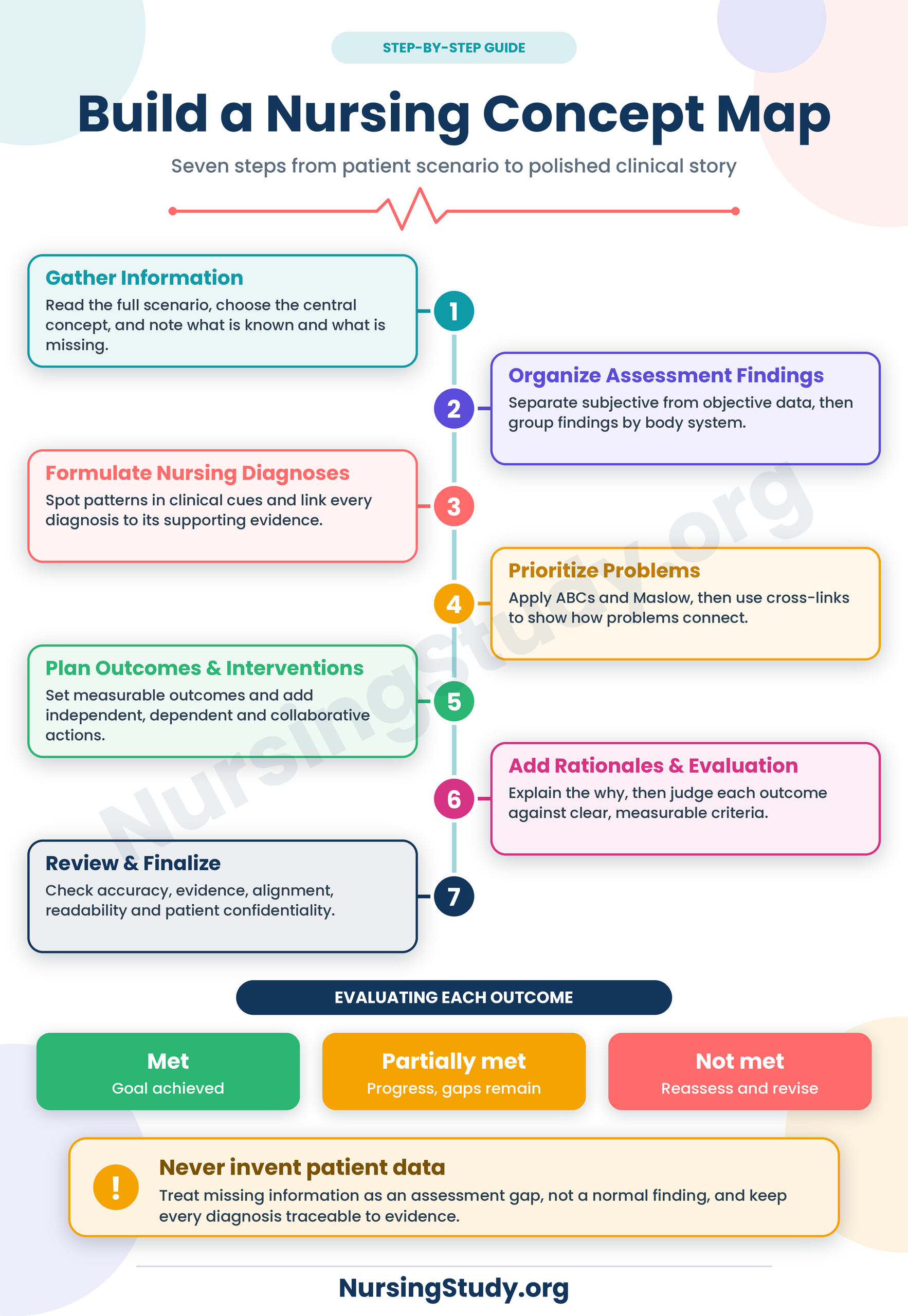
Using Concept Maps for Clinical Handoffs and Team Collaboration
Clinical handoffs and team collaboration are essential parts of safe and coordinated patient care. Patients may receive care from several nurses and healthcare professionals during admission, treatment, transfer, and discharge. Each professional needs an accurate understanding of the patient’s condition, current priorities, ongoing interventions, and potential risks.
Concept maps can support this process by providing a visual overview of important patient information and showing how different clinical problems are related. They may help teams understand complex cases, organize care responsibilities, and identify areas requiring coordinated intervention.
However, a concept map should supplement established handoff and documentation systems rather than replace them. Formal handoff procedures, structured communication tools, and the patient’s official clinical record remain essential for communicating current orders, treatment changes, safety concerns, and other time-sensitive information.
Providing a visual overview of patient conditions
A patient with multiple medical conditions may have several interconnected nursing problems. A written summary may list these problems, but it may not clearly demonstrate how they influence one another.
A concept map can provide a broader visual picture of the patient’s condition by connecting medical diagnoses, assessment findings, nursing diagnoses, treatment requirements, and expected outcomes.
For example, consider an older adult admitted with heart failure, type 2 diabetes, and reduced mobility. The patient’s care may involve:
- Monitoring fluid balance and respiratory status.
- Assessing blood glucose levels.
- Administering prescribed medications.
- Monitoring skin integrity and foot condition.
- Supporting safe mobility.
- Providing education about medication adherence and self-management.
These responsibilities involve several aspects of nursing care. A concept map can help show how the patient’s conditions interact and why different healthcare professionals may need to contribute to the care plan.
The visual representation can also help team members recognize shared priorities. For example, a mobility intervention may need to account for the patient’s cardiovascular tolerance, blood glucose management, and risk of falls.
Supporting structured clinical handoffs
During a shift change or transfer, nurses must communicate essential information about the patient’s current condition and ongoing care. Missing or unclear information can contribute to misunderstandings, delays, or gaps in treatment.
A concept map may serve as a supplementary visual reference during handoffs, particularly when a patient has multiple nursing diagnoses or complicated care requirements.
For example, a concept map for a patient recovering from major abdominal surgery may highlight:
| Area of care | Information to communicate |
|---|---|
| Current condition | Postoperative status and relevant changes since the previous assessment |
| Priority concerns | Pain, respiratory status, wound condition, mobility, and other identified problems |
| Nursing diagnoses | Current priority nursing problems supported by assessment findings |
| Ongoing interventions | Prescribed medications, monitoring, wound care, and mobility assistance |
| Potential complications | Relevant risks requiring continued observation |
| Expected outcomes | Progress toward pain control, safe mobility, wound recovery, and other goals |
| Follow-up requirements | Pending investigations, reassessments, and actions requiring completion |
The concept map can help organize the discussion, but the receiving nurse must still obtain the necessary details through the approved handoff process.
For instance, a map may identify pain management as a priority, but the handoff should also communicate the latest pain assessment, medication administration time, response to treatment, and any relevant changes in the patient’s condition. Similarly, a branch indicating wound monitoring does not replace specific documentation of the wound’s appearance and the required care.
Improving communication among healthcare professionals
Patient care often involves collaboration between nurses, physicians, pharmacists, physiotherapists, occupational therapists, dietitians, and other professionals. Each team member contributes expertise that supports the patient’s treatment and recovery.
Concept maps can help illustrate how these responsibilities relate to the patient’s overall care needs.
For example, a patient recovering from a stroke may require coordinated care involving:
- Nurses, who monitor neurological status, support daily care, administer prescribed medications, and identify changes in condition.
- Physicians, who assess the patient’s medical condition and direct medical management.
- Physiotherapists, who support mobility, balance, and physical rehabilitation.
- Occupational therapists, who help improve independence in daily activities.
- Speech-language therapists, who assess and manage communication and swallowing difficulties.
- Dietitians, who help address nutritional requirements and feeding considerations.
A concept map can connect these professional contributions to the patient’s identified problems and rehabilitation goals. It may show, for example, how swallowing difficulties influence nutritional intake and aspiration risk, while communication difficulties may affect the patient’s ability to express needs.
This shared visual understanding can help team members appreciate how their individual responsibilities contribute to broader patient outcomes.
Identifying gaps and coordinating care priorities
Another application of concept mapping in team collaboration is identifying areas where patient needs may not be adequately addressed.
When different problems and interventions are displayed together, it becomes easier to recognize missing assessments, unclear responsibilities, or goals that require additional input from the healthcare team.
For example, a patient with a diabetic foot ulcer may require wound management, glycemic monitoring, infection assessment, nutritional support, and mobility guidance. If the concept map identifies impaired skin integrity but contains no clear plan for assessing circulation or addressing pressure on the affected foot, the team may recognize the need for further assessment and appropriate referrals.
Similarly, a patient with poor medication adherence may benefit from collaboration involving nursing education, medication review, pharmacy support, and discharge planning.
The concept map does not independently assign professional responsibilities or authorize treatment changes. Instead, it helps make care requirements visible so that the appropriate team members can discuss and coordinate the necessary actions.
Supporting discharge planning and continuity of care
Concept mapping can also help organize information needed when patients transition from hospital care to home, rehabilitation facilities, or other healthcare settings.
Discharge planning involves more than confirming that a patient is medically ready to leave the hospital. The team must consider ongoing treatment, medication management, functional ability, follow-up appointments, patient education, and available support systems.
A concept map can bring these requirements together.
For example, a patient discharged after a heart failure admission may require:
- Understanding of prescribed medications and their administration schedules.
- Education about monitoring symptoms and reporting worsening breathlessness or swelling.
- Individualized guidance on dietary sodium and fluid management where prescribed.
- Instructions about daily weight monitoring where recommended.
- Follow-up appointments and access to appropriate healthcare services.
- Support with mobility and daily activities when necessary.
These elements can be connected to the patient’s discharge goals and identified barriers to self-management.
A visual map may also help the team recognize whether the patient has adequate support to follow the discharge plan. For instance, difficulty understanding medication instructions, limited mobility, or lack of access to follow-up care may require additional planning.
The final discharge instructions and clinical documentation must still contain the specific information required by the receiving provider and applicable institutional procedures.
Important considerations when using concept maps for team communication
Although concept maps can improve the organization of patient information, they must be used appropriately in clinical communication.
- Keep information current: Patient conditions and treatment plans can change rapidly. An outdated map may misrepresent the patient’s current needs.
- Use clear terminology: All team members should be able to understand the concepts, abbreviations, and linking phrases.
- Distinguish confirmed findings from potential problems: Avoid presenting suspected conditions or possible complications as established diagnoses.
- Protect patient confidentiality: Share maps only through approved channels and with authorized individuals.
- Maintain formal documentation: Record assessments, medication administration, treatment changes, and other required information in the appropriate clinical record.
- Use structured handoff procedures: Follow established communication frameworks and escalation protocols rather than relying on a visual diagram alone.
- Encourage team input: Update relevant information through appropriate clinical discussions and collaboration.
Concept maps are most effective when they complement professional communication and established nursing procedures. Their value lies in helping healthcare professionals see the broader relationships between patient problems, planned interventions, and expected outcomes.
Across nursing assignments, clinical rotations, handoffs, and team collaboration, concept mapping provides a practical way to organize complex information and make clinical reasoning more visible. It supports the transition from theoretical learning to clinical application while encouraging a more connected approach to patient assessment, nursing diagnoses, care planning, and evaluation.
Conclusion
A concept map in nursing is more than a visual arrangement of patient information; it is a practical tool for connecting clinical knowledge, strengthening reasoning, and supporting informed nursing decisions. By bringing together patient assessment findings, medical conditions, nursing diagnoses, expected outcomes, interventions, and evaluation criteria, concept mapping helps nurses develop a clearer understanding of how different aspects of a patient’s health influence one another.
Its value extends across nursing education and clinical practice. In academic settings, concept maps help organize case studies, apply theoretical knowledge, and demonstrate an understanding of complex nursing concepts. During clinical rotations, they support patient assessment, clinical preparation, prioritization, and reflective learning. In healthcare teams, they can provide a shared visual overview of patient needs and support coordinated care, provided they complement established documentation and communication procedures.
Creating an effective nursing concept map requires accurate patient information, logical connections, appropriate nursing terminology, and sound clinical judgment. The goal is not to include every available detail but to highlight the relationships that matter most to patient care. Whether using a basic nursing concept map template, a digital tool, or a more detailed clinical diagram, nurses should ensure that the information is relevant, evidence-based, individualized, and easy to interpret.
As nursing practice continues to involve increasingly complex patient needs, the ability to organize information and recognize clinical relationships remains essential. Concept mapping provides a structured approach to developing these skills, promoting thoughtful decision-making, and maintaining a holistic focus on patient outcomes
Frequently Asked Questions
1. Can you give me some examples of nursing concepts?
Examples of nursing concepts include patient safety, pain management, infection prevention, oxygenation, fluid and electrolyte balance, mobility, nutrition, wound healing, patient education, and therapeutic communication. These concepts guide nursing assessment, diagnoses, interventions, and patient care.
2. What is a concept map and example?
A concept map is a visual diagram that organizes information and illustrates relationships between related ideas. For example, a heart failure concept map may connect reduced cardiac function to fluid retention, peripheral edema, shortness of breath, and fatigue. These findings can then be linked to nursing diagnoses, interventions, and expected patient outcomes.
3. Can ChatGPT create a concept map?
Yes. ChatGPT can create nursing concept maps using text-based diagrams, tables, and structured layouts. It can organize patient assessment findings, nursing diagnoses, goals, interventions, and rationales into a visual representation. It can also help develop concept map templates and examples for conditions such as diabetes, pneumonia, and heart failure.
4. How to prepare a concept map?
To prepare a concept map, follow these steps:
- Identify the central topic or patient condition.
- Gather relevant patient information and assessment findings.
- Organize the information into related categories.
- Identify appropriate nursing diagnoses and priority problems.
- Connect related concepts using lines, arrows, and linking phrases.
- Add expected outcomes, nursing interventions, and rationales.
- Include evaluation criteria and review the map for accuracy and clarity.
