

Mary Eliza Mahoney: First African American Nurse, First Black Nurse in American Nursing and Black History of African-American Nurses
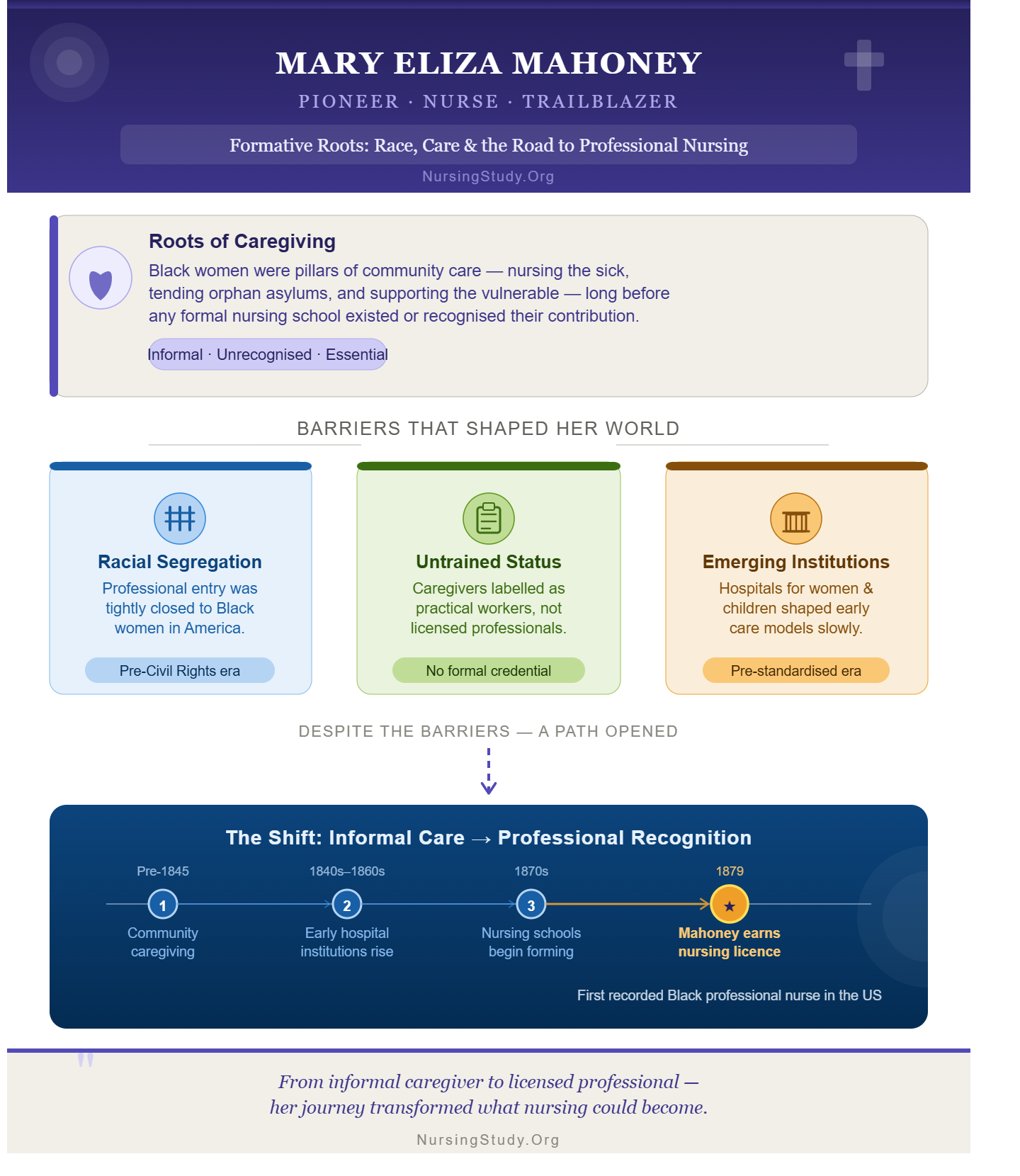
Mary Eliza Mahoney represents a foundational figure in the evolution of American nursing, particularly in the transition from informal caregiving practices to a structured, professionally regulated healthcare discipline. Her historical significance lies not only in her individual achievements but also in the broader social and institutional changes that shaped nursing during the late 19th century. At a time when nursing was beginning to develop standardized education and formal hospital-based training programs, access to these emerging systems was highly restricted, especially for Black women and other marginalized groups. Within this context, her emergence as a professionally trained nurse marks an important moment in the history of both nursing education and Black history in the United States.
The development of nursing as a profession during this period was influenced by several intersecting factors that shaped who could participate in formal healthcare training and how nursing roles were defined. These include:
- Professionalization of nursing practice
- Nursing was shifting from informal, unregulated caregiving into a recognized profession
- Hospitals began introducing structured training programs for nurses
- Emphasis was placed on discipline, hygiene, and standardized patient care practices
- Limited access to nursing education
- Nursing schools were few and highly selective
- Admission policies often excluded African American women
- Training opportunities were concentrated in segregated or restrictive institutions
- Social and racial context of healthcare
- Broader societal segregation influenced access to education and employment
- Black women were largely confined to informal caregiving or domestic labor roles
- Representation in formal healthcare systems was extremely limited
- Emergence of nursing as a professional identity
- Nursing began to establish itself as a skilled and regulated occupation
- Formal training became a marker of professional legitimacy
- The role of the nurse was increasingly defined through education and certification rather than informal experience
Within this evolving landscape, the significance of Mary Eliza Mahoney’s place in history becomes clearer. Her life and work are best understood as part of a broader transformation in nursing, where questions of access, education, and professional recognition were central to the development of the field.
Early Life and Black History Context of African-American Nurses in American Nursing
The historical emergence of mary eliza mahoney within American nursing must be understood through the broader development of american nursing and the lived realities of black women and the african-american nurse identity in the 19th century. During this period, nursing was transitioning into a regulated nursing profession, yet access remained highly unequal. The social conditions that shaped mary mahoney’s early environment reflect a healthcare system still in formation, influenced by institutions such as the hospital for women and children and the new england hospital for women, where early structured care and nursing education were beginning to develop.
Early life, upbringing, and formative influences
The life of mary eliza mahoney was born into a historical period marked by racial segregation and limited professional access for african american woman seeking entry into healthcare. Her formative environment reflects the broader reality of black history, where caregiving roles for black nurse figures were often informal and unrecognized.
Key formative realities included:
- Early caregiving exposure
- Many black women participated in informal caregiving within households and communities
- These roles resembled aspects of public nursing, but were not recognized as professional practice
- Care responsibilities often included support for vulnerable populations such as those in the orphan asylum for black children and colored orphan asylum for black institutions
- Social and institutional limitations
- Before structured training, many caregivers were considered untrained practical nurse workers
- Opportunities for advancement into formal nursing school systems were extremely limited
- The concept of a licensed nurse or professionally trained nurse was still emerging in American healthcare
- Early healthcare institutional context
- Institutions such as the hospital for women and children played a role in shaping early care models
- The nursing program structure was still developing prior to standardized professionalization
- By 1845, early reforms in healthcare education had not yet fully opened access to African American participants
- Emerging pathway toward professional nursing
- The later establishment of structured nursing education created limited pathways for advancement
- The transition toward recognizing a trained nurse in the united States marked a shift from informal caregiving to professional standards
- This shift would eventually lead to recognition of individuals as professional nurse practitioners
Pressed for time after clinical rotations?
We’ll complete your nursing assignment while you focus on practice.
Status of Black women and African-American nurses in 19th-century American nursing
The status of first african american and first black women in nursing during the 19th century reflects systemic exclusion from formal healthcare systems and professional recognition. Within american nursing, racial segregation and gender inequality significantly restricted participation in formal training programs such as those offered by the new england hospital for women and similar institutions.
Key historical conditions included:
- Exclusion from formal nursing institutions
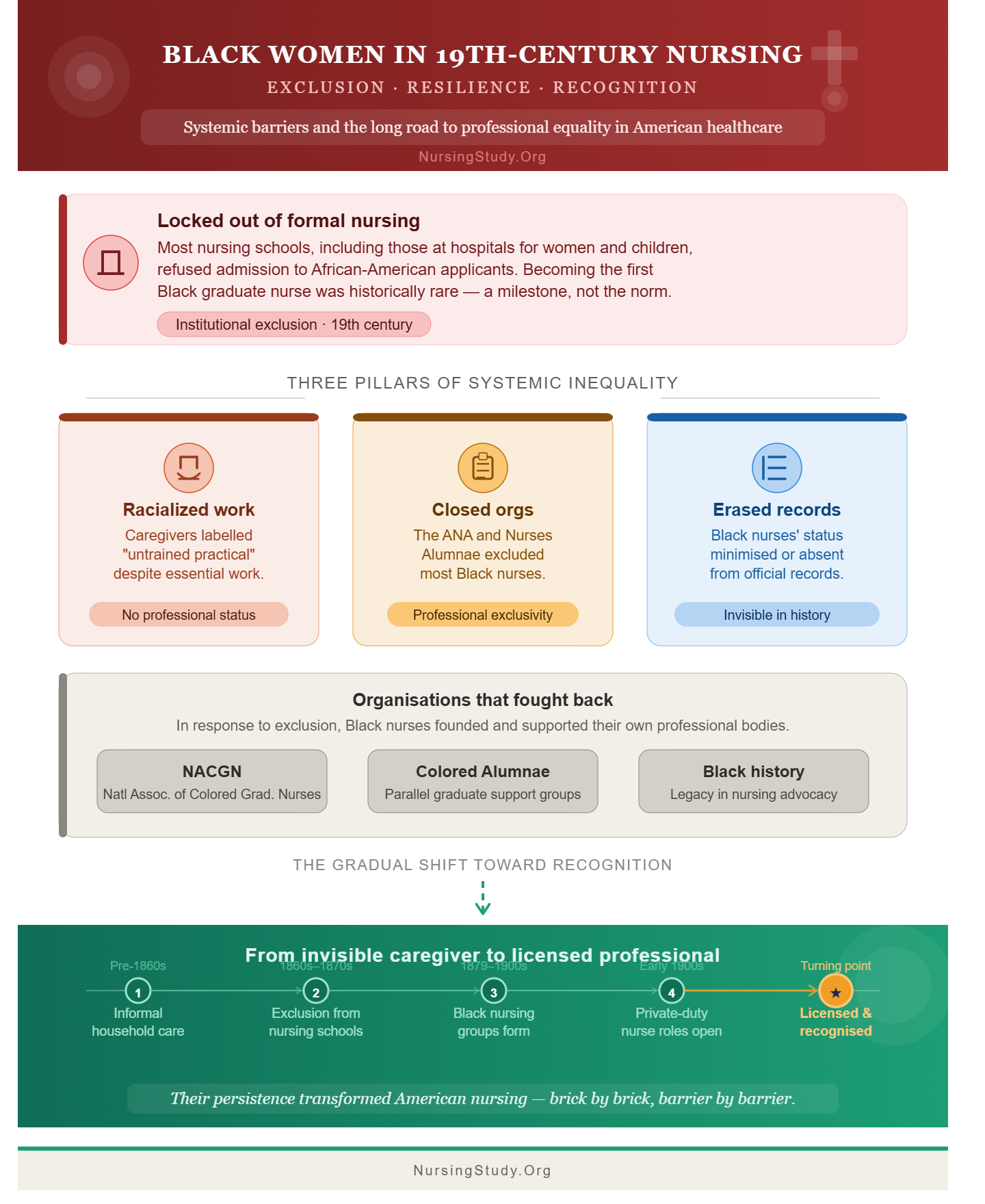
- Many nursing institutions did not admit African Americans into formal nursing school programs
- The nursing program structure was largely inaccessible to Black applicants
- The idea of becoming a first african american to graduate from a nursing school was historically rare
- Professional barriers in nursing organizations
- Early nursing organizations such as the nurses associated alumnae and later the american nurses association (ana) excluded many Black nurses
- These exclusions reinforced inequality within the nursing profession
- Efforts toward inclusion would later be supported through groups such as the association of colored graduate nurses (nacgn) and the broader national association of colored graduate initiatives
- Racialized structure of nursing work
- Many African American caregivers were categorized as untrained practical nurse workers despite providing essential care
- The distinction between informal caregivers and professionally trained nurse status was heavily racialized
- White institutions such as white nurses associated alumnae maintained professional exclusivity
- Limited recognition and early professional inequality
- The status of african-american nurse professionals was often minimized in institutional records
- Recognition as america’s first professionally trained nurses for Black women was rare
- Early barriers delayed equal access to equal opportunities in nursing
- Historical significance within Black history
- These conditions form a critical part of black history month reflections in nursing
- The lack of access to first integrated schools and professional systems reinforced inequality
- The eventual emergence of recognized Black nurses marked a turning point toward inclusion in american association healthcare structures
- Pathway toward professional recognition
- Over time, structured institutions such as the school of nursing and later professional bodies began formalizing standards
- This shift created conditions where African American women could eventually become recognized as a first african american woman licensed practitioner
- The transition from informal care to private-duty nurse and licensed nurse roles reflects the gradual professionalization of nursing
Nursing Education (1878–1879) and the First African American Graduate Nurse in the United States
The period between 1878 and 1879 represents a defining moment in the evolution of american nursing, particularly in the formalization of nursing education as a structured pathway into the nursing profession. During this time, hospital-based training systems were emerging as the dominant model for preparing a professionally trained nurse, replacing earlier reliance on informal caregiving by untrained practical nurse workers. Within this shifting landscape, the educational journey of mary eliza mahoney became historically significant, as it marked a breakthrough for black women and the broader recognition of the african-american nurse in professional healthcare.
At a time when access to nursing school programs was highly restricted, particularly for first african american and first black women, the existence of structured training institutions such as the new england hospital for women and the hospital for women and children created rare opportunities for formal instruction. These institutions played an important role in shaping early nursing program structures, combining classroom instruction with supervised clinical experience in patient care. However, entry into such programs remained highly selective, and many African American women were excluded from participation in the emerging professional system of american nursing.
Training at the New England Hospital for Women and Children nursing school
The new england hospital for women was one of the few institutions in the United States during this period that contributed to the development of structured nursing training for women. Within its nursing school, the nursing program was designed to provide both theoretical knowledge and hands-on clinical experience, reflecting early models of formalized healthcare education.
Key features of the training environment included:
- Structured clinical instruction
- Students were trained in bedside care within hospital wards
- Practical experience was combined with observation and supervised practice
- Emphasis was placed on discipline, hygiene, and patient management
- Emerging standards of nursing practice
- Training focused on transforming caregiving into a regulated nursing profession
- Students were expected to demonstrate consistency, responsibility, and ethical care
- This marked a shift from informal caregiving toward recognized professional nurse identity
- Limited access for African American women
- Admission opportunities for african american woman applicants were extremely rare
- The presence of a Black trainee within such a system was highly unusual in american nursing at the time
- This reflects the broader exclusion of black nurse candidates from formal education systems
Within this context, mary mahoney entered a structured environment that was still defining the standards of modern nursing practice. The training she received represented one of the earliest forms of standardized professional preparation in the United States.
Becoming the first African American to graduate from a nursing program in the United States
The completion of the nursing program between 1878 and 1879 marked a historic milestone in black history and the evolution of american nursing. By successfully completing the training at the new england hospital for women, mary eliza mahoney was born into historical recognition as the first african american to graduate from a formal nursing program in the United States.
This achievement carried multiple layers of significance:
- Professional recognition in nursing education
- Graduation represented formal acknowledgment as a licensed nurse equivalent within emerging standards
- It signified transition from informal caregiving to a trained nurse in the united States healthcare system
- It established a precedent for African American participation in structured healthcare training
- Breaking racial and gender barriers
- At a time when most nursing schools excluded Black applicants, this milestone challenged systemic norms
- It redefined possibilities for black women seeking entry into the nursing profession
- It positioned mary mahoney as a pioneering figure within early efforts toward equal opportunities in nursing
- Impact on the identity of African-American nurses
- Her graduation contributed to the early visibility of the african-american nurse within professional healthcare
- It helped shift perceptions of Black caregivers from informal workers to recognized professionals
- It laid groundwork for later recognition of first professionally trained african-american nurse status in nursing history
- Historical significance in American nursing development
- The milestone occurred during a critical phase of professionalization in american association healthcare systems
- It demonstrated that structured training systems such as the school of nursing could produce competent and qualified nurses regardless of race, even though access remained unequal
- It contributed to the broader narrative of america’s first professionally trained nurses emerging from formal institutions
A practical example of this significance can be seen in how trained nurses like mary mahoney were able to provide more consistent and structured care compared to untrained practical nurse caregivers. Her clinical competence reflected the value of formal education in improving patient outcomes and reinforcing the importance of standardized nursing education within healthcare systems.
Ultimately, this period solidified mary eliza mahoney’s place in black history month narratives and established her as a foundational figure in the transformation of nursing from informal caregiving into a recognized and structured profession.
Clinical Practice as a Black Nurse in American Healthcare
Following formal preparation in structured nursing education, the clinical practice of mary eliza mahoney reflects a critical phase in the evolution of american nursing from informal caregiving into a recognized nursing profession. During this period, the role of the african-american nurse was still emerging within a healthcare system shaped by racial segregation, limited institutional access, and unequal professional recognition. Despite these barriers, mary mahoney contributed meaningfully to early models of professional care, particularly through her work as a professionally trained nurse operating within both institutional and private care settings.
At a time when many caregivers were still classified as untrained practical nurse workers, her practice demonstrated the value of formal preparation and structured clinical judgment. Her role as a licensed nurse represented a transition in American healthcare toward recognizing nursing as a skilled and regulated occupation rather than informal domestic labor.
Private-duty nursing and early professional nursing practice in the United States
One of the most defining aspects of mary mahoney’s career was her work in private-duty nurse practice, a dominant model of professional nursing in the late 19th and early 20th centuries. Private-duty nursing involved providing individualized, continuous care to patients in private homes, hospitals, and charitable institutions such as the orphan asylum for black children and other community-based care environments.
Key characteristics of private-duty nursing during this period included:
- Individualized patient care
- Nurses were assigned to a single patient for extended periods
- Care included monitoring symptoms, administering comfort measures, and supporting recovery
- This model required strong clinical judgment and adaptability
- Expansion of professional nursing roles
- Private-duty nursing represented one of the earliest forms of structured employment for a nurse in the united states
- It contributed to the recognition of nursing as a paid and specialized service within american association healthcare systems
- Nurses like mary mahoney helped establish expectations for reliability and professionalism in patient care
- Work across diverse care environments
- Care settings ranged from private homes to institutions such as the hospital for women and children
- Nurses also supported vulnerable populations in charitable institutions, including facilities serving marginalized communities
- This work demonstrated the expanding reach of public nursing services
- Professional distinction from informal caregivers
- Private-duty nurses were distinguished from untrained practical nurse workers through formal training
- This distinction reinforced the importance of structured nursing school preparation and clinical competency
- It contributed to the gradual professionalization of nursing practice in the United States
Through these experiences, mary mahoney helped demonstrate that nursing required not only compassion but also technical skill, discipline, and formal education, reinforcing the identity of the professional nurse within the evolving healthcare system.
Development of professional nursing standards and patient-centered care
The clinical work of mary eliza mahoney also coincided with the broader development of standardized practices within american nursing, where nursing was increasingly defined by formal expectations, ethical principles, and structured care delivery. During this period, institutions such as the new england hospital for women and other early training environments contributed to shaping the foundation of modern nursing standards.
Key developments in professional nursing standards included:
- Emergence of standardized care practices
- Nurses were expected to follow consistent procedures in hygiene, observation, and patient monitoring
- Training emphasized accuracy, discipline, and accountability in clinical tasks
- These standards marked a shift toward regulated nursing education outcomes
- Focus on patient-centered care
- Care increasingly emphasized the needs, comfort, and dignity of patients
- Nurses provided emotional support in addition to physical care
- This approach aligned with early principles of holistic care in the nursing profession
- Role of trained nurses in improving healthcare quality
- The presence of a first african american trained nurse demonstrated the value of formal education in improving patient outcomes
- Structured training reduced reliance on inconsistent caregiving practices
- It strengthened the credibility of licensed nurse professionals within healthcare systems
- Early contribution to nursing identity formation
- Nurses began to be recognized as skilled healthcare providers rather than assistants to physicians
- The role of mary mahoney reflected this transition toward professional autonomy
- Her work contributed to the broader identity of the african-american nurse within the healthcare workforce
- Illustrative example of professional practice
- In private care settings, trained nurses were responsible for observing patient conditions, maintaining hygiene standards, and reporting changes in health status
- For example, a professionally trained nurse like mary mahoney would be expected to maintain continuous observation of a recovering patient, ensuring comfort while also preventing complications through early detection of changes in condition
- This level of structured responsibility distinguished professional nursing from informal caregiving roles
Through these contributions, mary eliza mahoney played a role in reinforcing early expectations of nursing professionalism, helping to establish standards that would later become central to modern american nursing practice. Her clinical work illustrates the gradual transformation of nursing into a regulated and respected profession grounded in education, skill, and patient-centered care.
Barriers Faced by the First Black Nurse in American Nursing History
The professional journey of mary eliza mahoney within american nursing must be understood alongside the persistent structural barriers that shaped the experiences of the african-american nurse in the late 19th and early 20th centuries. While the nursing profession was undergoing formalization through expanding nursing education and hospital-based training systems, access to these opportunities remained deeply unequal. The reality for a black nurse during this period was one of limited institutional access, restricted employment pathways, and systemic exclusion from professional recognition. These barriers were not isolated challenges but were embedded in the broader social and healthcare structures of the time.
Racial and gender discrimination in nursing education and healthcare employment
The most significant obstacles faced by mary mahoney and other black women in american nursing were rooted in intersecting systems of racial and gender discrimination. Although nursing was becoming a structured nursing profession, the distribution of opportunities was heavily shaped by segregation and exclusionary policies.
1. Discrimination in nursing education and training access
Access to formal nursing school programs was one of the most significant barriers for African American women.
- Many training institutions explicitly denied admission to first african american and first black applicants
- Hospitals offering structured nursing program education often enforced racial segregation in admissions
- Even when training opportunities existed, they were typically limited to segregated or charitable institutions
- The expectation that a professionally trained nurse should come from approved institutional backgrounds excluded many qualified African American candidates
For example, while institutions such as the new england hospital for women and the hospital for women and children contributed to early nursing training models, access remained highly selective. This meant that becoming a licensed nurse or completing structured nursing education was an exceptional achievement for African American women rather than a standard pathway.
2. Employment discrimination in healthcare institutions
After training, African American nurses faced continued exclusion in healthcare employment settings.
- Hospitals frequently refused to hire african-american nurse professionals regardless of qualifications
- Employment opportunities were often limited to domestic service or informal caregiving roles
- Many black nurse professionals were restricted to private-duty work rather than institutional hospital positions
- Even when employed, they often lacked equal pay and recognition compared to white counterparts
In practice, this meant that a nurse in the united states who was Black could be highly trained yet still excluded from mainstream hospital systems, reinforcing inequality within the american association healthcare structure.
3. Gender-based limitations within the nursing profession
In addition to racial discrimination, black women also faced gender-based barriers within the evolving healthcare system.
- Leadership positions in nursing were largely controlled by white institutional authorities
- Opportunities for advancement within the nursing profession were limited for women of color
- Professional nursing organizations often excluded African American women from membership
- Gender expectations reinforced caregiving roles rather than leadership or administrative positions
This dual discrimination meant that African American women were often excluded from both professional authority and institutional decision-making within american nursing.
4. Exclusion from professional nursing organizations
Professional recognition was a critical component of nursing identity, yet African American nurses were largely excluded from major associations.
- Organizations such as early nursing associations limited or denied membership to Black nurses
- This exclusion prevented participation in professional networking and continuing education
- Lack of representation reduced visibility of first african american woman nurses in professional spaces
- It reinforced a divide between formally recognized nurses and marginalized practitioners
As a result, even highly skilled professionally trained nurse practitioners like mary mahoney operated in a system that did not fully recognize their professional legitimacy.
5. Structural inequality in healthcare systems
The barriers faced by African American nurses were not incidental but structural within american nursing systems.
- Segregation policies influenced hospital staffing and patient care assignments
- Training institutions often reflected broader societal racial hierarchies
- Access to clinical experience was uneven and often restricted for Black trainees
- The pathway to becoming a licensed nurse was shaped by institutional gatekeeping rather than merit alone
For example, even when African American nurses demonstrated competence equivalent to their peers, they were often denied access to the same employment networks or professional advancement opportunities. This reinforced long-standing inequities within the nursing profession.
6. Impact of these barriers on professional identity
These combined forms of discrimination had long-term effects on the professional identity of African American nurses.
- Limited access to recognition delayed full inclusion of african-american nurse professionals in mainstream nursing history
- Black nurses were often categorized as auxiliary caregivers rather than equal professionals
- The contributions of mary mahoney and others were historically underrepresented in early accounts of black history in healthcare
- These conditions highlighted the urgent need for later advocacy around equal opportunities in nursing
Advocacy for African American Nurses and Equality in American Nursing
The advocacy work associated with mary eliza mahoney represents a critical phase in the evolution of american nursing, particularly in the struggle for equal opportunities in nursing for black women and the broader african-american nurse community. While the nursing profession was becoming more structured through formal nursing education, access to professional recognition and organizational membership remained unequal. African American nurses were often excluded from mainstream institutions, reinforcing disparities within the healthcare system. In response, advocacy movements emerged to challenge these inequalities and promote inclusion, professionalism, and representation for black nurse practitioners.
Leadership in the National Association of Colored Graduate Nurses (NACGN)
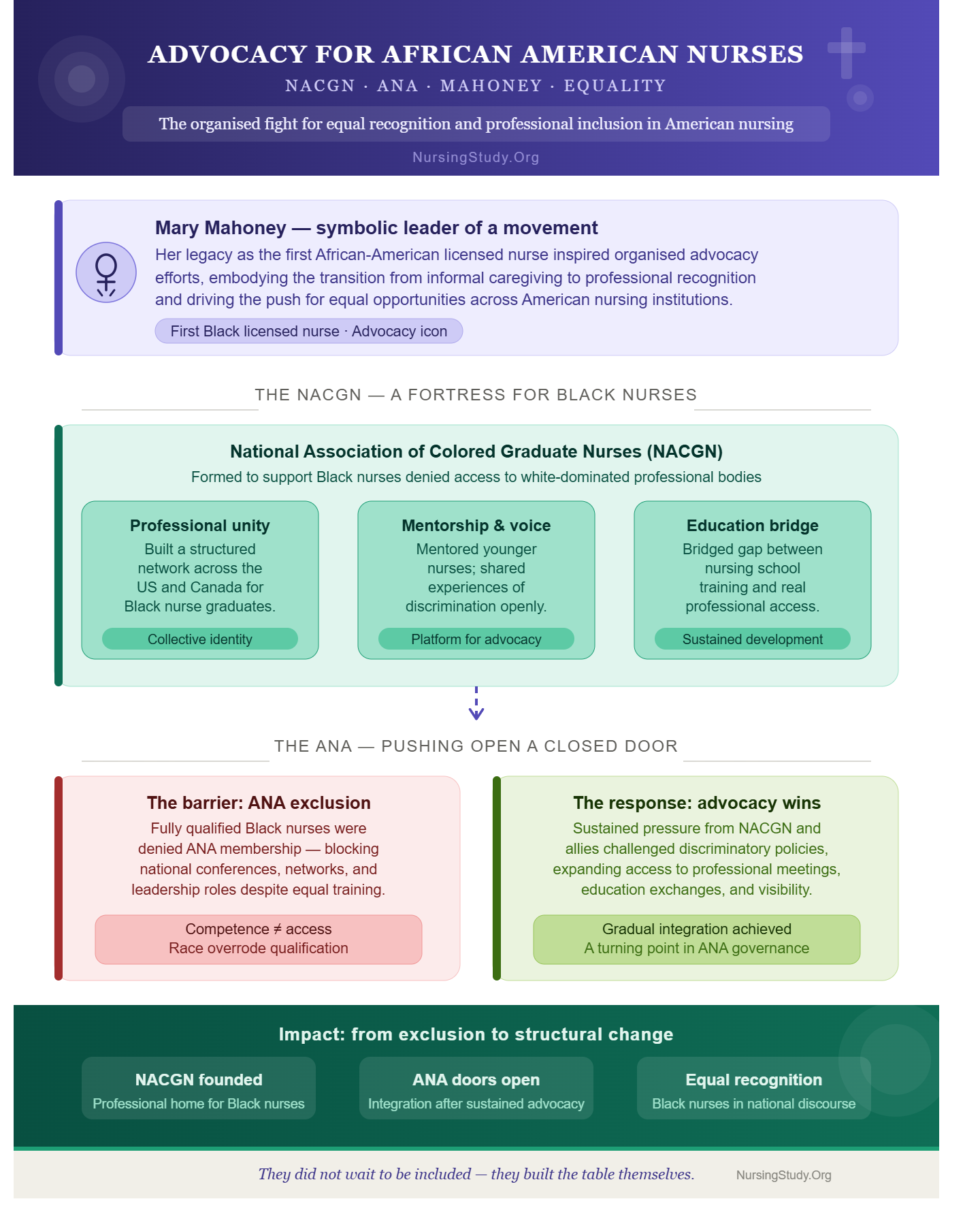
One of the most significant developments in the history of African American nursing advocacy was the establishment and growth of the association of colored graduate nurses, also known as the nacgn or the national association of colored graduate nurses. This organization became a central platform for advancing the professional interests of African American nurses who were excluded from mainstream nursing bodies.
Key aspects of NACGN leadership and influence include:
1. Purpose and formation of NACGN
- The nacgn was formed to support african-american nurse professionals who were denied access to white-dominated nursing organizations
- It provided a structured professional network for Black nurses across the united states and canada
- The organization promoted professional identity among professionally trained nurse practitioners who were otherwise marginalized
2. Professional development and unity
- NACGN encouraged collaboration among black women working in healthcare
- It supported continuing education and skill development within the nursing profession
- It helped establish a sense of collective identity among African American nurses as legitimate contributors to american nursing
3. Connection to early nursing institutions
- Many members had trained in institutions such as the new england hospital for women and the hospital for women and children
- These nurses used their training to strengthen advocacy for recognition in broader healthcare systems
- The organization helped bridge the gap between formal nursing school education and professional opportunity
4. Role of mary mahoney in symbolic leadership
- mary mahoney served as a powerful symbolic figure representing the achievements of the first african american and first black nurses in professional nursing history
- Her legacy inspired advocacy efforts aimed at improving representation and inclusion
- She embodied the transition from informal caregiving to recognized licensed nurse status
5. Example of advocacy impact
- NACGN provided mentorship opportunities for younger African American nurses
- It created platforms for sharing experiences of discrimination in employment and training
- It strengthened advocacy for fair treatment of african-american nurse professionals in hospitals and institutions
Through these efforts, NACGN became a foundational organization in the advancement of African American nursing leadership and professional solidarity within american association healthcare systems.
Advocacy for inclusion in the American Nurses Association (ANA)
The american nurses association (ana) represented one of the most influential professional bodies in american nursing, yet historically it excluded African American nurses from full participation. Advocacy for inclusion within the ANA became a central focus of equity efforts led by organizations such as NACGN and supported by the legacy of mary eliza mahoney.
1. Exclusion from professional recognition
- African American nurses were often denied membership in the ANA despite being fully qualified professionally trained nurse practitioners
- This exclusion limited access to national conferences, professional networks, and leadership opportunities
- It reinforced inequality between white nurses and black nurse professionals
2. Advocacy for professional equality
- Efforts were made to challenge discriminatory membership policies within the ANA
- African American nurses argued for recognition based on competence rather than race
- Advocacy emphasized that a licensed nurse should be evaluated on training and skill, not racial identity
3. Role of organized nursing advocacy
- The association of colored graduate nurses (nacgn) played a key role in pushing for inclusion
- Advocacy groups highlighted disparities in nursing education access and professional advancement
- These efforts aligned with broader movements for equal opportunities in nursing
4. Gradual shift toward inclusion
- Over time, sustained advocacy contributed to the eventual integration of African American nurses into mainstream professional organizations
- This shift represented a major transformation in american nursing governance and professional structure
- It marked progress toward recognizing African American contributions to the nursing profession
5. Example of structural change
- As advocacy gained momentum, African American nurses began gaining increased visibility in national nursing discourse
- Participation in professional meetings and educational exchanges expanded opportunities for collaboration
- This helped elevate the status of the african-american nurse within national healthcare systems
Legacy in Black History and Recognition of African-American Nurses
The legacy of mary eliza mahoney within american nursing extends far beyond her individual achievements, representing a foundational shift in how the nursing profession recognizes the contributions of black women and the african-american nurse workforce. Her impact must be understood within the broader framework of black history, where her work symbolizes both professional excellence and the struggle for equal opportunities in nursing. As american nursing evolved through structured nursing education systems and formalized nursing school pathways, her legacy continued to serve as a reference point for inclusion, equity, and professional recognition of black nurse practitioners.
At the core of her legacy is the transformation of nursing identity in the United States—from a system that largely excluded African Americans to one that increasingly acknowledges the importance of diversity, representation, and professional contribution from all groups within healthcare.
Honors, awards, and recognition in nursing history and professional organizations
Over time, mary mahoney has been recognized as a pioneering figure in the development of professional nursing in the United States. These honors reflect her enduring influence on american association healthcare systems and her symbolic importance in advancing the status of the professionally trained nurse.
Key forms of recognition include:
1. Historical recognition in nursing institutions
- mary eliza mahoney is widely acknowledged in nursing history as one of the earliest first african american and first black professionally trained nurses in the United States
- She is recognized as a licensed nurse who helped redefine professional standards in early american nursing
- Her contributions are included in historical accounts of the nursing profession as foundational to its development
2. Nursing hall of fame recognition
- She has been honored through inclusion in the nursing hall of fame, reflecting her long-term impact on healthcare history
- Her legacy is also associated with broader national recognition systems, including the national women’s hall of fame
- These recognitions highlight her role as a pioneering african-american nurse in shaping healthcare equity
3. Professional awards and commemorations
- The mary mahoney award and mahoney medal were established to honor excellence in nursing practice and leadership
- These awards recognize contributions aligned with her values of professionalism, service, and advocacy for equal opportunities in nursing
- They continue to serve as benchmarks for excellence within the nursing profession
4. Commemoration in public health and history
- Her legacy is frequently highlighted during black history month celebrations in healthcare institutions
- Nursing organizations continue to reference her contributions when discussing diversity in american nursing
- She remains a symbolic figure for the advancement of african-american nurse representation in healthcare systems
Influence on African-American nurses and nursing education in the United States
The influence of mary eliza mahoney on African-American nurses and nursing education in the United States is both historical and ongoing. Her legacy continues to shape how institutions understand access, representation, and professional development within american nursing.
1. Expansion of educational opportunities
- Her achievement as one of the earliest graduates from structured nursing school systems helped demonstrate the capability of African American women in formal healthcare education
- Over time, this contributed to the gradual expansion of access for african american woman applicants in nursing programs
- It supported the broader movement toward integrating African American students into mainstream nursing education systems
2. Role model for African-American nurses
- mary mahoney became a symbolic reference point for aspiring black nurse professionals entering the healthcare field
- Her career demonstrated that a professionally trained nurse from an African American background could achieve recognition in a segregated system
- She provided a historical foundation for identity and pride among african-american nurse practitioners
3. Influence on professional standards and practice
- Her work reinforced the importance of formal training for nurse in the united states healthcare systems
- It contributed to the evolving expectation that nursing should be grounded in structured education rather than informal caregiving
- This shift strengthened the credibility of licensed nurse professionals across healthcare institutions
4. Long-term impact on equity in nursing
- Her legacy continues to inform discussions around equal opportunities in nursing and diversity in healthcare
- Nursing curricula increasingly include her contributions as part of black history education within healthcare programs
- She remains central to conversations about representation in the nursing profession
5. Example of educational influence
- In modern nursing programs, case studies on historical figures like mary eliza mahoney are used to illustrate the evolution of american nursing
- Students are taught how early african-american nurse pioneers helped shape professional standards despite systemic barriers
- This ensures that her legacy continues to influence both theoretical learning and professional identity formation
Lasting Impact on American Nursing, Black Nurses, and Healthcare Equity
The long-term impact of mary eliza mahoney on american nursing is deeply embedded in the historical development of the nursing profession, particularly in relation to professional identity, educational standards, and the advancement of black women in healthcare. Her contributions extend beyond her individual achievements as a professionally trained nurse, representing a broader transformation in how african-american nurse professionals are recognized within systems of care, education, and leadership. Within the context of black history, her legacy reflects both the challenges and progress associated with achieving equal opportunities in nursing and expanding access for black nurse practitioners in the United States.
Her influence continues to be relevant in discussions about healthcare equity, diversity in clinical practice, and the historical exclusion of marginalized groups from formal nursing education systems. As american nursing continues to evolve, her contributions remain a foundational reference point in understanding how nursing became a structured, regulated, and inclusive profession.
Contribution to the professionalization of nursing in the United States
The contribution of mary mahoney to the professionalization of nursing in the United States is closely tied to the broader transition from informal caregiving to structured, competency-based healthcare practice. During a time when many caregivers were still considered untrained practical nurse workers, her role as a licensed nurse helped reinforce the importance of formal education and clinical training in defining professional nursing standards.
Key contributions include:
1. Strengthening the identity of nursing as a formal profession
- Her work helped reinforce nursing as a structured nursing profession requiring formal nursing school education
- She demonstrated that nursing was not simply domestic caregiving but a skilled clinical discipline
- Her example supported the idea that a nurse in the united states should be trained, competent, and professionally accountable
2. Advancing standards of professional nursing practice
- Through her clinical work, she contributed to early expectations of consistency, hygiene, and patient-centered care in american nursing
- Her practice helped distinguish the professionally trained nurse from informal caregivers in healthcare settings
- This distinction strengthened the need for standardized nursing education systems
3. Supporting the evolution of structured nursing education
- Her success as one of the earliest graduates of formal training programs helped validate hospital-based education models
- Institutions such as the new england hospital for women and the hospital for women and children became key examples of structured nursing program development
- This helped shape future nursing curricula across the United States
4. Example of professional transformation in practice
- In early healthcare settings, patients were often cared for by individuals without formal training
- The introduction of trained professionals like mary eliza mahoney demonstrated improved consistency in patient outcomes
- This shift contributed to the broader acceptance of the licensed nurse as a necessary part of healthcare delivery systems
Enduring legacy in Black history and diversity in the nursing profession
The enduring legacy of mary eliza mahoney in black history and modern american nursing lies in her role as a symbol of resilience, professionalism, and progress for african-american nurse representation. Her achievements continue to influence how healthcare systems understand diversity, inclusion, and equity in professional practice.
1. Representation and visibility of Black nurses in healthcare history
- Her legacy ensures that the contributions of black women in nursing are formally recognized in historical narratives
- She remains a central figure in discussions of the first african american woman to achieve professional nursing status
- Her story challenges earlier exclusionary narratives within american association healthcare history
2. Influence on diversity in modern nursing
- Her legacy supports ongoing efforts to increase representation of black nurse professionals in healthcare institutions
- Nursing schools increasingly incorporate her contributions into diversity and inclusion curricula
- She serves as a model for addressing inequities in nursing education and workforce development
3. Symbol of healthcare equity and inclusion
- Her life reflects the importance of equal opportunities in nursing for all racial and ethnic groups
- She represents progress from exclusion toward inclusion within the nursing profession
- Her legacy is frequently referenced in initiatives focused on improving equity in american nursing systems
4. Example of continued educational impact
- Modern nursing programs use her story to illustrate the historical development of professional standards
- Students studying american nursing history learn how early African American pioneers shaped healthcare systems despite systemic barriers
- Her example is used to discuss how diversity strengthens healthcare delivery and patient outcomes
5. Connection to ongoing healthcare transformation
- Her legacy continues to influence discussions on workforce diversity and inclusion in healthcare policy
- Institutions recognize the importance of representation in improving trust and cultural competence in patient care
- The historical journey of mary mahoney remains relevant in shaping equitable healthcare systems today
Pressed for time after clinical rotations?
We’ll complete your nursing assignment while you focus on practice.
Conclusion
The historical journey of mary eliza mahoney occupies a defining place in the evolution of american nursing, illustrating how the nursing profession developed through both advancement and exclusion. Her emergence as one of the earliest professionally trained nurse figures in the United States marked a turning point in the recognition of formal nursing education and the gradual shift from informal caregiving to structured clinical practice. At the same time, her experience reflects the broader realities faced by black women and the african-american nurse workforce within a system shaped by racial segregation and gender inequality.
Across her life and legacy, mary mahoney represents more than an individual achievement; she embodies the transformation of nursing into a regulated profession and the persistent struggle for equal opportunities in nursing. Her contributions highlight how early barriers in nursing school access, professional recognition, and employment did not prevent African American nurses from shaping the foundations of healthcare practice in the United States. Instead, they underscore the resilience and determination that helped redefine what it meant to be a licensed nurse in a changing healthcare system.
Her influence continues to resonate within black history, where she is remembered as a symbol of progress, representation, and professional excellence. In modern american nursing, her legacy serves as a reminder that diversity and inclusion are not recent developments but long-standing aspirations rooted in the experiences of pioneers like her. The recognition of her role ensures that the history of nursing remains complete, acknowledging both its achievements and its inequities.
Ultimately, the story of mary eliza mahoney reinforces an essential truth within healthcare: the strength of the nursing profession lies in its ability to evolve toward fairness, inclusivity, and respect for all who contribute to it. Her legacy continues to guide ongoing efforts to build a more equitable and representative healthcare system, ensuring that the contributions of every african-american nurse are fully recognized and valued.
Frequently Asked Questions
Who was Mary Eliza Mahoney (1845–1926), America’s first Black professional nurse?
Mary Eliza Mahoney was an early African American pioneer in nursing history who became one of the first Black women to complete formal hospital-based nursing training in the United States. She graduated in 1879 from the New England Hospital for Women and Children, making her widely recognized as the first Black professional nurse in America and a trailblazer for racial equality in healthcare.
Who is Mary Mahoney?
Mary Mahoney is a historic figure in American nursing known for breaking racial barriers in professional healthcare. She is remembered as a trained nurse who worked primarily in private-duty nursing and as an advocate for African American nurses seeking equal opportunities in education and employment within the nursing profession.
How did Mary Eliza Mahoney impact nursing?
Mary Eliza Mahoney impacted nursing by challenging racial exclusion in nursing education and proving that African American women could meet professional nursing standards. Her success helped open doors for future Black nurses, influenced early nursing organizations, and strengthened advocacy for diversity, equity, and inclusion in healthcare.
What did nurse Mary do?
Nurse Mary (Mary Eliza Mahoney) provided skilled bedside care as a private-duty nurse, caring for patients in homes and hospitals with a focus on hygiene, comfort, and recovery. She also supported efforts to improve opportunities for Black nurses and played a symbolic leadership role in advancing professional recognition for African American women in nursing.
