

Subjective vs Objective in Nursing: Understanding the Difference Between Subjective and Objective Nursing Data in Patient Assessment
Introduction to Subjective vs Objective Data in Nursing
Understanding subjective vs objective data and why it matters in patient assessment
In clinical practice, Subjective vs Objective Data in Nursing forms the backbone of how patient information is interpreted and used to guide care. Every patient encounter generates data, and the ability to correctly classify and analyze that data determines the accuracy of clinical decisions. At its core, data is information collected during interactions with patients, and this information is essential for understanding health status, identifying problems, and planning appropriate interventions.
The difference between subjective and objective data is fundamental to effective nursing assessment:
- Subjective data refers to what the patient reports
- It includes symptoms, feelings, perceptions, and experiences
- It is often described as a subjective report because it cannot be directly measured
- Objective data refers to what can be observed or measured
- It includes vital signs, physical findings, and diagnostic results
- It is considered reliable because it is factual and verifiable
Understanding Subjective vs Objective Data in Nursing is critical because:
- It improves diagnostic accuracy
- Objective findings such as abnormal vital signs may confirm or challenge a patient’s subjective experience
- It supports clinical reasoning
- Nurses must interpret both types of data together to understand the full clinical picture
- It reduces errors in patient care
- Misinterpreting a data type can lead to incorrect nursing diagnoses or inappropriate interventions
For example:
- A patient may report severe chest pain (subjective data), but normal ECG results (objective data) may require further investigation rather than immediate conclusions.
This illustrates that understanding the difference between subjective and objective is not about choosing one over the other, but about integrating both effectively.
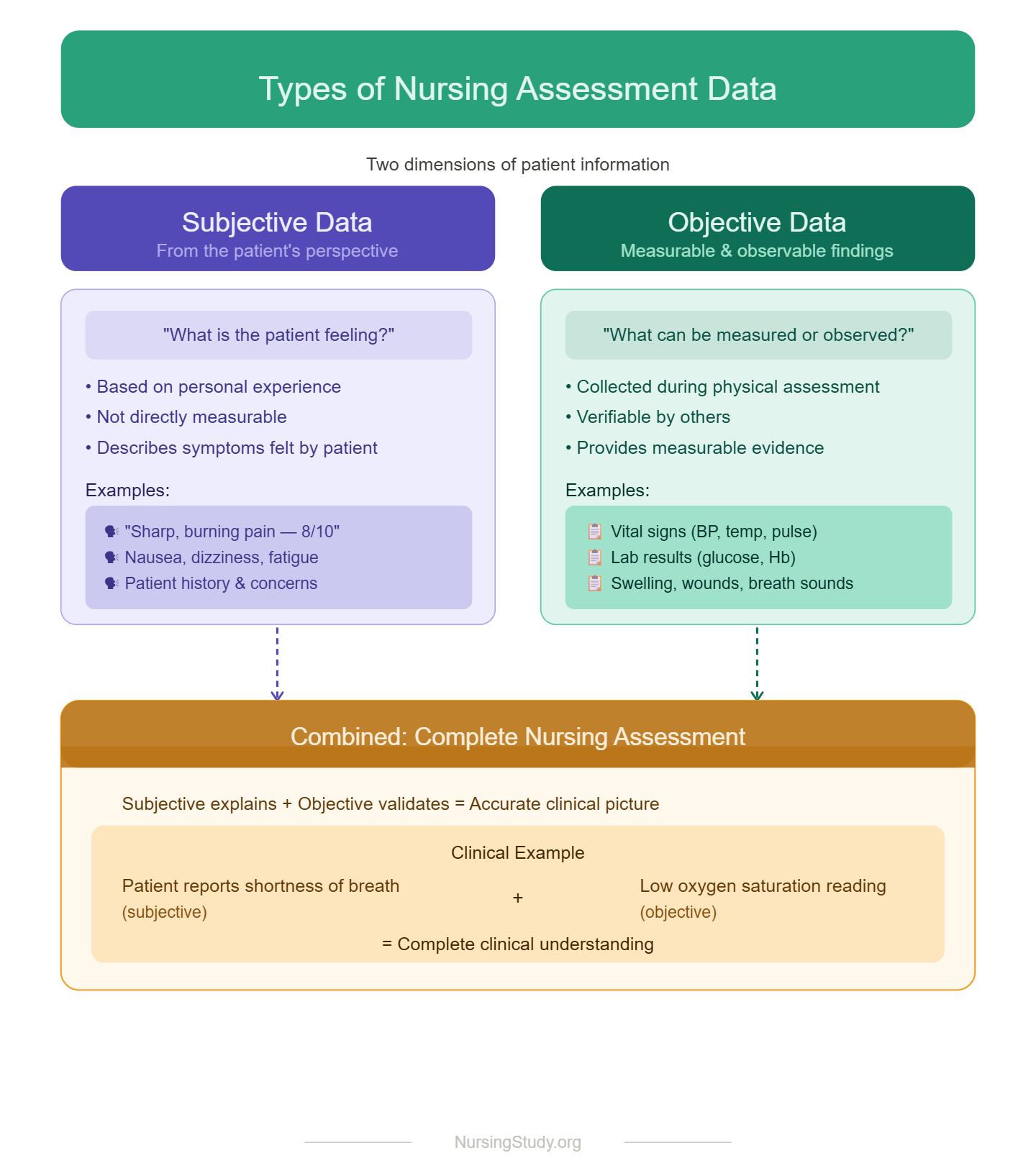
Overview of subjective and objective nursing data as two types of data
In nursing, two types of data are consistently used: subjective nursing data and objective nursing data. These data types represent different but equally important dimensions of patient information.
1. Subjective nursing data
Subjective data refers to information that comes directly from the patient’s perspective.
- It is based on the patient’s subjective experience
- It includes symptoms that cannot be directly measured
- It often answers the question: “What is the patient feeling or experiencing?”
Examples of subjective data include:
- Pain descriptions (“sharp,” “burning,” “8/10 pain”)
- Nausea or dizziness
- Fatigue or anxiety
- Patient history and personal concerns
In this sense, subjective data provides valuable context that cannot be obtained through physical assessment alone. It helps explain why a patient may be experiencing certain conditions.
2. Objective nursing data
Objective data, on the other hand, consists of objective findings that are measurable and observable.
- It is often collected during a physical assessment
- It includes information that can be verified by others
- It answers the question: “What can be measured or observed?”
Examples of objective data include:
- Vital signs (temperature, pulse, respiration, blood pressure)
- Laboratory results (blood glucose, hemoglobin levels)
- Physical signs (swelling, wounds, abnormal breath sounds)
In clinical terms, objective data is factual and provides measurable evidence that supports clinical decisions. This is why objective data in nursing is essential for confirming diagnoses and monitoring patient progress.
3. Relationship between subjective and objective data
Rather than functioning independently, subjective and objective data are most effective when used together. This relationship can be summarized as follows:
- Subjective data explains the patient’s experience
- Objective data validates and measures clinical findings
- Combining both types of data leads to accurate nursing assessment
For instance:
- A patient’s complaint of shortness of breath (subjective data) combined with low oxygen saturation levels (objective data) provides a clearer and more complete understanding of the patient’s condition.
Feeling stressed about writing a detailed nursing paper?
Let us produce a thorough, high-quality document.
The role of accurate data collection in nursing practice and nursing care
Accurate data collection is a foundational skill in nursing practice because all clinical decisions depend on the quality of the information gathered. Inaccurate or incomplete data may lead to:
- Misdiagnosis
- Ineffective care plans
- Delayed interventions
- Increased risk to patient safety
Within the Nursing Process, data is gathered during the assessment phase and influences every subsequent step. This makes it essential that nurses:
1. Collect subjective and objective data systematically
- Use structured interviews to collect subjective information
- Perform thorough physical assessments to collect objective data
- Ensure no critical patient data is overlooked
2. Ensure data accuracy and reliability
- Verify subjective data when possible (e.g., clarifying patient statements)
- Double-check objective findings (e.g., repeating abnormal vital signs)
3. Apply data to patient-centered care
- Use subjective and objective nursing data to develop an individualized care plan
- Adapt interventions based on both measurable outcomes and patient-reported experiences
Why accurate data is essential in nursing care
Accurate data is crucial because it directly influences the quality of care delivered. Specifically:
- Data helps guide clinical decisions
- Data is gathered to support evidence-based interventions
- Data is essential for continuity of care across healthcare providers
- Data offers insight into patient progress and treatment effectiveness
In practice, combining subjective and objective data allows for a more holistic approach to patient care. While objective data offers measurable evidence, subjective data helps ensure that care remains patient-centered and responsive to individual needs.
Understanding Objective Data in Nursing
Definition of objective data and objective data in nursing
Within the broader concept of Subjective vs Objective Data in Nursing, objective data represents the measurable and observable component of patient information. Unlike subjective data, which is based on personal experiences, objective data is factual and can be independently verified by any trained healthcare provider. In essence, objective data is information that reflects what can be seen, measured, or tested during patient assessment.
In clinical settings, objective data in nursing refers specifically to the objective information collected through:
- Direct observation
- Physical examination
- Diagnostic procedures
- Monitoring equipment
This type of data is often referred to as objective nursing data because it forms the scientific and evidence-based foundation of nursing care. It answers the question: “What can be proven or measured about the patient’s condition?”
For example:
- A blood pressure reading of 150/95 mmHg
- A temperature of 38.5°C
- A laboratory value showing elevated white blood cell count
These are all objective findings because they are measurable and reproducible. In the context of Subjective vs Objective Data in Nursing, objective data provides the evidence needed to support or refute clinical assumptions, making it indispensable in accurate nursing assessment.
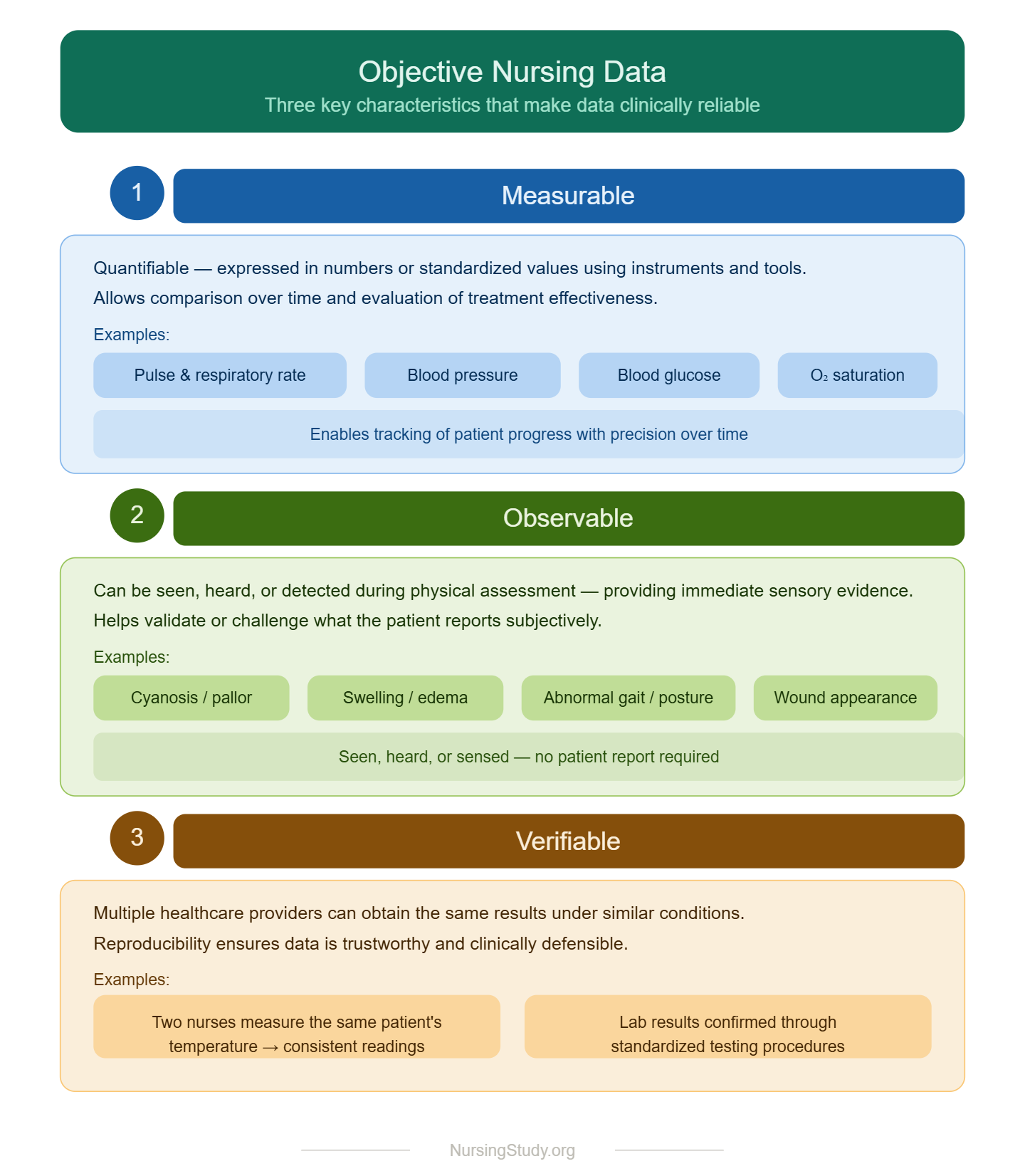
Key characteristics of objective nursing data (measurable, observable, verifiable)
To fully understand objective vs subjective data, it is important to examine the defining features of objective nursing data. These characteristics ensure that the data collected is reliable and clinically useful.
1. Measurable
Objective data is quantifiable, meaning it can be expressed in numbers or standardized values.
- It often involves the use of instruments or tools
- It allows for comparison over time
Examples include:
- Vital signs such as pulse rate, respiratory rate, and blood pressure
- Blood glucose levels
- Oxygen saturation levels
Because objective data is measurable, it allows healthcare providers to track patient progress and evaluate treatment effectiveness.
2. Observable
Another defining feature is that objective data is observable—it can be seen, heard, or detected during a physical assessment.
Examples include:
- Skin color changes (e.g., cyanosis or pallor)
- Swelling or edema
- Abnormal gait or posture
- Wound appearance
These objective signs provide immediate visual or sensory evidence about a patient’s condition. In Subjective vs Objective Data in Nursing, observable findings help validate or challenge a patient’s subjective report.
3. Verifiable
Objective data is also verifiable, meaning that multiple healthcare providers can obtain the same results under similar conditions.
- If two nurses measure the same patient’s temperature, the readings should be consistent
- Lab results can be confirmed through standardized testing procedures
This reliability is what makes objective data offers measurable and dependable input for clinical decision-making. It ensures that data is factual and not influenced by personal interpretation.
Summary of characteristics
To differentiate between subjective and objective, objective data can be summarized as:
- Measurable → expressed numerically
- Observable → detected through senses
- Verifiable → consistent across observers
These characteristics reinforce why objective data is essential in maintaining accuracy and consistency in nursing practice.
Examples of objective data: vital signs, lab results, and physical assessment findings
Understanding Subjective vs Objective Data in Nursing becomes clearer when examining real-world data examples. Examples of objective data include a wide range of measurable and observable findings collected during patient care.
1. Vital signs
Vital signs are among the most common and critical forms of objective data in nursing. They provide immediate insight into a patient’s physiological status.
Examples include:
- Temperature
- Pulse rate
- Respiratory rate
- Blood pressure
- Oxygen saturation
These measurements are fundamental because they:
- Establish a baseline for patient condition
- Help detect early signs of deterioration
- Guide urgent clinical interventions
2. Laboratory and diagnostic results
Laboratory tests provide highly reliable objective findings that support diagnosis and treatment planning.
Examples include:
- Blood tests (e.g., hemoglobin, white blood cell count)
- Urinalysis results
- Imaging findings (X-rays, CT scans, MRIs)
Such data is critical because it offers objective data provides measurable biochemical and physiological insights that are not visible through observation alone.
3. Physical assessment findings
During a physical assessment, nurses collect observable objective information through inspection, palpation, percussion, and auscultation.
Examples of objective data include:
- Crackles heard in the lungs
- Presence of edema in the lower limbs
- Skin integrity issues such as pressure ulcers
- Pupil size and reaction to light
These findings are essential in forming a complete picture of the patient’s health status and are key components of objective and subjective nursing data integration.
Importance of objective data in nursing for clinical decision-making and patient safety
The role of objective data in nursing extends beyond simple measurement—it is central to accurate nursing, safe care delivery, and effective clinical judgment. In Subjective vs Objective Data in Nursing, objective data acts as the evidence base that supports all clinical actions.
1. Supports accurate clinical decision-making
- Objective data eliminates guesswork by providing factual evidence
- It helps confirm or challenge subjective data from patients
- It ensures that nursing diagnoses are based on reliable information
For instance:
- A patient may report dizziness (subjective data), but low blood pressure (objective data) confirms the need for intervention
2. Enhances patient safety
Patient safety depends on early detection of abnormalities, which is only possible through accurate data collection.
- Abnormal vital signs can signal deterioration
- Lab results can reveal hidden conditions
- Objective findings reduce the risk of misinterpretation
Because objective data is essential, it plays a critical role in preventing errors and ensuring timely interventions.
3. Guides effective nursing care and care planning
Objective data directly informs the development of a care plan by:
- Identifying patient needs
- Setting measurable goals
- Evaluating treatment outcomes
In practice, objective data offers measurable benchmarks that allow nurses to assess whether interventions are effective or need adjustment.
4. Strengthens communication and documentation
Clear and accurate objective information improves communication among healthcare providers.
- It ensures consistency in patient records
- It supports legal and professional accountability
- It provides a reliable reference for ongoing care
Understanding Subjective Data in Nursing
Definition of subjective data and subjective data in nursing
Within the framework of Subjective vs Objective Data in Nursing, subjective data refers to information that originates from the patient’s personal perspective. In simple terms, subjective data is information that cannot be directly measured or verified by others but is instead communicated by the patient based on their subjective experience.
In nursing contexts, subjective data in nursing is gathered through:
- Patient interviews
- Conversations during care
- Health history discussions
- Open-ended questioning
This type of subjective nursing data answers the question: “What is the patient feeling or experiencing?”
It is often described as a subjective report because it reflects the patient’s interpretation of their condition rather than observable facts. For example:
- “I feel a sharp pain in my chest”
- “I have been feeling very tired lately”
- “I feel anxious and unable to sleep”
These statements represent subjective data from patients, and although they cannot be measured directly, they are essential in understanding the patient’s condition.
In Subjective vs Objective Data in Nursing, subjective data complements objective data by providing context, meaning, and insight into the patient’s health status. Without it, care would rely solely on measurable findings, potentially overlooking important symptoms or concerns.
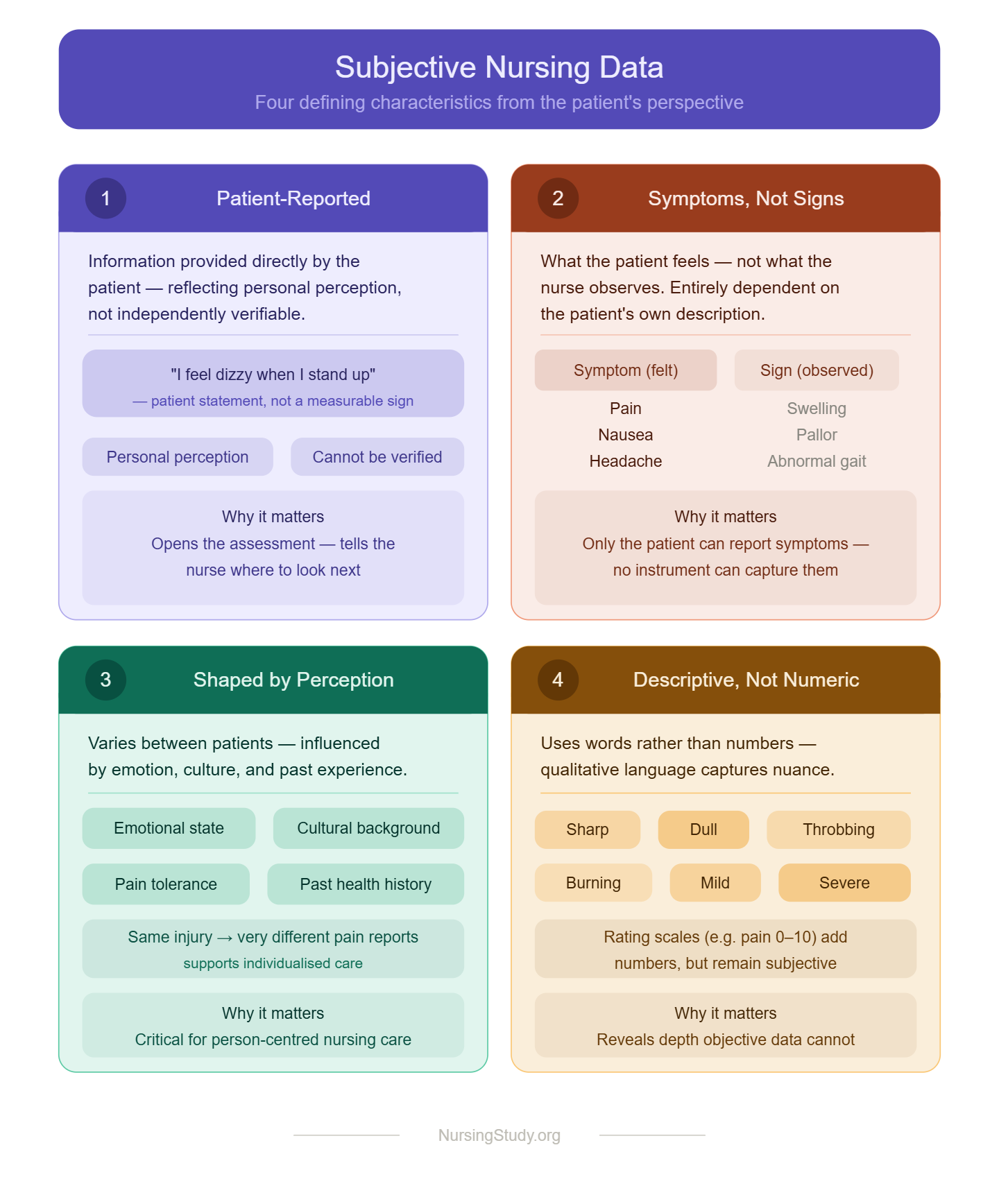
Characteristics of subjective nursing data (patient-reported, symptoms, experiences)
To fully understand subjective vs objective nursing data, it is important to examine the defining characteristics of subjective nursing data. These features distinguish it from objective data and highlight its clinical value.
1. Patient-reported information
The most defining characteristic is that subjective data refers to information provided directly by the patient.
- It is based on what the patient says
- It reflects personal perceptions rather than observable facts
- It cannot be independently verified
For instance:
- A patient stating, “I feel dizzy when I stand up” is providing subjective information that must be considered during assessment.
2. Based on symptoms rather than signs
Subjective data focuses on symptoms, not objective signs.
- Symptoms are what the patient feels
- Signs are what the nurse observes
Examples include:
- Pain
- Nausea
- Shortness of breath (as described by the patient)
- Headache
These are classic examples of subjective data, as they depend entirely on the patient’s description.
3. Influenced by personal perception and experience
Subjective data is shaped by the patient’s:
- Emotional state
- Cultural background
- Pain tolerance
- Past health experiences
This means that subjective data may vary significantly between patients, even when they have similar conditions. For example:
- Two patients with the same injury may report very different pain levels
This variability highlights why understanding subjective data is critical in delivering individualized care.
4. Descriptive rather than measurable
Unlike objective data, subjective data provides descriptive insights rather than numerical values.
- It often includes words like sharp, dull, throbbing, severe, mild
- It may use rating scales (e.g., pain score), but the interpretation remains subjective
This descriptive nature makes subjective data essential for understanding the quality and impact of symptoms.
Summary of characteristics
To differentiate between subjective and objective, subjective data can be summarized as:
- Patient-reported → comes directly from the patient
- Symptom-based → describes feelings or experiences
- Perception-driven → influenced by individual interpretation
- Descriptive → not directly measurable
These characteristics reinforce the role of subjective data within Subjective vs Objective Data in Nursing.
Examples of subjective data: pain levels, nausea, fatigue, and health history
Applying Subjective vs Objective Data in Nursing becomes clearer through practical data examples. Examples of subjective data include a wide range of patient-reported experiences that provide insight into their condition.
1. Pain assessment
Pain is one of the most common and important subjective data elements.
- Patients may describe pain as:
- Sharp, dull, burning, or throbbing
- Mild, moderate, or severe
- Pain is often rated using a scale (e.g., 0–10), but it remains subjective
Example:
- “My pain is an 8 out of 10 and feels like a stabbing sensation in my abdomen.”
This is a clear example of subjective, as it cannot be directly measured.
2. Gastrointestinal symptoms
Patients frequently report symptoms such as:
- Nausea
- Vomiting
- Loss of appetite
Example:
- “I feel nauseated after eating and have no appetite.”
This type of subjective information helps guide further assessment and intervention.
3. Fatigue and general well-being
Fatigue is another common subjective experience that may indicate underlying conditions.
Examples include:
- “I feel extremely tired even after resting”
- “I don’t have the energy to perform daily activities”
Such statements represent subjective data in nursing that may prompt further investigation.
4. Health history and personal concerns
A patient’s history provides essential subjective data from patients.
- Past illnesses
- Medication use
- Allergies (as reported by the patient)
- Lifestyle habits
Example:
- “I have been experiencing headaches for the past two weeks”
This type of subjective data provides valuable background information that supports diagnosis and care planning.
Importance of subjective data in providing holistic nursing care
In Subjective vs Objective Data in Nursing, subjective data plays a critical role in ensuring that care is not only clinically accurate but also patient-centered. While objective data provides measurable evidence, subjective data captures the human experience of illness.
1. Supports holistic patient care
Holistic care involves addressing:
- Physical needs
- Emotional well-being
- Psychological state
- Social context
Subjective data helps nurses understand how illness affects the patient beyond measurable signs.
2. Enhances clinical judgment and decision-making
Although subjective data cannot be measured, it often:
- Signals early symptoms before objective findings appear
- Guides further diagnostic testing
- Helps prioritize patient concerns
For example:
- A patient reporting chest discomfort may prompt immediate investigation, even before abnormal objective findings are detected.
3. Strengthens patient-centered communication
Collecting subjective data requires:
- Active listening
- Empathy
- Effective communication
This process builds trust and encourages patients to share important information, improving the overall quality of patient care.
4. Complements objective data for accurate assessment
In Subjective vs Objective Data in Nursing, neither type of data is sufficient alone.
- Subjective data provides context
- Objective data provides measurable evidence
- Combining both types of data leads to a complete and accurate assessment
5. Guides individualized nursing care and care planning
Subjective data is essential when developing a care plan because:
- It reflects patient priorities and concerns
- It helps tailor interventions to individual needs
- It ensures that care is aligned with patient experiences
Difference Between Subjective and Objective Data
Understanding the difference between subjective and objective data in nursing
A clear understanding of Subjective vs Objective Data in Nursing is essential for accurate patient assessment and effective clinical decision-making. At the most fundamental level, the difference between subjective and objective data lies in how the data is obtained and validated.
- Subjective data is based on the patient’s personal experience
- Objective data is based on measurable and observable findings
In nursing, this distinction defines how patient data is interpreted and applied within the Nursing Process. While both are critical, they serve different purposes:
Subjective data
- Comes directly from the patient
- Reflects symptoms, feelings, and perceptions
- Cannot be independently verified
- Example: “I feel short of breath”
Objective data
- Obtained through observation or measurement
- Includes objective signs such as abnormal lung sounds or vital signs
- Can be verified by multiple healthcare providers
- Example: Oxygen saturation of 88%
To understand the difference between subjective, it is important to recognize that both types of data are complementary. Subjective and objective data together provide a complete picture of the patient’s condition. Relying on one without the other can lead to incomplete or inaccurate conclusions.
Objective vs subjective data: key distinctions in data type and reliability
When comparing objective vs subjective data, several key distinctions emerge, particularly in terms of data type, reliability, and clinical application.
1. Nature of the data type
- Subjective data type
- Based on subjective experience
- Descriptive and qualitative
- Includes patient statements and feelings
- Objective data type
- Based on measurable evidence
- Quantitative and precise
- Includes lab results, physical findings, and monitored values
This distinction highlights that data consists of information that can either be descriptive (subjective) or measurable (objective).
2. Reliability and accuracy
- Objective data is measurable and verifiable
- Considered more reliable in clinical validation
- Less prone to personal bias
- Subjective data may vary
- Influenced by perception, culture, and emotional state
- Still valuable but requires careful interpretation
For example:
- A patient may report severe pain (subjective data), but normal diagnostic findings (objective data) may require further assessment to reconcile the difference.
3. Source of information
- Subjective data
- Comes from the patient or caregiver
- Known as subjective data from patients
- Objective data
- Comes from the nurse’s observation, physical assessment, or diagnostic tools
- Known as objective information
4. Role in clinical use
- Subjective data helps
- Identify symptoms
- Provide insight into patient concerns
- Guide initial assessment
- Objective data provides
- Evidence for diagnosis
- Measurable benchmarks for treatment
- Validation of clinical findings
Summary of key distinctions
To simplify the difference between subjective vs objective, consider:
| Feature | Subjective Data | Objective Data |
|---|---|---|
| Source | Patient-reported | Observed/measured |
| Nature | Descriptive | Measurable |
| Reliability | Variable | High |
| Example | Pain, fatigue | Vital signs, lab results |
Understanding these differences is central to mastering Subjective vs Objective Data in Nursing.
How to differentiate between subjective and objective data in patient assessment
In real clinical settings, the ability to differentiate between subjective and objective data is a critical skill. During patient assessment, nurses must quickly determine the type of data they are collecting.
Step-by-step approach to differentiation
- Ask: Where did the data come from?
- Patient statement → subjective data
- Observation/measurement → objective data
- Ask: Can it be measured or verified?
- Yes → objective data
- No → subjective data
- Ask: Is it a symptom or a sign?
- Symptom → subjective
- Sign → objective
Practical clinical examples
- Example 1: Pain assessment
- Patient says: “I have severe abdominal pain” → subjective
- Nurse observes guarding behavior → objective
- Example 2: Respiratory condition
- Patient reports shortness of breath → subjective
- Oxygen saturation of 90% → objective
- Example 3: Infection
- Patient reports chills → subjective
- Temperature of 38.8°C → objective
These data examples demonstrate how both types of data are collected simultaneously and must be interpreted together.
Using both data types effectively
To provide accurate nursing care:
- Nurses must collect subjective and objective data systematically
- Avoid prioritizing one type of data over the other
- Focus on combining subjective and objective data for a complete assessment
This integration is essential in Subjective vs Objective Data in Nursing and ensures that clinical decisions are well-informed.
Common areas of confusion when comparing subjective vs objective nursing data
Despite clear definitions, confusion often arises when applying Subjective vs Objective Data in Nursing in practice. Understanding these common challenges helps improve accuracy in nursing assessment.
1. Misinterpreting patient statements as objective data
A common mistake is treating patient-reported information as measurable evidence.
- “I feel feverish” → subjective
- Actual temperature reading → objective
Even if the statement suggests a measurable condition, it remains subjective data until verified.
2. Confusion between symptoms and signs
- Symptoms → subjective (experienced by the patient)
- Signs → objective (observed by the nurse)
Example:
- Nausea → subjective
- Vomiting observed → objective
3. Over-reliance on objective data
While objective data is essential, relying only on measurable findings can lead to incomplete care.
- Ignoring patient discomfort or emotional distress may compromise patient care
- Subjective data provides valuable insights that objective data cannot capture
4. Difficulty when data contradicts
In some cases, subjective and objective data may not align.
- Patient reports severe pain, but no visible injury
- Normal lab results despite reported symptoms
In such cases:
- Nurses must apply clinical judgment
- Reassess and gather additional patient data
- Consider psychological, cultural, or underlying conditions
5. Documentation errors
Another common issue is incorrect classification when recording subjective and objective nursing data.
- Mixing subjective statements with objective findings
- Failing to clearly separate data types
Proper documentation ensures clarity and supports effective communication in nursing practice.
Collecting Subjective and Objective Data in Patient Assessment
Data collection methods in the nursing process
Effective Subjective vs Objective Data in Nursing begins with systematic and accurate data collection. In clinical settings, data collection is not random—it is a structured activity embedded within the Nursing Process, particularly in the assessment phase.
During this phase, patient data is gathered to establish a baseline and identify health problems. This involves collecting two types of data:
- Subjective data (patient-reported information)
- Objective data (measurable and observable findings)
To ensure accuracy and completeness, nurses use several standardized data collection methods:
1. Patient interviews
- Used to collect subjective data
- Focus on patient history, symptoms, and concerns
- Requires strong communication and listening skills
2. Physical assessment
- Used to collect objective data
- Involves inspection, palpation, percussion, and auscultation
- Provides objective findings about physical health
3. Observation
- Helps gather both subjective and objective cues
- Includes noting behavior, appearance, and responses
4. Review of medical records and diagnostics
- Provides additional objective information
- Includes lab results, imaging, and previous assessments
Because data is gathered from multiple sources, accuracy depends on consistency and thoroughness. In Subjective vs Objective Data in Nursing, the goal is to ensure that all relevant data is information that contributes to a complete understanding of the patient.
How to collect subjective data through patient interviews and communication
Collecting subjective data requires intentional communication strategies. Since subjective data refers to information provided by the patient, the quality of this data depends heavily on how effectively the nurse engages with the patient.
Key principles for gathering subjective data
- Establish rapport and trust
- Patients are more likely to share accurate subjective information when they feel comfortable
- Introduce yourself, maintain eye contact, and show empathy
- Use open-ended questions
- Encourage detailed responses rather than yes/no answers
- Examples:
- “Can you describe your pain?”
- “What symptoms have you been experiencing?”
- Practice active listening
- Pay attention to both verbal and non-verbal cues
- Avoid interrupting the patient’s subjective report
- Clarify and validate responses
- Repeat or rephrase to confirm understanding
- Example: “You mentioned the pain started yesterday—can you tell me more about that?”
Types of subjective data collected
When gathering subjective data, nurses typically focus on:
- Symptoms (pain, nausea, fatigue)
- Health history (past illnesses, medications)
- Lifestyle factors (diet, activity, habits)
- Emotional and psychological status
Examples of subjective data include:
- “I feel dizzy when I stand up”
- “I have been experiencing chest tightness for two days”
- “I feel anxious and unable to sleep”
This type of subjective data from patients provides context that cannot be obtained through measurement alone. In Subjective vs Objective Data in Nursing, subjective data provides valuable insight into the patient’s lived experience and guides further assessment.
How to collect objective data through physical assessment and observation
In contrast, objective data is obtained through structured examination and observation. Collect objective data involves using clinical skills and tools to gather objective information that is measurable and verifiable.
Core methods of collecting objective data
- Physical assessment techniques
These are standardized methods used during a physical assessment:- Inspection → observing appearance (skin color, posture)
- Palpation → using touch to assess temperature, tenderness, swelling
- Percussion → tapping to assess underlying structures
- Auscultation → listening to internal sounds (heart, lungs)
- Measurement of vital signs
Vital signs are essential examples of objective data and include:
- Temperature
- Pulse
- Respiratory rate
- Blood pressure
- Oxygen saturation
These measurements provide immediate insight into physiological status and are critical in identifying abnormalities.
- Use of diagnostic tools and tests
- Laboratory tests (blood work, urinalysis)
- Imaging (X-rays, CT scans)
- Monitoring devices (cardiac monitors)
These tools enhance the accuracy of objective data in nursing by providing precise and reproducible results.
- Direct observation
- Assessing mobility, behavior, and physical condition
- Identifying objective signs such as swelling, wounds, or abnormal movements
Examples of objective data include:
- Blood pressure of 140/90 mmHg
- Crackles heard in lung auscultation
- Elevated blood glucose level
- Presence of edema in the lower limbs
Because objective data is measurable, it provides reliable evidence that supports clinical decisions. In Subjective vs Objective Data in Nursing, objective data provides measurable confirmation of patient conditions.
Combining subjective and objective data for a complete patient assessment
Accurate patient assessment requires more than collecting data—it requires combining subjective and objective data to form a complete clinical picture. Neither data type is sufficient on its own.
Why combining both types of data is essential
- Subjective data provides context
- Explains how the patient feels
- Objective data provides measurable evidence
- Confirms or refines clinical findings
- Together, they ensure accurate nursing and effective decision-making
Clinical example of combining data
Scenario: Respiratory distress
- Subjective data:
- Patient reports shortness of breath and chest tightness
- Objective data:
- Oxygen saturation at 89%
- Rapid respiratory rate
- Wheezing on auscultation
Interpretation:
- Combining both data types confirms a respiratory issue and guides immediate intervention
Steps to effectively combine data
- Collect subjective and objective data systematically
- Analyze patterns and relationships between symptoms and findings
- Validate inconsistencies by reassessing or gathering more data
- Use both data types to support nursing diagnoses and care planning
Impact on nursing care and outcomes
When combining both types of data, nurses can:
- Develop accurate and individualized care plans
- Improve clinical judgment and decision-making
- Enhance patient safety and quality of care
In Subjective vs Objective Data in Nursing, this integration is what transforms raw patient data into meaningful clinical insight.
Role of Subjective and Objective Data in the Nursing Process
How subjective and objective nursing data support each stage of the nursing process
In nursing practice, the nursing process is a structured, systematic framework used to provide safe, effective, and individualized patient care. Subjective vs Objective Data in Nursing plays a central role in each stage of this process, from assessment to evaluation. Understanding how to collect subjective and objective data and apply it appropriately ensures accurate decision-making and quality care.
The nursing process consists of five core stages: assessment, diagnosis, planning, implementation, and evaluation. Each stage relies heavily on both subjective and objective nursing data:
- Assessment
- Data collection phase where nurses gather information about the patient’s health status.
- Subjective data includes patient-reported symptoms, emotional states, and experiences (e.g., pain, fatigue, nausea).
- Objective data includes measurable findings such as vital signs, lab results, and observed physical conditions.
- Together, these data types provide a comprehensive understanding of the patient’s baseline health.
- Nursing Diagnosis
- Nurses analyze both subjective and objective data to identify actual or potential health problems.
- Accurate nursing diagnoses rely on correlating patient-reported symptoms with measurable objective findings.
- Example:
- Subjective data: Patient reports shortness of breath and anxiety.
- Objective data: Oxygen saturation 88%, increased respiratory rate.
- Nursing diagnosis: Ineffective breathing pattern related to hypoxemia.
- Planning
- The planning stage uses collected data to set goals, prioritize interventions, and create a care plan.
- Objective data helps define measurable outcomes (e.g., maintain oxygen saturation ≥95%).
- Subjective data informs patient-centered goals (e.g., patient reports relief from dyspnea or anxiety reduction).
- Combining both types ensures the care plan addresses physical, emotional, and psychological needs.
- Implementation
- Execution of interventions relies on data-driven decision-making.
- Objective data monitors the patient’s response to interventions (e.g., improved lung sounds, stable vital signs).
- Subjective data provides real-time feedback on patient comfort, pain levels, or satisfaction with care.
- Example: Administering analgesics for pain based on subjective pain scores and observing objective signs like vital signs or facial grimacing.
- Evaluation
- Nurses assess the effectiveness of interventions using both data types.
- Objective data provides measurable evidence of improvement (e.g., decreased fever, normalized blood pressure).
- Subjective data reflects the patient’s perception of health and satisfaction with care.
- Example: A patient reports decreased nausea and shows improved hydration status on labs; both data types validate successful care.
Using objective and subjective data to form nursing diagnoses
The foundation of an accurate nursing diagnosis is the ability to interpret subjective and objective nursing data in a complementary way:
- Analyze data patterns
- Identify trends, relationships, and discrepancies between subjective complaints and objective findings.
- Validate findings
- Confirm patient statements with measurable data or observation.
- Example: A patient reports dizziness (subjective), and a nurse records hypotension (objective), confirming the diagnosis of risk for falls.
- Prioritize diagnoses
- Severity and urgency are assessed by integrating objective data (clinical signs) and subjective data (patient experience).
- Example: Shortness of breath with oxygen saturation of 85% is prioritized over mild fatigue reported by the patient.
- Formulate accurate, patient-centered diagnoses
- Nursing diagnoses should address both measurable conditions and patient-reported experiences to guide effective nursing interventions.
By combining subjective data and objective data, nurses develop nursing diagnoses that are accurate, actionable, and patient-centered, which is essential for safe, high-quality care.
The importance of accurate patient data in planning and implementing nursing care
Accurate subjective and objective nursing data is critical for effective planning and implementation of care. Key reasons include:
- Ensures individualized care
- Patient-specific data allows interventions tailored to physical, emotional, and psychosocial needs.
- Supports evidence-based practice
- Objective findings such as lab results and vital signs provide factual evidence to guide clinical decisions.
- Subjective data offers insights that evidence alone may not capture, such as pain perception or emotional distress.
- Facilitates patient safety
- Accurate data collection prevents errors and reduces the risk of adverse events.
- Example: Recognizing both subjective dizziness and objective hypotension prevents falls and injuries.
- Improves communication and collaboration
- Clear documentation of subjective and objective data ensures all healthcare team members understand the patient’s condition, enhancing continuity of care.
- Guides evaluation and outcome measurement
- By collecting reliable subjective and objective data, nurses can assess the effectiveness of interventions and make timely adjustments to the care plan.
Practical example
Case: A postoperative patient reports severe incision pain (subjective data). The nurse observes redness and swelling at the incision site, with an elevated temperature of 38.5°C (objective data).
- Nursing diagnosis: Risk for infection related to surgical wound
- Planning: Administer analgesics, monitor vital signs, educate the patient on wound care
- Implementation: Apply dressing changes, administer prescribed medications
- Evaluation: Pain reduction reported by patient and normalization of temperature and wound appearance
This scenario demonstrates how subjective and objective data in nursing guide each stage of the nursing process, ensuring accurate nursing care and optimal patient outcomes.
Documentation of Subjective vs Objective Nursing Data
Accurate documentation of Subjective vs Objective Data in Nursing is a critical component of the nursing process and plays a vital role in ensuring effective nursing care, continuity, and patient safety. Both subjective nursing data and objective data in nursing must be recorded systematically, clearly, and in compliance with legal and professional standards. Documentation serves not only as a communication tool among healthcare professionals but also as a legal record of care provided.
Best practices for documenting subjective and objective data in nursing notes
- Be precise and specific
- Subjective data: Record the patient’s exact words when possible, using quotation marks to indicate subjective reports.
- Example: Patient states, “I feel a sharp, stabbing pain in my lower back that worsens with movement.”
- Objective data: Include measurable, observable, and verifiable findings.
- Example: Blood pressure 142/88 mmHg, pulse 96 bpm, respiratory rate 22 breaths/min, incision site red with 2 cm swelling.
- Subjective data: Record the patient’s exact words when possible, using quotation marks to indicate subjective reports.
- Use standardized terminology
- Utilize accepted nursing and medical terminology to avoid ambiguity.
- Example: “Dyspnea on exertion” instead of vague descriptions like “breathing problem.”
- Maintain chronological order
- Document data as it is collected to preserve the sequence of events.
- This is especially important for objective data in nursing that may change rapidly (vital signs, lab results).
- Separate subjective and objective data
- Clearly distinguish between subjective reports (what the patient says) and objective findings (what the nurse observes or measures).
- This clarity supports accurate nursing diagnoses and subsequent interventions.
- Use consistent format
- Many institutions follow SOAP (Subjective, Objective, Assessment, Plan) or PIE (Problem, Intervention, Evaluation) formats to structure documentation of subjective and objective data effectively.
Recording objective data vs subjective data in care plans and reports
1. Subjective data in nursing documentation
- Documented as patient-reported information that cannot be independently verified.
- Includes symptoms, feelings, perceptions, and concerns.
- Example in a care plan:
- Subjective data: Patient reports 8/10 abdominal pain, nausea, and fatigue after chemotherapy session.
2. Objective data in nursing documentation
- Recorded as factual, measurable findings from physical assessment, laboratory tests, or imaging studies.
- Examples in reports:
- Objective data: Temperature 38.2°C, pulse 102 bpm, hemoglobin 9.5 g/dL, wound with serosanguinous drainage, and erythema noted around incision.
3. Integration into care plans
- Both subjective and objective nursing data are used to identify nursing diagnoses, plan interventions, and evaluate outcomes.
- Example:
- Nursing diagnosis: Acute pain related to surgical incision as evidenced by subjective report of 8/10 pain and objective finding of incision erythema and swelling.
By distinguishing subjective data from objective data, care plans become evidence-based, patient-centered, and actionable.
Ensuring clarity, accuracy, and legal compliance in documentation
- Clarity and readability
- Use concise, legible, and professional language.
- Avoid jargon, abbreviations that are not standardized, or ambiguous terms.
- Example: Instead of writing “Patient feels bad”, document: “Patient reports nausea and dizziness upon standing.”
- Accuracy and completeness
- Record all relevant subjective and objective data in real-time or as close to the time of assessment as possible.
- Ensure measurements are accurate and descriptions reflect true observations.
- Avoid assumptions—document only what is observed or reported.
- Timeliness
- Immediate documentation supports continuity of care and ensures that interventions are based on the most recent patient information.
- Legal and ethical considerations
- Documentation is a legal record and can be used in case of disputes or regulatory review.
- Ensure subjective and objective nursing data is factual, unbiased, and free from personal opinions.
- Never alter prior entries; instead, use addendums to correct or update information.
- Confidentiality
- Maintain patient privacy in compliance with HIPAA or local regulations.
- Only authorized personnel should access documentation containing patient data.
Practical examples of proper documentation
Scenario 1: Pain assessment
- Subjective data: Patient reports sharp, throbbing headache rated 7/10.
- Objective data: Blood pressure 150/92 mmHg, facial grimacing noted, patient holding head.
- Nursing note: Patient reports 7/10 headache. Observed facial grimacing and holding head. BP 150/92 mmHg. Administered acetaminophen 500 mg orally as per care plan.
Scenario 2: Postoperative wound assessment
- Subjective data: Patient states, “I feel tenderness around my incision.”
- Objective data: Incision 5 cm long, edges approximated, slight erythema, 1 cm swelling, no drainage.
- Nursing note: Patient reports tenderness at surgical site. Incision 5 cm, edges approximated, mild erythema, 1 cm swelling, no drainage observed.
These examples illustrate how accurate documentation of both subjective and objective data enhances patient safety, supports nursing diagnoses, and guides interventions.
Examples of Subjective vs Objective Data in Nursing Practice
A thorough understanding of Subjective vs Objective Data in Nursing is best illustrated through real-world examples that show how subjective nursing data and objective data in nursing complement each other to inform accurate patient assessment and guide clinical decision-making. Nurses rely on both data types to develop care plans, implement interventions, and evaluate outcomes.
Side-by-side data examples: subjective vs objective nursing data
| Subjective Nursing Data | Objective Nursing Data | Notes / Clinical Relevance |
|---|---|---|
| Patient reports 7/10 abdominal pain | Abdominal distension noted; guarding observed; BP 130/78 mmHg | Combines patient-reported symptom with measurable findings to guide pain management and monitor for complications |
| “I feel dizzy when I stand up” | Orthostatic BP: 90/60 mmHg standing, 110/70 mmHg supine | Validates patient-reported dizziness with measurable objective data for risk of falls |
| “I feel nauseous since this morning” | Patient vomited twice; mild dehydration signs (dry mucous membranes) | Confirms subjective report and provides evidence for fluid therapy and antiemetic interventions |
| “I feel anxious and can’t sleep” | Tachycardia 102 bpm; restless movements observed | Combines subjective emotional experience with observable physical signs to guide anxiety management |
These side-by-side comparisons demonstrate the complementary role of subjective and objective nursing data in developing a complete picture of the patient’s condition.
Example of objective data vs example of subjective data in clinical scenarios
- Pain Assessment
- Subjective data: Patient reports “sharp, throbbing chest pain rated 8/10, worse with deep breaths.”
- Objective data: Heart rate 110 bpm, BP 145/90 mmHg, ECG shows ST-segment elevation.
- Clinical application: Subjective report indicates severity; objective findings provide measurable evidence for cardiac evaluation and urgent interventions.
- Respiratory Assessment
- Subjective data: Patient complains, “I feel short of breath walking to the bathroom.”
- Objective data: Respiratory rate 28 breaths/min, SpO₂ 88% on room air, crackles heard on auscultation.
- Clinical application: Subjective experience alerts the nurse to distress; objective data quantifies severity, guiding oxygen therapy and monitoring.
- Postoperative Wound Care
- Subjective data: Patient states, “My incision feels tender and itchy.”
- Objective data: Incision 6 cm, edges approximated, mild erythema, no drainage, temperature 37.8°C.
- Clinical application: Subjective pain and discomfort are addressed through analgesics; objective findings confirm absence of infection, guiding postoperative care.
Applying data examples to real patient assessment situations
Case Study Example:
Scenario: A patient presents with nausea, fatigue, and dizziness.
- Subjective data collected:
- Patient reports feeling lightheaded upon standing, persistent nausea, and extreme fatigue over the last 24 hours.
- “I feel weak and my stomach hurts.”
- Objective data collected:
- Vital signs: BP 88/60 mmHg, pulse 110 bpm, temperature 37.5°C
- Physical assessment: pale skin, dry mucous membranes, decreased skin turgor
- Lab results: Hemoglobin 8.8 g/dL, Hematocrit 27%
Nursing application:
- The nurse synthesizes subjective data (dizziness, nausea, fatigue) with objective findings (hypotension, tachycardia, anemia) to identify nursing diagnoses such as risk for falls and activity intolerance related to decreased hemoglobin.
- Care plan interventions include fluid replacement, monitoring vital signs, patient education on gradual position changes, and medication as prescribed.
Resolving Conflicts Between Subjective and Objective Data
In nursing practice, it is common to encounter situations where subjective data reported by the patient may contradict objective data obtained during assessment. Understanding how to resolve these conflicts is essential for accurate patient assessment, effective nursing care, and patient safety. Nurses must use critical thinking, clinical judgment, and systematic strategies to reconcile discrepancies between subjective vs objective nursing data.
When subjective data contradicts objective data in nursing practice
Conflicts between subjective data in nursing and objective data can arise for several reasons:
- Patient perception differences
- Patients may overestimate or underestimate symptoms due to anxiety, fear, or misunderstanding.
- Example: A patient reports severe shortness of breath (subjective report), but oxygen saturation is 97% on room air (objective data).
- Physiological compensations or early-stage conditions
- Certain illnesses may present symptoms before measurable objective changes occur.
- Example: Early myocardial ischemia may cause chest pain (subjective data) without significant ECG changes (objective data) initially.
- Communication or cognitive limitations
- Language barriers, hearing impairment, or cognitive deficits may lead to misinterpretation of subjective information.
- Example: Elderly patient reports dizziness (subjective) but vital signs remain stable (objective); careful assessment may reveal dehydration or medication side effects.
- Measurement errors or observation limitations
- Inaccurate equipment, improper technique, or environmental factors can result in objective data that does not align with patient-reported experiences.
- Example: Blood pressure cuff too small yields normal readings despite patient feeling hypertensive.
Strategies to validate and prioritize patient data
To resolve conflicts, nurses should apply systematic strategies to validate and prioritize information:
- Reassess and verify
- Repeat objective measurements (vital signs, lab tests, physical assessment) to confirm accuracy.
- Reevaluate subjective complaints to check for consistency or progression.
- Example: Rechecking blood pressure in different positions if patient reports dizziness.
- Corroborate with additional sources
- Review medical history, past records, and reports from caregivers or family members.
- Example: Patient claims nausea, but no vomiting observed; caregiver confirms frequent episodes at home.
- Use multiple assessment methods
- Combine physical assessment, diagnostic tests, and patient interviews to cross-check subjective and objective data.
- Example: Pain assessment using self-report scales (subjective) and observing grimacing, guarding, or vital sign changes (objective).
- Document discrepancies clearly
- Record both subjective and objective findings, noting the conflict for transparency.
- Example: “Patient reports severe abdominal pain (9/10) despite abdomen soft, non-tender, vitals stable.”
- Prioritize data based on clinical significance
- When discrepancies occur, prioritize data indicating immediate risk to patient safety.
- Example: A patient reports mild dizziness (subjective) but SpO₂ is 84% (objective); hypoxia takes precedence, and interventions are initiated promptly.
Clinical judgment in handling inconsistencies in patient assessment
Resolving conflicts between subjective and objective nursing data requires sound clinical judgment, integrating both evidence and patient context:
- Assess potential causes of discrepancy
- Consider underlying medical conditions, psychosocial factors, and medications that may explain differences.
- Balance patient experience with measurable findings
- Even if objective data appears normal, subjective complaints should not be dismissed. Patient-reported experiences provide important clues to emerging problems.
- Example: Chronic pain patients may have normal lab results, yet subjective pain reports indicate need for ongoing management.
- Engage interdisciplinary collaboration
- Consult physicians, pharmacists, or specialists when conflicts persist. Collaborative evaluation ensures that both subjective and objective data guide care safely.
- Adjust care plans as necessary
- Incorporate both validated subjective data and objective findings into nursing diagnoses and interventions.
- Example: If a patient reports chest tightness but ECG is normal, monitor for changes, administer prescribed medication, and provide patient education on symptom recognition.
Practical Example
Scenario: Patient reports severe headache and blurred vision (subjective data). Blood pressure reads 120/80 mmHg (objective data).
Nursing response:
- Reassess vital signs and neurological status.
- Check for additional objective findings: pupillary reaction, coordination, or lab results.
- Document both subjective and objective data clearly.
- Prioritize safety: monitor for potential hypertensive crisis or neurological changes.
- Collaborate with physician to determine further diagnostic testing or interventions.
Practical Tips to Differentiate and Use Nursing Data Effectively
Mastering the use of subjective vs objective nursing data is essential for effective patient assessment and delivering high-quality nursing care. Nurses must be able to differentiate between subjective data (patient-reported experiences) and objective data (measurable and observable findings) efficiently, avoid common pitfalls, and use both data types to inform nursing diagnoses, care planning, and interventions.
How to quickly differentiate between subjective and objective data
- Identify the source of the data
- Subjective data in nursing comes directly from the patient’s perspective, reflecting their experiences, feelings, and symptoms.
- Example: “I feel nauseous,” “My pain is 7/10,” or “I feel anxious.”
- Objective data in nursing is measurable, observable, and verifiable by the nurse or clinical tools.
- Example: Vital signs (BP 140/90 mmHg), lab results, pulse oximetry readings, or wound appearance.
- Subjective data in nursing comes directly from the patient’s perspective, reflecting their experiences, feelings, and symptoms.
- Focus on measurability and observability
- Objective data provides factual evidence that can be quantified or tested, whereas subjective data provides context to interpret these findings.
- Quick check: Ask yourself, “Can another clinician verify this observation independently?”
- Yes → Objective data
- No → Subjective data
- Use common categories for clarity
- Subjective nursing data often includes:
- Pain, fatigue, nausea, dizziness
- Emotional state, anxiety, depression
- Patient-reported health history or lifestyle changes
- Objective nursing data often includes:
- Vital signs, lab tests, imaging results
- Observable behaviors (grimacing, guarding)
- Physical assessment findings (skin color, edema, wound measurements)
- Subjective nursing data often includes:
Common mistakes nursing students make with data types
- Confusing subjective reports with objective findings
- Example: Recording “patient appears tired” as subjective instead of observable objective data.
- Tip: Focus on what can be measured or observed versus what is felt by the patient.
- Overlooking subjective data
- Students may prioritize objective data like vital signs or lab results while dismissing patient complaints, leading to incomplete nursing assessments.
- Failing to document both data types clearly
- Example: Recording “patient has fever” without including the patient’s report of chills or discomfort.
- Tip: Ensure documentation includes both subjective and objective nursing data for a holistic view.
- Inaccurate interpretation of objective findings
- Example: Not correlating elevated heart rate with reported anxiety or pain.
- Tip: Combine subjective and objective data to form accurate nursing diagnoses.
- Relying solely on patient self-report
- Subjective data alone may not reflect the severity of a condition; always validate with objective findings.
Tips to improve data collection, interpretation, and nursing care planning
- Use structured data collection tools
- Standardized tools like pain scales, Braden Scale, and Glasgow Coma Scale help differentiate subjective and objective nursing data accurately.
- Example: Patient reports pain 8/10 (subjective), nurse observes grimacing and increased BP (objective).
- Perform systematic assessments
- Follow a consistent approach: history taking → physical assessment → lab and diagnostic review.
- This ensures both subjective and objective data are collected and integrated.
- Correlate subjective and objective data
- Cross-reference what the patient reports with observable signs and test results.
- Example: Patient reports dizziness (subjective); orthostatic BP confirms drop in systolic pressure (objective).
- Document thoroughly and accurately
- Use clear terminology distinguishing subjective reports (“Patient states…”) from objective findings (“BP 130/80 mmHg”).
- Proper documentation supports clinical reasoning and legal compliance.
- Apply critical thinking
- Evaluate the significance of each data point in context.
- Example: Fatigue may be subjective, but low hemoglobin (objective) indicates anemia contributing to the patient’s experience.
- Practice reflective assessment
- Regularly review nursing assessments to identify missed data or misinterpretations.
- Encourage feedback from mentors or senior nurses to enhance skills in differentiating subjective vs objective data.
Practical Example
Scenario: Patient reports, “I feel very weak and dizzy.”
- Subjective data collected: Patient complains of dizziness and weakness.
- Objective data collected: BP 88/60 mmHg, pulse 110 bpm, pale skin, SpO₂ 92%.
Nursing application:
- Recognize the subjective report as the patient’s experience of dizziness.
- Validate with objective findings indicating hypotension and possible hypoxia.
- Combine both data types to prioritize interventions: elevate legs, administer fluids, monitor vitals, and educate the patient on gradual position changes.
Why Understanding Subjective vs Objective Data Improves Patient Care
A thorough understanding of subjective vs objective nursing data is a cornerstone of effective nursing practice. Integrating both types of data into patient assessment and care planning not only enhances the accuracy of nursing diagnoses but also strengthens clinical reasoning and promotes patient safety. Nurses who can accurately interpret and utilize subjective and objective data are better equipped to deliver individualized, evidence-based care that meets patient needs.
Impact on patient outcomes and safety
- Early detection of health issues
- Accurate recognition of subjective symptoms—such as pain, dizziness, or fatigue—combined with objective findings like vital signs or lab results allows for timely interventions.
- Example: A patient reports mild shortness of breath (subjective data), and oxygen saturation is 88% (objective data). Prompt intervention prevents hypoxia and reduces the risk of complications.
- Improved accuracy of nursing diagnoses
- Combining subjective and objective nursing data ensures that nursing diagnoses reflect the patient’s actual condition rather than assumptions based solely on observable findings.
- Example: A patient reports severe abdominal pain (subjective) and has abdominal rigidity on assessment (objective). The nurse can accurately identify risk for peritonitis and plan appropriate interventions.
- Enhanced patient safety and risk management
- Misinterpreting or neglecting either subjective data or objective data can lead to missed diagnoses or delayed treatment.
- Example: Ignoring a patient’s report of dizziness (subjective data) while only considering normal vital signs (objective data) could result in unrecognized orthostatic hypotension, increasing the risk of falls.
- Holistic, patient-centered care
- Subjective data provides insight into the patient’s experience, preferences, and quality of life, while objective data provides factual evidence. Integrating both ensures care plans address not only physiological needs but also emotional and psychosocial well-being.
Enhancing critical thinking and clinical reasoning
- Developing analytical skills
- Differentiating subjective vs objective nursing data requires analyzing the reliability, relevance, and context of information.
- Example: Evaluating a patient’s reported fatigue (subjective) alongside low hemoglobin and hematocrit (objective) strengthens critical thinking in forming nursing diagnoses.
- Prioritizing patient care
- Nurses must weigh subjective reports against objective findings to determine which issues require immediate intervention.
- Example: A patient reports mild pain (subjective) but presents with tachycardia and hypotension (objective); the nurse prioritizes stabilizing vital signs before administering analgesics.
- Problem-solving and decision-making
- Understanding data types enhances the ability to interpret conflicting information and make informed clinical decisions.
- Example: A patient reports shortness of breath (subjective) but exhibits normal oxygen saturation. The nurse investigates further, assessing for anxiety, asthma exacerbation, or early hypoxia, integrating both data types to guide interventions.
Building confidence in nursing students through mastering data types
- Strengthening assessment skills
- Mastering the collection and interpretation of subjective and objective data equips nurses to conduct comprehensive nursing assessments with confidence.
- Facilitating evidence-based practice
- Confidently distinguishing between subjective and objective nursing data enables nurses to base interventions on verifiable evidence, reducing errors and improving care quality.
- Empowering clinical communication
- Accurate reporting of subjective and objective findings enhances communication with interdisciplinary teams, ensuring that all clinicians have a clear, evidence-based understanding of the patient’s condition.
- Supporting professional growth
- Nurses who consistently integrate subjective and objective nursing data demonstrate competency in the nursing process, contributing to better patient outcomes, stronger clinical judgment, and professional credibility.
Practical Example
Scenario: A postoperative patient reports nausea and dizziness (subjective data) after receiving analgesics, and the nurse notes hypotension and pallor (objective data).
Application:
- Integrating both types of data allows the nurse to recognize possible adverse drug effects.
- Interventions include monitoring vital signs, providing antiemetic therapy, and notifying the physician.
- Accurate documentation of both subjective and objective nursing data ensures continuity of care and supports patient safety.
Feeling stressed about writing a detailed nursing paper?
Let us produce a thorough, high-quality document.
Conclusion
A clear understanding of subjective vs objective nursing data is fundamental to accurate patient assessment, effective nursing care, and improved patient outcomes. Both data types play complementary roles: subjective data offers insight into the patient’s experiences, symptoms, and concerns, while objective data provides measurable, verifiable evidence that guides clinical decision-making. Integrating subjective and objective nursing data throughout the nursing process ensures that care plans are comprehensive, evidence-based, and patient-centered.
Proficient differentiation and documentation of subjective vs objective data in nursing enhance critical thinking, strengthen clinical reasoning, and foster professional confidence. Nurses who consistently collect, interpret, and apply both types of data can identify subtle changes in patient conditions, resolve discrepancies, and prioritize interventions effectively.
Ultimately, mastering subjective vs objective nursing data is not only a core skill for safe and accurate nursing practice but also a key factor in delivering holistic, high-quality patient care. By combining measurable findings with patient-reported experiences, nurses can ensure that assessments are thorough, interventions are timely, and outcomes are optimized, reinforcing the essential role of data-driven decision-making in modern nursing practice.
Frequently Asked Questions
What is an example of subjective and objective data in nursing?
- Subjective data: Patient reports, such as “I feel nauseous” or “My pain is 7/10.”
- Objective data: Measurable or observable findings, such as blood pressure 140/90 mmHg, heart rate 102 bpm, or a reddened surgical site.
What is the difference between subjective and objective data?
- Subjective data is information provided by the patient about their feelings, symptoms, or experiences. It is personal and cannot be independently verified.
- Objective data is factual, measurable, and observable information collected by the nurse or through diagnostic tools.
What is subjective vs objective with examples?
- Subjective vs objective refers to the distinction between patient-reported experiences (subjective) and observable or measurable findings (objective).
- Example: Patient reports fatigue (subjective), nurse measures hemoglobin of 9 g/dL (objective)
What is subjective and objective in a nursing care plan?
- In a nursing care plan, subjective data documents the patient’s reported symptoms or concerns, while objective data records measurable findings, observations, and test results. Both are used together to formulate nursing diagnoses, plan interventions, and evaluate outcomes.
