

Essential Nursing Conversion Chart: Free Nursing Metric Conversion Chart & Cheat Sheet for Students
Accurate medication administration is a cornerstone of safe nursing practice, relying heavily on a clear understanding of nursing conversions and metric units. Nurses routinely navigate multiple measurement systems, translating between milligrams, micrograms, kilograms, milliliters, and liters to ensure patients receive the correct dosage. Errors in these calculations can compromise patient safety, highlighting the importance of structured methods for calculating medication dosages and performing reliable unit conversions.
A nursing conversion chart serves as a practical reference, consolidating essential metric conversions, common medical conversions, and measurement conversion principles in one accessible format. Beyond its role as a reference tool, a nursing metric conversion chart reinforces key concepts in dimensional analysis, med math, and drug calculation, supporting both theoretical knowledge and clinical application.
Understanding measurement conversion charts equips practitioners to approach dosage calculation problems systematically, whether converting milliliters to liters, calculating weight conversions from pounds to kilograms, or applying temperature conversions from Celsius to Fahrenheit. Mastery of these conversions is fundamental for accurate medication dosages, safe IV administration, and efficient clinical workflow.
This guide explores the scope of nursing conversions, from basic metric system prefixes and key conversions to advanced techniques such as dimensional analysis and calculations conversion. It incorporates practical strategies, including cheat sheets, digital downloads, and study guides, to provide structured approaches to med math and dosage calculation nursing. By applying these tools, clinicians can minimize errors, strengthen confidence in calculations, and improve patient care outcomes.
Throughout the article, examples of drug dose calculation, common IV drug calculations, weight and volume conversions, and calculation exercises will illustrate how structured nursing conversion charts and measurement conversion tables can be integrated into everyday practice. The principles outlined provide a comprehensive framework for safe, accurate, and efficient nursing calculations, bridging theoretical knowledge with practical application in clinical settings.
Understanding Nursing Conversions and Metric Units
What Are Nursing Conversions and Why They Matter
Nursing conversions involve translating one unit of measurement into another to ensure accurate dosage calculation, fluid administration, and safe patient care. Nurses routinely encounter scenarios that require converting weight, volume, or medication units. These conversions are critical for avoiding errors that can compromise patient safety.
- Significance of Nursing Conversions:
- Patient Safety: Proper nursing conversions prevent medication errors, including overdosing or underdosing.
- Medication Accuracy: Accurate dosage calculation nursing ensures medications are administered at therapeutic levels.
- Clinical Efficiency: Nurses can calculate medication dosages and fluid rates quickly using structured conversion tables or nursing cheat sheets.
- Common Scenarios Requiring Conversions:
- Converting milligrams (mg) to micrograms (mcg) for high-potency medications.
- Converting pounds to kilograms for weight-based dosing in pediatrics or adult care.
- Converting milliliters to liters for IV fluid administration.
Example: A prescription requires 0.5 g of acetaminophen, but tablets are in 250 mg. Using unit conversion, the nurse calculates 0.5 g = 500 mg → 2 tablets. Similarly, if a child weighs 44 lbs and the dose is 10 mg/kg, converting 44 lbs to 20 kg allows accurate weight-based medication calculation.
Introduction to the Metric System in Nursing
The metric system is the globally recognized system of measurement in healthcare, offering a decimal-based, standardized framework for nursing calculations. Mastery of the metric system is essential for accurate medication dosages, fluid administration, and interpreting laboratory values.
- Core Metric Units:
- Gram (g): Measures weight or mass.
- Milligram (mg) and Microgram (mcg): Smaller units critical for pharmacology and medication dosages.
- Kilogram (kg): Used in weight-based dosing and calculating body surface area.
- Liter (L) and Milliliter (mL): Measures for fluids and IV medications.
- Metric System Prefixes:
- 1 kg = 1,000 g
- 1 g = 1,000 mg
- 1 mg = 1,000 mcg
- Why the Metric System Matters in Nursing:
- Simplifies math conversions and dosage calculation.
- Reduces the risk of decimal errors in drug dose calculation.
- Supports dimensional analysis techniques used for med math.
Example: A physician prescribes 0.25 mg of digoxin. Tablets available are 125 mcg each. The nurse converts 0.25 mg = 250 mcg → administers 2 tablets. Without understanding the metric system and metric conversions, this calculation could easily result in error.
Measurement Conversion vs. Unit Conversion
It is crucial to distinguish between measurement conversion and unit conversion as both apply to different clinical scenarios.
- Measurement Conversion:
- Refers to converting between different types of measurement (volume, weight, temperature).
- Examples:
- Milliliters to liters for IV fluids
- Pounds to kilograms for weight-based dosing
- Celsius to Fahrenheit for temperature conversions in patient monitoring
- Unit Conversion:
- Refers to converting within the same type of measurement, often using metric system prefixes.
- Examples:
- mg to g
- mcg to mg
- mL to L
- Clinical Application:
- Medication Dosage: A prescription requires 0.5 g of a drug; tablets are 250 mg → unit conversion determines 2 tablets.
- IV Fluid Administration: 750 mL IV over 8 hours → measurement conversion calculates mL/hour = 93.75 mL/hour.
- Temperature Monitoring: Converting 37°C → 98.6°F using Celsius to Fahrenheit conversions ensures accurate reporting.
- Best Practices for Nursing Conversions:
- Always double-check using nursing conversion charts or measurement conversion tables.
- Use dimensional analysis when performing dosage calculation nursing.
- Apply ratios and proportions for accurate med math.
- Maintain nursing notes or cheat sheets for reference to avoid common conversion errors.
Example: A patient requires 25 mcg of a hormone, but available tablets are 0.05 mg. The nurse converts: 0.05 mg = 50 mcg → administer 0.5 tablet. Combining measurement conversion and unit conversion ensures precise dosage calculation and patient safety.
Not sure how to write your next nursing assignment?
Give us the patient details, and we’ll take care of the rest.
Comprehensive Nursing Conversion Chart and Cheat Sheet
Anatomy of a Nursing Conversion Chart
A nursing conversion chart is a structured reference tool that organizes essential metric conversions, unit conversions, and dosage calculations in a concise, accessible format. Understanding the anatomy of a nursing conversion chart enables healthcare professionals to locate and apply the correct measurements quickly, enhancing safety in medication administration and other clinical tasks.
- Core Components of a Nursing Conversion Chart:
- Metric Units: Includes kg, g, mg, mcg, L, mL for common weight, volume, and mass conversions.
- Measurement Conversions: Provides common medical conversions, such as pounds to kilograms, ounces to milliliters, and Celsius to Fahrenheit.
- Dosage Calculation Guidelines: Offers simplified formulas or step-by-step approaches for drug dose calculation using dimensional analysis or ratios and proportions.
- Reference Tables: Quick access to key conversions, including metric system prefixes, decimal conversions, and common unit conversions.
- Visual Layout:
- Conversion charts often use columns for unit type, conversion factor, and equivalent units.
- Color-coded sections or bolded headings can help differentiate weight, volume, and medication units.
- Some charts include examples of calculation problems, demonstrating how to convert and calculate nursing dosage.
Example: A chart may show:
| Unit | Conversion | Equivalent |
|---|---|---|
| 1 kg | = 1000 g | Weight conversion |
| 1 g | = 1000 mg | Dosage calculation |
| 1 mg | = 1000 mcg | Medication math |
This layout allows nurses to perform calculations conversion efficiently, reducing errors during med math or drug dose calculation.
Free Nursing Metric Conversion Chart for Students
Free nursing metric conversion charts are widely available as printable PDFs, digital downloads, or online templates. They provide a ready-to-use reference for quick access to common medical conversions and metric units, particularly useful for dosage calculation nursing, IV fluid administration, and bedside nursing practice.
- Advantages of Free Nursing Conversion Charts:
- Immediate access to key conversions without memorizing all metric system prefixes.
- Enhances accuracy in nursing dosage calculations and med math.
- Can be integrated into nursing notes, study guides, or pinned as nursing study posters in clinical areas.
- Supports NCLEX preparation, practice problems, and real-world drug calculation exercises.
- Formats:
- Printable PDF Download: Easy to include in a calculations workbook or cheat sheet bundle.
- Digital Download / Online Template: Accessible on computers or tablets for instant reference during clinical shifts.
- Compact Study Guide: Combines metric conversions, weight conversion, and dosage calculation examples for rapid review.
Example: A downloadable nursing metric conversion chart may include:
- Weight conversions: kg ↔ lbs, g ↔ mg, mg ↔ mcg
- Volume conversions: L ↔ mL, mL ↔ oz
- Temperature conversions: Celsius ↔ Fahrenheit
- Medication conversions: mg/kg dosing, common IV drug calculations
This format supports safe nursing practice and provides a practical reference during complex medication calculations.
Using a Nursing Cheat Sheet to Simplify Med Math
A nursing cheat sheet complements the conversion chart by condensing essential metric conversions, key calculations, and common unit conversions into a single, easily navigable reference. This is particularly valuable in high-pressure clinical settings or during medication rounds where accurate dosage calculation is critical.
- Components of an Effective Nursing Cheat Sheet:
- Quick Reference Table: Lists metric units, common conversions, and dosage equivalents.
- Step-by-Step Calculation Examples: Demonstrates dimensional analysis, ratios and proportions, and weight-based dosing.
- Tips for Accuracy: Reminders for double-checking decimal points, verifying unit conversions, and cross-referencing with drug calculation guidelines.
- Practice Problems: Mini exercises for dosage calculation nursing, IV drug calculations, and medication math practice.
- Benefits in Clinical Practice:
- Reduces calculation errors in medication dosages.
- Saves time by avoiding repeated unit conversions during drug administration.
- Supports learning and skill reinforcement in nursing math and med math exercises.
- Enhances confidence for RNs and healthcare providers in real-world dosage calculations.
Example: A cheat sheet might include:
- 1 kg = 2.2 lbs → weight conversion
- 1 mg = 1000 mcg → dosage conversion
- IV drip: 1000 mL over 8 hours → 125 mL/hour → infusion rate calculation
By combining a nursing conversion chart with a cheat sheet, nurses and healthcare providers can streamline calculations conversion, strengthen med math skills, and ensure accurate nursing dosage calculations in every clinical scenario.
Dosage Calculation and Drug Math in Nursing
Basics of Nursing Dosage Calculations
Nursing dosage calculation is a fundamental skill in clinical practice, ensuring that medications are administered safely and effectively. Accurate calculations are essential for patient safety, especially when dealing with high-potency medications, pediatric dosing, or IV drug administration.
- Key Principles of Dosage Calculation:
- Identify the Prescribed Dose: Verify the medication dosage ordered by the physician in mg, mcg, g, mL, or units.
- Determine the Available Form: Check the medication concentration, such as tablets, liquid solutions, or IV formulations.
- Select the Conversion Method: Use unit conversion, dimensional analysis, or ratio and proportion to calculate the exact dose.
- Double-Check the Calculation: Confirm calculations against nursing conversion charts or medication math cheat sheets.
- Basic Formulas for Common Calculations:
- Oral Medications: Number of tablets=Prescribed doseAvailable dose per tablet\text{Number of tablets} = \frac{\text{Prescribed dose}}{\text{Available dose per tablet}}Number of tablets=Available dose per tabletPrescribed dose
- Example: A prescription is 500 mg acetaminophen; tablets available are 250 mg.
Calculation: 500 ÷ 250 = 2 tablets. - Liquid Medications: Volume to administer (mL)=Prescribed dose (mg)Concentration (mg/mL)\text{Volume to administer (mL)} = \frac{\text{Prescribed dose (mg)}}{\text{Concentration (mg/mL)}}Volume to administer (mL)=Concentration (mg/mL)Prescribed dose (mg)
- Example: A patient requires 75 mg of amoxicillin; solution available is 125 mg/5 mL.
Calculation: (75 ÷ 125) × 5 = 3 mL.
- Weight-Based Dosages:
Often used in pediatrics and critical care, requiring weight conversion from pounds to kilograms.
Example: A drug is prescribed at 10 mg/kg. Patient weighs 44 lbs → 44 ÷ 2.2 = 20 kg. Required dose: 20 × 10 = 200 mg.
Understanding these basics allows nurses to approach drug calculations confidently, reducing errors during nursing practice.
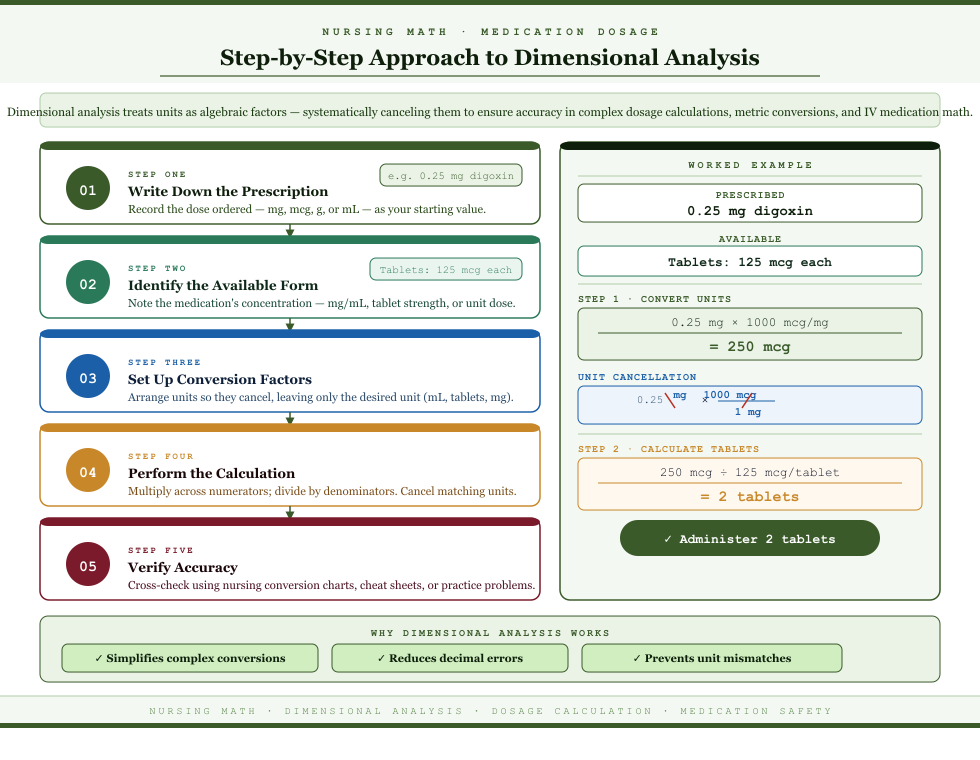
Step-by-Step Approach to Dimensional Analysis
Dimensional analysis is a systematic method to perform dosage calculation nursing by treating units as algebraic factors. It ensures accuracy, especially in complex conversions involving metric units, weight conversions, or IV medications.
Steps for Dimensional Analysis:
- Write Down the Prescription: Start with the dose ordered (e.g., mg, mcg, g, mL).
- Identify the Available Form: Note the concentration of the medication (e.g., mg/mL, tablet strength).
- Set Up Conversion Factors: Arrange units so they cancel, leaving the desired unit (mL, tablets, or mg).
- Perform the Calculation: Multiply across numerators and divide by denominators.
- Verify Accuracy: Cross-check against nursing conversion charts, cheat sheets, or practice problems.
Example: A patient is prescribed 0.25 mg digoxin. Tablets available: 125 mcg.
- Step 1: Convert mg → mcg: 0.25 mg × 1000 = 250 mcg
- Step 2: Calculate tablets: 250 ÷ 125 = 2 tablets
Dimensional analysis simplifies common medical conversions, ensures accuracy in med math, and reduces the likelihood of errors caused by decimal misplacement or unit mismatches.
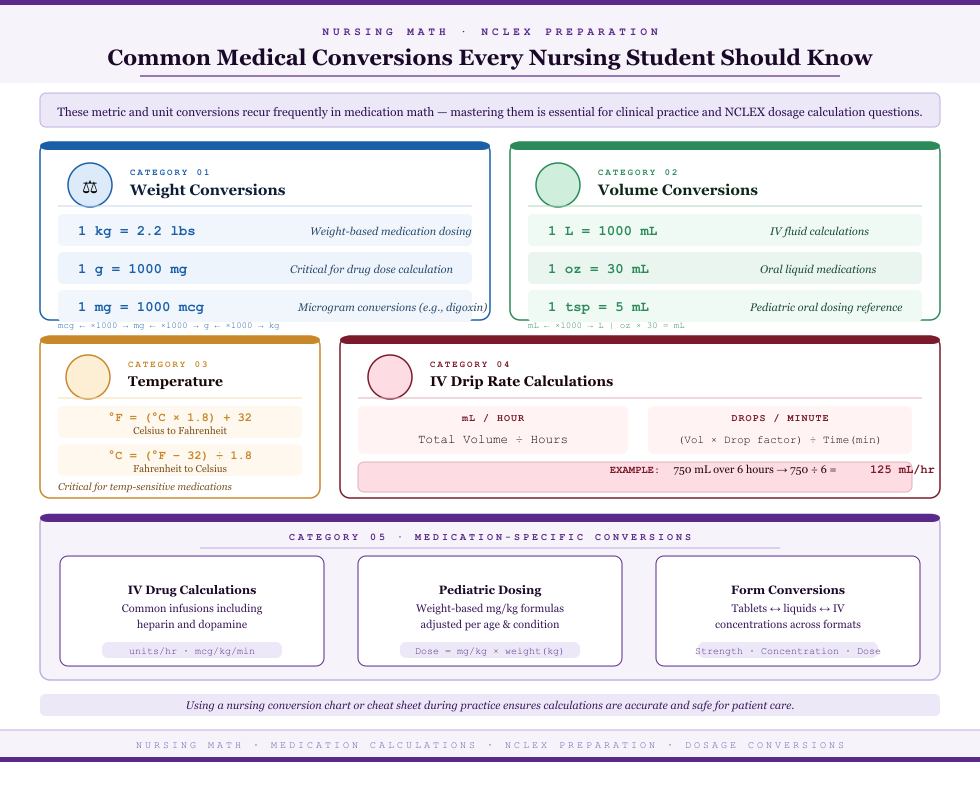
Common Medical Conversions Every Nursing Student Should Know
Certain metric conversions and unit conversions recur frequently in medication math, making them essential for both clinical practice and NCLEX preparation. Nurses should become familiar with these to streamline nursing dosage calculations.
- Weight Conversions:
- 1 kg = 2.2 lbs → essential for weight-based medication dosing
- 1 g = 1000 mg; 1 mg = 1000 mcg → critical in drug dose calculation
- Volume Conversions:
- 1 L = 1000 mL → for IV fluid calculations
- 1 oz = 30 mL → useful for oral liquid medications
- Temperature Conversions:
- Celsius to Fahrenheit: F=(C×1.8)+32F = (C \times 1.8) + 32F=(C×1.8)+32
- Important for temperature-sensitive medications and patient monitoring
- Time and Rate Calculations (IV Drip):
- mL/hour = total volume ÷ hours
- Drops per minute: (Total volume (mL)×drop factor)÷time in minutes(\text{Total volume (mL)} \times \text{drop factor}) ÷ \text{time in minutes}(Total volume (mL)×drop factor)÷time in minutes
- Medication-Specific Conversions:
- Common IV drug calculations (e.g., heparin, dopamine)
- Pediatric doses using mg/kg formulas
- Converting between tablet strengths, liquid concentrations, and IV infusions
Example: A patient requires 750 mL of IV fluid over 6 hours.
- Calculation: 750 ÷ 6 = 125 mL/hour
- Using a nursing cheat sheet or nursing conversion chart ensures this is calculated accurately.
By mastering these common medical conversions, nurses can confidently perform dosage calculation nursing, apply dimensional analysis, and use med math to deliver safe and effective care.
Advanced Conversion Techniques for Safe Medication Administration
Converting Metric Units for IV Drugs and Medication Math
Administering IV medications requires precise metric conversions and accurate dosage calculation nursing. Errors in these calculations can lead to serious patient harm, making mastery of advanced metric unit conversions essential.
- Volume-to-Volume Conversions for IV Medications:
Nurses often convert liters to milliliters or milliliters to drops for IV infusions.- Example: An IV prescription requires 1.5 L of fluid over 24 hours.
- Convert liters to milliliters: 1.5 L × 1000 = 1500 mL
- Calculate mL/hour: 1500 ÷ 24 = 62.5 mL/hour
- Example: An IV prescription requires 1.5 L of fluid over 24 hours.
- Medication Concentration Conversions:
IV medications are often provided as solutions of varying concentrations (mg/mL). Nurses must calculate the volume needed based on the prescribed dosage.- Example: A patient requires 250 mg of a medication; the IV solution available is 50 mg/10 mL.
- Determine volume: (250 ÷ 50) × 10 = 50 mL
- Using a nursing conversion chart ensures that these calculations are accurate and reduces the risk of dosage errors.
- Example: A patient requires 250 mg of a medication; the IV solution available is 50 mg/10 mL.
- Using Ratios and Proportions:
For medications not in standard concentrations, ratio and proportion methods can be applied:- Formula: Volume to administer=Desired DoseAvailable Dose×Volume Available\text{Volume to administer} = \frac{\text{Desired Dose}}{\text{Available Dose}} \times \text{Volume Available}Volume to administer=Available DoseDesired Dose×Volume Available
- Example: Desired dose = 0.5 g, available = 250 mg/5 mL → (0.5 g ÷ 0.25 g) × 5 mL = 10 mL
- Dimensional Analysis in IV Calculations:
Using dimensional analysis for IV infusions ensures unit consistency and reduces errors.- Example: Administer 1000 mL of fluid over 8 hours with a drop factor of 20 gtt/mL: gtt/min=1000×208×60=41.6≈42gtt/min\text{gtt/min} = \frac{1000 \times 20}{8 \times 60} = 41.6 \approx 42 gtt/min gtt/min=8×601000×20=41.6≈42gtt/min
Handling Complex Nursing Conversions in Clinical Practice
In real-world nursing, conversions often require combining multiple unit types or applying advanced metric system knowledge. Understanding complex nursing conversions is critical for accurate medication administration.
- Weight- and Volume-Based Dosing:
- Pediatric and critical care medications often require mg/kg dosing combined with mL/kg fluid volumes.
- Example: A child weighing 22 lbs requires 15 mg/kg of medication.
- Convert weight: 22 ÷ 2.2 = 10 kg
- Calculate dose: 10 × 15 = 150 mg
- Temperature-Sensitive Medications:
- Some medications require adjustments based on Celsius to Fahrenheit conversions.
- Example: An IV solution must be administered at 37°C. Using a thermometer reading in Fahrenheit: F=(C×1.8)+32F = (C \times 1.8) + 32F=(C×1.8)+32 → 37 × 1.8 + 32 = 98.6°F
- Multi-Step Calculations:
Complex dosage calculation nursing may combine:- Unit conversion (mg → mcg)
- Weight conversion (lbs → kg)
- Volume calculation (mL/hr)
Example: A patient weighing 132 lbs requires 50 mcg/kg of a drug available as 0.1 mg/mL solution: - Convert weight: 132 ÷ 2.2 = 60 kg
- Calculate dose: 60 × 50 mcg = 3000 mcg = 3 mg
- Calculate volume: 3 mg ÷ 0.1 mg/mL = 30 mL
These examples illustrate why nursing conversion charts and cheat sheets are invaluable for reducing errors in complex calculations.
Avoiding Common Dosage Calculation Mistakes
Even experienced nurses can make errors in med math, particularly when metric conversions and complex calculations are involved. Awareness of common mistakes can prevent medication errors.
- Common Errors:
- Decimal point errors: Misplacing decimals can cause a tenfold overdose.
- Unit confusion: Confusing mg with mcg, mL with L, or kg with lbs.
- Incorrect formula application: Misapplying dimensional analysis or ratios and proportions.
- Failure to double-check: Omitting verification using a nursing conversion chart or cheat sheet.
- Best Practices to Avoid Errors:
- Always use nursing conversion charts or measurement conversion tables when performing dosage calculation nursing.
- Apply dimensional analysis consistently.
- Cross-check calculations with nursing notes or cheat sheets.
- Perform practice problems regularly to maintain accuracy in med math.
- Use step-by-step approaches for IV and weight-based dosing to avoid mistakes.
Example: A patient needs 0.25 mg of a potent medication; the available tablet is 250 mcg. Without proper unit conversion, a nurse might mistakenly administer 250 mg → a 1000-fold overdose. Using dimensional analysis and a nursing conversion chart prevents this type of error.
Using Nursing Conversion Tools for Learning and NCLEX Preparation
Creating a Compact Nursing Study Guide or Cheat Sheet
A nursing study guide or cheat sheet is an essential educational tool that condenses critical metric conversions, dosage calculation steps, and med math techniques into a compact, accessible format. These tools are invaluable for reinforcing nursing conversions and nursing dosage calculations during study sessions or clinical rotations.
- Components of an Effective Nursing Study Guide or Cheat Sheet:
- Metric System References: Include kg, g, mg, mcg, L, mL and metric system prefixes for quick reference.
- Common Medical Conversions: Display frequently used weight conversions, volume conversions, and temperature conversions such as Celsius to Fahrenheit or pounds to kilograms.
- Dosage Calculation Examples: Step-by-step drug dose calculation for oral medications, IV fluids, and weight-based dosing.
- Dimensional Analysis Tips: Include ratio and proportion methods and step-by-step examples for complex calculations.
- Practice Questions: Provide mini practice problems to reinforce med math skills.
- Formats and Accessibility:
- Printable PDF Download: Ideal for bedside reference or inclusion in a calculations workbook.
- Digital Download / Online Template: Easily accessible on tablets or computers during nursing study or NCLEX preparation.
- Cheat Sheet Bundle: Combines multiple measurement conversion charts, medication math guides, and practice problems for comprehensive review.
Example: A compact cheat sheet might include:
- Weight Conversion: 1 kg = 2.2 lbs
- Medication Conversion: 1 mg = 1000 mcg
- IV Fluid Calculation: 500 mL over 4 hours → 125 mL/hour
- Practice Problem: A child weighs 33 lbs; prescribed 10 mg/kg of medication. Convert lbs → kg → calculate dose.
This approach ensures students and nurses can access critical information quickly and accurately, minimizing errors in dosage calculation nursing.
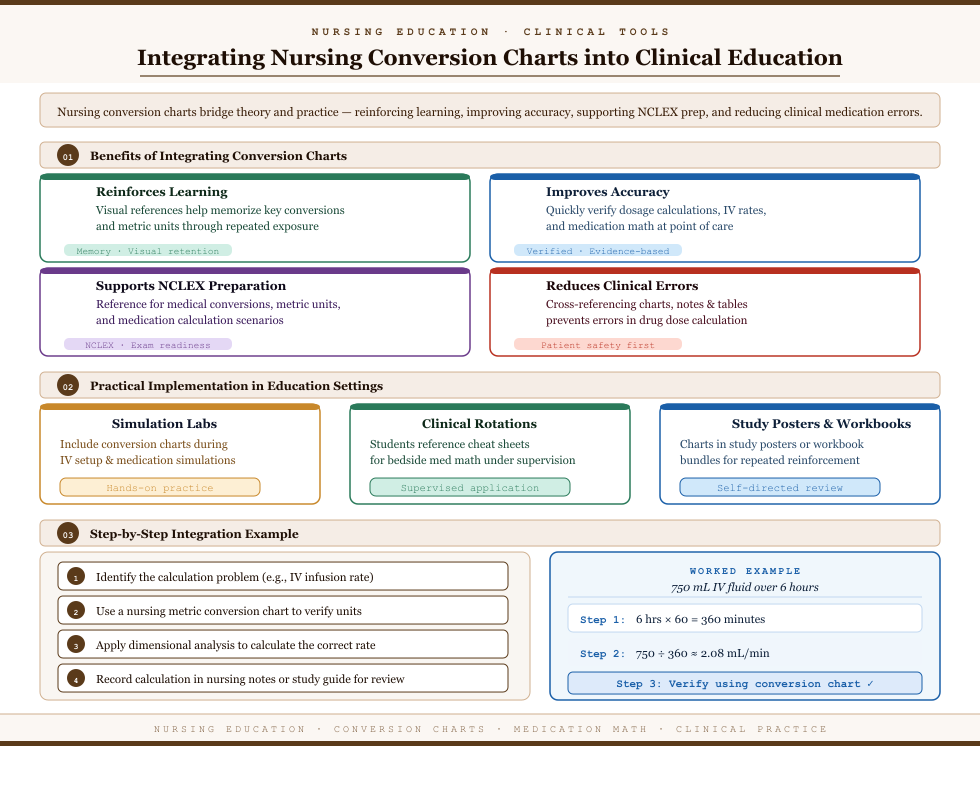
Integrating Nursing Conversion Charts into Clinical Education
Incorporating nursing conversion charts into clinical education enhances both learning and patient safety. These tools help nursing students and practicing nurses translate theoretical knowledge into real-world clinical practice.
- Benefits of Integrating Conversion Charts:
- Reinforces Learning: Visual references help memorize key conversions and metric units.
- Improves Accuracy: Nurses can quickly verify dosage calculations, IV rates, and medication math using charts.
- Supports NCLEX Preparation: Provides a reference for common medical conversions, metric conversions, and medication calculation scenarios.
- Reduces Clinical Errors: Cross-referencing nursing notes, cheat sheets, and conversion tables prevents errors in drug dose calculation.
- Practical Implementation in Education Settings:
- Simulation Labs: Include nursing conversion charts during IV setup or medication administration simulations.
- Clinical Rotations: Students reference cheat sheets for med math calculations at the bedside under supervision.
- Study Posters and Workbooks: Integrate nursing conversion charts into nursing study posters or calculations workbook bundles for repeated reinforcement.
- Step-by-Step Example of Integration:
- Step 1: Identify a common calculation problem (e.g., IV infusion rate).
- Step 2: Use a nursing metric conversion chart to verify units and volumes.
- Step 3: Apply dimensional analysis to calculate the correct rate.
- Step 4: Record the calculation in nursing notes or on a study guide for review.
Example: A patient requires 750 mL of IV fluid over 6 hours. Using a nursing cheat sheet:
- Convert hours → minutes: 6 × 60 = 360 minutes
- Calculate mL/min: 750 ÷ 360 ≈ 2.08 mL/min
- Verify using nursing conversion chart for accuracy
By consistently integrating nursing conversion charts into both study routines and clinical education, nurses develop confidence and proficiency in medication administration, which directly supports patient safety.
Not sure how to write your next nursing assignment?
Give us the patient details, and we’ll take care of the rest.
Conclusion
Mastering nursing conversions and dosage calculations is a cornerstone of safe and effective nursing practice. Accurate metric conversions, unit conversions, and drug calculations directly impact patient outcomes, making proficiency in med math essential for both clinical practice and standardized exams such as the NCLEX. By understanding the anatomy of nursing conversion charts, utilizing nursing cheat sheets, and applying dimensional analysis alongside ratio and proportion methods, nurses can navigate complex calculations with confidence.
Key takeaways include:
- The value of a structured reference: Comprehensive nursing conversion charts and measurement conversion tables provide quick access to metric units, common medical conversions, and dosage calculation formulas, reducing errors in high-pressure clinical settings.
- Step-by-step calculation methods: Approaches like dimensional analysis and weight-based dosing calculations offer reliable frameworks for converting units and determining accurate medication doses.
- Integration into education and practice: Embedding nursing conversion tools into study guides, cheat sheets, simulation labs, and clinical rotations enhances learning, reinforces accuracy, and strengthens critical med math skills.
- Error prevention: Consistent use of nursing conversion charts, cheat sheets, and verification steps reduces the risk of dosage calculation errors, ensuring safe medication administration and improved patient safety.
Ultimately, proficiency in nursing metric conversions is more than memorizing numbers; it is the application of knowledge through structured tools, critical thinking, and repeated practice. By combining conversion tables, cheat sheets, and study guides with disciplined clinical practice, nurses can confidently perform dosage calculation nursing, manage IV drugs, and apply med math with precision. These skills not only prepare nurses for NCLEX success but also underpin safe, high-quality patient care in every clinical setting.
Frequently Asked Questions
How to do conversion in nursing?
In nursing, conversion involves changing one unit of measurement to another to ensure accurate dosage calculation or fluid administration. This is typically done using:
- Nursing conversion charts or tables for quick reference.
- Dimensional analysis (factor-label method): Arrange units so unwanted units cancel and the desired unit remains.
- Ratio and proportion methods: Set up a proportion comparing known values to desired values.
Example: To convert 500 mg to grams: 500 ÷ 1000 = 0.5 g.
How to memorize metric conversions?
Memorization can be simplified by:
- Learning the metric system prefixes (kilo-, hecto-, deca-, base unit, deci-, centi-, milli-).
- Using the mnemonic “King Henry Died By Drinking Chocolate Milk” for kg → hg → dag → g → dg → cg → mg.
- Practice with examples and flashcards for weights, volumes, and medication doses.
- Repetition with nursing cheat sheets or conversion charts during study and clinical practice.
What is kg/hg/dag/g/dg/cg/mg?
These are metric system units for weight/mass:
- kg (kilogram) = 1000 g
- hg (hectogram) = 100 g
- dag (decagram) = 10 g
- g (gram) = base unit
- dg (decigram) = 0.1 g
- cg (centigram) = 0.01 g
- mg (milligram) = 0.001 g
These are essential in nursing conversions, especially for medication dosing.
What is the formula for conversion?
A general formula for converting units:
Desired Amount=Given Amount×Conversion Factor (Desired Unit)Conversion Factor (Given Unit)\text{Desired Amount} = \text{Given Amount} \times \frac{\text{Conversion Factor (Desired Unit)}}{\text{Conversion Factor (Given Unit)}}Desired Amount=Given Amount×Conversion Factor (Given Unit)Conversion Factor (Desired Unit)
Example: Convert 2 g to mg:
2 g×1000 mg1 g=2000 mg2 \text{ g} \times \frac{1000 \text{ mg}}{1 \text{ g}} = 2000 \text{ mg}2 g×1 g1000 mg=2000 mg
This formula applies to weight, volume, and medication conversions, making it a universal tool in nursing dosage calculation.
