

Fidelity in Nursing: Upholding Ethical Principles and Professional Practice
Fidelity in nursing is a foundational ethical principle that guides professional practice, shapes patient care, and reinforces the integrity of the nursing profession. Much like clinical protocols provide structured guidance for patient management, fidelity provides nurses with a framework to honor commitments, maintain trust, and uphold ethical standards in their daily practice. Far from being a theoretical concept, fidelity in nursing directly influences interactions with patients, families, and healthcare teams, ensuring that care is consistent, reliable, and rooted in ethical nursing principles.
At its core, fidelity refers to a nurse’s commitment to being faithful to professional obligations, ethical standards, and the promises made to patients. It intersects closely with autonomy, allowing patients to make informed decisions, and veracity, supporting truthful and transparent communication. Fidelity also aligns with beneficence and nonmaleficence in nursing, emphasizing actions that promote well-being while minimizing harm. By practicing fidelity, nurses not only uphold the ethical principle of justice but also contribute to high-quality care, patient safety, and positive outcomes.
Understanding fidelity in nursing is essential for both seasoned professionals and nursing students. It is embedded in the nursing code of ethics, including guidance from the American Nurses Association, and is reinforced throughout nursing education programs, clinical rotations, and professional development activities. Nurses demonstrate fidelity in multiple ways—through accurate care planning, ethical decision-making, patient advocacy, and collaboration with healthcare providers. When fidelity is absent or compromised, patient trust and the integrity of care can be affected, highlighting the importance of ethical vigilance and reflective practice.
This article provides a comprehensive exploration of fidelity in nursing, examining its definition, ethical underpinnings, application in clinical practice, and integration into nursing education. Through real-world examples and guidance from professional standards, we will explore how nurses can uphold the principle of fidelity, navigate ethical dilemmas, and provide high-quality, competent care. By understanding and practicing fidelity, nurses reinforce their professional responsibilities and contribute to a culture of ethical, patient-centered care across the nursing profession.
Understanding Fidelity and Its Role in Nursing Practice
Defining Fidelity in Nursing and Nursing Ethics
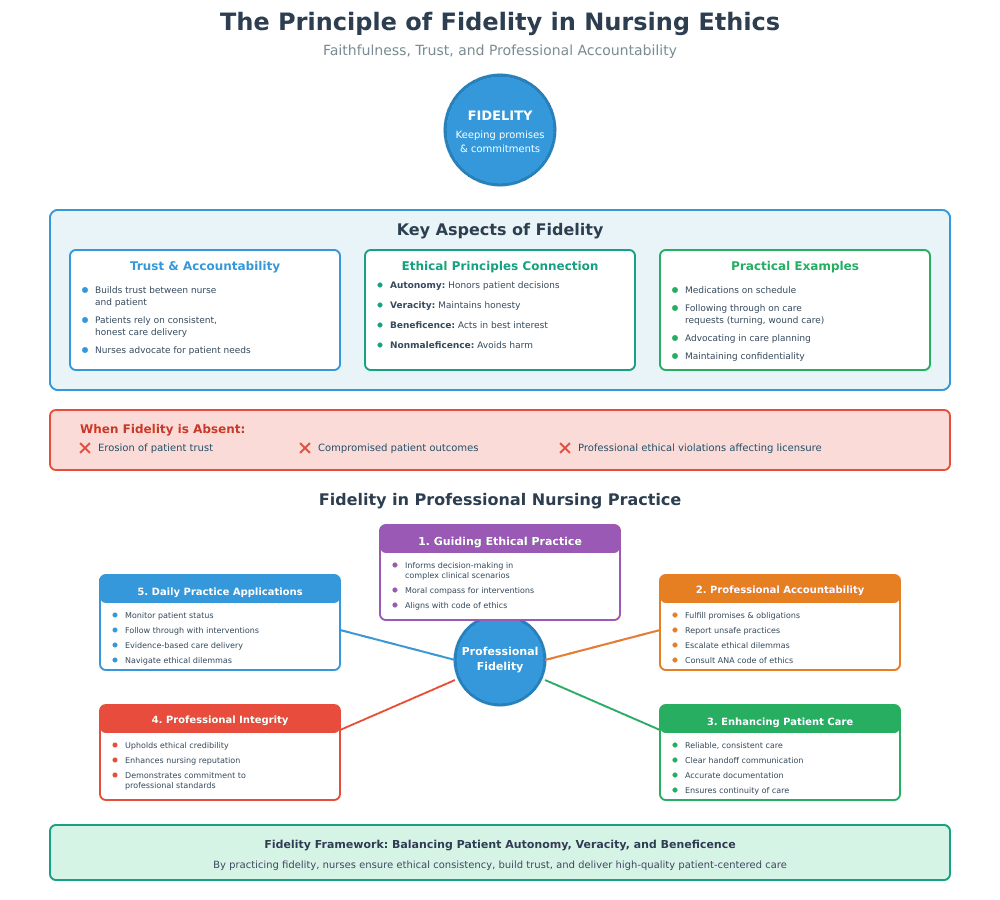
Fidelity in nursing is a foundational ethical principle that underpins trust, integrity, and professional responsibility in nursing practice. It refers to the commitment of a nurse to honor obligations, promises, and ethical standards in interactions with patients, families, and the healthcare team. Fidelity is not simply about following rules—it represents a deeper moral and professional responsibility that guides ethical nursing decisions.
Key aspects of fidelity in nursing ethics include:
- Trust and Accountability
- Fidelity builds trust between the nurse and the patient.
- Patients rely on nurses to deliver care consistently, communicate honestly, and advocate for their needs.
- Connection to Ethical Principles
- Autonomy: Fidelity respects a patient’s right to make informed decisions by providing accurate information and honoring their preferences.
- Veracity: Fidelity requires nurses to maintain honesty in all interactions, including reporting errors, discussing prognosis, and conveying care plans.
- Beneficence: Nurses practice fidelity when acting in the patient’s best interest and promoting well-being.
- Nonmaleficence: Fidelity also encompasses avoiding harm, ensuring that promises made to patients are fulfilled safely and competently.
- Practical Examples
- Administering medications on schedule as promised.
- Following through on patient care requests, such as turning schedules or wound care.
- Advocating for patient preferences in care planning and interdisciplinary meetings.
- Maintaining confidentiality and ethical documentation, which reinforces professional accountability.
When fidelity is absent, it can lead to:
- Erosion of patient trust
- Compromised patient outcomes
- Professional ethical violations that may affect licensure or standing in the nursing profession
The Principle of Fidelity in the Context of Professional Nursing
The principle of fidelity is central to professional nursing, guiding ethical practice and ensuring accountability within the scope of practice. It influences how nurses interact with patients, colleagues, and the broader healthcare system while promoting high-quality care and ethical consistency.
Key roles of fidelity in professional nursing include:
- Guiding Ethical Practice
- Nurses use fidelity to inform decision-making in complex clinical scenarios.
- Acts as a moral compass, ensuring that interventions align with ethical standards and nursing code of ethics guidance.
- Maintaining Professional Accountability
- Fidelity requires nurses to fulfill promises, meet professional obligations, and adhere to ethical standards in daily practice.
- Examples include reporting unsafe practices, escalating ethical dilemmas to an ethics committee, or consulting the American Nurses Association code of ethics when patient care conflicts arise.
- Enhancing Patient Care and Outcomes
- Patients receive reliable, consistent care, improving satisfaction and health outcomes.
- Examples of fidelity in practice:
- Clear communication during clinical handoffs.
- Accurate documentation in the care plan.
- Coordinating with healthcare providers to ensure continuity of care.
- Promoting Integrity of the Nursing Profession
- By practicing fidelity, nurses contribute to the ethical credibility and reputation of the nursing profession.
- Upholding fidelity demonstrates commitment to ethical nursing, professional standards, and quality nursing practices.
- Daily Applications in Nursing Practice
- Fidelity guides nurses in routine care: monitoring patient status, following through with interventions, and delivering care based on evidence and ethical standards.
- It also provides a framework for navigating ethical dilemmas, ensuring that care decisions balance patient autonomy, veracity, and beneficence.
Summary: Fidelity in nursing ensures that nurses act ethically, reliably, and professionally in all aspects of patient care. It strengthens trust, enhances outcomes, and supports the overall integrity and accountability of the nursing profession. Nurses who understand and practice fidelity can provide competent care, uphold the ethical principle of fidelity, and reinforce the values that guide professional nursing practice.
Fidelity in Nursing Codes and Ethical Guidelines
Fidelity in the American Nurses Association Nursing Code of Ethics
The American Nurses Association (ANA) Nursing Code of Ethics provides a structured framework that defines, supports, and guides the practice of fidelity in nursing. According to the ANA, fidelity refers to the nurse’s commitment to being faithful to the obligations of professional practice, maintaining trust with patients, and adhering to ethical standards outlined in the nursing code of ethics for nurses. By embedding fidelity into the code, the ANA emphasizes that nurses are ethically accountable not only to patients but also to the nursing profession and the broader healthcare system.
Key elements of fidelity as defined by the ANA include:
- Commitment to Patient Care
- Nurses are expected to prioritize patient interests, honor care promises, and maintain veracity in nursing communication.
- Example: A nurse promises to follow up with a patient regarding lab results. Maintaining fidelity means delivering that follow-up accurately and on time.
- Professional Accountability
- The code highlights that nurses must uphold professional and ethical standards consistently.
- Example: A nurse who identifies an ethical breach in patient care, such as medication errors or neglect, reports it to an ethics committee or relevant supervisory authority to uphold the integrity of the profession.
- Collaboration and Trust
- Fidelity in nursing extends to maintaining trust with the healthcare team. Nurses must reliably communicate patient information, collaborate on care plans, and respect shared responsibilities.
- Example: During a clinical handoff, a nurse demonstrates fidelity by accurately communicating changes in patient status to the incoming nurse, ensuring continuity and safety.
- Education and Mentorship
- The ANA code encourages nurses to act as role models for students and colleagues, helping nurses and nursing students understand and practice ethical principles.
- Example: Senior nurses mentoring new graduates reinforce fidelity by showing how to advocate for patients, follow care plans, and navigate ethical dilemmas.
By adhering to the ANA code, nurses not only fulfill their ethical obligations but also strengthen the integrity of the nursing profession and promote high-quality care. Fidelity becomes a tangible standard in everyday practice, linking ethical principles to concrete actions that impact patient outcomes and professional accountability.
Ethical Principles in Nursing and Fidelity
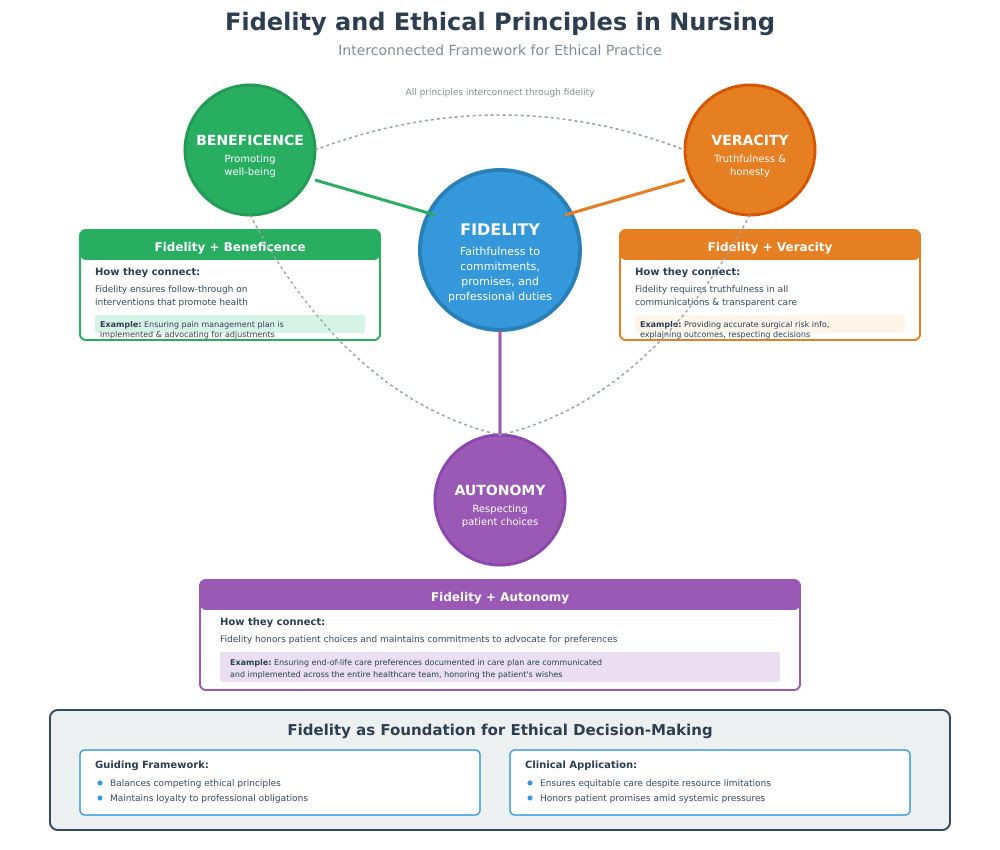
Fidelity is not an isolated ethical concept—it is deeply intertwined with other core ethical principles in nursing, including beneficence, veracity, and autonomy. Understanding these relationships is essential for ethical practice, clinical decision-making, and the development of trust in nurse-patient relationships.
- Fidelity and Beneficence
- The principle of beneficence emphasizes actions that promote patient well-being. Fidelity reinforces beneficence by ensuring nurses follow through on promises and interventions that support patient health.
- Example: A nurse committed to fidelity ensures a patient receives the appropriate pain management plan, advocating for adjustments when necessary to relieve suffering.
- Fidelity and Veracity
- Fidelity requires truthfulness and honesty in nursing practice. It is closely linked to veracity in nursing, ensuring transparent communication with patients and families.
- Example: If a patient asks about the risks of a surgical procedure, a nurse who demonstrates fidelity provides accurate information, explaining potential outcomes and respecting the patient’s decision-making process.
- Fidelity and Autonomy
- Respect for patient autonomy is central to ethical nursing. Fidelity supports autonomy by honoring the patient’s choices and maintaining commitments to advocate for their preferences.
- Example: A nurse demonstrates fidelity by ensuring that a patient’s end-of-life care preferences, documented in a care plan, are communicated and implemented across the healthcare team.
- Fidelity as a Foundation for Ethical Nursing Decision-Making
- Ethical nursing decisions often involve balancing competing principles. Fidelity provides a guiding framework by reminding nurses to remain loyal to professional obligations, patient rights, and ethical standards.
- Example: In cases where resource limitations or staffing challenges exist, a nurse practicing fidelity ensures that care remains equitable, high-quality care is provided, and patient promises are honored despite systemic pressures.
By integrating fidelity with other ethical principles that guide nursing, nurses create a cohesive approach to nursing care that prioritizes patient safety, supports trust, and enhances patient outcomes. Fidelity serves as a bridge between ethical theory and clinical practice, guiding nurses in both routine care and complex ethical dilemmas.
Demonstrating Fidelity in Nursing Practice
Practical Examples of Fidelity in Clinical Nursing
Fidelity in nursing is best understood through its practical application in daily nursing practice. Nurses demonstrate fidelity by being reliable, trustworthy, and ethically accountable in every interaction with patients, families, and healthcare providers. Integrating fidelity with veracity and respect for autonomy ensures that patients receive care that is both ethical and patient-centered.
Key areas where fidelity is demonstrated in clinical nursing include:
- Care Planning
- Nurses demonstrate fidelity by developing and adhering to care plans that reflect patient needs, preferences, and ethical standards.
- Example: A patient with diabetes expresses a preference for home-based glucose monitoring. A nurse who practices fidelity ensures the care plan accommodates this request while providing education on safe monitoring techniques.
- Maintaining fidelity in care planning also involves regularly reviewing and updating plans based on patient condition, test results, or changes in treatment protocols.
- Clinical Handoffs
- Accurate and complete handoffs are crucial for continuity of care. Fidelity ensures that nurses provide full disclosure of patient status, interventions completed, and pending tasks.
- Example: During a shift change, a nurse communicates that a patient’s IV antibiotics were delayed due to pharmacy issues. By honestly reporting this, the incoming nurse can continue care safely, demonstrating fidelity, veracity, and professional responsibility.
- Medication Administration
- Fidelity is central to safe and ethical medication administration. Nurses must follow the “five rights” (right patient, drug, dose, route, and time) and ensure that medications are given as prescribed.
- Example: A nurse notices a discrepancy in a patient’s medication order and promptly clarifies with the prescribing physician. By doing so, the nurse protects patient safety while upholding the ethical principle of fidelity.
- Patient Advocacy
- Fidelity extends to advocating for patients’ rights and preferences, particularly in situations where patients cannot voice concerns themselves.
- Example: A nurse observes that a patient’s pain is being undertreated. By speaking up and ensuring proper analgesia is administered, the nurse demonstrates a commitment to high-quality care and ethical nursing.
- Documentation and Communication
- Accurate documentation reflects fidelity by ensuring that patient care records are complete, truthful, and accessible to all members of the healthcare team.
- Example: A nurse carefully documents a patient’s response to a new treatment plan and communicates relevant changes to interdisciplinary colleagues, reinforcing trust and accountability.
Teaching and Practicing Fidelity in Nursing Education
Nursing students must develop the ability to practice fidelity early in their education to internalize ethical nursing principles and prepare for professional responsibilities. Nursing educators and clinical instructors play a pivotal role in teaching fidelity through structured experiences and mentorship.
Strategies for teaching and practicing fidelity include:
- Mentorship and Role Modeling
- Experienced nurses demonstrate fidelity in real clinical settings, providing students with tangible examples of ethical practice.
- Example: A preceptor guides a student through a care plan, emphasizing accurate communication, following through on promises to patients, and advocating for patient needs.
- Simulation-Based Learning
- Simulation labs allow students to practice fidelity in controlled scenarios, making decisions that reflect ethical principles without risking patient safety.
- Example: Students participate in a mock clinical handoff where they must accurately report patient information while prioritizing patient autonomy and veracity.
- Reflective Practice
- Encouraging students to reflect on clinical experiences fosters self-awareness and ethical reasoning. Reflective exercises help students identify instances where fidelity was practiced or could have been improved.
- Example: After a clinical rotation, students journal about situations where patient trust was established or compromised, linking experiences to ethical frameworks and nursing code of ethics standards.
- Integration into Nursing Programs and Curriculum
- Courses on nursing ethics and professional standards explicitly teach ethical principles in nursing, emphasizing the role of fidelity in decision-making, care planning, and patient advocacy.
- Example: Case studies and discussions allow students to analyze ethical dilemmas and explore how fidelity intersects with beneficence, nonmaleficence, and veracity.
By incorporating these strategies, nursing educators ensure that students not only understand fidelity in theory but also demonstrate fidelity in clinical practice. Early training in ethical principles strengthens professional nursing habits, reinforces patient-centered care, and prepares future nurses to uphold the standards of care and ethical accountability required in the nursing profession.
Addressing Challenges and Ethical Dilemmas Related to Fidelity
Recognizing Breaches of Fidelity in Nursing Care
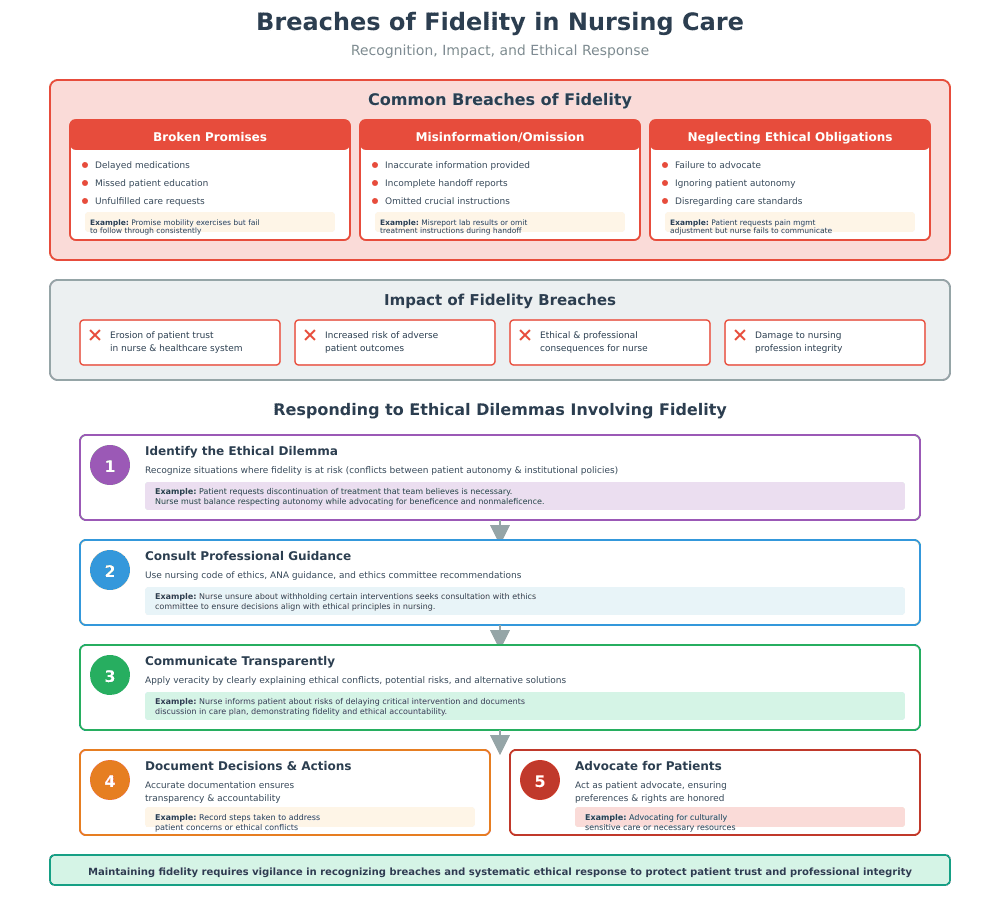
Fidelity is central to ethical nursing and patient trust. However, in clinical practice, nurses may encounter situations where fidelity is compromised. Recognizing these breaches is essential for maintaining professional accountability, ensuring high-quality care, and safeguarding the integrity of the nursing profession.
Common examples of lack of fidelity in nursing include:
- Broken Promises to Patients
- When nurses fail to follow through on commitments, such as delayed medications, missed patient education, or unfulfilled care requests, patients may feel neglected or deceived.
- Example: A nurse promises a family that their loved one will be assisted with mobility exercises at specific times but consistently fails to do so, undermining patient trust and professional credibility.
- Misinformation or Omission of Information
- Providing inaccurate or incomplete information violates veracity in nursing and breaches fidelity.
- Example: A nurse misreports lab results or omits crucial treatment instructions during a handoff, potentially compromising patient safety and patient outcomes.
- Neglecting Ethical Obligations
- Failure to advocate for a patient’s preferences, ignoring their autonomy, or disregarding care standards constitutes a breach of fidelity.
- Example: A patient requests pain management adjustments, but the nurse fails to communicate the request to the healthcare team, leading to inadequate care.
The impact of breaches in fidelity is significant:
- Erosion of patient trust in the nurse and healthcare system
- Increased risk of adverse patient outcomes
- Ethical and professional consequences for the nurse, including potential scrutiny from state boards of nursing or ethical review committees
- Damage to the overall reputation and integrity of the nursing profession
Responding to Ethical Dilemmas Involving Fidelity
Ethical dilemmas involving fidelity arise when competing obligations or patient preferences conflict with professional or institutional constraints. Nurses must navigate these situations carefully to maintain ethical practice.
Steps nurses can take include:
- Identify the Ethical Dilemma
- Recognize situations where fidelity is at risk, such as conflicts between patient autonomy and institutional policies.
- Example: A patient requests discontinuation of a treatment plan that the healthcare team believes is necessary. The nurse must balance respecting the patient’s autonomy while advocating for beneficence and nonmaleficence in nursing.
- Consult Professional Guidance
- Use the nursing code of ethics, guidance from the American Nurses Association, and recommendations from an ethics committee to inform decision-making.
- Example: A nurse unsure about withholding certain interventions seeks consultation with the ethics committee to ensure decisions align with ethical principles in nursing.
- Communicate Transparently
- Apply veracity by clearly explaining ethical conflicts, potential risks, and alternative solutions to patients and families.
- Example: A nurse informs a patient about the risks of delaying a critical intervention and documents the discussion in the care plan, demonstrating fidelity and ethical accountability.
- Document Decisions and Actions
- Accurate documentation ensures transparency and accountability, reinforcing fidelity in nursing practice.
- Example: Recording steps taken to address patient concerns or ethical conflicts protects both the patient and nurse, and upholds standards of care.
- Advocate for Patients
- Nurses must act as patient advocates, ensuring preferences and rights are honored even in challenging scenarios.
- Example: Advocating for culturally sensitive care or necessary resources to fulfill care promises demonstrates a commitment to fidelity and high-quality care.
Strategies for Nursing Students to Learn and Practice Fidelity
Nursing education plays a crucial role in cultivating ethical practice and fidelity among students. Educators and clinical instructors reinforce the principle of fidelity through:
- Mentorship and Role Modeling
- Experienced nurses model fidelity in clinical settings, showing students how to prioritize patient commitments, communicate honestly, and advocate for patient needs.
- Example: Preceptors guide students through ethical dilemmas in patient care, emphasizing transparency, trust, and accountability.
- Simulation-Based Learning
- Simulation labs allow students to practice fidelity in realistic scenarios, including care planning, medication administration, and patient handoffs.
- Example: A student participates in a simulated ethical conflict where a patient’s care preferences differ from standard protocols, learning how to balance autonomy and fidelity.
- Reflective Practice and Debriefing
- Encouraging students to reflect on clinical experiences helps identify instances where fidelity was upheld or could have been strengthened.
- Example: After a rotation, students discuss cases where patient promises were delayed or care instructions misunderstood, linking experiences to ethical principles in nursing and nursing code of ethics for nurses.
- Integration into Nursing Programs and Curriculum
- Courses on nursing ethics and professional standards embed fidelity as a central topic, preparing students to practice ethically in complex situations.
- Example: Students analyze case studies, identify breaches in fidelity, and develop strategies to uphold ethical standards in future nursing careers.
By systematically teaching fidelity, nursing programs ensure that students understand how to apply the ethical principle of fidelity in clinical settings, maintain professional accountability, and provide high-quality care that is consistent, reliable, and patient-centered.
The Importance of Fidelity for High-Quality Nursing Care and the Nursing Profession
Fidelity’s Impact on Patient Outcomes and Care Quality
Fidelity is a foundational ethical principle in nursing that directly influences the quality of care, patient safety, and overall health outcomes. When a nurse demonstrates fidelity, patients can trust that care will be consistent, evidence-based, and delivered in alignment with their preferences and needs. Fidelity fosters a culture of accountability and ethical responsibility that enhances nursing practice and improves patient outcomes.
Key ways fidelity impacts patient care include:
- Enhancing Patient Safety
- Fidelity ensures that nurses adhere to care plans, medication schedules, and monitoring protocols.
- Example: A nurse faithfully follows through on checking vital signs, administering medications at the correct times, and documenting patient responses. This reliability prevents errors, complications, and adverse events, demonstrating how fidelity in nursing practice protects patient safety.
- Promoting Patient Satisfaction
- Patients value nurses who are consistent, trustworthy, and honest in their communication.
- Example: A patient who receives accurate information about their treatment and timely responses to concerns feels respected and empowered. Nurses who practice fidelity reinforce trust and veracity in nursing, improving the overall patient experience.
- Supporting Ethical Decision-Making
- Fidelity guides nurses in making ethically sound decisions during complex care situations.
- Example: When a patient requests a modification to their care plan, the nurse assesses the request, provides guidance, and follows through, balancing autonomy, beneficence, and the ethical principle of fidelity. Such adherence ensures that care is both ethically and clinically appropriate.
- Maintaining Continuity and High-Quality Care
- Fidelity promotes consistency across all points of patient interaction, from clinical handoffs to interdisciplinary communication.
- Example: A nurse who accurately reports patient status during shift changes ensures continuity of care, preventing errors and reinforcing professional accountability. Fidelity in communication and follow-through contributes to high-quality care across healthcare settings.
By integrating fidelity into everyday nursing responsibilities, nurses uphold standards of care, enhance patient safety, and strengthen trust between patients, families, and healthcare teams.
Supporting Ethical Nursing Practice Across the Nursing Career
Fidelity is not limited to individual patient interactions; it is essential for sustaining ethical nursing practice and the integrity of the nursing profession throughout a nurse’s career. Lifelong adherence to fidelity fosters professional growth, reflection, and accountability.
Key aspects of fidelity in supporting the nursing career include:
- Lifelong Professional Development
- Fidelity encourages nurses to continuously develop skills, knowledge, and ethical reasoning.
- Example: A nurse participates in continuing education programs on ethical decision-making and patient advocacy to ensure they can consistently practice fidelity in nursing.
- Ethical Reflection and Self-Evaluation
- Reflecting on clinical experiences helps nurses assess whether their actions align with the nursing code of ethics, patient expectations, and professional standards.
- Example: After a challenging patient interaction, a nurse reviews whether all commitments were met and if ethical principles, such as beneficence and nonmaleficence, were upheld. This reflective practice strengthens ethical competence and professional nursing integrity.
- Sustaining the Integrity of the Nursing Profession
- Fidelity reinforces the reputation and credibility of the nursing profession, demonstrating commitment to ethical practice and quality care.
- Example: Nurses who consistently honor promises, advocate for patient preferences, and maintain accurate documentation contribute to the ethical standing and public trust of the profession.
- Accountable, Patient-Centered Practice
- Fidelity ensures that care is delivered in alignment with patient values, clinical standards, and ethical expectations.
- Example: A nurse in a long-term care facility coordinates with the healthcare team to fulfill a patient’s expressed wishes regarding mobility and daily care, exemplifying nursing ethical principles and reinforcing patient-centered care.
By embedding fidelity into daily nursing practice, nurses create a professional environment where ethical principles guide decisions, high-quality care is consistently delivered, and the trust between patients and the healthcare team is maintained. Fidelity, therefore, serves both as a moral compass and a practical standard, ensuring that the nursing profession continues to uphold its ethical responsibilities across every stage of a nurse’s career.
Conclusion
Fidelity is more than a theoretical concept in nursing; it is a practical and ethical cornerstone that shapes every aspect of nursing practice. By upholding the ethical principle of fidelity, nurses honor their commitments to patients, families, and the nursing profession, fostering trust, integrity, and accountability. Fidelity is closely intertwined with other ethical principles in nursing, including veracity, autonomy, and beneficence, creating a framework for ethically sound and patient-centered care.
In everyday practice, fidelity manifests through accurate care planning, transparent communication during clinical handoffs, safe medication administration, and consistent advocacy for patient preferences. Breaches of fidelity, such as misinformation or unfulfilled commitments, can erode patient trust, compromise high-quality care, and threaten the ethical integrity of the profession. Conversely, when nurses demonstrate fidelity, they enhance patient outcomes, satisfaction, and safety while reinforcing the ethical standards that guide professional nursing.
Fidelity also plays a critical role in nursing education and professional development. Through mentorship, simulation, reflective practice, and adherence to the nursing code of ethics, nursing students and practicing nurses learn to navigate ethical dilemmas, uphold commitments, and integrate fidelity into their clinical decision-making. By fostering a culture of fidelity, nurses contribute to the ongoing integrity of the nursing profession, ensuring that patient care remains ethical, compassionate, and reliable.
Ultimately, fidelity in nursing is not simply about keeping promises—it is about cultivating trust, maintaining ethical accountability, and providing care that consistently reflects the highest standards of professional and moral responsibility. For nurses, fidelity is both a guiding principle and a daily practice that safeguards the well-being of patients and strengthens the ethical foundation of the nursing profession.
Frequently Asked Questions
What is fidelity in the nursing code of ethics?
Fidelity in the nursing code of ethics refers to the nurse’s commitment to be faithful, trustworthy, and reliable in all professional relationships. It involves honoring promises, following through on care plans, and maintaining accountability to patients, families, and the healthcare team. By upholding fidelity, nurses demonstrate integrity and ethical responsibility in patient care.
What is fidelity in the code of ethics?
Fidelity in the code of ethics is the ethical obligation to act consistently with professional commitments and moral duties. It ensures that nurses provide honest, dependable, and patient-centered care, respecting patients’ rights, autonomy, and dignity. This principle serves as a foundation for ethical decision-making in nursing practice.
How do codes of ethics support fidelity?
Codes of ethics support fidelity by:
- Defining expectations for professional behavior and ethical accountability.
- Guiding nurses to honor commitments to patients, colleagues, and the nursing profession.
- Providing frameworks for navigating ethical dilemmas while maintaining trust, high-quality care, and consistency in practice.
What is ethical fidelity?
Ethical fidelity is the nurse’s commitment to uphold moral and professional responsibilities consistently. It combines ethical principles in nursing, such as veracity, beneficence, and autonomy, to ensure that care is reliable, trustworthy, and aligned with both patient needs and professional standards. Ethical fidelity strengthens patient trust, guides decision-making, and reinforces the integrity of the nursing profession.
