

Erikson 8 Stages of Psychosocial Development: A Nursing Student’s Guide to Stages of Psychosocial Development Explained
Psychosocial development is a foundational aspect of human growth, shaping the ways individuals think, feel, and interact across the lifespan. Central to understanding these processes is Erik Erikson’s theory of psychosocial development, which outlines eight stages of psychosocial development that occur from infancy through late life. Each stage of development presents unique psychosocial challenges, or psychosocial crises, that influence personality development, cognitive and emotional health, and the sense of self. Unlike purely biological perspectives on development, Erikson emphasized the interplay between social relationships, personal experiences, and individual growth, offering a comprehensive framework for understanding human development across life stages.
For nursing students, knowledge of psychosocial stages of development extends beyond theoretical understanding. It provides practical insight into patient behaviors, emotional responses, and coping mechanisms at different life stages. Whether assessing infants navigating autonomy, adolescents exploring identity development, or older adults reflecting on integrity versus despair, nurses can use Erikson’s stages to inform patient-centered care, anticipate developmental challenges, and implement interventions that support healthy psychosocial functioning. Understanding the eight stages of psychosocial development also enhances communication with patients and families, promotes empathy, and strengthens strategies for fostering cognitive and emotional health throughout the life span.
This guide presents Erikson’s eight stages in depth, exploring the psychosocial crises, developmental tasks, and nursing strategies relevant to each stage. By connecting developmental theory with clinical practice, nursing students can better appreciate the nuances of psychosocial growth, apply evidence-based interventions, and support patients’ psychological and emotional well-being in diverse care settings. From early childhood to late life, these stages of psychosocial development provide a structured lens for understanding how humans grow, adapt, and achieve a sense of purpose throughout their life span.
Understanding Psychosocial Development and Its Importance in Nursing
Psychosocial development is a central component of human growth, encompassing how individuals form relationships, navigate challenges, and establish a sense of identity across the life span. For nursing students, a thorough understanding of psychosocial development is essential because it informs patient care, helps anticipate patient behaviors, and supports holistic, person-centered interventions.
Overview of psychosocial development and developmental stages
Psychosocial development involves the interaction of psychological and social factors that shape personality development and emotional health. Key aspects include:
- Interplay of social and emotional growth: Development is influenced not only by biology but also by relationships with caregivers, peers, and society.
- Life span perspective: Psychosocial development occurs across life stages, from infancy to late life, with each stage presenting distinct challenges and tasks.
- Developmental stages: These are periods during which individuals face psychosocial tasks that contribute to their sense of self and social competence.
- Outcomes of successful development: Mastery of each stage fosters emotional resilience, self-confidence, social competence, and cognitive-emotional health.
- Consequences of unresolved challenges: Failure to resolve a stage may result in psychosocial vulnerabilities, such as feelings of inferiority, low self-esteem, or difficulties forming intimate relationships.
Example: An adolescent struggling with social belonging may exhibit emotional withdrawal, highlighting the importance of understanding psychosocial stages in clinical assessment.
Erik Erikson’s psychosocial theory and stages of psychosocial development explained
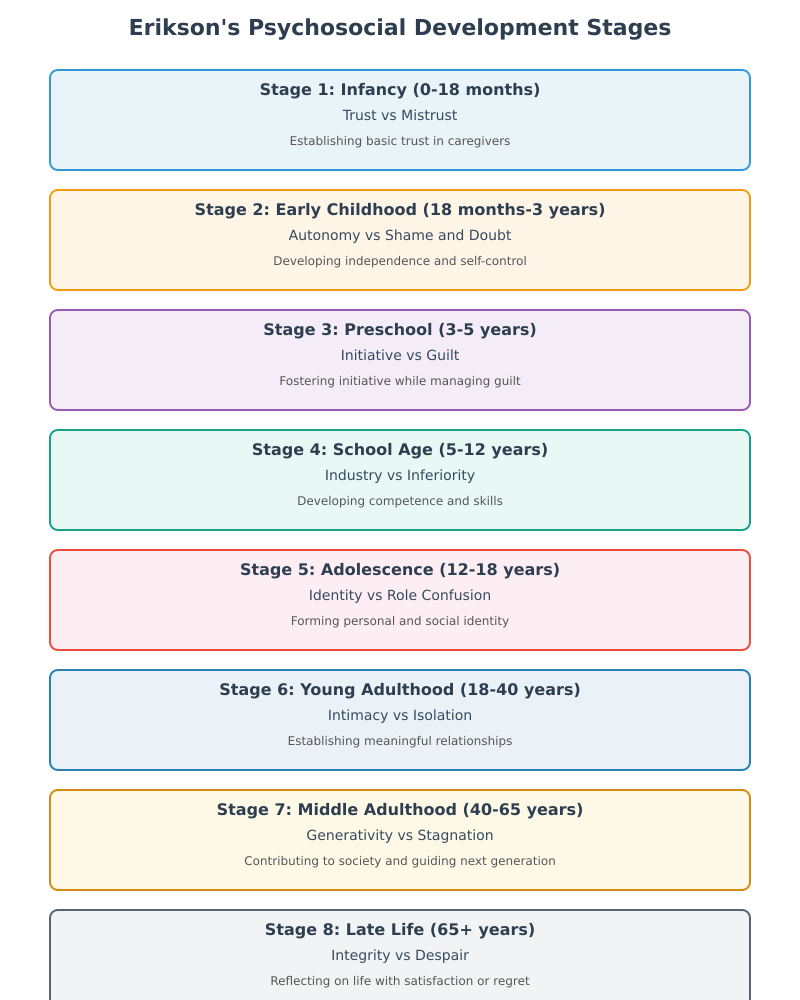
Erik Erikson, a developmental psychologist, proposed a comprehensive theory of psychosocial development that describes human growth in eight stages. Each stage is defined by a central psychosocial conflict that influences personality development and the sense of self:
The Eight Stages of Psychosocial Development (Overview):
- Infancy: Trust vs Mistrust – Establishing basic trust in caregivers.
- Early Childhood: Autonomy vs Shame and Doubt – Developing independence and self-control.
- Preschool: Initiative vs Guilt – Fostering initiative while managing feelings of guilt.
- School Age: Industry vs Inferiority – Developing competence and skills.
- Adolescence (Stage 5): Identity vs Role Confusion – Forming a personal and social identity.
- Young Adulthood: Intimacy vs Isolation – Establishing meaningful relationships.
- Middle Adulthood: Generativity vs Stagnation – Contributing to society and guiding the next generation.
- Late Life (Stage 8): Integrity vs Despair – Reflecting on life with satisfaction or regret.
Key Points:
- Each psychosocial stage involves a psychosocial crisis, representing a challenge with two opposing outcomes (e.g., autonomy vs shame and doubt).
- Successful resolution fosters positive attributes (e.g., confidence, intimacy, generativity), while failure may lead to difficulties in emotional, cognitive, or social functioning.
- Erikson emphasized that development continues throughout life, making these stages relevant for nursing practice across all patient age groups.
Relevance of psychosocial stages of development to nursing practice and patient care
Nursing students benefit from understanding psychosocial stages because this knowledge:
- Supports patient assessment: Helps identify behaviors, emotional needs, and coping mechanisms related to developmental stages.
- Enhances communication: Enables nurses to adjust interactions based on the patient’s psychosocial stage.
- Guides interventions: Informs strategies that promote healthy psychosocial development and cognitive-emotional well-being.
- Improves patient education: Facilitates age-appropriate guidance that respects developmental capacities.
Examples in Nursing Practice:
- A toddler exhibiting resistance to routine care may be experiencing challenges with autonomy vs shame and doubt. Nurses can support autonomy by offering simple choices during care activities.
- An adolescent struggling with social identity may benefit from guidance around identity development, peer support, and counseling interventions.
- An older adult reflecting on life may require interventions addressing integrity vs despair, such as life review sessions or reminiscence therapy.
How psychosocial crises influence personality and cognitive-emotional health
Psychosocial crises are critical developmental challenges at each stage. They are pivotal in shaping personality development and cognitive and emotional health:
- Positive resolution: Leads to adaptive traits like resilience, empathy, autonomy, and a strong sense of purpose.
- Negative resolution: Can result in emotional difficulties, feelings of inferiority, social withdrawal, or impaired decision-making.
Examples Across Life Stages:
- Childhood – Industry vs Inferiority: Unresolved challenges may manifest as poor academic performance or low confidence in social interactions.
- Adolescence – Identity vs Role Confusion (Stage 5): Confusion about identity can affect career planning, social interactions, and risk-taking behaviors.
- Adulthood – Intimacy vs Isolation: Difficulty forming close relationships may lead to loneliness or emotional distress.
- Midlife – Generativity vs Stagnation: Failure to achieve a sense of purpose can lead to midlife dissatisfaction or stagnation in personal growth.
- Late Life – Integrity vs Despair (Stage 8): Unresolved conflicts can result in regret or the perception that life has been wasted, impacting ego integrity and emotional well-being.
Clinical Implications: Nurses can intervene at any stage by:
- Assessing developmental milestones and psychosocial needs.
- Implementing interventions that promote positive resolution of psychosocial crises.
- Providing education and support tailored to the patient’s developmental stage.
- Collaborating with interdisciplinary teams to address complex psychosocial challenges.
Stage 1 – Trust vs Mistrust and Early Autonomy
The first stage of Erikson’s 8 stages of psychosocial development occurs during infancy (approximately 0–18 months) and sets the foundation for all subsequent stages of psychosocial development. During this stage, infants navigate two interrelated challenges: trust vs mistrust and autonomy vs shame and doubt, which are central to establishing a secure sense of self and early independence.
Autonomy vs shame and doubt: psychosocial stage in infancy
Definition:
According to Erikson, the psychosocial stage of autonomy vs shame and doubt emerges as infants begin to explore their environment, exercise control over bodily functions, and test independence. Successfully achieving autonomy fosters self-confidence, a sense of control, and resilience in later life. Conversely, repeated restrictions or negative responses from caregivers can lead to shame and doubt, limiting exploration and self-expression.
Developmental Milestones:
Infants at this stage typically demonstrate:
-
- Basic self-feeding or attempts at using a spoon.
- Early toilet training behaviors.
- Exploration of surroundings, such as crawling toward toys or objects of interest.
- Repetitive gestures signaling independence, like holding a cup or pointing.
Importance:
This stage is crucial because the foundation of autonomy established in infancy shapes later personality development, self-confidence, and cognitive and emotional health. A child who develops a secure sense of autonomy is more likely to approach future psychosocial crises with resilience.
Example: A toddler encouraged to choose between two outfits develops decision-making skills, supporting autonomy. Conversely, a child consistently scolded for “wrong” choices may develop shame and feelings of doubt, impacting their sense of self.
Identifying signs of autonomy or shame and doubt in infants and toddlers
Early recognition of autonomy and shame and doubt is vital for nurses and caregivers. Signs include:
Indicators of Autonomy:
- Self-initiated exploration and curiosity about surroundings.
- Positive responses to encouragement during tasks (e.g., smiling after attempting to feed themselves).
- Displaying preferences and making choices, even in simple tasks.
- Expressing mild frustration when encountering manageable obstacles (demonstrates effort and perseverance).
Indicators of Shame and Doubt:
- Hesitation or withdrawal from new experiences.
- Fearful reactions to attempting tasks independently.
- Excessive reliance on caregivers for basic tasks.
- Signs of distress when mistakes occur, such as crying or avoidance behaviors.
Clinical Observation Example:
A nurse in a pediatric unit notices a 14-month-old withdrawing when offered a sippy cup independently. This may indicate shame and doubt. Early interventions, such as encouraging small successes and providing positive reinforcement, can foster autonomy.
Nursing interventions to support autonomy and healthy early development
Nursing interventions play a pivotal role in guiding infants through this psychosocial stage. Strategies include:
- Facilitate Safe Exploration:
- Provide age-appropriate toys and safe spaces for infants to move, crawl, and explore.
- Encourage activities that promote motor skills, such as stacking blocks or grasping objects.
- Promote Choice and Independence:
- Offer simple, limited choices (e.g., “Do you want the blue cup or the red cup?”).
- Encourage self-feeding or dressing skills appropriate for developmental stage.
- Positive Reinforcement:
- Praise attempts rather than only successes to foster confidence and resilience.
- Avoid harsh criticism; instead, redirect or guide infants when mistakes occur.
- Educate Caregivers:
- Explain the importance of consistent and supportive responses to infants’ efforts.
- Encourage responsive parenting that balances guidance with freedom to explore.
- Monitor Psychosocial Development:
- Use developmental screening tools to identify delays or early signs of shame and doubt.
- Collaborate with interdisciplinary teams, including occupational and speech therapists, for comprehensive support.
Example of Nursing Practice:
During a routine well-child check, a nurse observes a 16-month-old attempting to stack rings. By providing encouragement and allowing repeated attempts without interruption, the nurse supports autonomy, reinforcing mastery experiences and promoting healthy personality development.
Stage 2 – Initiative vs Guilt and Early Childhood Development
Following the foundational stage of autonomy vs shame and doubt, preschool-aged children (approximately 3–5 years) enter the psychosocial stage of initiative vs guilt, which is critical for fostering a strong sense of self, independence, and early social competence. During this stage, children begin to assert control over their environment, explore creativity, and take on new tasks. How caregivers and healthcare professionals respond to these efforts directly influences the child’s personality development and confidence.
Initiative vs guilt: psychosocial stage of development in preschoolers
Definition:
According to Erikson, during this psychosocial stage, children strive to initiate activities, make decisions, and pursue goals independently. The successful resolution of this stage leads to initiative, a proactive attitude, and a willingness to explore, while repeated criticism or over-control from caregivers may result in feelings of guilt, hesitancy, and self-doubt.
Key Developmental Milestones:
Preschoolers in this stage typically:
-
- Engage in pretend play and imaginative scenarios.
- Express curiosity by asking questions and experimenting with new tasks.
- Begin developing moral reasoning, understanding right from wrong.
- Display leadership in small group activities or cooperative play.
Importance:
Successful navigation of this stage sets the groundwork for confidence in later psychosocial stages, such as industry vs inferiority. Failure to achieve initiative may hinder social development, reduce motivation, and increase feelings of guilt that affect cognitive and emotional health.
Example: A preschooler arranging blocks into a tower demonstrates initiative. If the child is scolded for making a “mess,” they may develop guilt about exploring or taking independent actions.
Recognizing initiative and feelings of guilt in early childhood
Identifying signs of initiative and guilt is essential for nurses, educators, and caregivers to provide targeted support:
Indicators of Initiative:
- Proactively engaging in tasks or play without prompting.
- Showing creativity in problem-solving or storytelling.
- Expressing enthusiasm for new challenges.
- Demonstrating early leadership behaviors during group play.
Indicators of Guilt:
- Hesitation or fear of attempting tasks independently.
- Withdrawal from activities after making mistakes.
- Apologizing excessively or expressing shame about accomplishments.
- Avoiding peer interactions due to fear of disapproval.
Clinical Observation Example:
During a preschool checkup, a nurse observes a child hesitant to participate in a group drawing activity, repeatedly asking if they are doing it “right.” This may indicate emerging feelings of guilt that require supportive intervention to promote confidence and initiative.
Nursing strategies to foster initiative and confidence in young children
Nurses play a critical role in supporting healthy development in preschoolers. Strategies to promote initiative and reduce guilt include:
- Encourage Exploration and Choice:
- Offer opportunities for independent play and decision-making.
- Provide age-appropriate materials for creative activities (e.g., art supplies, building blocks).
- Positive Reinforcement:
- Praise efforts and attempts, not just successful outcomes.
- Highlight problem-solving and creativity to reinforce initiative.
- Structured Guidance:
- Set clear, achievable expectations to balance freedom and boundaries.
- Use gentle correction rather than punishment to prevent excessive feelings of guilt.
- Model Initiative:
- Demonstrate task completion, curiosity, and problem-solving behaviors.
- Encourage collaborative projects where children can lead or make decisions.
- Educate Caregivers:
- Provide guidance on fostering autonomy, creativity, and exploration at home.
- Encourage supportive interactions that celebrate effort and reduce fear of failure.
Example in Nursing Practice:
In a daycare or pediatric clinic, a nurse may observe children during a group craft activity. By praising creative solutions and allowing children to take turns leading, the nurse promotes initiative, mitigates guilt, and strengthens early social and emotional skills.
Stage 3 – Industry vs Inferiority in School-Age Children
Following early childhood, children aged approximately 6–12 years enter the industry vs inferiority stage of psychosocial development. This psychosocial stage is characterized by an increasing desire to achieve competence in school, social interactions, and personal skills. Success in this stage fosters a sense of mastery and self-confidence, while unresolved challenges can result in feelings of inferiority, impacting cognitive and emotional health and social development.
Understanding inferiority and competence in school-aged psychosocial stages
Definition:
According to Erik Erikson, school-age children strive to develop industry, meaning competence, skill mastery, and the ability to meet goals. When children successfully navigate tasks in school, sports, or creative activities, they develop confidence and a healthy sense of self. Conversely, repeated failure, criticism, or lack of recognition can result in inferiority, leading to diminished self-esteem and hesitancy to attempt new challenges.
Developmental Milestones:
During this stage, children typically:
-
- Develop skills in reading, writing, math, and other academic areas.
- Participate in group activities and sports, learning teamwork and cooperation.
- Exhibit goal-oriented behaviors and persistence in tasks.
- Demonstrate an increased understanding of rules, structure, and societal expectations.
Importance:
Developing industry at this stage lays the foundation for future academic and social success. Failure to achieve competence may predispose children to feelings of inferiority, affecting motivation, social engagement, and overall psychosocial functioning.
Example: A child consistently praised for completing homework on time and receiving positive feedback from teachers develops a sense of competence. In contrast, a child who experiences repeated criticism for errors may feel incapable and develop inferiority, which can influence interactions with peers and future academic pursuits.
Signs of inferiority affecting cognitive, emotional, and social health
Recognizing inferiority early allows nurses and caregivers to intervene before it affects broader personality development and psychosocial health.
Indicators of Inferiority:
- Cognitive:
- Avoidance of challenging tasks due to fear of failure.
- Reduced attention or engagement in school-related activities.
- Negative self-talk or expressions of “I can’t do this.”
- Emotional:
- Low self-esteem and lack of confidence.
- Anxiety or frustration during tasks requiring skill mastery.
- Heightened sensitivity to criticism.
- Social:
- Withdrawal from peer activities.
- Difficulty cooperating in group tasks or team sports.
- Reluctance to share accomplishments or participate in class discussions.
Clinical Observation Example:
In a school-based clinic, a nurse may observe a 10-year-old who consistently avoids group projects and becomes distressed when asked to present work. This could signal early feelings of inferiority, requiring supportive interventions to promote skill mastery and confidence.
Nursing interventions to support industry and skill development in children
Nurses play a key role in fostering industry and mitigating inferiority through targeted interventions:
- Encourage Skill Mastery:
- Provide opportunities for children to practice academic, social, and physical skills in safe, supportive settings.
- Offer structured activities like educational games, group projects, or problem-solving exercises.
- Positive Reinforcement:
- Recognize effort and achievement, even for small successes.
- Encourage reflection on accomplishments to strengthen confidence and motivation.
- Promote Goal Setting:
- Help children set achievable goals to foster a sense of purpose and capability.
- Celebrate goal attainment to reinforce competence and mastery.
- Foster Peer Interaction and Collaboration:
- Encourage teamwork in classroom or extracurricular settings to build social competence.
- Mediate conflicts constructively to support healthy social development.
- Educate Caregivers and Teachers:
- Provide guidance on creating supportive environments that reward effort, not just results.
- Highlight the importance of encouragement over criticism to prevent feelings of inferiority.
Example in Nursing Practice:
A pediatric nurse in a community clinic might implement a workshop for school-age children on collaborative problem-solving games. By praising participation, supporting group decision-making, and celebrating successes, the nurse promotes industry, reinforces social skills, and strengthens emotional resilience.

Stage 5 – Identity vs Role Confusion in Adolescence
Adolescence (approximately 12–18 years) marks the critical psychosocial stage of identity vs role confusion. According to Erik Erikson, this stage is pivotal for identity development and establishing a coherent sense of self. Teenagers navigate complex social, emotional, and cognitive changes as they explore personal values, career interests, and social roles. Successfully resolving this stage fosters confidence, autonomy, and purpose, whereas failure may result in role confusion, low self-esteem, and difficulty making decisions.
Identity vs role confusion: psychosocial stage in adolescence
Definition:
During this stage of psychosocial development, adolescents actively explore their beliefs, values, and goals to form a stable personal identity. Identity formation involves synthesizing experiences from earlier stages, such as initiative, industry, and autonomy, into a coherent sense of self.
Developmental Milestones:
-
- Exploration of personal beliefs, values, and morals.
- Experimentation with roles in peer groups, extracurricular activities, and hobbies.
- Development of long-term goals, including career aspirations.
- Cognitive development enabling abstract thinking and self-reflection.
Importance:
Adolescents who successfully navigate this stage achieve a strong identity, which supports decision-making, healthy relationships, and preparation for adulthood. Failure to resolve this stage may result in role confusion, emotional instability, and difficulty establishing autonomy.
Example: A 15-year-old experimenting with different career ideas or social roles is navigating identity development. If the adolescent is consistently criticized or not supported, they may experience role confusion, leading to indecision and low confidence.
Common identity challenges and their impact on adolescent development
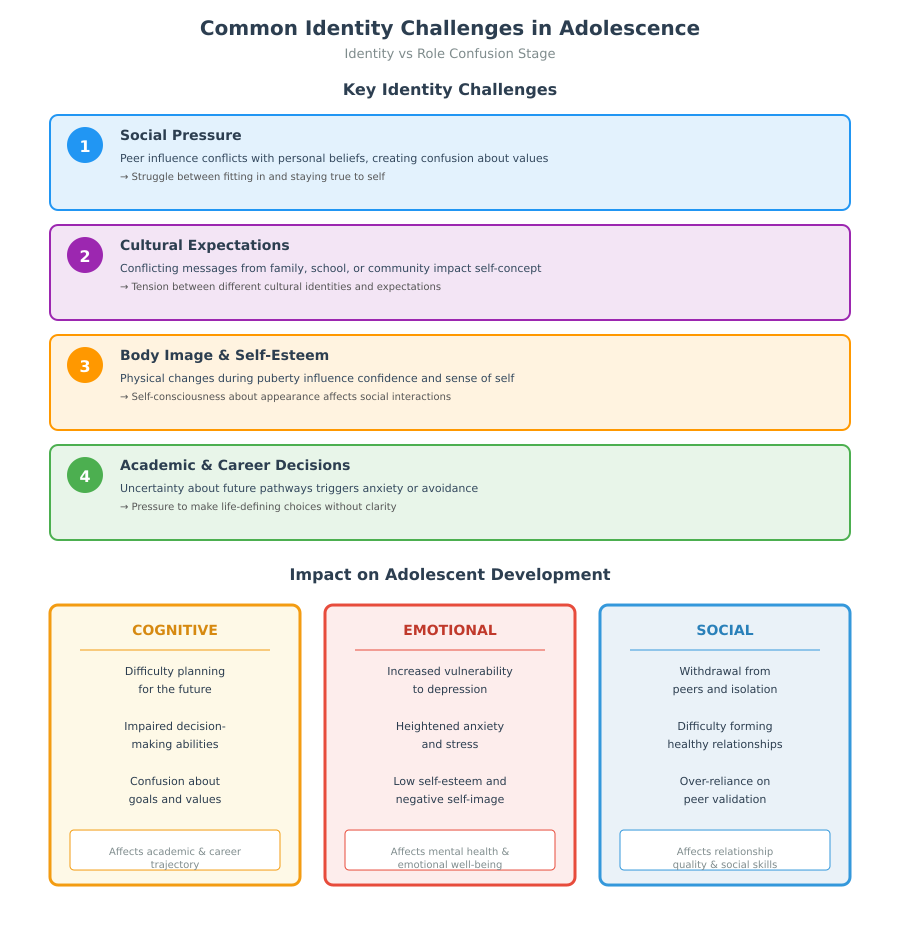
Adolescents face multiple psychosocial crises and challenges during this stage:
Identity Challenges:
- Social Pressure: Peer influence can conflict with personal beliefs, creating confusion about values.
- Cultural Expectations: Conflicting messages from family, school, or community may impact self-concept.
- Body Image and Self-Esteem: Physical changes during puberty can influence confidence and sense of self.
- Academic and Career Decisions: Uncertainty about future pathways may trigger anxiety or avoidance.
Impact on Development:
- Cognitive: Difficulty planning for the future or making informed decisions.
- Emotional: Increased vulnerability to depression, anxiety, and low self-esteem.
- Social: Withdrawal from peers, difficulty forming healthy relationships, or reliance on peer validation.
Clinical Observation Example:
A nurse working in an adolescent clinic notices a 16-year-old expressing confusion about career aspirations, frequently changing friend groups, and showing signs of withdrawal. This presentation may indicate emerging role confusion that requires targeted support.
Nursing strategies to support identity formation and reduce role confusion
Nurses play a key role in promoting healthy identity development and reducing role confusion by implementing developmentally appropriate interventions:
- Facilitate Self-Exploration:
- Encourage adolescents to express opinions, interests, and beliefs in a safe environment.
- Provide opportunities for decision-making in care and daily routines.
- Promote Autonomy and Responsibility:
- Allow adolescents to participate in care planning and health decisions.
- Encourage accountability and independent problem-solving, reinforcing sense of self.
- Support Social and Peer Engagement:
- Facilitate group activities that encourage collaboration and reflection.
- Encourage participation in clubs, sports, or volunteer opportunities to explore roles and interests.
- Provide Guidance and Mentorship:
- Offer counseling or mentorship programs to discuss academic, social, and career concerns.
- Collaborate with parents, educators, and social workers to create supportive networks.
- Address Mental Health Needs:
- Screen for anxiety, depression, or identity-related stress using age-appropriate tools.
- Implement interventions like cognitive-behavioral strategies, mindfulness, or life-skills training to enhance resilience.
Example in Nursing Practice:
A school nurse leading a small group discussion encourages adolescents to identify personal strengths and interests while exploring potential career paths. By validating their choices and guiding reflection, the nurse promotes identity formation, reduces role confusion, and strengthens cognitive and emotional health.
Stage 6 – Intimacy vs Isolation in Young Adulthood
Young adulthood, typically spanning ages 18–40, represents the psychosocial stage of intimacy vs isolation. According to Erik Erikson, this stage focuses on forming deep, meaningful relationships and connections. Successfully navigating this stage fosters the ability to build healthy partnerships, a strong sense of self, and emotional resilience, whereas failure may lead to isolation, loneliness, and difficulties in forming supportive social networks.
Intimacy vs isolation: psychosocial stage in adulthood
Definition:
Erikson believed that in young adulthood, individuals must balance their personal identity with the capacity to form close relationships. Intimacy involves emotional closeness, commitment, and mutual trust, while isolation arises when individuals fail to establish meaningful bonds. This stage is critical for long-term psychosocial development, as the ability to form connections influences future generativity and life satisfaction.
Developmental Milestones:
-
- Establishing long-term romantic relationships or partnerships.
- Forming deep friendships and professional connections.
- Developing empathy, emotional intelligence, and communication skills.
- Balancing independence with interdependence in relationships.
Importance:
Successfully achieving intimacy allows young adults to navigate complex life challenges, maintain social support systems, and develop a secure self-concept. Failure to form connections can contribute to isolation, emotional distress, and hinder future generativity vs stagnation in midlife.
Example: A 28-year-old forming a committed relationship while maintaining close friendships demonstrates intimacy and a balanced social network. In contrast, a young adult withdrawing from social interaction or fearing emotional closeness may experience isolation, affecting both cognitive and emotional health.
How intimacy shapes adult relationships, self-concept, and psychosocial health
Impact on Adult Relationships:
- Enhances trust, communication, and problem-solving within partnerships.
- Promotes collaboration and mutual support in personal and professional spheres.
- Encourages development of long-term attachment and commitment skills.
Impact on Self-Concept:
- Strengthens self-esteem and confidence in one’s ability to connect with others.
- Fosters a balanced sense of self, integrating personal identity with relational roles.
- Supports emotional regulation and coping strategies during life stressors.
Impact on Psychosocial Health:
- Reduces feelings of loneliness, anxiety, and depression.
- Encourages participation in supportive social networks and community engagement.
- Establishes a foundation for later midlife Eriksonian psychosocial development, particularly generativity vs stagnation.
Example in Nursing: A young adult patient struggling with social withdrawal after relocating for a new job may demonstrate signs of isolation, such as poor engagement in healthcare follow-up or reluctance to seek support. Encouraging participation in support groups or social activities can enhance intimacy, bolster emotional well-being, and promote a healthy psychosocial stage.
Recognizing signs of isolation and nursing interventions to promote healthy connections
Indicators of Isolation:
- Avoidance of social interactions or reluctance to form new relationships.
- Persistent feelings of loneliness or emotional detachment.
- Difficulty trusting others or expressing vulnerability.
- Withdrawal from professional, social, or recreational activities.
Nursing Interventions:
- Facilitate Social Engagement:
- Encourage involvement in group therapy, support groups, or community events.
- Promote opportunities for socialization through volunteering, sports, or professional networking.
- Encourage Healthy Relationship Skills:
- Provide education on communication, conflict resolution, and emotional expression.
- Offer role-playing exercises to practice interpersonal interactions.
- Support Emotional Health:
- Screen for depression, anxiety, or stress related to social withdrawal.
- Implement interventions such as cognitive-behavioral strategies, mindfulness, or stress management techniques.
- Collaborate with Multidisciplinary Teams:
- Work with social workers, psychologists, or counselors to develop individualized support plans.
- Involve families or partners when appropriate to strengthen relational support networks.
Example in Nursing Practice:
A nurse caring for a young adult in a community health setting may notice limited social engagement and feelings of loneliness. By facilitating participation in peer support groups and providing education on forming healthy relationships, the nurse promotes intimacy, reduces isolation, and strengthens the patient’s cognitive and emotional health.
Stage 7 – Generativity vs Stagnation in Midlife
Midlife, typically ranging from ages 40–65, represents the psychosocial stage of generativity vs stagnation. According to Erik Erikson, this stage is a critical period in adult development, during which individuals focus on contributing to society, nurturing the next generation, and leaving a legacy. Successful navigation of this stage leads to a strong sense of purpose and fulfillment, while unresolved challenges may result in stagnation, self-absorption, and diminished cognitive and emotional health.
Generativity and stagnation in midlife Eriksonian psychosocial development
Definition:
Erikson believed that generativity involves guiding and supporting others, whether through parenting, mentoring, community involvement, or professional contributions. Individuals who fail to engage meaningfully in these roles may experience stagnation, feeling disconnected, unproductive, or purposeless.
Developmental Milestones:
-
- Raising and nurturing children or mentoring younger adults.
- Contributing to work, community, or social causes.
- Guiding future generations and sharing accumulated knowledge.
- Reflecting on life achievements and long-term goals.
Importance:
Successfully achieving generativity enhances personality development, fosters meaningful relationships, and supports cognitive and emotional health. Conversely, stagnation can result in feelings of emptiness, depression, or social withdrawal, affecting both the individual and those around them.
Example: A 50-year-old who actively mentors colleagues, participates in volunteer work, and maintains family connections demonstrates generativity. In contrast, an individual disengaged from family, work, or community activities may experience stagnation, leading to dissatisfaction and reduced purpose in life.
Impact of stagnation on caregiving roles and cognitive-emotional health
Caregiving Roles:
- Midlife adults often occupy caregiving positions, supporting both children and aging parents. Stagnation can impair their ability to provide effective care, leading to frustration, burnout, or strained relationships.
- Lack of engagement or motivation may reduce the quality of caregiving, negatively impacting family dynamics.
Cognitive-Emotional Health:
- Individuals experiencing stagnation may exhibit decreased problem-solving abilities, reduced creativity, and limited emotional resilience.
- Emotional symptoms may include:
- Feelings of boredom or life dissatisfaction.
- Anxiety about aging or unfulfilled goals.
- Difficulty coping with stressors related to work, health, or relationships.
Clinical Observation Example:
A midlife patient presenting with low motivation, irritability, and disengagement from family responsibilities may be experiencing psychosocial stagnation. This could impact their overall well-being and the care they provide to dependents, highlighting the need for supportive interventions.
Nursing support strategies to foster generativity and purpose in midlife adults
Nurses play a vital role in promoting generativity and mitigating stagnation through targeted interventions:
- Encourage Mentorship and Guidance Roles:
- Support patients in mentoring younger family members, colleagues, or community members.
- Promote participation in educational, professional, or volunteer initiatives.
- Facilitate Life Reflection and Goal Setting:
- Encourage adults to reflect on achievements and identify meaningful future goals.
- Use life review exercises to highlight strengths, values, and contributions.
- Promote Social Engagement:
- Encourage participation in clubs, support groups, or community activities.
- Foster connections that reinforce interpersonal relationships and emotional support networks.
- Support Cognitive and Emotional Health:
- Integrate stress management, mindfulness, or problem-solving workshops.
- Screen for symptoms of depression or anxiety related to midlife transitions.
- Collaborate with Interdisciplinary Teams:
- Work with social workers, psychologists, or occupational therapists to develop individualized strategies for engagement and purpose.
- Educate families on the importance of supporting midlife adults in generativity roles.
Example in Nursing Practice:
In a community health setting, a nurse organizes a midlife wellness workshop where participants engage in mentoring programs, set personal goals, and share life experiences. Such interventions enhance generativity, improve emotional well-being, and prevent stagnation, fostering a stronger sense of purpose.
Stage 8 – Integrity vs Despair in Late Life
Late life, generally considered to span ages 65 and older, marks the final psychosocial stage in Erik Erikson’s 8 stages of psychosocial development: integrity vs despair. According to Erikson, this stage involves reflecting on a lifetime of experiences and evaluating personal achievements, relationships, and contributions. Successfully resolving this stage results in ego integrity, a sense of fulfillment, and acceptance of life’s trajectory. Conversely, unresolved challenges may lead to despair, regret, and diminished cognitive and emotional health.
Integrity vs despair: psychosocial stage in late life
Definition:
During this psychosocial stage, older adults assess the meaning and purpose of their lives. Ego integrity emerges when individuals recognize accomplishments, reconcile past conflicts, and accept both successes and limitations. Despair, in contrast, arises from unresolved regrets, unfulfilled goals, or feelings that life has been wasted.
Developmental Milestones:
-
- Reflecting on personal, professional, and social contributions.
- Achieving acceptance of life’s successes and failures.
- Preparing psychologically for the end of life.
- Maintaining emotional stability and resilience in the face of aging and physical decline.
Importance:
Achieving integrity supports positive personality development, emotional resilience, and a healthy sense of self, while despair can contribute to social withdrawal, depression, and decreased engagement in meaningful activities.
Example: An older adult who takes pride in mentoring younger family members and feels satisfied with personal achievements demonstrates ego integrity. Conversely, a senior expressing persistent regret for unachieved goals or unresolved conflicts may experience despair, impacting emotional well-being and social participation.
Manifestations of ego integrity and despair in older adults
Ego Integrity Indicators:
- Life satisfaction and acceptance of personal history.
- Ability to share wisdom and mentor younger generations.
- Emotional resilience and adaptive coping with age-related changes.
- Engagement in social, spiritual, or community activities.
Despair Indicators:
- Persistent feelings of regret or life has been wasted.
- Depression, anxiety, or hopelessness.
- Withdrawal from social interactions or loss of interest in activities.
- Negative self-perception and fear of death or dependency.
Clinical Observation Example:
A geriatric nurse notices a 78-year-old resident expressing contentment with life achievements, volunteering to mentor younger residents, and sharing life experiences—signs of ego integrity. Another resident repeatedly focuses on missed opportunities, expresses hopelessness, and avoids social interactions—indicative of despair, requiring intervention.
Nursing interventions to promote integrity, reduce despair, and enhance late-life reflections
Nurses play a pivotal role in supporting older adults during this psychosocial stage, promoting integrity, and mitigating despair:
- Facilitate Life Review and Reflection:
- Encourage older adults to reflect on accomplishments, personal growth, and meaningful relationships.
- Use reminiscence therapy, guided storytelling, or journaling to reinforce ego integrity.
- Promote Social Engagement and Community Involvement:
- Support participation in social, spiritual, or volunteer activities to maintain purpose.
- Encourage interactions with family, peers, and community members.
- Provide Emotional and Psychological Support:
- Screen for depression, anxiety, or signs of hopelessness.
- Offer counseling, cognitive-behavioral therapy, or supportive discussions to address regrets and unresolved conflicts.
- Enhance Sense of Legacy and Contribution:
- Facilitate mentorship opportunities, storytelling, or creative projects (e.g., writing, art) to leave a meaningful legacy.
- Recognize and celebrate personal achievements to reinforce life satisfaction.
- Collaborate with Interdisciplinary Teams:
- Work with social workers, psychologists, chaplains, or occupational therapists to provide comprehensive support.
- Engage families in care planning and reflective activities that honor the older adult’s life experiences.
Example in Nursing Practice:
In a long-term care facility, a nurse organizes weekly reminiscence therapy sessions where residents share life stories, highlight personal achievements, and reflect on challenges overcome. This intervention strengthens ego integrity, reduces despair, and fosters emotional well-being, improving overall cognitive and emotional health.
Applying the 8 Stages of Psychosocial Development in Nursing Practice
Understanding Erikson’s 8 stages of psychosocial development provides nurses with a structured framework to assess, plan, and implement care across the life span. From infancy to late life, each psychosocial stage informs strategies to promote cognitive and emotional health, support personality development, and address psychosocial crises at various life stages. Integrating Erikson’s theory into nursing practice enhances holistic patient care and ensures interventions are aligned with developmental needs.
Integrating psychosocial stages of development into life stage assessments
Nurses can use Erikson’s stages of psychosocial development as a guide to evaluate patients’ psychosocial health at every developmental stage. Key strategies include:
- Assessment by Life Stage:
- Infants and Toddlers (0–3 years): Evaluate trust vs mistrust and autonomy vs shame and doubt by observing attachment, responsiveness, and independence in basic self-care.
- Preschoolers (3–5 years): Assess initiative vs guilt through play, exploration, and decision-making behaviors.
- School-Age Children (6–12 years): Observe industry vs inferiority by monitoring academic achievement, skill development, and peer interactions.
- Adolescents (12–18 years): Assess identity vs role confusion through discussions about values, career aspirations, and peer relationships.
- Young Adults (18–40 years): Evaluate intimacy vs isolation by assessing relationships, social support, and emotional closeness.
- Midlife Adults (40–65 years): Observe generativity vs stagnation through contributions to family, community, and mentoring roles.
- Older Adults (65+ years): Assess integrity vs despair by exploring life satisfaction, acceptance of past experiences, and engagement in meaningful activities.
- Observation and Screening:
- Use structured interviews, developmental questionnaires, and behavioral observations to detect psychosocial crises or delays in achieving developmental milestones.
- Documentation:
- Record findings related to psychosocial stages of development in the care plan, noting strengths, challenges, and potential interventions to address gaps.
Example: A pediatric nurse observing a 7-year-old struggling with schoolwork and social interactions may identify signs of feelings of inferiority, prompting early intervention to foster industry and confidence.
Using psychosocial theory to inform individualized care plans
Applying Erikson’s psychosocial theory allows nurses to tailor care to each patient’s developmental stage and psychosocial needs. Strategies include:
- Stage-Specific Interventions:
- Align interventions with the patient’s psychosocial stage to support growth and prevent psychosocial crises.
- Example: Encouraging decision-making and autonomy in toddlers through safe choices in daily activities.
- Holistic Care Planning:
- Combine physical, emotional, cognitive, and social dimensions in care plans.
- Address barriers that impede personality development and sense of self.
- Family and Caregiver Involvement:
- Educate families on age-appropriate expectations and strategies to reinforce positive psychosocial development.
- Example: Guiding parents to support identity formation in adolescents by validating their interests and choices.
- Monitoring and Adjusting Care:
- Continuously assess progress in psychosocial stages and adapt interventions as patients advance through developmental stages.
Example in Nursing Practice:
A mental health nurse designing a care plan for a 30-year-old experiencing difficulty forming intimate relationships focuses on intimacy vs isolation. Interventions include counseling, social skills training, and support group participation to promote meaningful connections and enhance cognitive and emotional health.
Enhancing cognitive and emotional health across life stages using Erikson’s stages
Implementing Erikson’s stages of psychosocial development in practice helps nurses promote cognitive and emotional health throughout the life span:
- Early Life Stages:
- Foster trust, autonomy, and initiative to build secure attachment, confidence, and problem-solving skills.
- School-Age and Adolescence:
- Support industry and identity development by reinforcing skills, encouraging exploration, and facilitating social connections.
- Adulthood and Midlife:
- Promote intimacy and generativity through healthy relationships, mentorship opportunities, and purposeful activities.
- Late Life:
- Facilitate ego integrity and reduce despair through life review, reflective activities, and engagement in meaningful roles.
Example: A nurse working with older adults in a long-term care facility encourages life review sessions where residents share achievements and family contributions. These interventions enhance ego integrity, foster emotional well-being, and mitigate despair, demonstrating the practical application of Erikson’s psychosocial theory.
Conclusion
Erik Erikson’s 8 stages of psychosocial development provide an essential framework for understanding human growth, personality formation, and cognitive and emotional health across the life span. From trust vs mistrust in infancy to integrity vs despair in late life, each psychosocial stage highlights critical developmental tasks and challenges that influence a person’s sense of self, resilience, and social functioning.
For nurses, integrating knowledge of Erikson’s stages of psychosocial development into clinical practice is invaluable. Understanding the unique needs of patients at different life stages allows nurses to:
- Conduct Comprehensive Assessments: Identify developmental strengths, delays, or psychosocial crises that may impact health outcomes.
- Tailor Interventions: Apply stage-specific strategies, such as fostering autonomy in toddlers, supporting identity development in adolescents, or promoting generativity and purpose in midlife adults.
- Enhance Emotional and Cognitive Health: Promote adaptive coping, meaningful social engagement, and reflective practices to support ego integrity and reduce despair in older adults.
- Facilitate Holistic Care: Address not only physical needs but also emotional, social, and developmental dimensions, ensuring truly patient-centered care.
Moreover, understanding how unresolved psychosocial challenges, such as feelings of inferiority, isolation, or stagnation, influence personality development equips nurses to implement timely interventions, strengthen support systems, and enhance overall well-being. By recognizing the interplay between psychosocial stages of development and health outcomes, nurses can foster resilience, empowerment, and a sense of purpose at every stage of life.
Ultimately, applying Erikson’s psychosocial theory in nursing practice is not merely an academic exercise—it is a tool for improving patient outcomes, guiding clinical decision-making, and promoting lifelong healthy development. Whether assessing infants’ capacity for trust, supporting adolescents through identity formation, or assisting older adults in achieving ego integrity, nurses who understand and utilize these principles contribute to a healthcare environment that respects the complexity of human growth and nurtures the holistic well-being of every patient.
Frequently Asked Questions
What are Erikson’s 8 stages of psychosocial development?
Erik Erikson proposed eight psychosocial stages spanning the human life span, each characterized by a central psychosocial conflict:
- Trust vs Mistrust (Infancy, 0–1 year) – Developing trust in caregivers and the world.
- Autonomy vs Shame and Doubt (Early Childhood, 1–3 years) – Building independence and self-control.
- Initiative vs Guilt (Preschool, 3–5 years) – Encouraging exploration and initiative.
- Industry vs Inferiority (School Age, 6–12 years) – Developing competence and skills.
- Identity vs Role Confusion (Adolescence, 12–18 years) – Forming personal and social identity.
- Intimacy vs Isolation (Young Adulthood, 18–40 years) – Establishing meaningful relationships.
- Generativity vs Stagnation (Midlife, 40–65 years) – Contributing to society and guiding the next generation.
- Integrity vs Despair (Late Life, 65+ years) – Reflecting on life with satisfaction or regret.
What are the 8 stages of human development?
The 8 stages of human development align with Erikson’s psychosocial framework, highlighting the life stages and developmental tasks:
- Infancy (0–1 year) – Trust vs Mistrust
- Early Childhood (1–3 years) – Autonomy vs Shame and Doubt
- Preschool (3–5 years) – Initiative vs Guilt
- School Age (6–12 years) – Industry vs Inferiority
- Adolescence (12–18 years) – Identity vs Role Confusion
- Young Adulthood (18–40 years) – Intimacy vs Isolation
- Midlife (40–65 years) – Generativity vs Stagnation
- Late Life (65+ years) – Integrity vs Despair
These stages encompass physical, cognitive, emotional, and social developmental tasks throughout the life span.
How to remember Erik Erikson’s 8 stages?
A helpful mnemonic for nursing students:
“Trusty Autonomous Individuals In Interpersonal Groups Grow Integrity”
- T – Trust vs Mistrust (Infancy)
- A – Autonomy vs Shame and Doubt (Early Childhood)
- I – Initiative vs Guilt (Preschool)
- I – Industry vs Inferiority (School Age)
- I – Identity vs Role Confusion (Adolescence)
- I – Intimacy vs Isolation (Young Adulthood)
- G – Generativity vs Stagnation (Midlife)
- I – Integrity vs Despair (Late Life)
Another tip is to link each stage to a life stage and its central psychosocial task, e.g., infancy = trust, adolescence = identity, midlife = generativity. Visual timelines or charts can also help solidify memory.
Why are Erikson’s stages considered psychosocial?
Erikson’s stages are called psychosocial because they focus on the interaction between psychological growth and social experiences. Each stage represents a psychosocial crisis—a challenge between internal needs (psychological) and external demands or relationships (social).
- Example: In identity vs role confusion (adolescence), the individual must develop a clear sense of self (psychological) while navigating peer pressure, family expectations, and societal roles (social).
- The outcome of each stage depends on successfully balancing these psychological and social factors, influencing personality, relationships, and cognitive and emotional health throughout the life span.
