

How to Write a Research Paper Appendix: Format and Examples
Writing a research paper involves more than just presenting arguments and findings; it also requires providing readers with clear access to supplementary material that supports your study. This is where the appendix becomes invaluable. For many students and researchers, learning how to write a research paper appendix is a crucial skill that ensures transparency and clarity in academic writing.
An appendix in a research paper serves as a section where you can include additional information, raw data, tables and figures, or interview transcripts that would otherwise interrupt the flow of the paper if placed in the main body. By carefully organizing this material, writers can create an appendix that strengthens the credibility of their work while keeping the main text concise and focused.
In this article, we provide a step-by-step guide to help you understand the purpose of an appendix, the proper format to follow, and examples of how appendices are used in real-world research. Whether you are working on a journal-style scientific paper or a student assignment, understanding how to format appendices correctly can greatly improve the overall quality and readability of your project.
What is a Research Paper Appendix?
An appendix is a distinct section placed after the reference list (and after any tables or figures) that houses material too long, detailed, or distracting for the main body of the paper but still important for transparency and reproducibility. Typical appendix items include full questionnaires, interview transcripts, raw data excerpts, extended calculations, code, maps, and additional tables and figures that support the argument but would interrupt the narrative if inserted in the text. In academic and journal submissions the appendix is treated as back-matter and each appendix usually begins on its own page with a label (for example, “Appendix A”) and a descriptive title.
Example
If your study used a 25-item survey, include the full instrument under a heading such as Appendix A: Survey Questionnaire rather than reproducing every item inside the methods section. This keeps the methods concise while still letting readers inspect the exact questions.
Need a well-researched paper fast?
Get a plagiarism-free, well-structured research paper tailored to your needs.
Why is an Appendix Important in a Research Paper?
An appendix serves several complementary purposes:
- Preserves flow and readability. By moving bulky tables, long quotes, or entire instruments to the appendix, the main text stays concise and readable for the general audience.
- Supports transparency and reproducibility. Providing raw outputs, coding scripts, or detailed procedures lets other researchers reproduce analyses or verify claims — a key element of good scientific practice.
- Aids peer review and verification. Reviewers can examine the supplementary material to check robustness without burdening every reader with unnecessary detail.
- Documents research instruments and provenance. Consent forms, ethics approvals, and materials used to collect data are often archived in an appendix for record-keeping and ethical transparency.
What Types of Information are Typically Included in an Appendix?
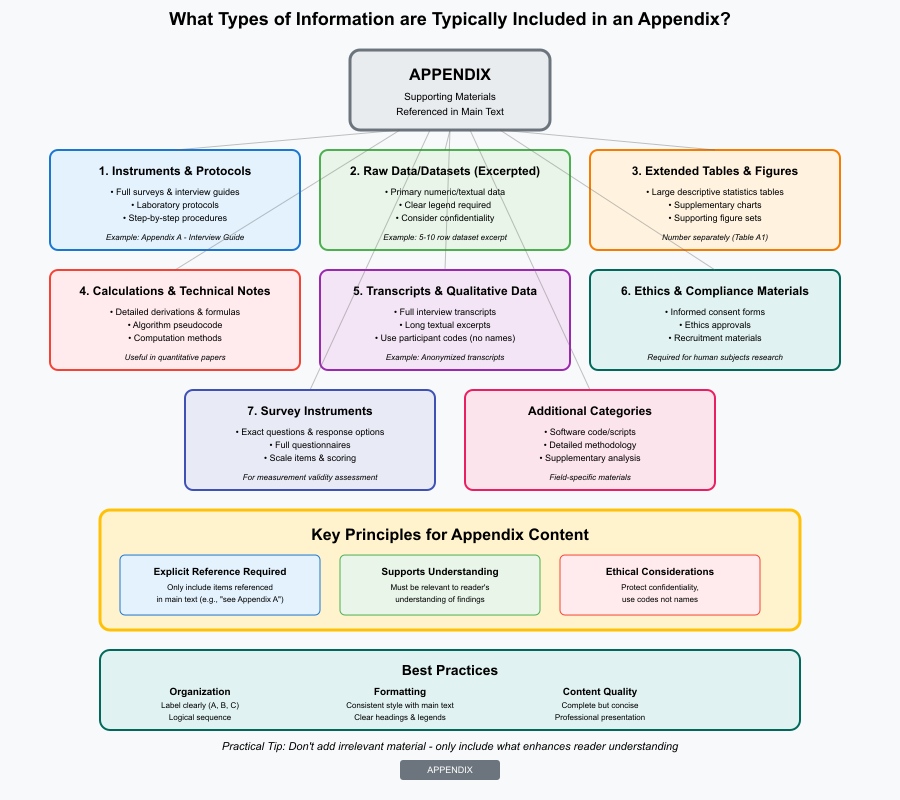
Below are common categories of appendix content with short notes and examples:
- Instruments and protocols — full surveys, interview guides, laboratory protocols, or step-by-step procedures that others may adopt or critique.
Example: Appendix A: Interview Guide (all interviewer prompts and probes). - Raw data or datasets (excerpted) — primary numeric or textual data that are too voluminous for the text. When including raw data, present a clear legend and consider confidentiality and ethical restrictions. Example: a 5–10 row excerpt of the dataset with column headings in Appendix B.
- Extended tables and figures — large tables of descriptive statistics, supplementary charts, or figure sets that support, but are not central to, the argument. Number these separately (e.g., Table A1).
- Calculations and technical notes — detailed derivations, formulas, or algorithm pseudocode used to compute results. Useful in quantitative and engineering papers.
- Transcripts and qualitative artifacts — full interview transcripts or long textual excerpts that underpin qualitative analysis. Provide participant codes (not names) to protect confidentiality. Example: Appendix C: Selected interview transcripts (anonymized).
- Informed consent forms, ethics approvals, and recruitment materials — often required for theses and human-subjects research to show compliance.
- Survey instruments and questionnaires — the exact questions and response options used; useful when you ask readers to judge measurement validity.
Practical tip: only include items you explicitly refer to in the text (e.g., “see Appendix A for the full questionnaire”). Don’t add material that is irrelevant to the reader’s understanding of your findings.
How Does an Appendix Enhance the Quality of a Research Paper?
An appendix improves a paper’s quality in measurable ways:
- Increases credibility. Readers and reviewers can inspect the evidence and instruments underpinning claims; a well-organized appendix signals thoroughness and methodological care.
- Enables reproducibility and secondary analysis. Including data excerpts, code, or detailed procedures lets other researchers replicate your workflow or perform additional analyses, strengthening the paper’s scientific contribution.
- Balances depth with readability. Authors can present complex or technical material without interrupting narrative flow, so the main text remains accessible while deeper material remains available to specialist readers.
- Provides audit trails for ethical and methodological transparency. Archiving consent forms, recruitment scripts, or ethics approvals demonstrates compliance and supports integrity.
Formatting and referencing best practice (summary): label each appendix clearly (Appendix A, Appendix B, etc.), give it a descriptive title, start each on a new page, and always refer to it in the main paper where relevant (e.g., “see Appendix A for the full questionnaire”). Follow your target style guide (APA, IEEE, MLA, journal instructions) for precise placement and label conventions.
What is the Proper Format for an Appendix?
The proper appendix format depends on the academic discipline, the style guide you are following, and the expectations of your instructor or target journal. Generally, an appendix in a research paper appears after the reference list and begins on a separate page. Each appendix should have a clear label (e.g., Appendix A, Appendix B) followed by a descriptive appendix title. The text of the paper must then direct the reader to the appendix at the relevant point, often with a phrase such as “see Appendix A for the full questionnaire.”
Example of placement:
- Main body of the paper → “Detailed results can be found in Appendix B.”
- At the end of the paper, on a new page → Appendix B: Additional Statistical Tables.
What Formatting Guidelines Should You Follow?
Most style guides provide specific directions for how appendices should be presented:
- APA style – The appendix begins on a new page after the reference list. Each appendix should have a centered, boldfaced label (e.g., Appendix A), followed by a title in italics (e.g., Interview Transcript). If there is only one appendix, it is simply titled “Appendix.” Tables or figures inside the appendix are numbered separately (Table A1, Figure A1, etc.).
- MLA style – Appendices are less common but follow similar rules: labeled as Appendix A, B, etc., and included after the works cited page.
- Chicago/Turabian – Appendices appear after the bibliography, each with a title and label. Numbering may vary depending on the journal or thesis requirements.
Formatting tips:
- Start each appendix on a separate page.
- Use consistent page numbers throughout.
- Refer explicitly in the main text (e.g., “see Appendix C”) so the reader knows when to consult it.
- Keep the appendix concise — avoid irrelevant information in an appendix.
Example (APA style):
Appendix A Survey Questionnaire This questionnaire was distributed to 120 participants to measure attitudes toward environmental policies...
How Should You Structure Your Appendix?
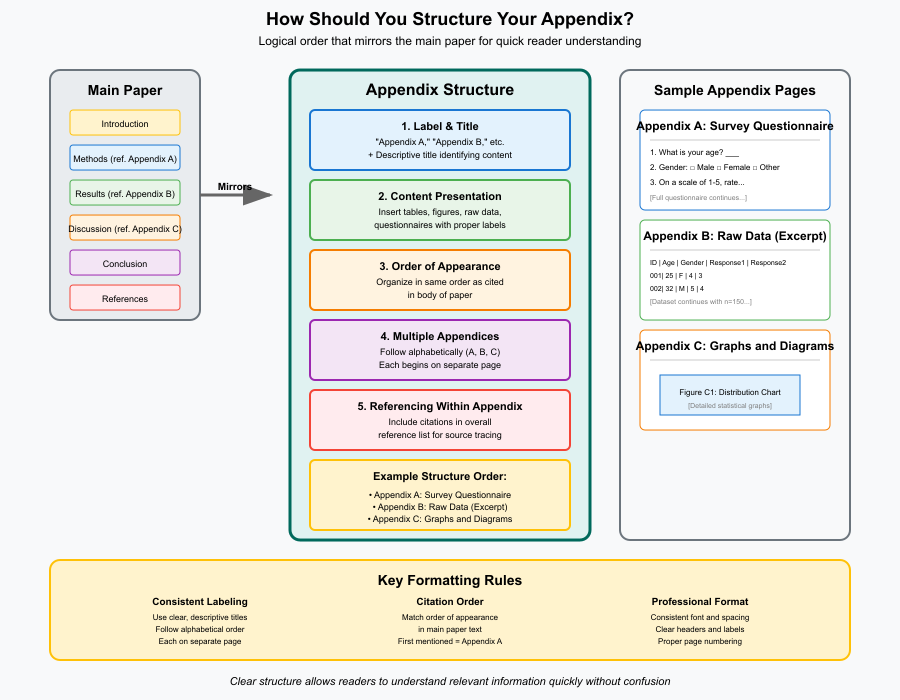
The appendix section should follow a logical order that mirrors the main paper. A clear structure allows the reader to understand the relevant information quickly without confusion. Here’s a suggested structure and format for appendices:
- Label and Title – Begin with “Appendix A,” “Appendix B,” etc., and provide an appendix title that identifies the content (Appendix A: Interview Transcript).
- Content Presentation – Insert the tables or figures, raw data, questionnaire, or other material. Each element should be properly labeled and, if necessary, explained briefly.
- Order of Appearance – Organize appendices in the same order they are cited in the body of the paper. For example, if you first refer to a diagram in your results, it should appear in Appendix A.
- Multiple Appendices – When a paper contains separate appendices, they should follow alphabetically (Appendix A, Appendix B, Appendix C). Each appendix begins on its own page.
- Referencing Within the Appendix – If your appendix contains a citation, include it in the overall reference list so the reader can trace the source.
Example of structure with multiple appendices:
- Appendix A: Survey Questionnaire
- Appendix B: Raw Data (Excerpt)
- Appendix C: Graphs and Diagrams
What Citation Styles are Used for Appendices?
The citation style you use in an appendix must match the overall style guide for the paper. Below are common approaches:
- APA style – Citations in the appendix follow the same rules as the main text. If you cite sources, they must appear in the reference list. For example, if an interview transcript in the appendix cites a published source, that citation belongs in the reference list. Tables and figures included in an appendix also follow APA numbering conventions (e.g., Table A1).
- Chicago/Turabian – Notes or references in the appendix should appear in the same format (footnotes or endnotes) as the main body of the paper.
- MLA style – Works cited are not repeated in the appendix; instead, they appear in the works cited page, but in-text citations within the appendix should follow MLA guidelines.
Example (APA citation inside appendix):
Appendix B Interview Transcript Interviewer: Can you describe how your organization handles sustainability? Participant: We use renewable energy sources in most facilities,as recommended by Smith (2020).
Need a well-researched paper fast?
Get a plagiarism-free, well-structured research paper tailored to your needs.
How to Write an Effective Research Paper Appendix?
Learning how to write an appendix effectively is essential for producing a well-structured academic paper. A strong appendix is not just a dumping ground for additional information; rather, it is a carefully designed section that contains supplementary material which supports but does not overwhelm the main body of your paper.
An effective appendix in a research paper must:
- Contain only relevant material that directly strengthens the argument.
- Be clearly labeled and formatted in line with the chosen style guide (such as APA style).
- Maintain consistency with the flow of the paper so readers can easily navigate between the text of the paper and the supporting materials.
For example, if your main paper discusses survey findings, you can include in the main research paper appendix the full questionnaire or a detailed interview transcript. This allows readers to verify your methodology without breaking the continuity of your analysis.
What Steps Should You Take Before Writing an Appendix?
Before you begin appendix writing, it is important to take some preparatory steps that will ensure quality and clarity:
- Identify the purpose of an appendix – Ask yourself why the content needs to be placed in an appendix rather than in the main text. Irrelevant information in an appendix should be avoided. Only include material that strengthens your argument.
- Sort and select content – Decide which elements (such as tables and figures, raw data, or a diagram) are essential. For example, in a scientific paper, extensive statistical outputs may be better placed in an appendix rather than crowding the results section.
- Review your research guides – Many institutions or journals have detailed instructions on how to create an appendix. Check whether your writing lab or department requires a specific structure and format.
- Prepare your sources and citations – If the appendix contains references, make sure they are consistent with the citation style used in the body of the paper. For instance, in APA style, any sources used in the appendix must also appear in the reference list.
How Can You Organize Your Appendix for Clarity?
Organization is crucial because appendices should follow a clear and predictable order that helps the reader to understand the relevant information quickly. Here are strategies to achieve clarity:
- Use labels and titles – Begin each appendix on a separate page with a clear heading such as Appendix A: Survey Instrument or Appendix B: Graphs of Statistical Models.
- Follow the order of appearance – Arrange appendices in the same sequence they are referenced in the main body of the paper. For instance, if the first reference is a graph, that becomes Appendix A.
- Number supporting material – Within each appendix, number tables or figures separately (Table A1, Figure B2) so that they can be cited directly.
- Keep content concise and organized – Avoid overloading a single appendix with too much detail. In some cases, multiple appendices (Appendix A, Appendix B, Appendix C) may be clearer than a single overly long section.
- Maintain flow – Insert brief explanations so that the appendix contains context for the material presented. For example, a table of contents listing the appendices can also help readers navigate separate appendices.
Example:
If you are writing a thesis on climate change awareness, your appendices may include:
- Appendix A: Survey Questionnaire
- Appendix B: Raw Data (Sample)
- Appendix C: Tables and Figures showing regression outputs
- Appendix D: Consent Form
This clear structure ensures that the appendix helps the reader while avoiding confusion.
What Language and Tone Should You Use in Your Appendix?
The appendix section should maintain the same formal academic writing style as the main paper, but the tone can be slightly more descriptive since it often explains instruments or technical details.
- Clarity and conciseness – The appendix should be written in concise language, free from unnecessary commentary. Each item must be easy to follow.
- Neutral and objective tone – Avoid persuasive or speculative wording. Instead, describe what the appendix contains. For example: “The following interview transcript illustrates participant responses to open-ended questions.”
- Consistency with style guide – Use the same formatting, page numbers, and citation style as in the main body of the paper. This ensures that the appendix does not appear as an afterthought but as part of a coherent journal-style scientific paper.
- Direct references – Use phrases like “see appendix” or “included in the appendices” when referring to material in the text of the paper, so the reader knows exactly where to look.
Example of tone:
“In this appendix, the full questionnaire used in the data collection process is provided. The instrument was designed to assess participants’ attitudes toward renewable energy. For a summary of results, refer to the main body of your paper.”
What are Some Examples of Research Paper Appendices?
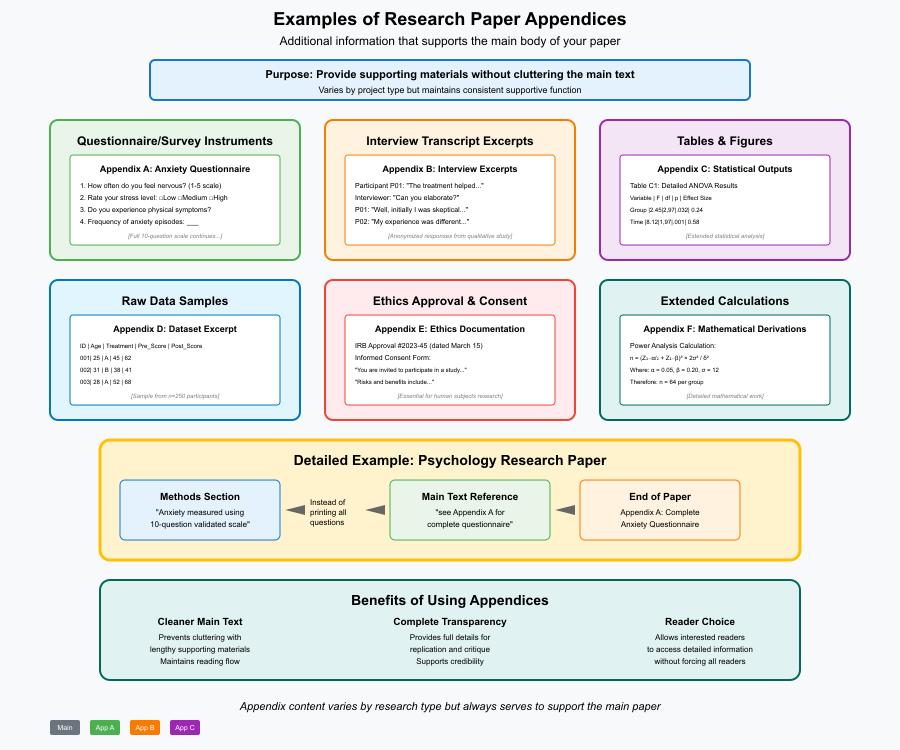
An appendix in a research paper often varies depending on the type of project, but the purpose remains the same: to provide additional information that supports the main body of your paper. Common examples include:
- Questionnaire or survey instruments – full copies of the survey questions used in the study.
- Interview transcript excerpts – anonymized participant responses used in qualitative research.
- Tables and figures – detailed statistical outputs, expanded data tables, or supporting graphs.
- Raw data samples – data subsets too large to include in the main research paper appendix.
- Ethics approval or consent forms – essential in human-subjects research.
- Extended calculations or formulas – mathematical derivations that would otherwise distract the reader.
Example: In a psychology paper, the methods section might summarize a 10-question anxiety scale. Instead of printing all the questions in the main text, the researcher would add Appendix A: Anxiety Questionnaire at the end of the paper.
How Can Tables and Figures Be Effectively Used in an Appendix?
Tables or figures in an appendix are especially useful when you need to present large amounts of data or complex visuals without breaking the flow of the paper. When using them:
- Label consistently – Tables and figures in appendices should be numbered separately from those in the main body of the paper. For instance, Table A1, Table A2, Figure B1.
- Provide context – A brief explanation should accompany each graph, diagram, or table so the reader understands what it represents.
- Follow format appendices guidelines – In APA style, for example, each appendix begins on a separate page, and every table or figure must include a title and caption.
- Avoid redundancy – Do not duplicate material already shown in the main body; instead, place extended versions or supporting visuals in the appendix.
Example: A scientific paper testing drug effectiveness might present a summary of results in the results section but provide complete regression tables in Appendix B. The researcher could also insert a diagram of the experimental setup in Appendix C.
What are Sample Appendices for Different Types of Research?
Different research approaches require different types of appendices:
- Quantitative research – often uses appendices for raw data, detailed tables and figures, statistical models, or coding instructions. Example: Appendix A: Regression Output Tables.
- Qualitative research – relies on appendices for full interview transcripts, observational notes, or thematic coding frameworks. Example: Appendix B: Selected Interview Transcript.
- Mixed-methods research – may combine both: a questionnaire in Appendix A, graphs in Appendix B, and transcripts in Appendix C.
- Journal-style scientific paper – frequently includes supplementary appendices with complex technical detail, such as laboratory protocols, that would otherwise overwhelm the main paper.
Example of three appendices in a thesis:
- Appendix A: Survey Questionnaire
- Appendix B: Raw Data (Excerpt)
- Appendix C: Graphs and Regression Outputs
This demonstrates how separate appendices can organize diverse supporting materials.
How Do Real-Life Research Papers Utilize Appendices?
In published research, appendices are used strategically to help the reader while keeping the argument in the main body of your paper focused.
- Case 1 – Social sciences: A sociology thesis might include Appendix 1: Interview Transcript and Appendix 2: Coding Scheme. This allows examiners to see how themes were derived without cluttering the results section.
- Case 2 – STEM research: An engineering article could include Appendix B: Technical Specifications and Appendix C: Extended Equations, allowing readers with technical expertise to review details without distracting general readers.
- Case 3 – Public health: A medical dissertation may attach Appendix A: Questionnaire and Appendix B: Informed Consent Form, ensuring ethical transparency and methodological clarity.
- Case 4 – Journal submission: Many peer-reviewed journals encourage authors to use online appendices (sometimes labeled supplementary material) where readers can download large datasets or tables or figures that are too extensive to publish in print.
By examining these examples, it becomes clear that the appendix contains supplementary material that contributes to a comprehensive understanding of the research without forcing irrelevant content into the part of the text where it does not belong.
What Common Mistakes Should You Avoid in Your Appendix?
While the appendix in a research paper can strengthen your project, it can also weaken it if not handled properly. A common issue is adding irrelevant information in an appendix simply because you don’t know where else to place it. For example, including unrelated articles or background readings distracts the reader rather than supporting the main body of your paper.
Another mistake is duplicating material already included in the main text. The appendix is not meant to repeat results or figures, but to provide additional depth, such as a full interview transcript or raw data excerpt.
Failing to follow the style guide (e.g., APA style) is also a frequent error. Journals often specify how each appendix section should appear (label, appendix title, and placement). If you don’t comply, the appendix may be considered sloppy or even rejected.
What Are the Most Frequent Errors Writers Make?
Some of the most common problems encountered when students or researchers make an appendix include:
- Poor organization – Mixing a questionnaire, graph, and tables or figures in one long appendix without labels makes it difficult for the reader to navigate. The best approach is to create separate appendices (Appendix A, Appendix B, etc.) so that each category has its own section.
- Lack of clear referencing – Not pointing to the appendix in the text of the paper (for example, forgetting to write “see appendix”) means readers may never know where to find important materials.
- Inconsistent formatting – Ignoring appendix format requirements such as page numbering, headings, or proper citation styles leads to confusion. For instance, an APA appendix contains a centered label and italicized title on a separate page, but many writers neglect this.
- Including raw data without explanation – Simply pasting raw data tables without context makes it hard for the reader to understand. A short note describing what the appendix contains is essential.
Example: Instead of writing Appendix A: Data and leaving it blankly filled with numbers, write Appendix A: Raw Data from Survey Responses (Sample of 50 Participants).
How Can You Ensure Your Appendix is Not Overly Lengthy?
An appendix should add value, not overwhelm. To avoid creating a bulky section at the end of the paper, consider the following strategies:
- Be concise – Only include relevant information that directly supports the understanding of your research problem. For instance, don’t paste the entire dataset if a smaller sample illustrates your point.
- Use excerpts and summaries – Instead of including every interview transcript, choose a few representative samples and explain that the full transcripts are archived elsewhere.
- Organize with multiple appendices – Break down long material into separate appendices so readers can jump directly to what they need without scrolling through dozens of pages.
- Leverage tables and figures – Replace long paragraphs of explanation with clear tables or figures that help the reader quickly grasp the information.
Example: A thesis that collected 200 survey responses should not paste all 200 in the appendix. Instead, it might show a table of contents listing variable codes, followed by an excerpt of 20 responses, with a note that the full dataset is available upon request.
What Should You Do If Your Appendix Is Rejected by Reviewers?
Sometimes, during peer review, a journal may decide that your appendix section is too long, redundant, or not aligned with their publication standards. If this happens, you should:
- Review the feedback carefully – Identify whether the issue was formatting, relevance, or length. For example, the reviewer might object that your appendix includes irrelevant information not tied to the research question.
- Revise and restructure – Consider trimming the appendix, reorganizing into separate appendices, or converting sections into tables or figures within the main body if they are central to your argument.
- Move to supplementary files – Many journals allow you to upload supplementary material online rather than including it in the printed main paper. This is often the solution when the appendix contains large datasets or multimedia.
- Follow the style guide – If the issue was formatting, adjust to meet the journal’s writing style guide (e.g., APA, Chicago, MLA). Sometimes a small change, such as correcting page numbers or adjusting the appendix label, resolves the rejection.
Example: If a journal-style scientific paper submits an appendix with 50 pages of calculations, reviewers may request shortening. The author can summarize methods in the main text, then move the full derivations to a downloadable supplementary file labeled as Appendix C.
How Can You Revise Your Research Paper Appendix?
Revision is one of the most critical steps in appendix writing, as it ensures that the section adds value to the body of your paper rather than distracting from it. A good revision process begins with asking: Does this appendix help the reader achieve a more comprehensive understanding of the research? If the answer is no, then the material may need to be trimmed, reorganized, or moved to supplementary files.
During revision, you should:
- Check alignment with the main paper – Every item in the appendix should be tied to a point in the main text. For instance, if you present survey results in a chart, reference it in your results section with “see appendix.”
- Ensure proper labeling and sequencing – Review the appendix label (Appendix A, Appendix B, etc.) and make sure numbering is consistent with the table of contents if included. This avoids confusion, especially in longer works with multiple appendices.
- Review for relevance – Remove irrelevant information in an appendix such as extra notes, drafts, or citations that already exist in the reference list. The appendix contains supplementary material, not duplications.
Example: In a scientific paper, you might initially include full raw data tables in the appendix. During revision, you may realize these are too lengthy, so you keep a summarized table of figures in the appendix while archiving the raw dataset separately.
What Tips Can Help You Edit Your Appendix for Quality?
Editing is about polishing your appendix to meet professional and academic standards. The following strategies can help:
- Be concise – Avoid lengthy paragraphs. Instead, use tables or figures, bulleted lists, or structured subsections. A concise appendix makes it easier for the reader to understand.
- Use a clear appendix title – Each appendix should have a descriptive title (e.g., Appendix A: Sample Interview Transcript) rather than a vague label. This improves the flow of the paper that includes multiple documents.
- Follow a style guide – In APA style, for example, each appendix begins on a separate page, with a centered heading such as Appendix 1 or Appendix B. Proper formatting shows attention to detail.
- Check page numbers and consistency – Ensure the page numbers of the appendices match those listed in the table of contents (if applicable) and that the writing style guide has been followed.
- Proofread for errors – Look for typos, mislabeled diagram captions, or missing tables and figures. These small mistakes can undermine the credibility of your research.
Example: A graduate thesis may include three appendices—a questionnaire, coding sheet, and detailed methodology. Editing ensures that each appendix section is clearly separated, properly titled, and free from formatting errors.
How Often Should You Refer Back to Your Appendix in the Main Text?
Cross-referencing is essential because an appendix may contain critical details that support your argument. However, balance is key: you want to guide the reader without overloading the text of the paper.
- Refer when necessary – Mention the appendix whenever you introduce data that cannot be fully included in the main research paper appendix. Example: “The complete coding framework is available in Appendix C.”
- Avoid over-referencing – Don’t point to the appendix every few sentences. Doing so interrupts the flow of the paper and makes the main body of your paper harder to follow.
- Use natural placement – Place references at logical points, usually after presenting summarized findings.
Example: If your study used a 50-question survey, you could describe the most relevant results in the main body, then add: “For the full questionnaire and response patterns, see Appendix A.”
Need a well-researched paper fast?
Get a plagiarism-free, well-structured research paper tailored to your needs.
Conclusion
Learning how to write a research paper appendix is an essential skill in academic writing, especially when your work involves detailed data, tables or figures, or supporting documents that cannot be fully presented in the main body of the paper. A well-prepared appendix ensures that your work is transparent, organized, and reader-friendly by providing relevant information without disrupting the flow of the paper.
Whether you are including a questionnaire, an interview transcript, or raw data, the goal is to present these materials in a clear and structured way. Following a recognized style guide such as APA style, labeling appendices correctly, and keeping them concise are critical steps that help the reader access supplementary materials with ease. Equally important is revising and editing so that the appendix contains supplementary material that genuinely enhances understanding rather than burdening the reader with irrelevant information in an appendix.
Ultimately, the purpose of an appendix is to provide additional information that strengthens your argument and supports your findings. When written carefully, the appendix not only demonstrates attention to detail but also helps create a comprehensive understanding of the research problem. By applying the principles of clarity, consistency, and relevance, you can make an appendix that reflects professionalism and elevates the overall quality of your research paper.
Frequently Asked Questions
What is an example of an appendix in a research paper?
An example could be a questionnaire, interview transcript, or graph that provides additional information supporting the main body of your paper. For instance, a psychology paper may include a full survey instrument in Appendix A.
What is the proper format for an appendix?
The proper appendix format follows a style guide like APA style. Each appendix begins on a separate page, has a clear appendix title (e.g., Appendix B: Survey Questions), uses an appendix label, and is referenced in the main text with “see appendix.”
How to make a good appendix?
To make an appendix effective, ensure it is concise, organized, and clearly labeled. Include only relevant information such as tables and figures or raw data, and avoid duplicating content already in the main paper.
What is an appendix and its examples?
An appendix in a research paper is a section at the end that contains supplementary material supporting your study. Examples include tables or figures, extended data sets, appendix b with statistical outputs, or appendix c with methodology details.
