

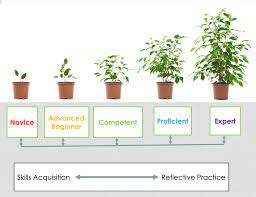
Patricia Benner: The Nurse Theorist Behind the Novice to Expert Nursing Theory and Modern Nursing Practice
Patricia Benner is one of the most influential nurse theorists in modern healthcare, best known for developing the Novice to Expert model that transformed the understanding of professional growth in nursing practice. Before Patricia Benner’s work gained widespread recognition, nursing competence was often measured by academic preparation, years of experience, or the completion of technical skills. While these factors remain important, Patricia Benner demonstrated that becoming an expert nurse is a dynamic developmental process that extends beyond formal education. She argued that true expertise emerges through continuous clinical experience, reflective learning, and repeated exposure to increasingly complex patient care situations.
One of the defining features of Benner’s theory is its emphasis on learning through practice rather than relying solely on theoretical knowledge. By adapting the Dreyfus Model of Skill Acquisition to the nursing profession, Patricia Benner showed that nurses gradually develop deeper understanding, stronger clinical judgment, and more refined decision-making abilities as they move through successive stages of competence. This perspective shifted the focus of many nursing theories from what nurses know to how they apply that knowledge in real clinical environments.
Unlike theories that primarily explain nursing concepts from a philosophical perspective, Patricia Benner’s work bridges the gap between education and actual nursing care. It recognizes that every patient encounter contributes to professional growth and that experience is one of the most valuable teachers in healthcare. Through this lens, nursing competence is viewed as an evolving process shaped by observation, reflection, mentorship, and hands-on practice.
Some of the key ideas that distinguish Patricia Benner’s theory include:
- Learning through direct clinical experience rather than memorization alone.
- Progressing through clearly defined stages of professional development, from novice to expert nurse.
- Developing clinical reasoning and clinical judgment through repeated exposure to diverse clinical situations.
- Recognizing that compassionate care and technical competence develop together throughout a nurse’s career.
- Viewing expertise as a gradual process that requires continuous learning rather than a fixed achievement.
These principles have profoundly influenced the way healthcare organizations approach competency development, performance evaluation, and professional advancement. Today, Benner’s model is widely incorporated into nursing education, orientation programs for new graduate nurses, residency programs, mentorship initiatives, and competency assessment frameworks. It has also guided educators in designing curricula that prepare nurses not only to perform clinical procedures but also to think critically, exercise sound judgment, and deliver safe, evidence-informed patient care.
The significance of Patricia Benner extends well beyond her contribution to a single theory. Her work has influenced curriculum development in schools of nursing, informed leadership and workforce development initiatives, and shaped discussions surrounding expertise in nursing practice across multiple specialties, including critical care, medical-surgical nursing, emergency care, and community health. By emphasizing the importance of experiential learning and the gradual acquisition of professional competence, Patricia Benner provided a framework that continues to guide educators, researchers, healthcare administrators, and practicing nurses worldwide.
This article presents a comprehensive exploration of Patricia Benner, her professional journey, and the lasting impact of her contributions to nursing. The discussion begins with her background and career before examining the development of the Novice to Expert theory, its relationship to the Dreyfus Model of Skill Acquisition, and the assumptions that underpin the framework. It then explores the five stages of skill development, the theory’s core principles, and its application in modern nursing practice, nursing education, and clinical decision-making. Finally, the article examines the strengths, limitations, and enduring legacy of Patricia Benner, highlighting why her work remains one of the most influential contributions to contemporary nursing knowledge and professional practice.
Who Is Patricia Benner?
Patricia Benner is an American nurse, educator, researcher, and theorist whose work has fundamentally changed the way the nursing profession understands clinical competence and professional development. She is internationally recognized for developing the Novice to Expert model, one of the most influential frameworks in modern nursing theories. By demonstrating that nursing expertise develops progressively through experience rather than being acquired solely through formal education, Patricia Benner reshaped approaches to nursing practice, nursing education, competency assessment, and professional development.
What distinguishes Patricia Benner from many other nurse theorists is her ability to bridge theory and practice. Rather than developing abstract concepts removed from the realities of patient care, she focused on how nurses think, make decisions, and respond to increasingly complex clinical situations. Her work emphasizes that becoming an expert nurse requires much more than mastering technical procedures; it involves cultivating clinical judgment, clinical reasoning, compassion, and the ability to recognize subtle changes in patients that may not be immediately apparent to less experienced practitioners.
At the heart of Patricia Benner’s philosophy is the belief that nursing knowledge develops through continuous interaction with patients and the healthcare environment. She argued that knowledge gained from textbooks and classrooms provides an essential foundation, but it is only through experience and clinical practice that nurses develop the deeper understanding needed to deliver exceptional care. This perspective transformed how healthcare organizations evaluate competence, moving beyond simple checklists of skills toward a broader appreciation of professional growth and expertise.
Today, Benner’s theory continues to influence numerous aspects of healthcare, including:
- Clinical competency frameworks for practicing nurses.
- Orientation and transition programs for new graduate nurses.
- Curriculum development within schools of nursing.
- Mentorship and residency programs.
- Leadership development and competency assessment.
- Professional standards for safe and effective patient care.
Because of these contributions, Patricia Benner remains one of the most respected figures in contemporary nursing scholarship, and her work continues to guide both clinical practice and healthcare education across the world.
Early Life and Education
The professional achievements of Patricia Benner were built upon a strong educational foundation and an enduring interest in understanding how healthcare professionals develop expertise over time. Born in the United States in 1942, Patricia Benner came of age during a period when nursing was undergoing significant transformation. Healthcare systems were becoming increasingly complex, advances in medical technology were changing patient care, and expectations for nurses were expanding beyond traditional bedside responsibilities. These developments would later influence her thinking about professional growth and lifelong learning.
Patricia Benner began her nursing education at Pasadena City College (sometimes referred to as Pasadena College), where she earned her initial degree in nursing. This early educational experience introduced her to both the scientific foundations of healthcare and the realities of direct patient care. While classroom instruction provided theoretical knowledge, clinical placements exposed her to the unpredictable and nuanced nature of actual nursing practice. These experiences planted the seeds for her later belief that professional competence cannot be fully understood through academic achievement alone.
Recognizing the importance of advanced education, Patricia Benner pursued graduate nursing studies at the University of California, where she continued to develop her interests in nursing science, education, and research. She earned a master’s degree in nursing, which provided opportunities to explore nursing from broader clinical and academic perspectives. During this period, she became increasingly interested in how experienced nurses consistently demonstrated better decision-making than beginners, even when both possessed similar theoretical knowledge.
Her academic journey continued with doctoral studies, culminating in a Ph.D. that strengthened her research skills and deepened her understanding of the social and behavioral sciences. This interdisciplinary background proved instrumental in shaping her later work, allowing her to combine nursing knowledge with insights from psychology, philosophy, education, and human development. Rather than viewing nursing solely as a collection of procedures, Patricia Benner approached it as a complex professional discipline requiring critical thinking, ethical decision-making, and reflective practice.
Several aspects of Patricia Benner’s education significantly influenced her future work:
- Strong clinical exposure that highlighted differences between beginner and experienced nurses.
- Graduate nursing education that emphasized research, critical inquiry, and evidence-informed practice.
- Training in the social and behavioral sciences, which helped explain how professionals acquire expertise.
- Advanced academic preparation that enabled her to conduct influential qualitative research on nursing competence.
These educational experiences ultimately provided the intellectual foundation upon which Patricia Benner developed one of the most enduring theories in nursing.
Professional Career and Academic Achievements
Following the completion of her advanced education, Patricia Benner established an academic and research career that would have a lasting impact on the nursing profession. Much of her professional work is closely associated with the University of California, particularly University of California, San Francisco (UCSF), where she served on the faculty of the School of Nursing and later became Professor Emerita.
At UCSF, Patricia Benner focused her scholarship on understanding how nurses develop expertise throughout their careers. Rather than relying exclusively on quantitative measurements, she employed qualitative and interpretive research methods to examine how experienced nurses approached patient care, solved clinical problems, and exercised professional judgment. Through interviews, observations, and analysis of clinical narratives, she identified consistent patterns in the progression from novice practitioners to highly competent clinicians.
Her landmark publication, From Novice to Expert: Excellence and Power in Clinical Nursing Practice, fundamentally changed the direction of nursing scholarship. Widely regarded as a classic in the field, the book received significant recognition, including Book of the Year honors from the American Journal of Nursing. More importantly, it provided healthcare educators and administrators with a practical framework for understanding competency development in nursing.
Throughout her career, Patricia Benner made substantial contributions in several areas:
- Research on clinical judgment and clinical reasoning.
- Development of competency-based approaches to nursing education.
- Studies examining expert practice in diverse healthcare settings.
- Investigation of ethics and spirituality in nursing.
- Contributions to health policy and healthcare workforce development.
- Research on improving the transition of new graduate nurses into professional practice.
In addition to her research and teaching responsibilities, Patricia Benner collaborated extensively with the Carnegie Foundation for the Advancement of Teaching. Her leadership in the Carnegie Study examined how nurses are educated and how educational programs could better prepare graduates for the complexities of modern healthcare. These efforts led to recommendations emphasizing the integration of classroom instruction, clinical experience, professional identity formation, and ethical practice.
Over the course of her distinguished career, Patricia Benner received numerous honors recognizing her contributions to nursing scholarship. She became a Fellow of the American Academy of Nursing, reflecting her influence on healthcare research, education, and policy. Her work has also been recognized internationally, with professional organizations such as the Royal College of Nursing acknowledging the significance of her scholarship in advancing nursing education and clinical excellence.
Her appointment as Professor Emerita at UCSF symbolizes not only her distinguished academic career but also the enduring influence of her work on generations of educators, researchers, and clinicians.
Patricia Benner’s Contributions to Nursing
The contributions of Patricia Benner extend far beyond the development of a single theoretical framework. Her work has influenced nearly every aspect of the nursing profession, from education and research to leadership, competency assessment, and clinical care. By focusing on how nurses actually learn and develop expertise, she helped shift nursing away from viewing competence as a static achievement toward understanding it as a continuous developmental process.
One of Patricia Benner’s most important contributions was demonstrating that professional competence develops through experience. Her adaptation of the Dreyfus Model of Skill Acquisition into nursing created a practical framework that explains how nurses move through the five stages of development, gradually acquiring the knowledge, confidence, and judgment necessary for increasingly complex responsibilities. This perspective has become foundational in many competency-based education programs and professional development initiatives.
Her contributions have transformed nursing in several important ways.
1. Advancing Nursing Theory
Patricia Benner expanded the field of nursing theories by emphasizing experiential knowledge as a legitimate and essential source of professional competence. Rather than separating theory from practice, Benner’s theory demonstrates how both continually interact to shape nursing expertise.
2. Improving Clinical Practice
Healthcare organizations use Benner’s model to:
- Design orientation programs.
- Assess professional competency.
- Develop residency programs.
- Structure mentorship initiatives.
- Support lifelong professional development.
These applications help nurses build confidence while improving the quality and safety of patient care.
3. Transforming Nursing Education
The influence of Patricia Benner on nursing education has been profound. Her work encourages educators to combine classroom learning with meaningful clinical experience, simulation, reflective practice, and supervised patient care. This approach recognizes that students develop competence most effectively when theoretical instruction is consistently integrated with authentic clinical learning opportunities.
4. Strengthening Clinical Judgment
One of the defining characteristics of an experienced nurse is the ability to recognize subtle changes in patient conditions before serious complications occur. Patricia Benner demonstrated that this ability develops through repeated exposure to diverse clinical experiences rather than through memorization alone. Her work therefore places clinical judgment, clinical reasoning, and clinical wisdom at the center of professional nursing competence.
Example:
An experienced emergency department nurse may recognize that a patient with seemingly stable vital signs is beginning to deteriorate based on subtle observations such as changes in skin color, behavior, or communication. A novice nurse may correctly record assessment findings but may not yet recognize the significance of these early warning signs. Benner’s theory explains that this difference reflects accumulated clinical experience rather than intelligence alone.
5. Influencing Healthcare Leadership and Policy
Beyond education and bedside care, Patricia Benner has influenced workforce planning, leadership development, and health policy. Healthcare institutions increasingly recognize that supporting nurses throughout different stages of professional development improves staff retention, strengthens teamwork, and enhances patient outcomes.
Today, decades after its introduction, Patricia Benner’s work continues to shape nursing around the world. Her emphasis on experiential learning, reflective practice, professional growth, and compassionate care remains highly relevant in an era characterized by rapidly advancing technology, increasingly complex patient needs, and expanding professional responsibilities. By redefining how expertise develops, Patricia Benner established a lasting legacy that continues to guide educators, researchers, healthcare leaders, and practicing nurses in their shared commitment to excellence in nursing.
Patricia Benner’s Novice to Expert Nursing Theory
Patricia Benner’s Novice to Expert Nursing Theory is one of the most influential frameworks in contemporary nursing theories, providing a systematic explanation of how nurses develop competence and expertise in nursing practice over time. Introduced in 1982 and later expanded in her landmark book From Novice to Expert: Excellence and Power in Clinical Nursing Practice (1984), the theory fundamentally changed how the nursing profession views professional growth, clinical competence, and the acquisition of nursing knowledge.
Prior to Patricia Benner’s work, competency in nursing was frequently measured using objective criteria such as years of experience, academic qualifications, certifications, or the ability to perform specific technical procedures. While these indicators remain important, Benner’s theory argued that they do not fully capture what distinguishes an experienced clinician from an expert nurse. According to Patricia Benner, expertise is not simply a function of time spent in practice but is the result of meaningful clinical experience, reflection, and continuous engagement with increasingly complex patient care situations.
One of the most important contributions of Patricia Benner was redefining competence as a developmental process rather than a fixed achievement. Instead of viewing nurses as either competent or incompetent, she proposed that professional growth occurs progressively through identifiable stages of skill acquisition. As nurses encounter diverse patients, collaborate with interdisciplinary teams, and navigate increasingly challenging clinical situations, they gradually develop stronger clinical judgment, more refined clinical reasoning, and greater confidence in decision-making.
Unlike many traditional educational models that emphasize memorization and technical proficiency, Patricia Benner’s framework recognizes that nursing is a practice discipline. It acknowledges that effective nursing requires integrating theoretical knowledge with experience, ethical reasoning, communication, intuition, and compassionate patient-centered care. This perspective reflects the complexity of actual nursing, where clinical decisions often involve uncertainty, rapidly changing patient conditions, and multiple competing priorities.
Today, Benner’s model is widely applied in:
- Nursing education to guide curriculum development and competency progression.
- Orientation programs for new graduate nurses transitioning into professional practice.
- Clinical competency assessments within hospitals and healthcare organizations.
- Residency and mentorship programs designed to support novice clinicians.
- Leadership development and succession planning.
- Professional development initiatives across various levels of nursing.
Its widespread adoption demonstrates that Patricia Benner’s work extends far beyond theory, providing a practical framework that continues to influence healthcare organizations, educators, researchers, and practicing nurses worldwide.
Overview and Purpose of the Theory
The primary purpose of Patricia Benner’s theory is to explain how nurses develop professional competence through experience. Rather than assuming that graduation or licensure produces an accomplished practitioner, Patricia Benner proposed that competence evolves gradually as nurses accumulate meaningful experiences, reflect on their practice, and repeatedly apply knowledge in real patient care settings.
At its core, the theory recognizes that professional growth involves far more than learning new procedures. It encompasses the development of critical thinking, ethical decision-making, situational awareness, and the ability to recognize patterns that are often invisible to less experienced practitioners. Through repeated exposure to clinical practice, nurses begin to move beyond rigid adherence to rules and develop a more intuitive understanding of patient needs.
The theory was designed to accomplish several important objectives.
Explain How Expertise Develops
One of the central goals of Patricia Benner’s framework is to explain why experienced nurses often make better decisions than beginners, even when both possess similar theoretical knowledge. The difference lies not simply in intelligence or academic preparation but in accumulated experience and clinical learning.
For example:
- A novice nurse caring for a postoperative patient may rely heavily on checklists, written protocols, and physician orders before making decisions.
- A proficient nurse caring for the same patient is more likely to anticipate potential complications based on subtle changes in assessment findings.
- An expert nurse may recognize signs of deterioration almost immediately because previous experiences have enabled rapid pattern recognition and informed clinical intuition.
The theory therefore explains why experience transforms knowledge into practical competence.
Improve Nursing Practice
Another purpose of Benner’s theory is to improve nursing practice by helping healthcare organizations understand how competence develops. Recognizing different developmental stages enables managers and educators to provide appropriate supervision, mentorship, and educational opportunities.
For example:
- Novice practitioners benefit from detailed guidance, structured orientation, and clearly defined procedures.
- Intermediate practitioners require increasing independence while still receiving constructive feedback.
- Experienced clinicians can assume leadership roles, mentor colleagues, and contribute to organizational improvement.
This developmental approach supports both patient safety and professional growth.
Enhance Nursing Education
The theory also provides a framework for educating nurses more effectively. Rather than focusing exclusively on classroom instruction, Patricia Benner emphasized combining theoretical learning with supervised clinical practice, reflective learning, and progressive responsibility.
Modern nursing programs frequently incorporate:
- Simulation laboratories.
- Clinical placements.
- Case-based discussions.
- Reflective journals.
- Competency assessments.
- Mentorship experiences.
These educational strategies reflect the principles of Patricia Benner’s work by recognizing that professional competence develops through active participation in patient care.
Promote Better Patient Care
Ultimately, the theory exists to improve patient care.
As nurses progress from novice practitioners toward expert practice, they become better equipped to:
- Recognize subtle clinical deterioration.
- Prioritize multiple patient needs.
- Respond effectively during emergencies.
- Communicate efficiently with interdisciplinary teams.
- Make sound decisions under pressure.
- Deliver individualized nursing care.
These improvements contribute directly to safer healthcare and better patient outcomes.
The Dreyfus Model of Skill Acquisition
The theoretical foundation of Patricia Benner’s work is the Dreyfus Model of Skill Acquisition, developed by brothers Hubert Dreyfus and Stuart Dreyfus. Originally created to explain how individuals acquire complex skills in fields such as aviation, mathematics, and chess, the Dreyfus and Dreyfus Model proposed that expertise develops progressively through experience rather than being acquired instantly through instruction.
Recognizing the relevance of this model to healthcare, Patricia Benner adapted it specifically for nursing. Rather than applying it mechanically, she integrated nursing values, patient-centered care, and the realities of clinical practice into the framework, creating a model that accurately reflects how professional nurses develop competence over time.
According to the Dreyfus Model of Skill Acquisition, learners move through progressively higher stages of skill acquisition, becoming less dependent on rigid rules and increasingly capable of interpreting complex situations holistically.
Several important characteristics distinguish the original model.
Learning Progresses Through Experience
The Dreyfus Model of Skill Acquisition proposes that experience fundamentally changes how professionals think.
Beginners typically:
- Depend heavily on written rules.
- Follow step-by-step instructions.
- Focus on isolated tasks.
- Have limited situational awareness.
Experienced professionals gradually:
- Recognize recurring patterns.
- Interpret situations more holistically.
- Prioritize effectively.
- Adapt to unexpected challenges.
These characteristics closely matched Patricia Benner’s observations of practicing nurses.
Decision-Making Evolves
Another important principle is that decision-making changes as competence develops.
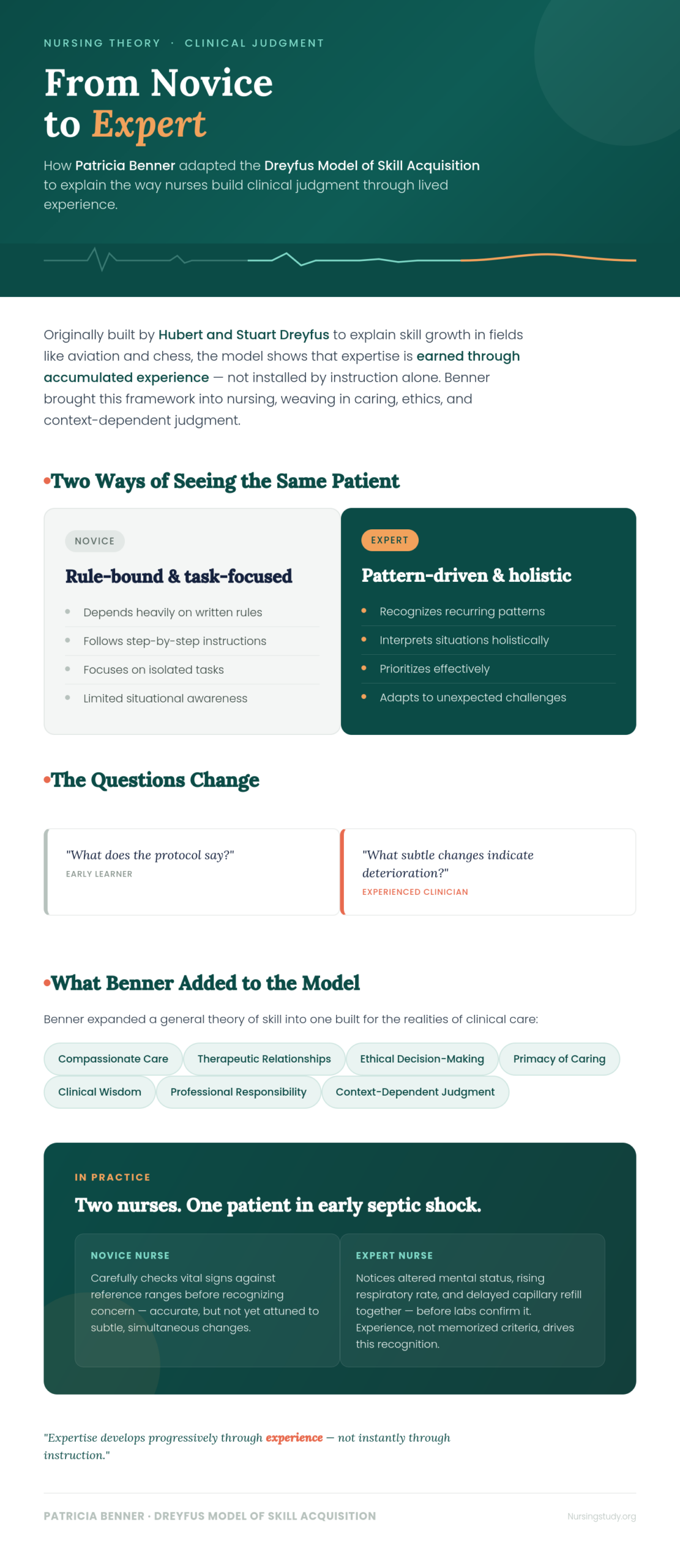
Early learners often ask:
- “What rule should I follow?”
- “What does the protocol say?”
Experienced clinicians instead ask:
- “What does this patient’s condition suggest?”
- “What is most important right now?”
- “What subtle changes indicate deterioration?”
This evolution reflects increasingly sophisticated clinical judgment and clinical reasoning.
Patricia Benner’s Adaptation of the Model
Although Patricia Benner based her work on the Dreyfus Model of Skill Acquisition, she expanded it in several important ways.
She incorporated concepts unique to nursing, including:
- Compassionate nursing care.
- Therapeutic relationships.
- Ethical decision-making.
- The primacy of caring.
- Clinical wisdom.
- Professional responsibility.
- Context-dependent decision-making.
These additions transformed a general learning theory into one specifically designed for nursing.
Example
Consider two nurses caring for a patient experiencing early septic shock.
A novice nurse may carefully compare vital signs against reference ranges before recognizing concern. The nurse follows established protocols accurately but may not yet appreciate the significance of subtle changes occurring simultaneously.
An experienced expert nurse, however, may immediately recognize a concerning combination of slightly altered mental status, increasing respiratory rate, delayed capillary refill, and patient appearance—even before laboratory values confirm deterioration. This ability develops through accumulated clinical experience, not simply through memorizing diagnostic criteria.
This example illustrates why Patricia Benner considered experience to be central to developing expertise.
Key Concepts and Assumptions
Patricia Benner’s theory rests on several interconnected concepts that explain how professional competence develops throughout a nurse’s career. Together, these assumptions provide the foundation for understanding both the Novice to Expert framework and its application in modern nursing practice.
1. Expertise Is Developed, Not Inherited
Perhaps the most fundamental assumption is that expertise is acquired through practice rather than innate talent.
According to Patricia Benner, nurses are not born as experts. Instead, they gradually develop competence by integrating theoretical knowledge with repeated clinical experience, reflection, and patient interactions.
2. Experience Is the Foundation of Nursing Knowledge
Another central assumption is that meaningful nursing knowledge develops through experience.
Formal education provides scientific principles, but practical understanding emerges through:
- Caring for diverse patient populations.
- Managing increasingly complex clinical situations.
- Reflecting on successes and mistakes.
- Learning from mentors.
- Participating in interdisciplinary care.
This experiential knowledge complements evidence-based practice rather than replacing it.
3. Clinical Judgment Improves Over Time
Clinical judgment and clinical reasoning are developmental abilities.
With increasing experience, nurses become more skilled at:
- Identifying priorities.
- Anticipating complications.
- Recognizing patterns.
- Interpreting incomplete information.
- Making timely decisions.
These abilities distinguish experienced practitioners from beginners.
4. Caring Is Central to Nursing
Unlike many professional development theories, Patricia Benner’s framework emphasizes that caring is inseparable from competence.
The concept of the primacy of caring suggests that genuine concern for patients enhances assessment, communication, advocacy, and decision-making. Technical expertise alone is insufficient without compassionate, patient-centered care.
5. Learning Is Context-Dependent
Another important assumption is that competence develops within specific clinical environments.
For example, a highly experienced pediatric intensive care nurse may still function as an advanced beginner when transitioning into neonatal intensive care because each specialty requires unique knowledge, workflows, and decision-making patterns.
This illustrates that expertise is influenced by the clinical context rather than years of employment alone.
6. Reflection Promotes Professional Growth
Patricia Benner also recognized the importance of reflective practice.
Reflecting on patient encounters enables nurses to:
- Identify strengths.
- Learn from errors.
- Improve future decision-making.
- Build confidence.
- Strengthen professional identity.
Reflection transforms experience into lasting professional knowledge.
7. Professional Development Is Lifelong
Finally, Patricia Benner’s theory assumes that learning never truly ends.
Healthcare continues to evolve through:
- New technologies.
- Emerging diseases.
- Updated evidence.
- Changing patient populations.
- Advances in treatment.
Consequently, even an expert nurse continues learning throughout a professional career. Expertise is therefore not a destination but an ongoing process of adaptation, reflection, and continuous improvement.
The Five Stages of the Novice to Expert Model
The defining feature of Patricia Benner’s theory is the progression through five stages of professional development. Adapted from the Dreyfus Model of Skill Acquisition, these stages of skill acquisition describe how a nurse develops from relying heavily on rules and instructions to demonstrating intuitive, flexible, and highly effective expert practice. Rather than viewing competence as a single milestone, Patricia Benner proposed that professional growth is a continuous process shaped by clinical experience, reflective learning, and exposure to increasingly complex clinical situations.
One of the most important aspects of Benner’s model is that progression through the stages is not determined solely by the number of years a nurse has practiced. Two nurses may have worked for the same amount of time yet demonstrate different levels of competence depending on the quality, variety, and intensity of their clinical experiences. For example, a nurse who has spent three years working in a busy trauma center may develop more advanced clinical judgment than another nurse with the same years of experience in a less demanding environment.
Another key principle is that progression is context-specific. A nurse who functions as an expert nurse in one specialty may return to an advanced beginner or competent nurse level when transitioning to a completely different specialty.
Example
An experienced critical care nurse who transfers to labor and delivery possesses strong communication, assessment, and emergency response skills. However, because maternal and fetal care require different clinical knowledge, equipment, and decision-making processes, the nurse may initially function as an advanced beginner within that specialty while gradually developing expertise through experience.
This illustrates an important assumption of Patricia Benner’s theory: expertise in nursing practice is specific to a particular clinical context rather than a universal status.
The five stages represent a gradual shift in how nurses:
- Acquire and apply nursing knowledge.
- Interpret patient information.
- Exercise clinical reasoning.
- Make decisions in uncertain situations.
- Prioritize nursing interventions.
- Deliver safe, individualized patient care.
Each stage builds upon the previous one, reflecting increasing confidence, independence, flexibility, and professional maturity.
Stage 1: Novice
The novice stage represents the beginning of professional development. According to Patricia Benner, a novice nurse has little or no previous experience with the situations in which they are expected to perform. Although novice nurses may possess substantial theoretical knowledge acquired through nursing education, they have not yet accumulated enough clinical experience to recognize patterns or adapt confidently to changing patient conditions.
Because of their limited experience, novice practitioners depend heavily on:
- Written procedures.
- Institutional policies.
- Clinical guidelines.
- Checklists.
- Step-by-step instructions.
- Direct supervision from experienced nurses.
At this stage, decision-making is largely rule-based. The nurse follows instructions exactly because they have not yet developed the confidence or experiential knowledge needed to modify care according to the patient’s unique circumstances.
Characteristics of the Novice Stage
A novice nurse typically demonstrates the following characteristics:
- Relies strictly on learned rules and protocols.
- Focuses on completing individual tasks correctly.
- Has limited ability to prioritize competing patient needs.
- Requires frequent guidance and feedback.
- Experiences uncertainty in unfamiliar clinical situations.
- Concentrates on performing procedures safely rather than understanding the broader clinical picture.
Because beginners often focus intensely on individual tasks, they may overlook subtle changes in patient condition that more experienced nurses recognize immediately.
Example
A newly licensed nurse assigned to a medical-surgical unit is caring for a patient recovering from abdominal surgery. The patient reports increasing discomfort, appears anxious, and has a slightly elevated respiratory rate.
The novice nurse carefully reviews the postoperative assessment checklist, documents the vital signs accurately, and administers prescribed pain medication according to protocol. Although these actions are appropriate, the nurse may not yet recognize that the combination of increasing respiratory rate, anxiety, and worsening pain could indicate an early postoperative complication requiring immediate reassessment.
This example illustrates how beginners rely primarily on established procedures rather than holistic clinical interpretation.
Challenges at the Novice Stage
New nurses commonly face several challenges:
- Translating classroom knowledge into actual nursing practice.
- Managing multiple responsibilities simultaneously.
- Building confidence during independent practice.
- Developing effective communication with interdisciplinary teams.
- Recognizing which patient findings require urgent intervention.
Supportive orientation programs, mentorship, simulation training, and supervised clinical practice play a crucial role in helping novice nurses progress toward the next developmental stage.
Stage 2: Advanced Beginner
As nurses accumulate meaningful clinical experience, they progress to the advanced beginner stage. At this level, practitioners begin recognizing recurring patterns in patient care and become increasingly comfortable applying theoretical knowledge in practice. However, they still require support when managing complex or rapidly changing clinical situations.
Unlike the novice stage, where every situation appears entirely new, advanced beginners start identifying similarities between current patients and previous experiences. These repeated encounters help them develop greater confidence and improve their ability to anticipate patient needs.
Characteristics of the Advanced Beginner Stage
An advanced beginner generally:
- Begins recognizing meaningful clinical patterns.
- Demonstrates improved organizational skills.
- Requires less direct supervision than a novice.
- Applies previous experiences to similar patient situations.
- Starts prioritizing patient care more effectively.
- Continues relying on mentors for guidance in unfamiliar circumstances.
Although progress is evident, decision-making often remains cautious and deliberate.
Example
A nurse who has worked for six months on a medical-surgical unit notices that several postoperative patients who later developed infections initially showed mild temperature elevations, increasing fatigue, and subtle changes in wound drainage.
When another patient begins demonstrating similar findings, the nurse recognizes the potential significance and promptly reports concerns to the healthcare team. While the nurse may still seek confirmation from a senior colleague, this ability to connect present observations with previous experiences represents advancement beyond the novice stage.
Professional Development During This Stage
Healthcare organizations frequently support advanced beginners through:
- Clinical preceptorship.
- Structured mentorship programs.
- Regular competency evaluations.
- Guided reflective practice.
- Exposure to progressively challenging patient assignments.
These opportunities strengthen both technical competence and clinical judgment, preparing nurses for greater independence.
Stage 3: Competent
The competent nurse typically develops after gaining substantial experience within a particular clinical setting. According to Patricia Benner, competence reflects a significant shift in thinking. Rather than reacting to individual tasks, the nurse begins managing patient care using long-term planning, prioritization, and organized decision-making.
At this stage, nurses become more confident because repeated clinical exposure enables them to predict likely patient outcomes and develop effective care plans.
Characteristics of the Competent Stage
A competent nurse generally demonstrates the ability to:
- Organize complex patient assignments efficiently.
- Set priorities based on patient acuity.
- Anticipate routine clinical events.
- Coordinate care among multiple healthcare professionals.
- Delegate responsibilities appropriately.
- Manage time effectively.
Competent practitioners also develop greater confidence in independent decision-making while recognizing situations requiring consultation.
Example
A charge nurse responsible for several postoperative patients prioritizes assessments based on clinical urgency rather than room order.
Recognizing that one patient with deteriorating oxygen saturation requires immediate attention while another awaiting discharge paperwork can safely wait demonstrates effective prioritization and organizational thinking characteristic of the competent stage.
Transition Toward Higher-Level Thinking
At this point, nurses begin moving beyond rigid rules and increasingly rely on experience when making decisions. Their clinical reasoning becomes more efficient because they can integrate assessment findings, laboratory results, patient history, and anticipated complications into comprehensive care plans.
Stage 4: Proficient
The proficient stage represents another major advancement in professional development. A proficient nurse no longer views patient care as isolated tasks but understands clinical situations as interconnected wholes.
This broader perspective enables nurses to anticipate problems before they occur and modify interventions proactively.
Characteristics of the Proficient Stage
A proficient nurse typically:
- Understands the overall clinical picture quickly.
- Anticipates patient needs before complications develop.
- Adapts care plans as situations evolve.
- Demonstrates strong clinical judgement and flexibility.
- Integrates technical competence with compassionate patient-centered care.
- Provides leadership and mentorship to less experienced colleagues.
Rather than depending solely on protocols, proficient nurses interpret guidelines within the context of each patient’s unique condition.
Example
A proficient nurse caring for a patient with heart failure notices subtle changes, including increased fatigue, slight confusion, and reduced appetite.
Although these findings individually appear minor, the nurse recognizes their combined significance and initiates further assessment before obvious clinical deterioration occurs. This proactive response reflects growing clinical wisdom developed through repeated experience.
Expanding Professional Responsibilities
At this stage, nurses frequently assume additional roles, including:
- Mentoring novice clinicians.
- Leading quality improvement initiatives.
- Participating in policy development.
- Serving as clinical resource persons.
- Supporting interdisciplinary collaboration.
Their growing expertise contributes significantly to improved patient care and team performance.
Stage 5: Expert Nurse
The final stage of Patricia Benner’s model is the expert nurse, representing the highest level of professional competence within a specific area of clinical practice. An expert nurse possesses extensive experiential knowledge that enables rapid, accurate, and intuitive decision-making without relying primarily on analytical rules or checklists.
Importantly, intuition at this stage is not guesswork. Instead, it reflects years of accumulated experience, deep nursing knowledge, and repeated exposure to similar clinical situations. Expert nurses recognize meaningful patterns almost immediately because previous experiences have refined their ability to distinguish normal variations from early signs of deterioration.
Characteristics of the Expert Nurse
An expert nurse typically demonstrates:
- Exceptional clinical judgment.
- Highly developed clinical reasoning.
- Rapid recognition of patient deterioration.
- Flexible decision-making in complex situations.
- Strong leadership abilities.
- Confidence during emergencies.
- Deep understanding of individualized patient needs.
- Ability to mentor and educate other nurses.
Rather than consciously following rules, expert practitioners integrate knowledge, experience, communication, ethics, and compassionate care into seamless clinical performance.
Example
An experienced intensive care nurse notices that a patient recovering from septic shock appears unusually restless despite stable monitor readings. Although laboratory values remain within expected ranges, the nurse senses that “something is not right.”
Based on years of caring for critically ill patients, the nurse immediately conducts a comprehensive reassessment, notifies the physician, and prepares for potential intervention. Shortly afterward, the patient develops significant hemodynamic instability requiring urgent treatment.
In this scenario, the nurse’s rapid response reflects good clinical judgment developed through extensive experience rather than reliance on a single abnormal vital sign.
The Role of Expert Nurses in Healthcare
Expert nurses play vital roles in strengthening healthcare systems by:
- Improving patient safety through early recognition of complications.
- Mentoring novice and experienced colleagues.
- Leading evidence-based practice initiatives.
- Supporting organizational quality improvement.
- Contributing to teaching and learning within healthcare organizations.
- Promoting excellence in nursing care and professional development.
Progression Is Continuous
Although Patricia Benner’s theory describes five distinct stages, progression is not strictly linear or automatic. Nurses may advance rapidly in one specialty while remaining beginners in another. Continuous learning, reflection, mentorship, and exposure to increasingly diverse clinical experiences remain essential throughout a professional career.
Core Principles of Patricia Benner’s Theory
While the Novice to Expert model is best known for its five stages of professional development, the true strength of Patricia Benner’s work lies in the principles that explain how and why nurses develop expertise over time. These principles form the theoretical foundation of Benner’s theory and distinguish it from many other nursing theories that focus primarily on abstract concepts or task-based competency.
At the center of Patricia Benner’s philosophy is the belief that becoming an expert nurse is not simply the result of accumulating years of experience. Instead, expertise develops through meaningful engagement with patients, continuous reflection on practice, and the gradual integration of theoretical knowledge with real-world clinical experience. According to Patricia Benner, professional competence is shaped by the interaction between knowledge, experience, ethical responsibility, and the ability to make sound decisions in complex healthcare environments.
These principles continue to influence modern nursing practice, nursing education, competency assessment, leadership development, and patient safety initiatives because they explain the cognitive and professional transformation that occurs as nurses move from novice practitioners to clinical experts.
The four core principles discussed below—Experiential Learning, Clinical Judgment and Clinical Reasoning, Clinical Wisdom, and the Primacy of Caring—are closely interconnected. Together, they provide a comprehensive understanding of how nurses develop professional competence and deliver high-quality patient-centered care.
Experiential Learning
One of the most fundamental principles of Patricia Benner’s theory is experiential learning. According to Patricia Benner, meaningful learning occurs through direct participation in clinical practice, where nurses repeatedly apply theoretical knowledge to actual patient care situations. Although classroom instruction provides an essential scientific foundation, it cannot fully prepare nurses for the complexity, unpredictability, and variability of real healthcare environments.
This principle challenges the traditional assumption that professional competence can be achieved solely through lectures, textbooks, or examinations. Instead, Benner’s theory proposes that expertise develops when nurses actively engage in patient care, reflect on their experiences, and continuously refine their knowledge through practice.
Why Experiential Learning Matters
Healthcare is inherently dynamic. No two patients present with exactly the same symptoms, responses to treatment, or psychosocial needs. As nurses encounter increasingly diverse patient populations, they begin recognizing patterns, anticipating complications, and adapting interventions based on previous experiences.
Through experiential learning, nurses gradually learn to:
- Connect theoretical concepts with real clinical situations.
- Recognize patterns in patient conditions.
- Develop confidence when making decisions.
- Improve communication with patients and interdisciplinary teams.
- Adapt interventions to individual patient needs.
- Strengthen professional judgment through reflection.
Each patient encounter contributes to the nurse’s growing body of nursing knowledge, creating a deeper understanding that cannot be acquired through theoretical study alone.
Example of Experiential Learning
Consider a novice nurse caring for a patient with chronic obstructive pulmonary disease (COPD) experiencing worsening shortness of breath.
Initially, the nurse follows established protocols by:
- Assessing oxygen saturation.
- Administering prescribed oxygen therapy.
- Monitoring respiratory rate.
- Reporting abnormal findings.
These actions are appropriate but largely guided by learned procedures.
After caring for many patients with COPD over several years, the same nurse begins noticing subtle indicators that often precede respiratory deterioration, such as increasing anxiety, changes in posture, decreased conversation tolerance, and mild accessory muscle use. These observations may prompt earlier intervention, even before objective measurements become critically abnormal.
The difference between these two responses illustrates how experience and clinical exposure transform theoretical knowledge into practical expertise.
Reflection as Part of Experiential Learning
For Patricia Benner, experience alone does not automatically produce expertise. Learning is strengthened through reflection.
Reflective practice involves asking questions such as:
- What happened during this patient encounter?
- Why did the patient respond this way?
- What clinical decisions were effective?
- What could have been done differently?
- How will this experience influence future care?
Reflection converts everyday experiences into lasting professional knowledge, enabling nurses to continuously improve their practice.
Clinical Judgment and Clinical Reasoning
Another central principle of Patricia Benner’s theory is the development of clinical judgment and clinical reasoning. These two concepts are essential for safe, effective, and individualized patient care, and they become increasingly sophisticated as nurses progress through the Novice to Expert continuum.
Although the terms are closely related, they describe different aspects of professional thinking.
Clinical Reasoning
Clinical reasoning is the cognitive process nurses use to collect, interpret, and analyze patient information before making decisions. It involves deliberate thinking, problem-solving, and the integration of multiple sources of information.
Effective clinical reasoning requires nurses to:
- Gather relevant assessment findings.
- Interpret laboratory and diagnostic results.
- Consider patient history.
- Identify potential complications.
- Evaluate treatment effectiveness.
- Select appropriate nursing interventions.
Clinical Judgment
Clinical judgment is the conclusion or decision reached after applying clinical reasoning. It reflects the nurse’s ability to determine the most appropriate course of action based on available information.
While clinical reasoning focuses on the thinking process, clinical judgment focuses on the decision that results from that process.
How These Skills Develop
According to Patricia Benner, beginners often rely heavily on established protocols because they lack sufficient experience to interpret complex situations independently.
As nurses gain clinical experience, several changes occur:
| Novice Nurse | Expert Nurse |
|---|---|
| Follows written procedures | Recognizes patient patterns quickly |
| Focuses on isolated findings | Integrates multiple assessment findings |
| Requires guidance for complex decisions | Makes independent clinical decisions confidently |
| Reacts after complications develop | Anticipates problems before they occur |
This progression illustrates why Benner’s model places such strong emphasis on professional development through experience.
Example
Imagine a patient recovering from abdominal surgery.
A novice practitioner observes:
- Mild tachycardia.
- Slight abdominal discomfort.
- Restlessness.
Each finding is documented separately.
An experienced nurse, however, immediately recognizes that these seemingly minor changes may collectively indicate internal bleeding. The nurse initiates further assessment, contacts the surgical team, and prepares for possible emergency intervention.
Both nurses collected similar data, but the experienced clinician demonstrated superior clinical judgment by recognizing the significance of the overall clinical picture.
Importance in Nursing Practice
Strong clinical judgement contributes directly to:
- Improved patient safety.
- Earlier recognition of deterioration.
- Reduced medical errors.
- Better prioritization of care.
- More effective interdisciplinary communication.
- Higher quality nursing care.
For these reasons, healthcare organizations increasingly evaluate clinical judgment as a key indicator of professional competence.
Clinical Wisdom
Among the most distinctive contributions of Patricia Benner’s theory is the concept of clinical wisdom. While knowledge and technical competence are essential, Patricia Benner argued that exceptional nursing requires something more—the ability to combine scientific evidence, professional experience, ethical understanding, and compassionate care when making decisions.
Clinical wisdom develops gradually through repeated exposure to diverse patient experiences. It represents the mature integration of knowledge, experience, values, and intuition.
Unlike intuition based on guesswork, clinical wisdom is grounded in years of thoughtful practice and careful observation.
Characteristics of Clinical Wisdom
A nurse demonstrating clinical wisdom typically:
- Recognizes subtle changes in patient conditions.
- Anticipates complications before they become obvious.
- Adapts care to each patient’s unique circumstances.
- Balances evidence-based guidelines with individualized care.
- Makes sound ethical decisions.
- Considers psychological, social, and cultural factors alongside physical health.
Clinical wisdom allows nurses to move beyond rigid protocol adherence while still maintaining safe, evidence-informed practice.
Example
An elderly patient recovering from pneumonia repeatedly states, “I just don’t feel right.”
Although laboratory values and vital signs remain within acceptable limits, an experienced nurse notices:
- Reduced eye contact.
- Increased fatigue.
- Slower responses.
- Decreased appetite.
- Family concern regarding subtle personality changes.
Rather than dismissing these observations, the nurse conducts a more comprehensive assessment and requests further evaluation. Hours later, the patient develops sepsis.
This scenario demonstrates how clinical wisdom enables experienced nurses to recognize patterns that objective measurements alone may not immediately reveal.
Clinical Wisdom and Ethical Practice
Clinical wisdom also includes the ability to navigate ethically challenging situations.
For example, nurses frequently balance:
- Patient autonomy.
- Family preferences.
- Institutional policies.
- Cultural beliefs.
- Evidence-based recommendations.
The ability to make thoughtful decisions while respecting patient values reflects mature professional practice and aligns with Patricia Benner’s broader understanding of nursing expertise.
Primacy of Caring
The primacy of caring is one of the defining philosophical principles of Benner’s theory. Unlike models that focus primarily on technical competence, Patricia Benner argued that caring is not separate from clinical excellence—it is fundamental to it.
According to Patricia Benner, caring strengthens professional competence because nurses who genuinely understand and value their patients are better able to recognize subtle needs, communicate effectively, and provide individualized care.
Caring, therefore, is not simply an emotional quality. It is a professional commitment that influences every aspect of nursing practice.
Dimensions of the Primacy of Caring
The principle includes several interconnected elements:
- Respecting patient dignity.
- Building therapeutic relationships.
- Advocating for patient needs.
- Listening actively to patients and families.
- Supporting emotional well-being alongside physical recovery.
- Delivering culturally sensitive and individualized care.
These behaviors enhance both patient satisfaction and clinical outcomes.
Example
Two nurses administer identical medications according to physician orders.
One nurse completes the task efficiently but provides little communication beyond procedural instructions.
The second nurse administers the medication while:
- Explaining its purpose.
- Addressing patient concerns.
- Assessing emotional well-being.
- Encouraging questions.
- Identifying fears about treatment.
- Noticing nonverbal signs of discomfort.
Although both nurses performed the technical procedure correctly, the second nurse demonstrated the primacy of caring, integrating technical competence with compassionate, patient-centered care.
Caring as a Foundation for Expertise
According to Patricia Benner, caring enhances professional competence by enabling nurses to:
- Build trust with patients and families.
- Gather more accurate assessment information.
- Improve communication.
- Recognize subtle changes in patient behavior.
- Individualize nursing interventions.
- Strengthen patient engagement in care.
In this way, caring becomes both a moral responsibility and a clinical asset.
Applying Patricia Benner’s Theory in Nursing Practice
One of the greatest strengths of Patricia Benner’s work is its practical application in everyday nursing practice. While many nursing theories provide conceptual frameworks for understanding nursing, Benner’s theory offers a model that can be directly integrated into patient care, professional development, competency assessment, and healthcare leadership. This practical focus is one of the primary reasons why Patricia Benner’s Novice to Expert model remains widely used in hospitals, community health organizations, academic institutions, and healthcare systems around the world.
The central premise of Patricia Benner’s theory is that expertise develops through meaningful clinical experience rather than through theoretical instruction alone. Every patient encounter, interdisciplinary collaboration, clinical challenge, and reflective learning opportunity contributes to the nurse’s professional growth. As nurses gain experience, they become increasingly capable of interpreting complex clinical information, anticipating patient needs, prioritizing care, and making sound decisions under pressure.
Modern healthcare presents nurses with rapidly changing patient conditions, technological advancements, increasing patient acuity, and expanding professional responsibilities. In these environments, the ability to apply knowledge effectively is just as important as possessing that knowledge. Patricia Benner recognized that expert performance depends on integrating scientific evidence with practical experience, compassionate care, and professional judgment.
Today, Benner’s model supports nursing practice in numerous ways, including:
- Guiding competency-based orientation programs.
- Supporting the transition of new graduate nurses into independent practice.
- Improving clinical judgment and clinical reasoning.
- Enhancing patient safety through earlier recognition of deterioration.
- Strengthening mentorship and professional development.
- Assisting healthcare organizations with competency assessment and workforce planning.
- Promoting lifelong learning and continuous improvement.
Rather than functioning solely as a developmental model, Patricia Benner’s theory has become a practical framework for improving healthcare delivery while helping nurses develop the knowledge, confidence, and adaptability needed to provide high-quality, patient-centered care.
Clinical Decision-Making
Effective clinical decision-making is one of the defining characteristics of professional nursing competence. Every shift requires nurses to interpret assessment findings, prioritize patient needs, evaluate treatment responses, collaborate with healthcare teams, and determine the most appropriate interventions. According to Patricia Benner, these abilities develop progressively through experience rather than emerging immediately after graduation.
In Benner’s theory, decision-making evolves as nurses move through the Novice to Expert continuum. Beginners typically rely on written procedures, institutional protocols, and clearly defined rules because they have limited exposure to diverse clinical situations. As experience increases, nurses become more confident in interpreting patient information, recognizing subtle patterns, and adapting interventions to individual circumstances.
This progression can be summarized as follows:
| Developmental Stage | Clinical Decision-Making Characteristics |
|---|---|
| Novice | Relies heavily on rules, checklists, and supervision. |
| Advanced Beginner | Begins recognizing recurring patient patterns but still seeks guidance for complex situations. |
| Competent Nurse | Prioritizes care effectively and plans interventions based on previous experiences. |
| Proficient Nurse | Interprets the overall clinical picture and anticipates likely complications. |
| Expert Nurse | Makes rapid, intuitive, and highly accurate decisions based on extensive clinical experience. |
One of Patricia Benner’s major contributions was demonstrating that experienced nurses often identify patient deterioration before objective indicators become obvious. This ability is not based on intuition alone but on years of accumulated clinical experience, refined clinical reasoning, and pattern recognition.
Example: Early Recognition of Patient Deterioration
A patient admitted with community-acquired pneumonia appears stable during morning rounds. Vital signs show only slight abnormalities, but an experienced nurse notices several subtle changes:
- Increased restlessness.
- Reduced appetite.
- Difficulty maintaining conversation.
- Slight confusion.
- Mild increase in respiratory effort.
A novice nurse may document each finding individually without recognizing their collective significance. An expert nurse, however, understands that these changes may represent early clinical deterioration and immediately initiates further assessment, notifies the healthcare provider, and increases patient monitoring.
This example illustrates how clinical judgment improves with experience, allowing nurses to intervene before serious complications develop.
Factors That Strengthen Clinical Decision-Making
According to Patricia Benner, effective decision-making develops through continuous exposure to practice and is strengthened by:
- Diverse clinical experience.
- Reflective learning.
- Mentorship from experienced clinicians.
- Constructive feedback.
- Exposure to increasingly complex patient cases.
- Collaboration with interdisciplinary healthcare teams.
Healthcare organizations increasingly recognize these factors when designing residency and mentorship programs because strong decision-making directly contributes to patient safety and improved clinical outcomes.
Patient Care Across Healthcare Settings
One of the reasons Patricia Benner’s theory remains highly relevant is its adaptability across virtually every healthcare environment. Although patient populations, technologies, and clinical responsibilities differ among healthcare settings, the developmental principles outlined in Benner’s model apply consistently because every nurse progresses through similar stages of professional growth.
Whether caring for patients in hospitals, outpatient clinics, long-term care facilities, rehabilitation centers, community health programs, or home healthcare services, nurses continuously refine their skills through experience and reflection.
Acute Care Hospitals
In acute care hospitals, nurses frequently manage rapidly changing patient conditions that require continuous assessment and prompt intervention.
Examples include:
- Monitoring postoperative recovery.
- Identifying early signs of infection.
- Managing medication therapies.
- Responding to emergency situations.
- Coordinating multidisciplinary care.
As nurses gain experience, they become increasingly effective at prioritizing competing responsibilities while maintaining patient safety.
Community and Primary Care
Community health nurses apply Patricia Benner’s principles differently because patient care often focuses on prevention, education, and chronic disease management.
Experienced community nurses develop expertise in:
- Health promotion.
- Preventive care.
- Patient education.
- Home assessments.
- Family-centered care.
- Resource coordination.
For example, an experienced community nurse visiting a patient with diabetes may recognize subtle signs of declining medication adherence based on changes in home organization, dietary habits, and family interactions. This broader assessment reflects the holistic thinking emphasized in Benner’s theory.
Long-Term Care
Long-term care settings require nurses to develop strong observational skills because residents often experience gradual rather than sudden health changes.
Experienced nurses become adept at identifying:
- Behavioral changes.
- Functional decline.
- Nutritional problems.
- Cognitive deterioration.
- Early signs of infection.
- Emotional distress.
These observations support timely interventions that improve quality of life and reduce avoidable hospital admissions.
Emergency Care
Emergency departments present highly unpredictable clinical situations requiring rapid assessment and prioritization.
Experienced emergency nurses excel at:
- Rapid triage.
- Prioritizing critically ill patients.
- Managing multiple emergencies simultaneously.
- Coordinating interdisciplinary responses.
- Making decisions under intense time pressure.
These abilities reflect advanced clinical reasoning developed through repeated exposure to high-acuity patient care.
Home Healthcare
Home healthcare nurses must assess not only the patient but also the surrounding environment.
Experienced practitioners evaluate factors such as:
- Medication management.
- Family support systems.
- Home safety.
- Access to healthcare resources.
- Nutritional status.
- Ability to perform activities of daily living.
This comprehensive perspective demonstrates how Patricia Benner’s theory extends beyond hospital-based nursing.
Example
Consider two home healthcare nurses assessing an older adult recently discharged following heart failure treatment.
A less experienced nurse focuses primarily on:
- Vital signs.
- Medication administration.
- Scheduled wound care.
An experienced nurse additionally observes:
- Empty food cupboards.
- Difficulty climbing stairs.
- Missed medication doses.
- Increasing social isolation.
- Financial barriers to obtaining prescriptions.
By recognizing these broader influences on health, the experienced nurse develops a more comprehensive care plan that addresses both clinical and social determinants of health.
Application in Specialty and Critical Care Nursing
The value of Patricia Benner’s theory becomes especially apparent in specialty nursing environments where patients often present with rapidly changing conditions requiring advanced assessment and decision-making skills. These settings demand not only technical competence but also exceptional clinical judgment, clinical reasoning, teamwork, and adaptability.
Among all specialty areas, critical care provides one of the clearest demonstrations of Benner’s model in action.
Critical Care Nursing
Patients admitted to intensive care units frequently experience life-threatening conditions that require continuous monitoring and rapid intervention.
Experienced critical care nurses develop the ability to:
- Interpret complex physiological data.
- Recognize early signs of organ dysfunction.
- Anticipate complications before they become severe.
- Prioritize multiple simultaneous interventions.
- Coordinate closely with physicians, respiratory therapists, and pharmacists.
These advanced capabilities develop through years of focused clinical practice, illustrating the progression described by Patricia Benner.
Example: Intensive Care Unit
A mechanically ventilated patient develops only minor changes in blood pressure and urine output.
A novice nurse accurately records these findings and continues scheduled monitoring.
An experienced ICU nurse recognizes that the combined changes may represent the earliest signs of septic shock. The nurse immediately performs a more comprehensive assessment, obtains additional laboratory studies, communicates concerns to the critical care team, and prepares emergency interventions.
The difference lies not in technical knowledge alone but in the nurse’s ability to interpret subtle clinical patterns developed through extensive experience.
Emergency and Trauma Nursing
Emergency and trauma nurses frequently encounter patients whose conditions change within minutes.
Patricia Benner’s framework explains how experienced emergency nurses become increasingly proficient at:
- Rapid patient assessment.
- Prioritizing competing emergencies.
- Managing uncertainty.
- Communicating effectively during crises.
- Leading interdisciplinary teams.
These abilities contribute directly to improved patient survival and safer healthcare delivery.
Perioperative Nursing
Operating room nurses also demonstrate progression through Benner’s model.
Experienced perioperative nurses anticipate:
- Equipment requirements.
- Surgical workflow changes.
- Potential complications.
- Surgeon preferences.
- Patient safety risks.
Rather than simply reacting to requests, they proactively prepare for anticipated needs, improving procedural efficiency and reducing preventable errors.
Oncology, Pediatrics, and Other Specialties
The developmental principles of Patricia Benner’s theory are equally valuable in other specialty areas.
Experienced specialty nurses often develop expertise in:
- Managing highly specialized treatments.
- Educating patients and families.
- Coordinating multidisciplinary care.
- Addressing psychosocial concerns.
- Supporting complex decision-making.
- Providing individualized long-term care.
Although the clinical context differs, the underlying process of professional growth remains consistent.
Why Benner’s Theory Is Valuable in Specialty Nursing
Specialty practice highlights several important principles of Patricia Benner’s work:
- Expertise develops through repeated exposure to specific clinical situations.
- Clinical competence extends beyond technical skill.
- Experience strengthens clinical judgment and clinical reasoning.
- Patient-centered care improves as professional expertise increases.
- Lifelong learning remains essential regardless of experience level.
These principles explain why healthcare organizations frequently use Benner’s model when designing specialty orientation programs, competency assessments, mentorship initiatives, and professional development pathways.
Patricia Benner’s Theory in Nursing Education
One of the most significant and enduring contributions of Patricia Benner is the influence of her theory on nursing education. While the Novice to Expert model is widely recognized for explaining professional development in clinical settings, its impact extends equally to the preparation of future nurses. Patricia Benner’s work challenged traditional educational approaches that emphasized memorization and technical proficiency as the primary indicators of competence. Instead, she argued that effective nursing education should cultivate critical thinking, clinical reasoning, professional identity, and the ability to apply knowledge within authentic clinical practice.
Before Benner’s theory gained widespread acceptance, many nursing programs focused heavily on classroom instruction and competency checklists. Although these methods ensured that students acquired essential scientific knowledge and procedural skills, they often did not fully prepare graduates for the complexities of actual nursing. New graduates frequently encountered situations that required judgment, prioritization, adaptability, and communication—abilities that develop primarily through meaningful clinical experience.
Patricia Benner emphasized that becoming a competent practitioner requires far more than successfully completing examinations or demonstrating isolated technical skills. Nursing education should provide structured opportunities for learners to integrate theoretical knowledge with real patient care, reflect on their experiences, and progressively assume greater responsibility under appropriate supervision. In doing so, educational programs help learners transition from the novice stage toward competent professional practice.
Today, many schools of nursing have incorporated principles from Patricia Benner’s work into curriculum planning, competency frameworks, simulation programs, and clinical placements. Her influence is also evident in recommendations from the Carnegie Foundation for the Advancement of Teaching, particularly the Carnegie Study, which emphasized the importance of integrating classroom learning with experiential clinical education.
The application of Benner’s model within nursing education supports several important objectives:
- Bridging the gap between classroom learning and clinical practice.
- Strengthening clinical judgment and decision-making.
- Promoting experiential learning throughout nursing programs.
- Supporting professional identity formation.
- Preparing graduates for increasingly complex healthcare environments.
- Facilitating lifelong learning and continuous professional development.
Rather than viewing graduation as the endpoint of learning, Patricia Benner presented nursing education as the beginning of a lifelong developmental journey in which competence continues to evolve throughout a nurse’s career.
Developing Nursing Students from Novice to Competent Practitioners
The transition from nursing students to practicing professionals is one of the most challenging periods in a nurse’s career. Students enter educational programs with limited understanding of healthcare systems, patient care, and clinical decision-making. Through structured learning experiences, they gradually develop the knowledge, skills, attitudes, and confidence necessary for independent practice.
According to Patricia Benner, this developmental process reflects progression through the early stages of the Novice to Expert model. Most learners begin as novice practitioners because they have little or no practical experience in real clinical environments. They rely heavily on textbooks, classroom instruction, faculty guidance, and established procedures to perform nursing tasks safely.
As students gain clinical experience, they begin recognizing recurring patient patterns, understanding the rationale behind interventions, and connecting theoretical concepts with real-world practice. Over time, these experiences enable them to transition toward the advanced beginner and eventually the competent nurse stage.
Characteristics of Student Development
The progression from novice to competence involves continuous growth in several areas:
| Early Learning | Developing Competence |
|---|---|
| Memorizes facts and procedures | Integrates knowledge into patient care |
| Depends on detailed instructions | Makes increasingly independent decisions |
| Focuses on individual tasks | Understands the patient’s overall condition |
| Limited confidence | Growing professional confidence |
| Requires constant supervision | Functions with appropriate independence |
This progression reflects the gradual transformation from performing nursing procedures to understanding the broader goals of patient-centered care.
Building Clinical Confidence
One of the greatest challenges faced by new graduate nurses is translating theoretical knowledge into effective clinical performance. Many graduates understand disease processes, pharmacology, and nursing interventions but initially struggle to prioritize multiple patient needs simultaneously.
Patricia Benner explained that this difficulty is a natural part of professional development rather than evidence of inadequate preparation. Confidence develops through repeated clinical encounters, constructive feedback, and opportunities to apply knowledge in increasingly complex situations.
Educational strategies that promote confidence include:
- Supervised clinical placements.
- Skills laboratories.
- Simulation-based learning.
- Reflective practice.
- Case-based discussions.
- Gradually increasing patient care responsibilities.
Each experience contributes to the learner’s growing body of nursing knowledge, strengthening both technical competence and professional judgment.
Example
Consider a student nurse assigned to care for a patient with newly diagnosed heart failure.
Initially, the student focuses on:
- Measuring vital signs accurately.
- Administering medications correctly.
- Completing documentation.
- Following instructor guidance.
These are essential beginner responsibilities.
After several clinical rotations caring for similar patients, the student begins recognizing early indicators of fluid overload, understands why daily weight monitoring is important, anticipates patient education needs, and participates more confidently in interdisciplinary discussions.
This progression demonstrates how Patricia Benner’s theory explains the natural evolution of professional competence through structured learning and clinical experience.
Curriculum Design and Clinical Education
The influence of Patricia Benner on curriculum development has been substantial. Her work encouraged nursing educators to move beyond information delivery toward educational experiences that foster critical thinking, professional identity, and competent clinical performance.
According to Benner’s theory, effective curricula should integrate three essential components:
- Scientific and theoretical knowledge.
- Hands-on clinical education.
- Reflective learning that transforms experience into professional understanding.
Rather than treating classroom learning and clinical practice as separate activities, Patricia Benner advocated for their continuous integration throughout nursing programs.
Integrating Theory with Practice
One of the central principles of curriculum design influenced by Benner’s model is the deliberate connection between classroom concepts and patient care experiences.
For example:
Students learning cardiovascular physiology in lectures may simultaneously complete clinical rotations in cardiac units where they:
- Assess patients with heart disease.
- Interpret electrocardiograms.
- Administer cardiovascular medications.
- Educate patients about lifestyle modifications.
- Observe interdisciplinary care planning.
This integration helps students understand not only what to do but why specific interventions are necessary.
Simulation-Based Learning
Modern nursing programs increasingly incorporate simulation as part of clinical education.
Simulation allows learners to practice:
- Emergency response.
- Medication administration.
- Communication skills.
- Teamwork.
- Ethical decision-making.
- Prioritization of care.
Because simulation recreates realistic clinical situations without risking patient safety, students gain valuable experience before entering actual healthcare settings.
For example, a high-fidelity simulation involving septic shock enables students to recognize deteriorating patient conditions, communicate with physicians, administer treatments, and evaluate outcomes in a controlled learning environment.
The Carnegie Study and Educational Reform
The influence of Patricia Benner expanded significantly through her leadership in the Carnegie Study, conducted by the Carnegie Foundation for the Advancement of Teaching.
The study examined how nurses are educated and identified opportunities for improvement. It recommended that nursing education integrate three essential forms of learning:
- Knowledge acquisition through classroom instruction.
- Clinical practice through direct patient care experiences.
- Professional identity formation through reflection, ethics, and professional values.
These recommendations reinforced Patricia Benner’s belief that competent nurses develop through the integration of theory, practice, and reflective learning rather than through isolated educational experiences.
Developing Clinical Judgment Through Education
Curricula influenced by Benner’s theory increasingly emphasize activities that strengthen clinical reasoning and clinical judgment, including:
- Case studies.
- Problem-based learning.
- Simulation scenarios.
- Reflective journals.
- Clinical conferences.
- Interdisciplinary learning activities.
These educational methods prepare graduates to think critically rather than simply perform procedures.
Mentorship and Competency Assessment
Another major contribution of Patricia Benner’s theory to nursing education is its influence on mentorship and competency assessment. Recognizing that expertise develops progressively, Benner’s model encourages educators and healthcare organizations to provide individualized support based on each learner’s developmental stage.
Rather than expecting all learners to perform at the same level, the theory acknowledges that different stages require different teaching strategies, supervision, and evaluation methods.
The Importance of Mentorship
Mentorship is particularly valuable because experienced nurses help bridge the gap between theoretical instruction and professional practice.
Effective mentors assist learners by:
- Demonstrating clinical procedures.
- Modeling professional behavior.
- Explaining clinical reasoning.
- Encouraging reflective practice.
- Providing constructive feedback.
- Building learner confidence.
Experienced mentors also help learners understand the subtle aspects of patient care that cannot easily be taught through textbooks alone.
Example
A student nurse caring for a postoperative patient notices increasing discomfort but is unsure whether additional assessment is necessary.
Rather than immediately providing the answer, an experienced mentor asks:
- What changes have you observed?
- How do today’s findings compare with yesterday’s assessment?
- What possible complications should be considered?
- What additional information would help guide your decision?
This questioning encourages the learner to develop clinical reasoning independently rather than simply memorizing responses.
Competency Assessment
Traditional competency assessments often focus on whether a learner can perform individual procedures correctly.
Patricia Benner’s theory suggests that comprehensive competency assessment should also evaluate:
- Clinical decision-making.
- Prioritization of care.
- Communication skills.
- Professional behavior.
- Ethical practice.
- Adaptability in changing clinical situations.
- Reflective learning.
These broader assessments provide a more accurate understanding of professional development than technical skill evaluation alone.
Competency Assessment Methods
Educational institutions and healthcare organizations frequently use multiple assessment strategies, including:
- Direct observation during clinical practice.
- Simulation performance evaluations.
- Objective Structured Clinical Examinations (OSCEs).
- Reflective portfolios.
- Clinical competency checklists.
- Peer and instructor evaluations.
- Self-assessment and reflective journals.
Using multiple assessment methods acknowledges that competence involves knowledge, technical ability, judgment, communication, and professionalism.
Supporting Lifelong Professional Development
Although mentorship is often associated with students and new graduate nurses, Patricia Benner emphasized that professional development continues throughout a nurse’s career.
Experienced nurses continue developing through:
- Continuing education.
- Specialty certification.
- Advanced clinical roles.
- Leadership opportunities.
- Research participation.
- Teaching responsibilities.
- Interdisciplinary collaboration.
This commitment to lifelong learning reflects the central premise of Benner’s theory: expertise is never static but continually evolves through ongoing experience and reflection.
Strengths and Limitations of Patricia Benner’s Theory
Since its introduction in the early 1980s, Patricia Benner’s Novice to Expert theory has become one of the most widely recognized frameworks in nursing theories. Its influence extends across nursing practice, nursing education, leadership, competency assessment, and professional development. Few nursing models have had such a lasting impact on how nurses are educated, evaluated, and supported throughout their careers.
Like any theoretical framework, however, Benner’s theory is not without limitations. While many educators, clinicians, and researchers consider it one of the most practical models available, scholars have also identified areas where the theory could be strengthened or expanded. Understanding both its strengths and its limitations provides a balanced perspective and helps nurses appreciate when and how the model should be applied.
Evaluating Patricia Benner’s work is particularly important because healthcare has changed significantly since the theory was first introduced. Advances in technology, evidence-based practice, simulation, digital health, artificial intelligence, and interprofessional care have transformed many aspects of clinical work. Despite these changes, the central ideas of Patricia Benner continue to shape professional nursing because they focus on a timeless principle: expertise develops through meaningful experience combined with continuous learning and reflection.
Strengths
One of the primary reasons Patricia Benner’s theory has remained influential is its practicality. Unlike some conceptual models that are difficult to apply in everyday healthcare settings, Benner’s model directly reflects how nurses develop competence during actual clinical practice. Its concepts are easy to understand, align closely with professional experiences, and provide clear guidance for educators, healthcare organizations, and practicing nurses.
1. Strong Foundation in Real Clinical Practice
Perhaps the greatest strength of Patricia Benner’s work is that it was developed from observations of practicing nurses rather than purely theoretical assumptions.
Using qualitative research, Patricia Benner studied how experienced nurses approached patient care, solved clinical problems, and exercised professional judgment. This research demonstrated that expertise develops gradually through repeated exposure to diverse clinical situations.
Because the theory reflects real nursing experiences, many nurses recognize their own professional development within the framework.
Example
A nurse working in an emergency department often recalls feeling overwhelmed during the first few months of employment. Years later, that same nurse confidently prioritizes multiple critically ill patients, anticipates complications, and supports less experienced colleagues.
This progression closely mirrors the developmental pathway described in Patricia Benner’s theory.
2. Practical Application Across Multiple Healthcare Settings
Another major strength is the theory’s versatility.
The Novice to Expert model can be applied in virtually every area of healthcare, including:
- Medical-surgical nursing.
- Community health.
- Mental health nursing.
- Pediatrics.
- Maternity care.
- Oncology.
- Intensive and critical care.
- Long-term care.
- Home healthcare.
Regardless of specialty, nurses continually develop greater competence through clinical experience, making the theory applicable across diverse healthcare environments.
3. Emphasizes Experiential Learning
A defining contribution of Patricia Benner is the recognition that experiential learning is essential for professional growth.
The theory acknowledges that classroom instruction provides important scientific knowledge, but meaningful competence develops through:
- Direct patient care.
- Reflective practice.
- Clinical observation.
- Problem-solving.
- Collaboration with experienced clinicians.
This emphasis has significantly influenced educating nurses, encouraging nursing programs to integrate classroom instruction with supervised clinical experiences rather than treating them as separate components of learning.
4. Promotes Development of Clinical Judgment
Modern healthcare requires nurses to make complex decisions in environments characterized by uncertainty and rapidly changing patient conditions.
Patricia Benner’s framework highlights the progressive development of:
- Clinical judgment.
- Clinical reasoning.
- Prioritization.
- Pattern recognition.
- Decision-making.
These cognitive skills are now considered fundamental competencies within professional nursing.
Healthcare organizations increasingly use Benner’s model when designing orientation programs because improving clinical judgment contributes directly to patient safety.
5. Supports Competency-Based Education
Another significant strength is its contribution to competency-based nursing education.
Rather than expecting identical performance from all learners, Patricia Benner’s framework recognizes that nurses develop competence progressively.
This understanding allows educators to:
- Tailor supervision to learner needs.
- Develop stage-appropriate learning experiences.
- Design realistic competency assessments.
- Provide individualized feedback.
- Support lifelong professional development.
Many schools of nursing have adopted educational strategies that reflect these principles.
6. Encourages Lifelong Professional Growth
Unlike models that imply learning ends after graduation, Patricia Benner viewed professional development as a lifelong process.
Even highly experienced clinicians continue developing through:
- Continuing education.
- Specialty certifications.
- Leadership opportunities.
- Research participation.
- Reflective practice.
- Advanced clinical roles.
This perspective promotes continuous improvement throughout a nurse’s career.
7. Integrates Technical Competence with Compassionate Care
Another unique strength is the theory’s emphasis on the primacy of caring.
Rather than separating technical competence from compassion, Patricia Benner argued that effective patient care requires both.
This holistic perspective recognizes that exceptional nurses combine:
- Scientific knowledge.
- Technical proficiency.
- Communication skills.
- Ethical practice.
- Empathy.
- Professional responsibility.
This balanced approach remains one of the defining characteristics of Benner’s theory.
Limitations
Although Patricia Benner’s theory has been widely adopted, scholars have identified several limitations that should be considered when applying the framework in education, research, and nursing practice.
These limitations do not diminish the importance of the theory but rather highlight opportunities for refinement and further investigation.
1. Difficulty Measuring Progression Objectively
One commonly discussed limitation is the absence of standardized criteria for determining exactly when a nurse progresses from one stage to another.
Although the five stages describe developmental differences conceptually, they do not specify objective measurements that consistently identify competency levels.
For example:
- When does an advanced beginner officially become a competent nurse?
- How should organizations measure progression?
- Which competencies define an expert nurse?
Different institutions may answer these questions differently, creating variation in competency assessments.
2. Experience Does Not Always Equal Expertise
One assumption often associated with Benner’s theory is that increasing experience naturally leads to higher competence.
However, critics argue that years of employment alone do not guarantee professional growth.
Factors such as:
- Motivation.
- Continuing education.
- Clinical diversity.
- Reflective practice.
- Organizational support.
- Personal learning habits.
all influence professional development.
A nurse with many years of repetitive experience may not necessarily demonstrate the same expertise as someone who actively pursues lifelong learning and regularly encounters diverse clinical challenges.
3. Limited Emphasis on Individual Learning Differences
People learn differently.
Some nurses develop competence rapidly through simulation, mentorship, and self-directed learning, while others require longer periods of supervised practice.
Although Patricia Benner acknowledged the importance of clinical experience, critics suggest the theory places less emphasis on individual learning styles, personality traits, cultural influences, and cognitive differences that may affect professional development.
4. Primarily Based on Qualitative Research
Another frequently discussed limitation concerns the theory’s research foundation.
Patricia Benner developed the model primarily through qualitative research, which provides rich descriptions of professional experiences but may be more difficult to generalize across all healthcare settings.
Some researchers have argued that additional quantitative evidence would strengthen the empirical support for the theory and improve its application in competency measurement.
Nevertheless, qualitative methods remain highly valuable for exploring complex professional behaviors such as clinical judgment, decision-making, and expert performance.
5. Context-Specific Nature of Expertise
One important concept within Benner’s theory is that expertise develops within particular clinical contexts.
While this accurately reflects professional practice, it also creates practical challenges.
For example:
An expert nurse working in pediatric oncology may possess exceptional competence within that specialty but still require orientation when transferring to neonatal intensive care or emergency medicine.
This context-dependent nature of expertise makes universal competency classification more difficult.
6. Limited Consideration of Technological Advancements
When Patricia Benner introduced her theory, healthcare technology was far less advanced than it is today.
Modern nursing increasingly involves:
- Electronic health records.
- Artificial intelligence decision-support systems.
- Telehealth.
- Remote patient monitoring.
- Advanced diagnostic technologies.
- Digital clinical documentation.
Although the theory remains applicable, it does not specifically address how rapidly evolving technologies influence professional competence or decision-making.
Contemporary Relevance
Despite these limitations, Patricia Benner’s theory remains remarkably relevant in modern healthcare. Many of the challenges facing today’s nurses—including increasing patient complexity, workforce shortages, technological innovation, and expanding professional responsibilities—make the principles of Benner’s model even more valuable than when they were first introduced.
Healthcare organizations continue to rely on the theory because it provides practical guidance for developing competent clinicians while supporting safe, evidence-informed patient care.
Continued Influence on Nursing Education
Many contemporary schools of nursing continue incorporating Patricia Benner’s principles into curriculum design.
Educational programs increasingly emphasize:
- Experiential learning.
- Clinical simulation.
- Case-based instruction.
- Reflective practice.
- Competency-based assessment.
- Integration of theory with clinical practice.
These educational strategies align closely with the developmental approach described in the Novice to Expert model.
Importance in Transition-to-Practice Programs
Many healthcare organizations now implement nurse residency programs designed specifically for new graduate nurses.
These programs recognize that newly licensed nurses remain in the early stages of professional development and require structured support before functioning independently.
Elements commonly included are:
- Extended orientation.
- Clinical coaching.
- Mentorship.
- Reflective debriefing.
- Competency evaluation.
- Progressive patient assignments.
These initiatives clearly reflect Patricia Benner’s developmental philosophy.
Supporting Evidence-Based Practice
Although Benner’s theory emphasizes experience, it complements rather than replaces evidence-based practice.
Modern nurses must combine:
- Current scientific evidence.
- Clinical expertise.
- Patient preferences.
- Professional judgment.
This integration reflects the balanced approach advocated by Patricia Benner, where experiential knowledge enhances rather than competes with research evidence.
Leadership and Workforce Development
Healthcare leaders increasingly apply Benner’s model to:
- Develop leadership pathways.
- Design clinical ladder programs.
- Identify educational needs.
- Support professional advancement.
- Improve staff retention.
- Strengthen succession planning.
Recognizing that nurses progress through different developmental stages allows organizations to provide appropriate educational resources throughout professional careers.
Relevance in an Increasingly Complex Healthcare Environment
Modern healthcare is characterized by:
- Aging populations.
- Multiple chronic diseases.
- Advanced medical technologies.
- Interdisciplinary collaboration.
- Rapid clinical decision-making.
- Greater emphasis on patient safety.
These realities require nurses who possess not only technical competence but also strong clinical reasoning, clinical judgment, adaptability, and compassionate communication.
The developmental framework proposed by Patricia Benner remains highly effective in preparing nurses to meet these demands.
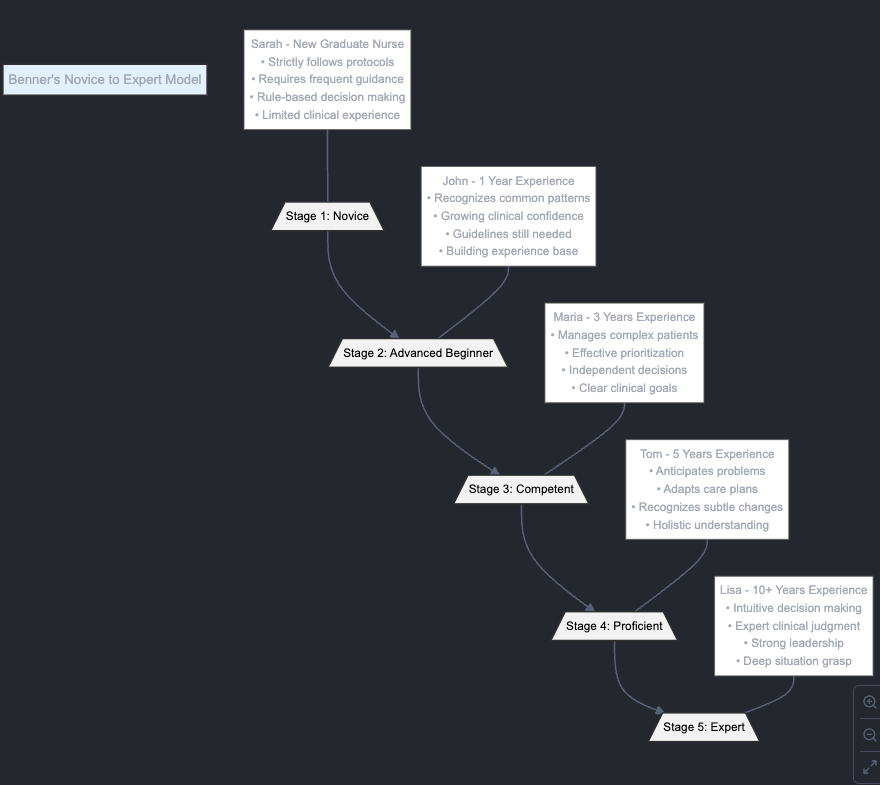
Patricia Benner’s Legacy
The enduring legacy of Patricia Benner extends far beyond the development of the Novice to Expert model. Over several decades, her work has fundamentally influenced how nurses are educated, how professional competence is understood, how clinical judgment is developed, and how healthcare organizations support lifelong learning. Few nurse theorists have had such a broad and lasting impact across nursing education, nursing practice, research, leadership, and healthcare policy.
What makes Patricia Benner’s legacy particularly significant is that her ideas have remained relevant despite major changes in healthcare. Since the publication of From Novice to Expert: Excellence and Power in Clinical Nursing Practice in 1984, nursing has experienced remarkable advances in technology, evidence-based practice, patient safety initiatives, simulation education, and interdisciplinary collaboration. Yet the central message of Benner’s theory—that expertise develops through meaningful clinical experience, reflection, and compassionate patient care—continues to guide professional nursing worldwide.
The influence of Patricia Benner can be seen in virtually every stage of a nurse’s career. Students encounter her developmental framework during their education, new graduate nurses benefit from orientation and residency programs inspired by her work, experienced clinicians apply her concepts when mentoring colleagues, and healthcare leaders use her principles to design competency pathways and professional development programs.
Her contributions also extend beyond individual professional growth. Patricia Benner helped shift the focus of nursing from simply performing technical procedures to developing thoughtful practitioners capable of exercising sound clinical reasoning, ethical decision-making, and holistic patient care. This broader understanding of nursing competence has strengthened both educational standards and the quality of healthcare delivery.
Today, Patricia Benner’s work remains an essential part of nursing literature because it provides a practical framework for preparing nurses to meet the increasingly complex needs of modern healthcare systems.
Influence on Nursing Education
Perhaps no area has been more profoundly influenced by Patricia Benner than nursing education. Her work transformed educational philosophy by demonstrating that professional competence develops through the integration of theoretical knowledge with meaningful clinical practice rather than through classroom instruction alone.
Before the widespread adoption of Benner’s theory, nursing education often emphasized factual knowledge, procedural competence, and technical skills. While these components remain essential, Patricia Benner argued that they represent only part of professional development. She maintained that nurses must also develop the ability to think critically, recognize patterns, exercise sound judgment, and adapt care to each patient’s unique circumstances.
This perspective encouraged educators to redesign learning experiences so that students could progressively build competence through supervised practice, reflection, and increasingly complex clinical responsibilities.
Integration of Theory and Practice
One of Patricia Benner’s greatest educational contributions is the emphasis on integrating classroom learning with direct patient care experiences.
Modern nursing curricula frequently combine:
- Foundational scientific knowledge.
- Skills laboratory instruction.
- Clinical simulation.
- Supervised hospital placements.
- Community health experiences.
- Reflective learning activities.
This integrated approach helps learners understand not only how nursing interventions are performed but also why they are necessary and when they should be modified to meet individual patient needs.
Influence on Curriculum Development
Many schools of nursing have incorporated principles from Patricia Benner’s work into curriculum planning.
Educational programs increasingly emphasize:
- Progressive competency development.
- Experiential learning.
- Case-based instruction.
- Clinical simulation.
- Reflective practice.
- Evidence-based decision-making.
- Professional identity formation.
Rather than expecting students to master every competency immediately, curricula acknowledge that expertise develops gradually throughout a professional career.
The Carnegie Study
One of Patricia Benner’s most influential educational contributions occurred through her leadership of the Carnegie Study, conducted by the Carnegie Foundation for the Advancement of Teaching.
The study examined nursing education across the United States and identified opportunities to strengthen the preparation of future nurses. Its recommendations encouraged educators to integrate three essential dimensions of learning:
- Acquisition of scientific and professional knowledge.
- Development of clinical skills through authentic patient care experiences.
- Formation of professional identity grounded in ethical practice, reflection, and compassionate care.
These recommendations reinforced the educational philosophy already established within Benner’s theory and continue to influence nursing curricula internationally.
Supporting New Graduate Nurses
The transition from student to practicing nurse is widely recognized as one of the most demanding stages of professional development.
Healthcare organizations increasingly use Patricia Benner’s developmental framework when designing transition-to-practice programs for new graduate nurses.
These programs commonly include:
- Extended orientation.
- Clinical mentorship.
- Structured competency assessment.
- Reflective debriefing.
- Gradually increasing patient assignments.
- Ongoing professional coaching.
By recognizing that newly licensed nurses remain in the early stages of professional development, these initiatives improve confidence, reduce transition-related stress, and promote patient safety.
Example
A hospital implementing a year-long nurse residency program may gradually increase patient assignments while pairing new graduates with experienced mentors.
Initially, participants manage stable patients under close supervision. As confidence and competence improve, they begin caring for increasingly complex patients while developing stronger clinical judgment and decision-making skills.
This educational progression closely reflects the developmental principles proposed by Patricia Benner.
Contributions to Nursing Research
In addition to transforming education and practice, Patricia Benner made substantial contributions to nursing scholarship and research. Her work broadened understanding of how nurses think, learn, and develop expertise, while also expanding the use of qualitative research within the nursing profession.
Rather than focusing solely on measurable technical skills, Patricia Benner explored the lived experiences of practicing nurses, examining how professional competence develops through repeated exposure to authentic clinical situations.
Advancing Qualitative Research
Much of Patricia Benner’s scholarship relied on qualitative research methods.
Through interviews, observations, and analysis of clinical narratives, she examined how experienced nurses interpreted patient situations, solved problems, and made decisions in everyday practice.
These methods provided valuable insights into complex professional behaviors that are often difficult to measure quantitatively, including:
- Clinical reasoning.
- Pattern recognition.
- Decision-making.
- Ethical practice.
- Professional identity.
- Expert performance.
Her work demonstrated that understanding nursing expertise requires more than evaluating procedural competence alone.
Expanding Nursing Knowledge
Patricia Benner’s research significantly enriched the profession’s understanding of nursing knowledge.
She distinguished between:
- Theoretical knowledge acquired through formal education.
- Practical knowledge developed through clinical experience.
This distinction helped explain why experienced nurses often recognize subtle patient changes that may not yet be reflected in laboratory values or standardized assessment tools.
Her research emphasized that both forms of knowledge are essential for safe and effective patient care.
Influential Publications
Among Patricia Benner’s most influential scholarly works is From Novice to Expert: Excellence and Power in Clinical Nursing Practice, which has become one of the most widely cited books in nursing literature.
The book received significant professional recognition, including Book of the Year honors from the American Journal of Nursing, reflecting its lasting influence on nursing scholarship.
In addition to this landmark publication, Patricia Benner authored and co-authored numerous books, research articles, and educational resources exploring topics such as:
- Clinical competence.
- Professional ethics.
- Clinical judgment.
- Caring in nursing.
- Professional development.
- Healthcare education.
- Expertise in nursing practice.
These publications continue to inform educators, researchers, clinicians, and healthcare leaders worldwide.
Influence on Future Research
The work of Patricia Benner inspired generations of nursing researchers to investigate:
- Professional competency development.
- Clinical decision-making.
- Reflective practice.
- Nursing expertise.
- Patient safety.
- Professional identity formation.
- Educational innovation.
Many contemporary studies examining simulation education, mentorship, residency programs, and competency assessment continue building upon concepts originally introduced by Patricia Benner.
Recognition Among Nurse Theorists
Among the many influential nurse theorists, Patricia Benner occupies a distinctive position because her work successfully bridged theory and practice. While numerous nursing models provide valuable conceptual frameworks, Benner’s theory gained exceptional recognition because nurses could readily apply its principles within everyday clinical environments.
Her contributions have earned widespread respect from educators, researchers, healthcare organizations, and professional associations across the world.
Recognition Within the Nursing Profession
Throughout her career, Patricia Benner has received numerous honors acknowledging her contributions to nursing scholarship and professional practice.
Among the most notable recognitions are:
- Induction as a Fellow of the American Academy of Nursing, one of the profession’s highest honors.
- Appointment as Professor Emerita after her distinguished academic career.
- International recognition for advancing nursing education and professional development.
- Leadership roles in major educational and research initiatives.
- Multiple awards recognizing contributions to nursing scholarship and healthcare improvement.
These achievements reflect the profession’s recognition of her lasting influence.
International Influence
Although Patricia Benner developed her theory within the United States, its influence extends internationally.
Educational institutions, healthcare organizations, and professional bodies around the world continue incorporating Benner’s model into:
- Clinical competency frameworks.
- Orientation programs.
- Leadership development.
- Curriculum planning.
- Professional advancement pathways.
Organizations such as the Royal College of Nursing have also recognized the importance of competency development, reflective practice, and lifelong learning—principles closely aligned with Patricia Benner’s work.
Influence Alongside Other Nurse Theorists
Within the history of nursing theories, Patricia Benner is frequently discussed alongside influential figures such as:
- Virginia Henderson, who emphasized the nurse’s role in promoting patient independence.
- Dorothea Orem, known for the Self-Care Deficit Nursing Theory.
- Jean Watson, recognized for the Theory of Human Caring.
- Imogene King, whose Goal Attainment Theory focuses on nurse-patient interactions.
- Sister Callista Roy, developer of the Adaptation Model.
While these theorists explored different dimensions of nursing, Patricia Benner made a unique contribution by explaining how nurses themselves develop expertise over time. Rather than concentrating solely on patient needs or nursing interventions, she examined the professional growth of the nurse and the cognitive processes underlying expert practice.
Continuing Influence in Modern Healthcare
Today, Patricia Benner’s ideas remain deeply embedded within modern healthcare systems.
Healthcare organizations continue using her developmental framework to:
- Design nurse residency programs.
- Structure clinical ladder systems.
- Support continuing professional development.
- Evaluate competency progression.
- Develop leadership programs.
- Improve patient safety initiatives.
- Strengthen mentorship and preceptorship.
This continued application demonstrates the enduring practical value of Benner’s theory.
Conclusion
Patricia Benner transformed the nursing profession by providing a practical framework that explains how nurses develop competence, confidence, and expertise throughout their careers. Through her Novice to Expert model, she demonstrated that becoming an exceptional nurse is not simply a matter of acquiring theoretical knowledge or accumulating years of experience. Instead, expertise emerges through the continuous integration of education, clinical experience, reflective practice, and compassionate patient care. This perspective has fundamentally changed how healthcare organizations, educators, and clinicians understand professional development within nursing practice.
One of the enduring strengths of Patricia Benner’s work is its ability to bridge theory and practice. Her model illustrates that nursing competence evolves gradually through real-world patient encounters, where knowledge is refined, clinical judgment is strengthened, and clinical reasoning becomes increasingly sophisticated. By recognizing the developmental journey from novice to expert nurse, Benner’s theory provides realistic expectations for professional growth while encouraging lifelong learning and continuous improvement.
Beyond its influence on individual practitioners, Patricia Benner’s contributions have reshaped nursing education, competency assessment, mentorship programs, and leadership development across healthcare systems worldwide. Her emphasis on experiential learning, the primacy of caring, and the importance of clinical wisdom continues to guide the preparation of future nurses and supports experienced professionals in adapting to increasingly complex healthcare environments.
As modern healthcare continues to evolve through technological advancements, evidence-based practice, and changing patient needs, the principles established by Patricia Benner remain highly relevant. Nurses today are expected not only to perform technical procedures competently but also to think critically, communicate effectively, make sound clinical decisions, and deliver compassionate, patient-centered care. The Novice to Expert framework provides a roadmap for achieving these goals by recognizing that professional excellence is developed through continuous learning, reflection, and meaningful clinical practice.
Ultimately, Patricia Benner’s legacy extends far beyond the creation of a single nursing theory. Her work has provided generations of nurses with a deeper understanding of how expertise develops, why experience matters, and how reflective practice transforms knowledge into professional excellence. As one of the most influential nurse theorists in modern nursing, Patricia Benner continues to inspire educators, researchers, healthcare leaders, and practicing nurses to pursue lifelong growth, strengthen patient care, and uphold the highest standards of the nursing profession.
Frequently Asked Questions
What is Patricia Benner’s theory of nursing?
Patricia Benner’s theory of nursing, known as the Novice to Expert Theory, explains how nurses develop clinical competence through education, experience, and reflective practice. Adapted from the Dreyfus Model of Skill Acquisition, the theory proposes that nurses progress through five levels of proficiency as they gain clinical experience, improving their clinical judgment, decision-making, and ability to provide safe, individualized patient care.
What are the 5 stages in Benner’s model?
The five stages in Patricia Benner’s Novice to Expert model are:
- Novice – Has little or no clinical experience and relies on rules, guidelines, and supervision.
- Advanced Beginner – Begins recognizing recurring clinical situations but still needs support with complex patient care.
- Competent – Typically has several years of experience in the same clinical area and can prioritize, plan, and manage patient care effectively.
- Proficient – Sees patient situations holistically, anticipates complications, and adapts care based on experience.
- Expert – Demonstrates intuitive clinical judgment, extensive experience, and the ability to make rapid, accurate decisions in complex clinical situations.
What is the Patricia Bernard theory?
The Patricia Bernard theory is likely a mistaken reference to Patricia Benner’s theory. Patricia Benner developed the Novice to Expert Theory, which explains how nurses progress from beginners to experts through experiential learning, clinical experience, and reflective practice. The theory is widely used in nursing education, competency assessment, and professional development.
What was Patricia Benner’s famous quote?
One of Patricia Benner’s most well-known quotes is:
“Experience is not merely the passage of time; it is the refinement of preconceived notions and theory through encounters with many actual practical situations.”
This quote reflects the central idea of her theory—that nursing expertise is developed by combining theoretical knowledge with meaningful clinical experience and reflective practice.
