

Example of Summary Research Paper: Research Summaries, Executive Summary, and Article Summary Guide for Nursing Students
The ability to write a summary of a research paper is a fundamental component of academic writing and evidence-based learning. In healthcare and nursing education, research articles, research reports, and other academic papers form the foundation of clinical decision-making, policy development, and professional practice. Because of this, understanding how to summarize a research paper accurately and effectively is an important skill that supports both academic success and professional growth. A well-developed summary helps readers condense complex information into a concise and organized format while preserving the meaning and integrity of the original paper.
Summary writing involves more than shortening a piece of writing. It requires careful reading, critical thinking, paraphrasing, and the ability to identify the most relevant information from an entire research paper. Rather than copying sentences directly from the original article, effective summarization focuses on presenting the main idea, research question, methods used, statistical analysis, key findings, and conclusions in a clear and logical way. This process allows readers to understand the overview of a research paper without having to read the full research in detail every time.
In academic settings, research paper summaries are commonly used in assignments, literature reviews, evidence-based practice projects, annotated bibliographies, and research discussions. Whether working with a qualitative research study, quantitative research report, or mixed-methods academic article, the ability to write a research summary helps improve comprehension of scholarly material while strengthening analytical and communication skills. Since modern healthcare relies heavily on good research and effective research utilization, summarization has become an essential part of learning how to interpret and apply scientific evidence responsibly.
A summary of a research paper generally serves several important purposes, including:
- Providing a concise overview of a research study
- Summaries condense research findings into a shorter format that is easier to understand.
- They help readers quickly identify the purpose, methods, and outcomes of a study.
- They reduce the need to repeatedly read the entire research paper when reviewing information.
- Highlighting the main points of an academic article
- A good summary identifies the central argument or hypothesis of the original paper.
- It presents supporting details and key findings without unnecessary information.
- It captures the overall meaning of the research article while maintaining brevity.
- Supporting academic writing and critical analysis
- Summary writing improves reading comprehension and analytical thinking.
- It helps writers evaluate the strengths and limitations of a research study.
- It encourages proper paraphrasing and reduces the likelihood of plagiarism.
- Improving communication of research findings
- Summaries make complex academic papers more accessible.
- They allow important healthcare information to be communicated efficiently.
- They provide a stand-alone document that presents the major points of a study clearly and logically.
Although many people use the terms article summary, research paper summary, and executive summary interchangeably, these forms of writing are not exactly the same. Each serves a different purpose and may vary in structure, word count, depth, and intended audience. For example:
- A research article summary focuses on condensing the important information presented in an academic article.
- An executive summary provides a professional overview of a research report or project and is often written for administrators, faculty members, policymakers, or organizational leaders.
- A research paper summary generally presents the main idea, research question, methods used, and key findings of a study in a concise academic format.
Understanding these distinctions is essential when learning how to write a research paper summary effectively. Choosing the correct format ensures that the summary matches the assignment requirements and communicates information appropriately.
Writing an effective summary also requires strong organizational and language skills. A well-written summary should:
- Present accurate information from the original article
- Maintain clarity and logical flow
- Use concise and objective language
- Include relevant information without excessive detail
- Avoid personal opinions unless specifically requested
- Demonstrate effective paraphrasing techniques
- Reflect the meaning of the original paper faithfully
At the same time, there are several common mistakes that can weaken the quality of a summary. These include:
- Copying sentences directly from the source and plagiarizing content
- Including too many supporting details instead of focusing on key points
- Misinterpreting the research findings or hypothesis
- Omitting important information such as methods used or conclusions
- Writing unclear or disorganized paragraphs
- Failing to proofread the first draft before submission
Learning how to summarize effectively therefore involves much more than shortening information. It requires the ability to read the paper critically, make notes, identify major points, condense research summaries accurately, and communicate ideas in a coherent and academically appropriate manner. In many cases, summarization also involves reviewing data analysis methods, understanding the tools used in a study, and evaluating how the research findings contribute to broader healthcare knowledge.
This guide provides a comprehensive overview of summary writing and research paper summaries. It explores the structure of academic articles, explains how to identify the main idea and research question, and outlines the step-by-step process used to write a research paper summary. The discussion also examines paraphrasing strategies, writing an executive summary, summary templates, proofreading techniques, and practical writing tips that improve clarity, accuracy, and conciseness.
By developing strong summarization skills, readers become better equipped to analyze academic papers, interpret effective research, and communicate complex information clearly. More importantly, understanding how to create a good summary strengthens the ability to engage with scholarly evidence thoughtfully and responsibly in both academic and professional settings.
Understanding Research Summaries and Academic Summary Writing
Research summaries are an essential part of academic writing because they help readers condense large amounts of scholarly information into a concise and organized format. In healthcare education and professional practice, individuals are expected to read academic papers regularly, interpret research findings accurately, and communicate the major points of a research study clearly. Since modern nursing and healthcare rely heavily on evidence-based practice, understanding how to summarize a research paper has become an important skill that supports critical thinking, professional communication, and effective research utilization.
Academic summary writing is not simply about shortening an original paper. Instead, it involves carefully analyzing the entire research paper, identifying the main idea and supporting details, and presenting the information in a clear and logical manner using one’s own words. A well-written summary allows readers to understand the purpose, methods used, statistical analysis, and key findings of a research article without reviewing every section of the full research document.
Research paper summaries are commonly used in:
- Literature reviews
- Evidence-based practice assignments
- Nursing research courses
- Clinical case discussions
- Annotated bibliographies
- Research presentations
- Healthcare policy evaluations
- Academic article critiques
Because academic writing emphasizes clarity, objectivity, and accuracy, summary writing requires strong reading comprehension, paraphrasing abilities, and organizational skills. Writers must determine which information is most relevant while maintaining brevity and avoiding plagiarism.
What Is a Summary of a Research Paper?
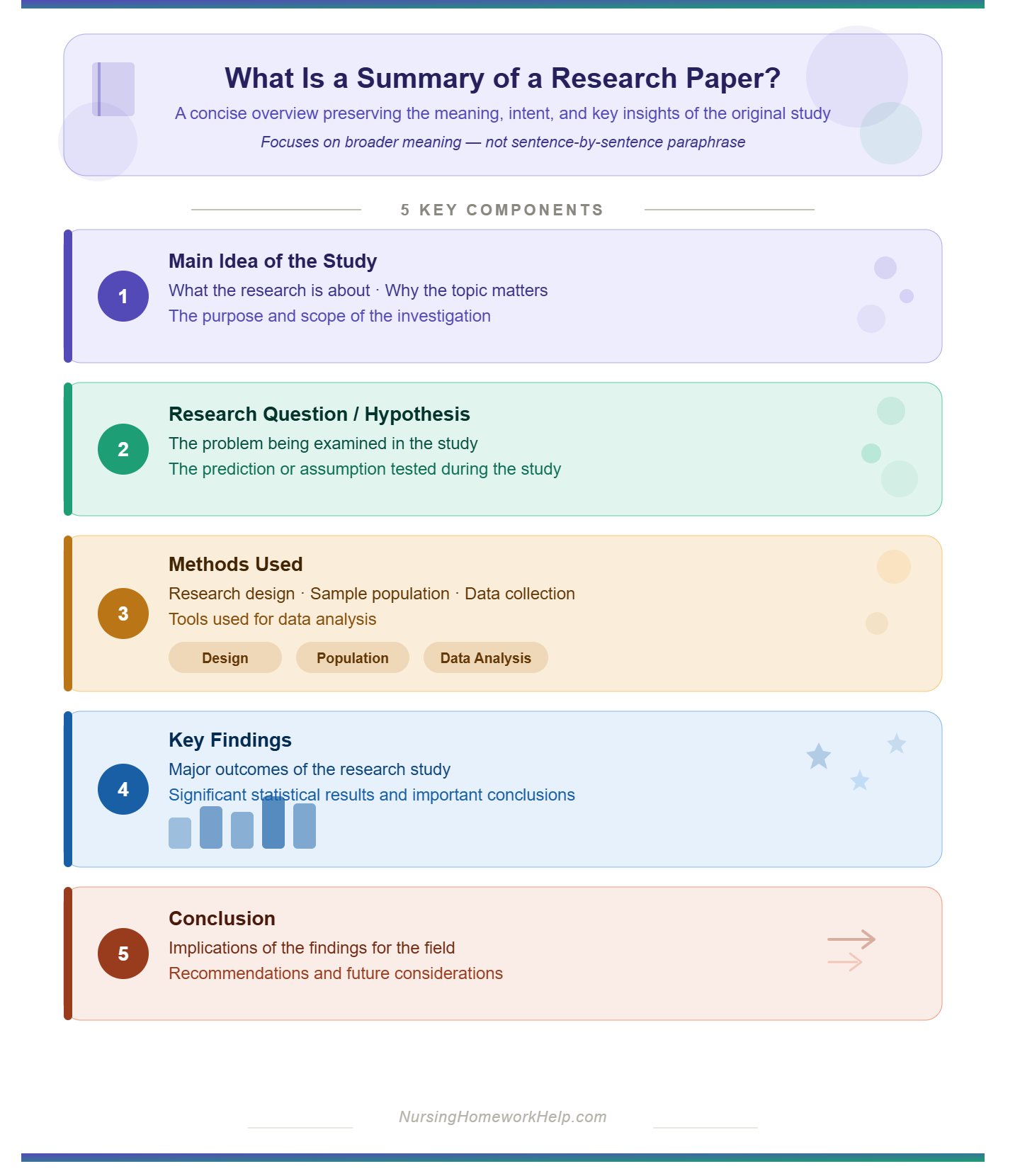
A summary of a research paper is a shortened version of an academic article or research report that presents the central ideas, research question, hypothesis, methods used, major points, and conclusions of the original paper. The purpose of summarization is to provide readers with an overview of a research paper while preserving the meaning and intent of the original article.
Unlike a simple paraphrase of individual sentences, a research paper summary focuses on the broader meaning of the research study as a whole. It condenses research summaries into a stand-alone document that communicates the most important information in a concise and organized format.
A research paper summary typically includes:
- The main idea of the study
- What the research study is about
- Why the topic is important
- The purpose of the investigation
- The research question or hypothesis
- The problem being examined
- The prediction or assumption tested during the study
- Methods used
- Research design
- Sample population
- Data collection procedures
- Tools used for data analysis methods
- Key findings
- Major outcomes of the research
- Significant statistical analysis results
- Important conclusions drawn from the study
- The conclusion
- Implications of the findings
- Recommendations or future considerations
For example, imagine an original article examining whether hourly patient rounding reduces fall rates in hospitalized older adults. Instead of rewriting every paragraph from the academic article, the summary would condense the information into a concise explanation such as:
A research study investigated the effectiveness of hourly rounding in reducing patient falls among older adults in medical-surgical units. Using a quantitative research design, the researchers compared fall rates before and after implementing hourly nurse rounding protocols. Statistical analysis showed a significant reduction in patient falls following implementation, suggesting that structured rounding may improve patient safety outcomes.
This example demonstrates how a summary captures the main points of an entire research paper without including unnecessary supporting details.
A good summary should not:
- Include personal opinions unless requested
- Copy large sections from the original paper
- Overemphasize minor details
- Misrepresent the research findings
- Change the meaning of the research article
Instead, the goal is to summarize a research paper accurately, objectively, and concisely.
Purpose of Research Summaries in Nursing Education
Research summaries serve several important functions in nursing education and healthcare training. Since nursing practice depends heavily on effective research and evidence-based decision-making, healthcare professionals must understand how to interpret academic papers and communicate research findings clearly.
One major purpose of research paper summaries is to simplify complex academic information. Many healthcare research articles contain technical terminology, detailed statistical analysis, and extensive discussions of methods used. Summarization helps condense the full research into a format that is easier to review and understand.
Research summaries are especially valuable because they help:
Improve Understanding of Research Literature
Writing a research summary requires readers to:
- Read the paper critically
- Identify the main idea
- Recognize major points
- Analyze supporting details
- Interpret research findings logically
This process strengthens comprehension of academic articles and improves the ability to evaluate good research effectively.
Support Evidence-Based Practice
Evidence-based nursing relies on the integration of:
- Current research evidence
- Clinical expertise
- Patient preferences
Healthcare professionals frequently review research article summaries and research reports to stay informed about new treatment approaches, safety interventions, and healthcare policies. A concise overview of a research paper helps practitioners apply relevant information efficiently in clinical settings.
For example:
- A nurse manager may review an executive summary about infection prevention strategies before implementing new unit protocols.
- A nursing student completing a literature review may summarize multiple academic papers examining pain management interventions.
Strengthen Academic Writing Skills
Summary writing improves several academic writing abilities, including:
- Paraphrasing
- Organization
- Clarity
- Conciseness
- Logical paragraph development
- Objective communication
Because summarization requires writers to rewrite information using their own words, it also helps reduce plagiarism and encourages stronger critical thinking skills.
Prepare for Advanced Research Activities
Learning how to write a research paper summary prepares individuals for more advanced forms of academic writing, including:
- Literature reviews
- Research proposals
- Evidence-based practice projects
- Case study analyses
- Research critiques
Many writing center resources also emphasize summary writing because it forms the foundation for higher-level scholarly work.
Difference Between a Research Paper Summary, Research Article Summary, and Executive Summary
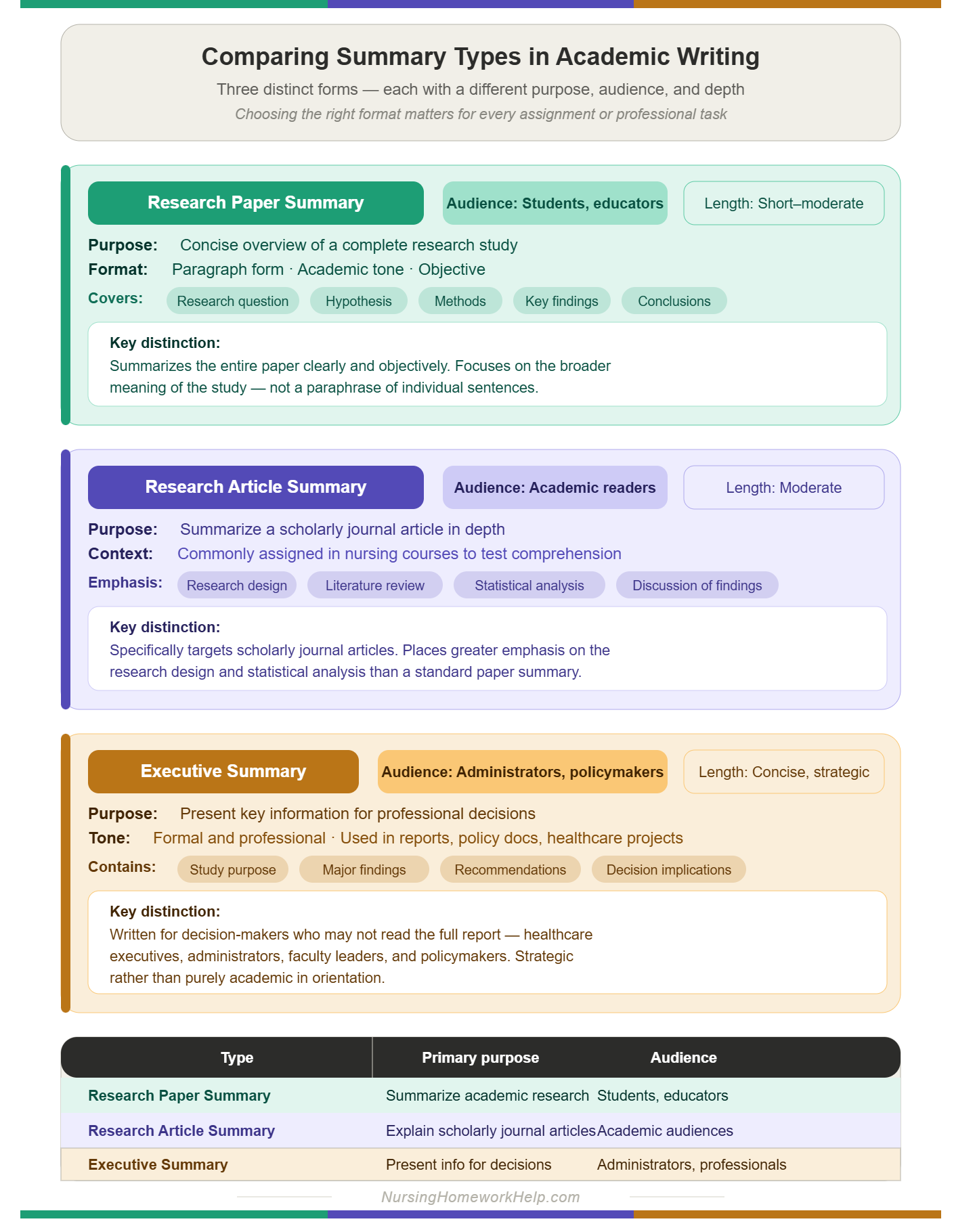
Although the terms research paper summary, research article summary, and executive summary are closely related, they are not identical. Each form of writing serves a different purpose and may vary in structure, audience, depth, and word count.
Research Paper Summary
A research paper summary provides a concise overview of a complete research study. It focuses on:
- The research question
- Hypothesis
- Methods used
- Key findings
- Conclusions
The goal is to summarize the entire research paper clearly and objectively.
Common Features:
- Usually written in paragraph format
- Concise but informative
- Academic tone
- Focus on summarization rather than critique
Research Article Summary
A research article summary specifically focuses on summarizing an academic article published in a scholarly journal. It may place greater emphasis on:
- Research design
- Literature review
- Statistical analysis
- Discussion of findings
Research article summaries are commonly assigned in nursing courses to evaluate comprehension of scholarly literature.
Executive Summary
An executive summary is more formal and professional in tone. It is commonly included in:
- Research reports
- Policy documents
- Healthcare improvement projects
- Organizational studies
Writing an executive summary involves presenting:
- The purpose of the research
- Major findings
- Recommendations
- Implications for decision-making
Unlike standard research summaries, executive summaries are often written for administrators, faculty leaders, healthcare executives, or policymakers who may not read the entire research report.
Example Comparison
| Type | Primary Purpose | Audience | Length |
|---|---|---|---|
| Research Paper Summary | Summarize academic research | Students, educators | Short to moderate |
| Research Article Summary | Explain scholarly journal articles | Academic audiences | Moderate |
| Executive Summary | Present key information for decisions | Administrators, professionals | Concise but strategic |
Understanding these distinctions helps writers choose the correct structure and writing style for a specific assignment or professional purpose.
Characteristics of a Good Summary
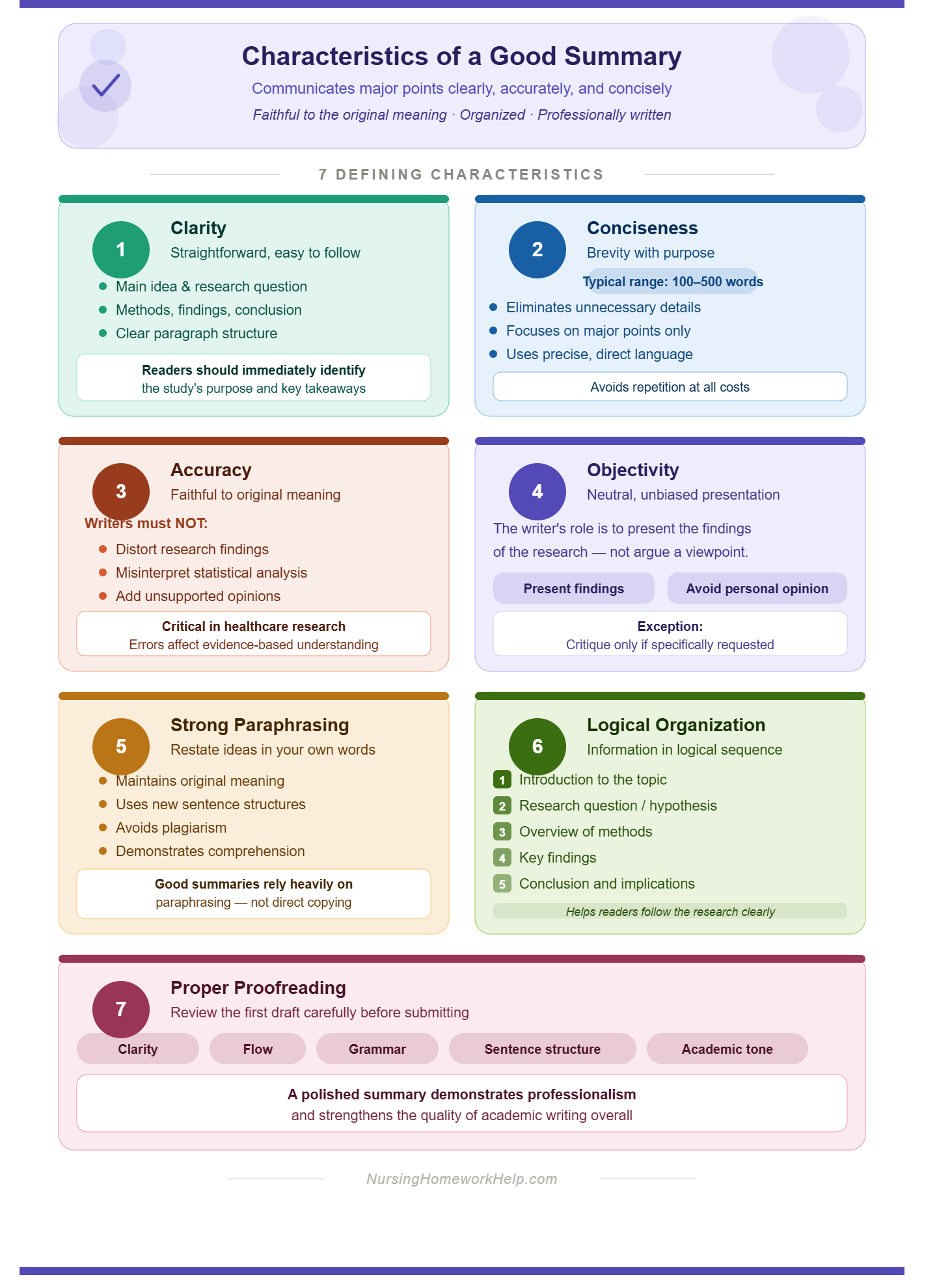
A good summary communicates the major points of an original article clearly, accurately, and concisely while remaining faithful to the meaning of the research study. Effective summary writing requires careful organization, strong paraphrasing skills, and attention to relevant information.
Several characteristics define a well-written summary.
Clarity
A summary should present information in a straightforward and understandable manner. Readers should easily identify:
- The main idea
- Research question
- Methods used
- Key findings
- Conclusion
Clear paragraph structure improves readability and logical flow.
Conciseness
One of the primary goals of summarization is brevity. Most summaries range between 100-500 words depending on assignment requirements and word count expectations.
A concise summary:
- Eliminates unnecessary details
- Focuses on major points
- Avoids repetition
- Uses precise language
Accuracy
An effective summary reflects the meaning of the original paper correctly. Writers should not:
- Distort research findings
- Misinterpret statistical analysis
- Add unsupported opinions
- Omit critical information
Accuracy is especially important when summarizing healthcare research because incorrect interpretation can affect evidence-based understanding.
Objectivity
A research paper summary should remain objective unless evaluation or critique is specifically requested. The writer’s role is to present the findings of the research study rather than argue personal viewpoints.
Strong Paraphrasing
Good summaries rely heavily on paraphrasing instead of copying sentences directly from the original article. Effective paraphrasing:
- Maintains the original meaning
- Uses new sentence structures
- Avoids plagiarizing
- Demonstrates comprehension of the research
Logical Organization
An organized summary presents information in a logical sequence. Most summaries follow this structure:
- Introduction to the research topic
- Explanation of the research question or hypothesis
- Overview of methods used
- Summary of key findings
- Final conclusion or implications
This structure helps readers understand the overview of a research clearly and efficiently.
Proper Proofreading
Even strong summaries can lose effectiveness if they contain grammar, spelling, or formatting errors. Writers should always proofread the first draft carefully to improve:
- Clarity
- Flow
- Grammar
- Sentence structure
- Academic tone
A polished and well-written summary demonstrates professionalism and strengthens the quality of academic writing overall
Understanding a Research Paper Before You Summarize
Before attempting to write a summary of a research paper, it is important to fully understand the original paper and its purpose. Many difficulties associated with summary writing occur because readers attempt to summarize a research paper too quickly without carefully analyzing the academic article first. A good summary depends on strong comprehension of the research study, including its main idea, research question, methods used, statistical analysis, supporting details, and research findings.
Research papers are often detailed and highly structured academic documents designed to communicate effective research in a systematic manner. Unlike casual forms of writing, academic papers contain technical language, data analysis methods, literature review sections, and formal discussions of research findings. Because of this complexity, summarization requires more than identifying a few sentences or copying selected paragraphs. Writers must understand how the entire research paper is organized and how different sections contribute to the overall meaning of the study.
Reading a research article effectively involves:
- Identifying the central purpose of the study
- Recognizing the hypothesis or research question
- Understanding the methods used
- Interpreting the key findings
- Distinguishing major points from minor supporting details
- Evaluating the relevance of the information presented
When readers fail to understand the structure of a research study, their summaries often become disorganized, inaccurate, or incomplete. Some may focus too heavily on statistical analysis while ignoring the broader overview of a research paper. Others may include excessive details from the literature review without identifying the main idea or major findings.
Understanding the original article before summarization improves:
- Accuracy of information
- Clarity of summary writing
- Ability to paraphrase effectively
- Organization of ideas
- Overall academic writing quality
For example, consider a research article investigating the relationship between nurse staffing levels and patient outcomes. A reader who only skims the abstract may incorrectly assume the study focuses solely on nurse burnout. However, a careful reading of the entire research paper may reveal that the primary research question examines how staffing ratios influence patient mortality rates and hospital-acquired infections. Without understanding the full context of the study, it becomes difficult to write a research summary that accurately reflects the purpose and conclusions of the research.
Proper preparation before writing also helps readers condense research summaries more effectively. Instead of becoming overwhelmed by lengthy academic papers, individuals can break the research article into smaller sections, make notes, identify key points, and organize relevant information logically before beginning the first draft.
Identifying the Main Idea, Research Question, and Key Findings
One of the most important steps in summarization is identifying the central focus of the research study. Every academic article is built around a primary idea or problem the researchers aim to investigate. Understanding this focus allows writers to summarize a research paper clearly and accurately.
Identifying the Main Idea
The main idea refers to the central concept or purpose of the research paper. It explains what the study is primarily about and why the research was conducted.
In many academic papers, the main idea can be found in:
- The title
- Introduction section
- Problem statement
- Purpose statement
- Research objectives
For example:
Research Title:
“Effects of Nurse-Led Patient Education on Diabetes Self-Management”
Main Idea:
The study examines whether nurse-led education improves diabetes self-management outcomes among patients.
A common mistake in summary writing is confusing supporting details with the main idea. Supporting details provide evidence, explanations, or examples, but they are not the primary focus of the research study.
Example of Main Idea vs Supporting Details
| Component | Example |
|---|---|
| Main Idea | Nurse-led education improves diabetes self-management |
| Supporting Details | Blood glucose monitoring rates, dietary adherence, patient satisfaction scores |
A good summary focuses primarily on the main idea and major points rather than excessive minor details.
Identifying the Research Question
The research question defines the specific issue or problem the study seeks to answer. It guides the entire research process and influences:
- Study design
- Data collection
- Statistical analysis
- Interpretation of results
Research questions are often introduced in:
- The introduction
- Literature review
- Purpose statement
- Hypothesis section
Example Research Question:
“Does hourly rounding reduce patient fall rates in medical-surgical units?”
Understanding the research question is essential because it helps readers:
- Understand the purpose of the study
- Identify relevant information
- Determine which findings are most important
- Organize the summary logically
Without recognizing the research question, writers may struggle to condense research summaries effectively or may include unrelated information from the original paper.
Understanding the Hypothesis
In quantitative academic papers, researchers often include a hypothesis, which is a prediction about the expected relationship between variables.
Example Hypothesis:
“Patients receiving hourly rounding will experience fewer falls compared to patients receiving standard care.”
The hypothesis provides direction for:
- Methods used
- Statistical analysis
- Interpretation of research findings
Although not every summary must explain the hypothesis in detail, understanding it helps readers interpret the entire research paper more accurately.
Identifying Key Findings
Key findings represent the most important outcomes of the research study. These findings explain what the researchers discovered after conducting the study and analyzing the data.
Key findings are commonly located in:
- Results sections
- Discussion sections
- Conclusion sections
- Executive summary sections
For example:
- Reduced infection rates
- Improved medication adherence
- Increased patient satisfaction
- Lower hospital readmission rates
When summarizing research findings, writers should focus on:
- Major outcomes
- Significant patterns
- Important conclusions
- Clinical implications
A common mistake is including every numerical result or statistical detail from the original article. Effective summary writing focuses on the broader meaning of the findings rather than overwhelming readers with unnecessary data.
Understanding Research Methods and Study Results
To summarize a research paper effectively, it is also necessary to understand how the study was conducted. The methods used in a research study determine the reliability and validity of the research findings.
Research methods explain:
- How data was collected
- Who participated in the study
- Which tools used for measurement
- How statistical analysis was performed
- How conclusions were reached
Understanding research methods helps writers evaluate:
- The quality of the research
- The relevance of the findings
- The credibility of the conclusions
Common Research Methods in Academic Papers
Quantitative Research
Quantitative studies focus on numerical data and statistical analysis.
Examples include:
- Surveys
- Experimental studies
- Randomized controlled trials
Example:
A study measuring whether bedside shift reporting improves patient satisfaction scores.
Qualitative Research
Qualitative research explores experiences, opinions, or perceptions using non-numerical data.
Methods may include:
- Interviews
- Focus groups
- Observations
Example:
A research study exploring nurses’ experiences with workplace burnout.
Mixed-Methods Research
Mixed-methods studies combine quantitative and qualitative approaches to provide a broader overview of a research problem.
Understanding Study Results
Study results explain what researchers discovered after analyzing the collected data.
Readers should focus on:
- Significant outcomes
- Trends or patterns
- Whether the hypothesis was supported
- Clinical or academic implications
For example:
Research Finding:
“Implementation of hourly rounding reduced patient falls by 35% over six months.”
In a concise summary, the writer does not need to include every table, graph, or numerical calculation. Instead, the goal is to communicate the most important research findings clearly and accurately.
Important Sections of a Research Article to Focus On
Most academic articles follow a predictable structure. Understanding these sections makes it easier to read the paper critically and organize a summary logically.
Several sections deserve special attention during summarization.
Title
The title often reveals:
- The main idea
- Population studied
- Research topic
Example:
“Effects of Simulation Training on Nursing Students’ Clinical Confidence”
Abstract
The abstract provides a concise overview of a research paper, including:
- Purpose
- Methods used
- Key findings
- Conclusions
Although helpful, the abstract alone is usually insufficient for writing a complete research paper summary.
Introduction
The introduction explains:
- Background information
- Importance of the topic
- Research question
- Purpose of the study
Literature Review
The literature review discusses previous academic papers and good research related to the topic.
This section helps readers:
- Understand the context of the study
- Identify knowledge gaps
- Recognize why the research matters
Methods Section
The methods section explains:
- Research design
- Sample population
- Data analysis methods
- Tools used
- Procedures followed
Understanding this section improves accuracy during summarization.
Results Section
This section presents:
- Statistical analysis
- Major findings
- Tables and charts
- Outcome measurements
Writers should focus on the most relevant information instead of copying every statistic.
Discussion and Conclusion
These sections explain:
- Interpretation of findings
- Implications of the study
- Recommendations for practice or future research
The conclusion often helps summarize the overall significance of the research study.
Common Mistakes Students Make When Reading Research Papers
Many readers struggle with academic papers because research articles are often lengthy, technical, and information-dense. Several common mistakes can weaken comprehension and reduce the quality of research paper summaries.
Reading Too Quickly
Some readers skim the original article without fully understanding the main idea or research question. This often leads to inaccurate summaries.
Better Approach:
- Read slowly
- Highlight key points
- Make notes while reading
Focusing on Minor Details
Another common mistake is emphasizing supporting details instead of major points.
For example:
- Listing every numerical result
- Including unnecessary statistical analysis
- Repeating background information excessively
A good summary prioritizes concise explanation of the most important findings.
Ignoring Research Methods
Failing to understand methods used may result in:
- Misinterpretation of findings
- Weak analysis
- Incomplete summaries
Readers should always examine how the study was conducted before summarization.
Copying Directly From the Original Paper
Some writers plagiarize unintentionally by copying phrases or sentences from the original article.
Effective paraphrasing is essential in academic writing because it demonstrates comprehension while preserving academic integrity.
Not Understanding Technical Terminology
Research articles frequently include:
- Clinical terminology
- Statistical language
- Specialized concepts
Readers should consult:
- Writing center resources
- Academic dictionaries
- Course materials
- Instructors or faculty guidance
when unfamiliar terms appear.
Skipping the Proofreading Process
Failing to proofread the first draft may result in:
- Grammar mistakes
- Missing information
- Poor paragraph structure
- Weak organization
Proofreading improves clarity, coherence, and professionalism in summary writing.
Step-by-Step Process to Write a Research Paper Summary
Writing a research paper summary requires a structured and systematic approach to ensure clarity, accuracy, and conciseness. Rather than attempting to condense the entire research study in one sitting, effective summary writing follows a step-by-step process that begins with careful reading of the original research article and ends with revising and finalizing a well-organized summary. Each stage plays a critical role in ensuring the final piece of writing accurately reflects the main idea, research question, methods used, and key findings of the original paper while maintaining brevity and coherence.
A well-developed research summary is not simply a shortened version of an academic article. It is a carefully constructed stand-alone document that captures the essence of the entire research paper in a concise and organized format. This process requires strong academic writing skills, including summarization, paraphrasing, critical reading, and logical organization of ideas.
Reading and Analyzing the Original Research Article
The first step in writing a research paper summary is thoroughly reading and analyzing the original article. This step is essential because misunderstanding the original research study leads to inaccurate or incomplete summaries.
Instead of reading the paper once, effective summarization involves multiple readings:
1. First Reading: General Understanding
During the first reading, the goal is to understand the overall overview of a research paper, including:
- The general topic of the research article
- The main idea of the research study
- The purpose of the research paper
- The general structure of the academic article
At this stage, readers should not focus on details but on gaining a broad understanding of the entire research.
2. Second Reading: Detailed Analysis
The second reading focuses on deeper analysis of the research article. This includes:
- Identifying the research question
- Understanding the hypothesis (if present)
- Noting the methods used
- Recognizing key findings and results
- Highlighting supporting details and major points
Example:
If a research article examines the effectiveness of nurse-led wound care interventions, the second reading would focus on:
- What intervention was used
- Who participated in the study
- What data analysis methods were applied
- What outcomes were measured (e.g., wound healing rates, infection reduction)
3. Active Reading Techniques
To improve understanding of the original paper, readers should:
- Highlight important information
- Underline key points
- Make notes in margins or notebooks
- Identify subheadings and section headings
- Write short summaries of each section
This process ensures that relevant information is clearly identified before writing begins.
Extracting and Organizing Important Information
After reading the research article, the next step is extracting and organizing important information. This stage is crucial for condensing research summaries effectively and avoiding confusion during the writing process.
Identifying Relevant Information
The goal is to separate:
- Major points from minor details
- Key findings from supporting explanations
- Research methods from background information
Important information usually includes:
- Research question
- Hypothesis
- Study design
- Sample population
- Methods used
- Tools used for data collection
- Statistical analysis
- Key findings
- Conclusions
Making Effective Notes
A structured note-taking system helps organize information logically before writing the first draft.
Example Note Format:
- Main Idea: Nurse-led education improves diabetes self-management
- Research Question: Does nurse education improve patient adherence?
- Methods Used: Quantitative study, surveys, 120 participants
- Key Findings: Improved blood sugar control and medication adherence
- Conclusion: Nurse-led education is effective in chronic disease management
This method simplifies complex academic papers into manageable sections that can later be transformed into a research summary.
Organizing Information Logically
Once notes are made, they should be arranged in a logical order:
- Main idea
- Research question
- Methods used
- Key findings
- Conclusion
This structure forms the foundation for a clear and well-written summary.
Writing the First Draft of a Research Summary
The first draft is where extracted information is transformed into a coherent piece of academic writing. At this stage, perfection is not required; the focus is on organizing ideas into sentences and paragraphs.
A first draft should:
- Present ideas in a logical sequence
- Use paraphrasing instead of copying the original article
- Maintain clarity and academic tone
- Focus on brevity and relevance
- Avoid unnecessary details
Example First Draft Structure
The research study examined the impact of nurse-led education on diabetes self-management. The research question focused on whether structured patient education improves adherence to treatment plans. A quantitative research design was used, involving 120 participants. Data was collected through surveys and analyzed using statistical analysis methods. The key findings showed improved blood glucose control and medication adherence among patients who received nurse-led education. The study concluded that nurse-led education is effective in improving chronic disease management outcomes.
This example demonstrates how a full research paper can be condensed into a concise summary while maintaining accuracy and meaning.
Key Considerations During the First Draft
When writing the first draft, writers should focus on:
- Using clear and concise language
- Avoiding repetition
- Including only relevant information
- Ensuring logical flow between sentences
- Maintaining objectivity
Structuring the Introduction, Body Paragraph, and Conclusion
A well-organized research paper summary follows a clear structure that improves readability and ensures all important information is included. Proper structure also enhances the effectiveness of summary writing in academic settings.
Introduction
The introduction of a research summary should:
- Present the main idea of the research study
- Introduce the research topic
- State the research question or purpose
- Briefly mention the significance of the study
Example:
This research paper examines the effectiveness of nurse-led interventions in improving patient outcomes in chronic disease management.
Body Paragraph
The body paragraph contains the core content of the summary and should include:
- Methods used in the study
- Sample population
- Data collection techniques
- Statistical analysis methods
- Key findings and results
Example:
The study used a quantitative research design involving 120 patients diagnosed with diabetes. Data was collected through structured surveys and analyzed using statistical analysis methods to measure changes in medication adherence and blood glucose control.
The body paragraph should focus on:
- Concise explanation
- Logical flow of ideas
- Clear presentation of key points
- Avoiding unnecessary supporting details
Conclusion
The conclusion section should:
- Summarize the key findings
- Highlight the significance of the research
- Present final interpretations or implications
Example:
The findings suggest that nurse-led education significantly improves diabetes self-management outcomes, indicating its importance in chronic disease care strategies.
A strong conclusion reinforces the main message of the research summary without introducing new information.
Revising and Finalizing Research Paper Summaries
The final step in writing a research paper summary is revising and refining the draft to ensure clarity, accuracy, and professionalism. This stage is essential for producing a good summary that meets academic standards.
Reviewing Content Accuracy
Writers should verify:
- Whether the main idea is correctly represented
- Whether key findings are accurate
- Whether the research question is clearly stated
- Whether important details are included
Improving Clarity and Conciseness
Revision should focus on:
- Removing unnecessary words
- Simplifying complex sentences
- Ensuring brevity
- Strengthening logical flow
A concise summary improves readability and demonstrates strong academic writing skills.
Paraphrasing and Avoiding Plagiarism
During revision, writers must ensure:
- All content is properly paraphrased
- No direct copying from the original article
- Academic integrity is maintained
- Ideas are expressed in original wording
Proofreading the Final Draft
Proofreading helps eliminate:
- Grammar errors
- Spelling mistakes
- Sentence structure issues
- Formatting inconsistencies
This step ensures the summary is a well-written and professional piece of academic writing.
Final Check Before Submission
Before completing the research summary, writers should confirm:
- The summary reflects the entire research paper accurately
- All major points are included
- The writing is concise and well-structured
- The document follows academic writing standards
- The final piece is clear and easy to understand
How to Paraphrase and Summarize Effectively
Paraphrasing and summarizing are core academic writing skills that directly influence the quality of a research paper summary. In most research articles and academic papers, information is presented using technical language, complex sentence structures, and detailed explanations of research methods, statistical analysis, and key findings. To transform this information into a clear and concise research summary, writers must be able to restate ideas accurately using their own words while preserving the original meaning of the research study.
Effective summarization depends on the ability to combine two key skills:
- Paraphrasing (rewriting ideas in new wording)
- Summarization (condensing entire sections of a research paper into brief, meaningful statements)
When used correctly, these skills allow writers to produce a good summary that is original, accurate, and free from plagiarism while still reflecting the main idea, research question, methods used, and key findings of the original article.
Techniques for Academic Paraphrasing
Academic paraphrasing involves rewriting information from an original research paper using different words and sentence structures without changing the meaning. It is a critical skill in summary writing because it ensures academic integrity and improves clarity in communication.
1. Understand the Original Text Fully
Before paraphrasing, it is essential to read and understand the original research article thoroughly. This includes:
- Identifying the main idea
- Understanding the research question
- Recognizing key findings
- Interpreting methods used and results
If the meaning is not fully understood, paraphrasing may distort the information or lead to incorrect interpretation of the research study.
2. Break Information Into Smaller Units
Long sentences in academic papers should be broken into smaller, manageable parts before rewriting.
Example:
Original:
The research study examined the impact of nurse-led interventions on reducing hospital readmissions among elderly patients with chronic illnesses.
Broken into ideas:
- The study examined nurse-led interventions
- Focus was on hospital readmissions
- Population included elderly patients with chronic illness
This helps in condensing research summaries more effectively.
3. Use Synonyms and Different Vocabulary
Replace key words with appropriate synonyms while maintaining meaning:
- “Investigated” → examined, explored, studied
- “Results” → findings, outcomes
- “Significant” → important, notable
However, technical terms such as research question, hypothesis, or statistical analysis methods should not be changed if they are essential to academic meaning.
4. Change Sentence Structure
Effective paraphrasing involves restructuring sentences:
- Change active to passive voice (or vice versa)
- Rearrange clauses
- Combine or split sentences
Example:
Original:
The study showed that nurse-led education improved patient adherence.
Paraphrased:
Improved patient adherence was observed as a result of nurse-led education in the study.
5. Use Your Own Writing Style
A paraphrased summary should reflect natural academic writing rather than mimicking the original research article. This improves readability and ensures originality in academic writing.
How to Summarize Without Plagiarism
Avoiding plagiarism is essential when writing a research paper summary. Since summaries involve using ideas from an original article, writers must ensure proper paraphrasing and avoid copying text directly.
1. Focus on Understanding, Not Copying
Instead of copying sentences from the original paper, focus on:
- Understanding the main idea
- Identifying major points
- Extracting relevant information
Then rewrite everything in your own words.
2. Do Not Over-Rely on the Original Paper
A common mistake in summary writing is constantly referring back to the original article word-for-word. Instead:
- Read the original paper carefully
- Close the article while writing
- Use notes to guide writing
This reduces the risk of plagiarism.
3. Focus on Key Points, Not Full Sentences
A summary should condense research summaries into shorter explanations:
- Remove unnecessary details
- Avoid long quotations
- Exclude repetitive explanations
Example:
Instead of writing:
The research study demonstrated that nurse-led interventions significantly reduced patient readmission rates in the intervention group compared to the control group over a six-month period.
A summarized version could be:
Nurse-led interventions reduced hospital readmissions over six months.
4. Properly Attribute Ideas When Necessary
Even though summaries are usually written in your own words, academic writing may require citations to the original research article to acknowledge the source.
5. Maintain Academic Integrity
Avoid:
- Copying phrases or paragraphs
- Replacing only a few words in a sentence
- Using online paraphrasing tools without review
- Misrepresenting the original research findings
A good summary reflects ethical academic writing and proper interpretation of a research study.
Maintaining Clarity, Accuracy, and Conciseness
A strong research paper summary must balance three essential qualities:
- Clarity
- Accuracy
- Conciseness (brevity)
These elements ensure the summary is readable, meaningful, and academically acceptable.
Clarity
Clarity means presenting ideas in a simple and understandable way.
To achieve clarity:
- Use short and direct sentences
- Avoid unnecessary academic jargon
- Organize ideas logically
- Ensure smooth transitions between sentences
Example:
Unclear:
The study was conducted in relation to intervention effectiveness outcomes in clinical environments.
Clear:
The study examined whether clinical interventions were effective in improving patient outcomes.
Accuracy
Accuracy ensures that the summary correctly reflects the original research paper without distortion.
To maintain accuracy:
- Do not misinterpret research findings
- Include correct data interpretation
- Reflect the original research question and hypothesis
- Ensure methods used are correctly described
Even a small error in interpreting statistical analysis or research findings can change the meaning of the entire summary.
Conciseness
Conciseness refers to expressing ideas using fewer words while maintaining meaning. This is a key principle in summary writing and is especially important in academic writing.
To improve conciseness:
- Remove redundant phrases
- Avoid repetition of ideas
- Focus on key findings and major points
- Use precise vocabulary
Example:
Wordy:
The research study was conducted in order to find out whether or not nurse-led education programs have any effect on improving patient outcomes.
Concise:
The study examined the effect of nurse-led education on patient outcomes.
A well-written research summary often falls within 100–500 words, depending on assignment requirements, making conciseness essential.
Examples of Effective and Weak Summarization
Understanding the difference between strong and weak summaries helps improve academic writing skills and reduces common errors in summarization.
Example 1: Research Article Summary
Original Idea:
A study found that nurse-led interventions reduced patient falls in hospital settings by 30%.
Weak Summary:
The research study talked about nurses and hospital care and how they did interventions and falls were reduced in hospitals.
Problems:
- Vague language
- Repetition of ideas
- Lack of clarity
- Poor academic structure
Effective Summary:
The study found that nurse-led interventions reduced patient falls in hospital settings by 30%, indicating improved patient safety outcomes.
Strengths:
- Clear and concise
- Includes key finding
- Maintains accuracy
- Uses academic tone
Example 2: Paraphrasing a Research Finding
Original:
The implementation of structured nurse education programs significantly improved medication adherence among diabetic patients.
Weak Summary:
The research said nurses gave education programs and patients followed medication better.
Effective Summary:
Structured nurse education programs significantly improved medication adherence among diabetic patients.
Writing an Executive Summary for a Research Paper
An executive summary is a critical component of academic writing and professional reporting, especially in healthcare, nursing research, and organizational research reports. Unlike a standard research paper summary, which focuses mainly on condensing academic content for general understanding, an executive summary is designed to provide a clear, concise, and decision-oriented overview of a research study. It is often used in professional environments where time is limited and where readers need to quickly understand the essential aspects of a research article without reading the entire research paper.
In nursing education and healthcare practice, writing an executive summary helps translate complex research studies into practical, actionable information. This is particularly important in settings where research findings influence policy decisions, clinical guidelines, and patient care strategies. Because of this, writing an executive summary requires not only summarization skills but also strong academic writing, paraphrasing ability, and an understanding of how to present research findings in a structured and meaningful way.
Purpose and Structure of an Executive Summary
Purpose of an Executive Summary
The primary purpose of an executive summary is to provide a stand-alone document that presents the most important aspects of a research study in a condensed and accessible format. It allows readers—such as healthcare administrators, nurse leaders, or academic supervisors—to quickly understand the essence of a research paper without reading the entire document.
Key purposes include:
- Providing a concise overview of a research paper
- Highlighting major points and key findings
- Supporting decision-making in healthcare settings
- Presenting research findings in a clear and professional format
- Saving time for readers reviewing academic or clinical reports
For example, in a hospital setting, a nurse manager may review an executive summary of a research study on infection control practices before deciding whether to implement new clinical protocols.
Structure of an Executive Summary
A well-structured executive summary follows a logical and organized format that reflects the entire research study while maintaining brevity.
Typical structure includes:
- Introduction to the Research Study
- Brief overview of the research topic
- Purpose of the research paper
- Background or problem statement
- Research Question or Objective
- What the study aimed to investigate
- The central problem being addressed
- Methods Used
- Research design (quantitative, qualitative, or mixed methods)
- Sample population
- Data collection tools
- Statistical analysis or data analysis methods
- Key Findings
- Main results of the research study
- Significant outcomes and trends
- Important statistical or qualitative insights
- Conclusion and Implications
- Interpretation of results
- Recommendations for practice or further research
- Relevance to healthcare or academic field
This structured approach ensures the executive summary remains organized, readable, and easy to interpret.
Key Elements to Include in Writing an Executive Summary
A strong executive summary must include specific academic and professional elements that reflect the entire research paper accurately while maintaining conciseness.
1. Clear Statement of Purpose
The executive summary must clearly state:
- The main objective of the research study
- The reason the research was conducted
- The importance of the research topic
Example:
This study examines the impact of nurse-led interventions on reducing hospital readmission rates among patients with chronic conditions.
2. Brief Overview of the Research Design
The methods section should summarize:
- Research approach
- Study population
- Data collection techniques
- Tools used for analysis
Example:
A quantitative research design was used involving 150 patients discharged from medical-surgical units. Data was collected using structured questionnaires and analyzed using statistical analysis methods.
3. Presentation of Key Findings
This is the most important part of an executive summary. It should focus only on:
- Major points
- Key findings
- Significant outcomes
Example:
The findings revealed a 25% reduction in hospital readmissions among patients who received structured nurse-led discharge education.
4. Interpretation and Implications
The executive summary should explain:
- What the findings mean
- How they can be applied in practice
- Their relevance to healthcare decision-making
Example:
The results suggest that nurse-led discharge education improves patient outcomes and may reduce healthcare costs associated with readmissions.
5. Concise and Professional Language
An executive summary must:
- Use formal academic writing
- Avoid unnecessary details
- Maintain clarity and precision
- Focus on brevity and relevance
Differences Between Executive Summaries and Standard Research Summaries
Although both executive summaries and research paper summaries involve condensing research information, they differ significantly in purpose, structure, audience, and level of detail.
1. Purpose
- Executive Summary: Designed for decision-making and professional use
- Research Summary: Designed for academic understanding and learning
2. Audience
- Executive Summary: Healthcare administrators, policymakers, organizational leaders
- Research Summary: Students, educators, researchers
3. Level of Detail
- Executive Summary: Highly concise and focused on key findings and implications
- Research Summary: May include more explanation of methods, concepts, and supporting details
4. Tone and Style
- Executive Summary: Formal, professional, and decision-oriented
- Research Summary: Academic, explanatory, and educational
5. Content Focus
| Aspect | Executive Summary | Research Summary |
|---|---|---|
| Focus | Decisions and outcomes | Understanding and learning |
| Length | Very concise | Moderately detailed |
| Emphasis | Key findings and implications | Full overview of research study |
Example Comparison
Executive Summary Example:
The study found that nurse-led education reduced hospital readmission rates by 25%, suggesting improved patient outcomes and cost efficiency in healthcare delivery.
Research Summary Example:
The research study examined the effectiveness of nurse-led education programs in reducing hospital readmissions among patients with chronic conditions. A quantitative design was used involving 150 participants, and statistical analysis revealed a 25% reduction in readmissions among the intervention group.
Tips for Writing a Concise Executive Summary
Writing a concise executive summary requires careful selection of information and strong summarization skills. The goal is to present only the most relevant details of the research paper while maintaining clarity and accuracy.
1. Focus on Key Points Only
An executive summary should include:
- Main idea
- Research question
- Methods used (briefly)
- Key findings
- Implications
Avoid unnecessary background details or lengthy explanations.
2. Use Brevity and Precision
Conciseness is essential in executive summary writing. Writers should:
- Use short sentences
- Avoid repetition
- Eliminate unnecessary words
- Focus on clarity over complexity
Example:
Wordy:
The purpose of this research study was to investigate whether nurse-led interventions would have any effect on improving patient outcomes in hospital environments.
Concise:
The study examined the effect of nurse-led interventions on patient outcomes.
3. Maintain Logical Flow
A strong executive summary should follow a clear sequence:
- Purpose
- Methods
- Key findings
- Conclusion
This structure ensures readability and coherence.
4. Avoid Technical Overload
While some technical terms may be necessary, an executive summary should avoid excessive:
- Statistical detail
- Complex methodological explanation
- Dense academic jargon
The goal is clarity for quick understanding.
5. Ensure Accuracy and Objectivity
The summary must:
- Reflect the original research paper accurately
- Avoid personal opinions
- Maintain objectivity
- Preserve the meaning of the research findings
6. Proofread Before Final Submission
Before finalizing, always:
- Check grammar and spelling
- Ensure clarity and flow
- Remove unnecessary repetition
- Confirm that all key findings are included
Summary Templates, Examples, and Practical Writing Tips
Writing a research paper summary becomes significantly easier when a structured approach is used. In academic writing, especially when dealing with complex research articles, using a summary template helps organize ideas logically and ensures that all essential components of the research study are included. A well-designed template supports clarity, improves conciseness, and reduces the likelihood of missing key elements such as the main idea, research question, methods used, and key findings.
This section focuses on practical tools that support effective summary writing, including structured templates, examples of a research article summary and executive summary, paragraph writing strategies, and useful writing center resources that enhance academic performance.
Using a Summary Template for Academic Writing
A summary template provides a structured framework for condensing a research paper into a clear and organized format. It helps writers focus on relevant information while avoiding unnecessary details or repetition.
Basic Research Paper Summary Template
A standard template for writing a research paper summary may include the following structure:
1. Introduction (Main Idea and Research Purpose)
- State the main idea of the research paper
- Introduce the research topic or overview of a research
- Identify the research question or purpose of the study
2. Methods Section
- Briefly describe the research design
- Mention the sample population
- Identify data collection tools used
- Include data analysis methods (e.g., statistical analysis, qualitative coding)
3. Key Findings
- Present major points and key findings
- Highlight important results from the research study
- Avoid unnecessary supporting details
4. Conclusion
- Summarize the overall findings
- Explain implications of the research
- State the significance of the study
Why a Summary Template is Important
Using a structured template helps writers:
- Maintain logical paragraph structure
- Improve summary writing consistency
- Ensure inclusion of all essential research elements
- Avoid missing key information from the original research article
- Produce a good summary that meets academic expectations
For example, instead of randomly writing about sections of a research paper, a template ensures that the writer moves systematically from introduction to conclusion.
Example of a Research Article Summary
A research article summary condenses the entire research study into a brief, structured paragraph while maintaining accuracy and clarity.
Example:
This research article examines the impact of nurse-led education programs on medication adherence among diabetic patients. The research question focused on whether structured education improves patient adherence to prescribed treatment plans. A quantitative research design was used, involving 120 participants recruited from outpatient clinics. Data was collected using structured questionnaires and analyzed using statistical analysis methods. The findings revealed that patients who received nurse-led education demonstrated significantly improved medication adherence compared to those who received standard care. The study concluded that nurse-led education is an effective intervention for improving chronic disease management outcomes.
Breakdown of the Example
This example demonstrates key features of effective summary writing:
- Clear identification of the main idea
- Inclusion of the research question
- Brief explanation of methods used
- Presentation of key findings
- Logical and concise conclusion
It avoids unnecessary detail while maintaining accuracy and clarity, which is essential in summarizing a research paper.
Example of Writing an Executive Summary
An executive summary is more concise and professional in tone compared to a standard research paper summary. It focuses on key findings and implications rather than detailed explanations.
Example:
This study evaluated the effectiveness of nurse-led discharge education in reducing hospital readmission rates among patients with chronic illnesses. A quantitative research design was implemented involving 150 patients discharged from medical-surgical units. Data was analyzed using statistical methods to assess readmission outcomes. The findings indicated a 25% reduction in readmission rates among patients who received structured nurse-led education. These results suggest that nurse-led discharge programs improve patient outcomes and may reduce healthcare system costs.
Breakdown of the Executive Summary Example
This example highlights:
- A clear and direct statement of purpose
- Brief description of research methods
- Focus on key findings only
- Emphasis on implications for healthcare decision-making
- Highly concise and professional academic tone
Unlike a research article summary, it avoids detailed explanations and focuses on outcomes and relevance.
Tips for Writing Clear and Effective Paragraphs
Strong paragraph writing is essential in summary writing because it improves readability, organization, and clarity. Each paragraph should focus on a single idea related to the research paper.
1. Start with a Clear Topic Sentence
Each paragraph should begin with a sentence that introduces the main idea.
Example:
The study used a quantitative research design to evaluate the effectiveness of nurse-led interventions.
2. Maintain Logical Flow of Ideas
Ideas should be organized in a logical sequence:
- Introduction of concept
- Explanation or supporting details
- Connection to key findings
This ensures smooth transition between sentences and sections.
3. Keep Paragraphs Concise
Effective academic writing avoids unnecessary repetition and wordiness. A good summary paragraph should:
- Focus on key points
- Avoid filler words
- Use concise language
- Maintain clarity and precision
Example:
Wordy:
The research study was conducted in order to try and determine whether nurse-led education programs could possibly have any effect on improving patient medication adherence.
Concise:
The study examined the effect of nurse-led education on medication adherence.
4. Use Paraphrasing Instead of Copying
Good paragraph writing requires strong paraphrasing skills:
- Rewrite ideas in your own words
- Maintain original meaning
- Avoid copying sentences from the original article
- Demonstrate understanding of the research study
5. Ensure Each Paragraph Has a Purpose
In summary writing, paragraphs typically serve the following purposes:
- Introducing the research paper
- Explaining methods used
- Presenting key findings
- Concluding the summary
Each paragraph should contribute directly to summarizing the research paper.
Writing Center Resources and Tools for Nursing Students
Writing center resources play an important role in improving academic writing skills, especially in summary writing and research paper analysis. These resources provide guidance on paraphrasing, summarization, academic formatting, and research interpretation.
1. Academic Writing Support Services
Writing centers often provide:
- One-on-one consultations
- Feedback on drafts
- Assistance with summary writing and research paper summaries
- Help with grammar, structure, and clarity
2. Paraphrasing and Summarization Tools
Helpful tools include:
- Academic paraphrasing guides
- Citation management tools
- Writing templates for research summaries
- Grammar and clarity improvement tools
These resources help ensure that the summary is well-written, accurate, and free from plagiarism.
3. Research Databases and Libraries
Access to academic databases supports effective research paper summary writing by providing:
- Original research articles
- Peer-reviewed academic papers
- Research reports and literature reviews
Common examples include:
- Nursing journals
- Healthcare databases
- University library systems
4. Writing Guides and Style Manuals
Writing centers also provide access to:
- APA formatting guides
- Academic writing handbooks
- Summary writing guidelines
- Research report writing standards
These resources ensure consistency in academic writing style and formatting.
5. Benefits of Writing Center Support
Using writing center resources helps writers:
- Improve clarity and organization
- Strengthen paraphrasing skills
- Avoid plagiarism
- Develop effective summary writing techniques
- Build confidence in academic writing
Conclusion
Writing a summary of a research paper is ultimately an exercise in disciplined reading, critical thinking, and precise academic communication. It requires the ability to move beyond surface-level reading of a research article and engage deeply with the structure, logic, and evidence of the entire research study. From identifying the main idea and research question, to interpreting methods used and extracting key findings, every step in the process contributes to producing a clear and meaningful condensed version of the original academic work.
A well-written research paper summary is not simply a shortened version of an academic article; it is a carefully constructed stand-alone document that captures the essence of the original research paper while maintaining clarity, accuracy, and conciseness. Whether presented as a standard research summary or an executive summary, the goal remains the same: to communicate the most relevant information in a structured and understandable format without distorting the meaning of the research study.
Throughout the process, several key principles remain central:
- Strong comprehension of the original research paper
- Effective paraphrasing to avoid plagiarism
- Careful selection of key points and supporting details
- Clear and logical paragraph organization
- Concise academic writing that eliminates unnecessary information
- Accurate representation of research findings and conclusions
Equally important is the understanding that summary writing is an evolving academic skill. It improves with practice, feedback, and exposure to a variety of research articles and academic papers. The use of summary templates, writing center resources, and structured writing strategies further strengthens the ability to condense research summaries effectively while maintaining academic integrity.
In professional and academic contexts, particularly in healthcare and nursing, the ability to summarize research is closely tied to evidence-based practice. It enables clearer interpretation of effective research, supports informed decision-making, and enhances the translation of academic findings into practical applications in clinical environments. As a result, summary writing is not only an academic requirement but also a foundational skill that contributes to lifelong learning and professional competence.
Ultimately, mastering how to write a research paper summary equips writers with the ability to transform complex academic content into clear, organized, and meaningful insights—an essential skill in both academic success and real-world healthcare practice.
Frequently Asked Questions
How to write a summary of a research paper example?
A research paper summary example condenses the original study into a short, structured overview that includes the main idea, research question, methods used, key findings, and conclusion.
Example (brief):
The study examined the effect of nurse-led education on medication adherence among diabetic patients. A quantitative design was used with 120 participants. Findings showed improved adherence in the intervention group, suggesting nurse education improves chronic disease outcomes.
How do I start a summary paper?
Start by clearly stating the main idea and purpose of the research paper. Begin with what the study is about and why it was conducted.
Example opening:
This research paper explores the impact of nurse-led interventions on improving patient outcomes in hospital settings.
A strong start should include:
- Topic of the research
- Purpose or research question
- Brief overview of the study focus
How do I summarize my research?
To summarize your research, follow these steps:
- Read the entire research paper carefully
- Identify the main idea and research question
- Note the methods used (design, sample, tools)
- Extract key findings and results
- Rewrite everything in your own words using concise language
Tip: Focus only on major points, not every detail.
How do you summarize a summary?
To summarize a summary, you further condense the already shortened text into an even more brief version while keeping only the essential idea.
Example:
- Original summary: Nurse-led education improved medication adherence in diabetic patients through structured teaching programs.
- Summarized summary: Nurse education improved diabetes medication adherence.
This involves:
- Removing extra details
- Keeping only the core message
- Maintaining clarity and accuracy
