

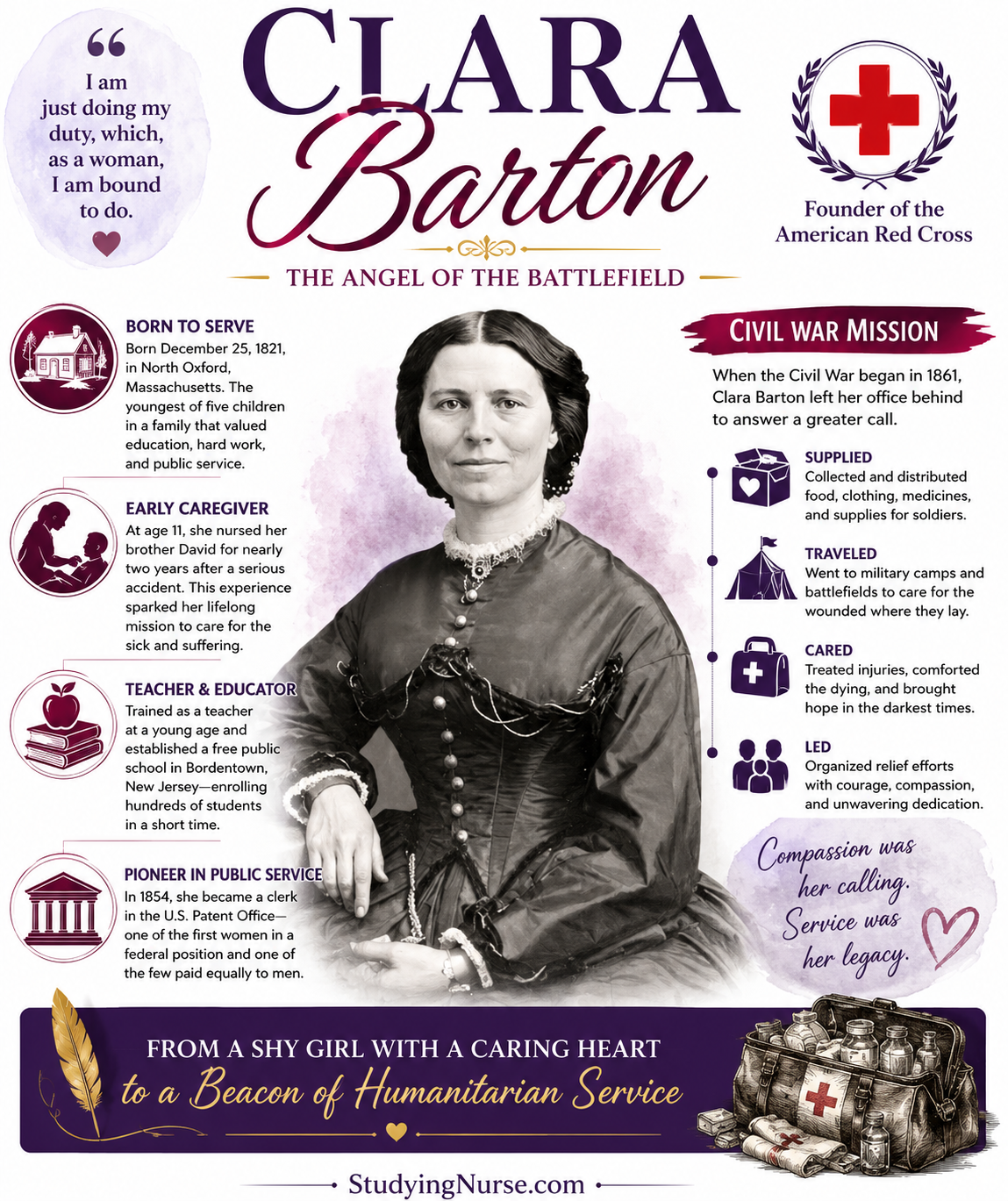
Clara Barton, the Missing Soldiers Office, and the American Red Cross: A Complete Guide for Nursing Students
Clara Barton occupies a unique place in the history of nursing, humanitarian service, and emergency response. Although she is widely recognized as the founder of the American Red Cross, her contributions extend far beyond establishing a single organization. Throughout her life, Clara Barton demonstrated extraordinary courage, compassion, and leadership by caring for the sick and injured during one of the most turbulent periods in American history. Her work on the battlefield, her commitment to locating missing soldiers, and her efforts to organize humanitarian aid fundamentally changed how individuals and communities responded to war, disasters, and public emergencies.
The legacy of Clara Barton continues to influence healthcare professionals today because her work embodied many of the principles that define modern nursing. She believed that every person deserved compassionate, timely, and effective care regardless of their background or circumstances. Whether delivering medical supplies to dangerous combat zones, comforting wounded troops, organizing records for grieving families, or leading large-scale relief efforts after natural disasters, Clara Barton consistently placed the needs of others before her own. Her life illustrates how clinical knowledge, organizational leadership, and humanitarian values can work together to improve countless lives.
Understanding Clara Barton is important because her achievements extend across multiple areas of healthcare and humanitarian history. Among her most significant contributions are:
- Providing direct care and medical assistance to wounded soldiers during the American Civil War.
- Delivering essential food, clothing, medicines, and medical supplies to active battlefield locations where resources were critically limited.
- Establishing the Missing Soldiers Office to help families locate relatives who disappeared during the war.
- Introducing the principles of the International Red Cross to the U.S. and leading the effort to establish the American Red Cross in 1881.
- Expanding organized disaster relief beyond wartime assistance to include responses to floods, hurricanes, epidemics, and other civilian emergencies.
Each of these accomplishments represented a significant advancement in humanitarian care. Rather than responding only after a crisis had ended, Clara Barton demonstrated the importance of delivering aid directly where it was needed most. Her work showed that effective emergency response requires careful planning, efficient coordination, strong leadership, and an unwavering commitment to serving vulnerable populations.
The historical context surrounding Clara Barton also helps explain why her achievements were so remarkable. Born in 1821, she lived during a period when opportunities for women in professional careers were extremely limited. Before becoming known for her humanitarian work, Clara Barton worked as a teacher and later as a clerk in the Patent Office, becoming one of the earliest women to hold such a position within the federal government. These experiences strengthened her administrative abilities, resilience, and sense of public service. When the Civil War began in 1861, she chose to leave the safety of civilian life and dedicate herself to caring for injured soldiers, despite the enormous physical dangers and logistical challenges involved.
Her service during the Civil War was unlike that of many volunteers at the time. Instead of remaining in hospitals far from active combat, Clara Barton frequently traveled directly to the front lines where medical supplies were scarce and the need for assistance was greatest. She organized supply distribution, treated injuries, prepared food, provided emotional support, and worked tirelessly under hazardous conditions. Her willingness to remain close to active fighting earned her the enduring title “Angel of the Battlefield,” a recognition that reflected not only her bravery but also her unwavering dedication to relieving human suffering.
The experiences Clara Barton gained during the war also revealed another humanitarian crisis that demanded attention. Thousands of families were left without information about loved ones who had disappeared during military service. In response, she established the Missing Soldiers Office, where extensive records, correspondence, and investigations were used to identify missing servicemen and provide answers to anxious families. This initiative highlighted the importance of accurate documentation, communication, and coordinated record management—principles that remain fundamental within healthcare systems and emergency management today.
Following the Civil War, Clara Barton expanded her humanitarian vision beyond military conflicts. While traveling in Europe, she became familiar with the work of the International Red Cross and recognized that the United States needed a similar organization capable of responding to both wartime emergencies and natural disasters. Her advocacy eventually led to the founding of the American Red Cross, an organization that transformed emergency response by coordinating volunteers, delivering relief supplies, supporting affected communities, and promoting preparedness before disasters occurred. This broadened approach established a lasting framework for humanitarian assistance that continues to benefit millions of people worldwide.
This guide provides a comprehensive examination of Clara Barton’s life, achievements, and enduring influence on nursing and humanitarian care. It explores:
- Clara Barton’s early life and the experiences that shaped her commitment to public service.
- Her work on the battlefield during the Civil War and the qualities that earned her national recognition.
- The establishment of the Missing Soldiers Office and its role in reuniting families after the war.
- The founding of the American Red Cross and the expansion of organized disaster relief in the United States.
- Her humanitarian leadership beyond the battlefield, including international service and lasting contributions to emergency response.
- Her enduring legacy, including the preservation of her history through the Clara Barton National Historic Site and the continuing relevance of her work in modern nursing and humanitarian practice.
More than a century after her death, Clara Barton remains one of the most respected figures in healthcare history. Her life demonstrates that compassionate care extends beyond treating illness or injury; it also involves leadership, advocacy, innovation, and an enduring commitment to improving the lives of others. By examining her remarkable journey, readers gain a deeper understanding of how one individual’s vision helped shape modern nursing, humanitarian organizations, and emergency response systems that continue to serve communities around the world.
Need a high-quality nursing paper fast?
Submit your brief, and get a fully completed assignment ready to submit
Clara Barton: Early Life and the Experiences That Shaped a Humanitarian
The extraordinary humanitarian legacy of Clara Barton did not begin on a Civil War battlefield or with the founding of the American Red Cross. Instead, it was shaped over decades through childhood experiences, educational opportunities, professional challenges, and an unwavering desire to improve the lives of others. Long before she became known as the Angel of the Battlefield, Clara Barton developed qualities that would define her life’s work: compassion, resilience, perseverance, and an exceptional ability to lead during times of crisis.
Understanding the early years of Clara Barton provides important context for her later achievements. Her childhood experiences cultivated empathy, her teaching career strengthened her communication and leadership skills, and her government service introduced her to large-scale administration and public responsibility. Together, these experiences prepared her for the enormous humanitarian challenges she would later face during the American Civil War and beyond.
Clara Barton biography: childhood, education, and family influences
Any comprehensive Clara Barton biography begins with her birth as Clarissa Harlowe Barton on December 25, 1821, in North Oxford, Massachusetts. She was the youngest of five children born to Stephen and Sarah Barton, a family known for valuing education, hard work, patriotism, and public service. Because Barton was the youngest, she spent much of her childhood surrounded by older siblings whose guidance greatly influenced her intellectual and emotional development.
Unlike many children of her era, Clara Barton displayed remarkable intelligence from an early age. However, she was also intensely shy. Historical accounts describe her as quiet, reserved, and uncomfortable in unfamiliar social situations. Rather than becoming a limitation, this reserved personality encouraged her to become an observant listener—an ability that would later prove invaluable when caring for patients and organizing humanitarian relief efforts.
One of the most significant events in Clara Barton’s childhood occurred when she was only eleven years old. Her older brother David suffered a serious accident after falling from a barn under construction. During his lengthy recovery, Clara Barton assumed many caregiving responsibilities, administering medications, monitoring his condition, and remaining at his bedside for nearly two years. Although nursing was not yet recognized as a formal profession in the United States, this experience introduced her to many fundamental principles of patient care, including:
- Careful observation of changes in a patient’s condition.
- Consistent administration of treatments.
- Emotional reassurance for both patients and family members.
- Patience throughout prolonged recovery.
- Compassionate nursing care during serious illness.
Many historians regard this period as the beginning of Clara Barton’s lifelong commitment to caring for vulnerable individuals. It demonstrated that effective caregiving requires more than technical skills; it also demands empathy, responsibility, and emotional resilience.
Education also played a pivotal role in shaping Clara Barton. Encouraged by her family, she attended local schools before receiving teacher training while still a teenager. At just seventeen years old, she began working as an educator, a profession that was among the few socially acceptable careers available to women during the nineteenth century. Teaching required organization, discipline, problem-solving, and effective communication—competencies that later became essential in coordinating humanitarian operations.
Her educational philosophy was progressive for its time. Instead of relying heavily on harsh discipline, Clara Barton emphasized encouragement, individualized instruction, and creating supportive learning environments. These beliefs reflected her broader view that every individual deserved dignity and respect, values that would later characterize her humanitarian work.
One of her most notable educational accomplishments was establishing a free public school in Bordentown, New Jersey. The school in Bordentown began with only a handful of students but expanded rapidly to enroll hundreds within a short period. This remarkable success demonstrated Clara Barton’s administrative ability, determination, and capacity to build institutions that served the public good. Unfortunately, despite founding the school, she was denied the position of principal after local officials appointed a man to lead the institution at a substantially higher salary. This experience exposed her to the widespread gender inequality of the era and reinforced her determination to pursue meaningful public service despite significant obstacles.
From teacher and Patent Office clerk to public servant
After leaving her teaching career, Barton moved to Washington, D.C., seeking broader professional opportunities. In 1854, she became a clerk in the Patent Office, making history as one of the first women to work in such a professional federal position. More significantly, she was among the few women performing comparable duties while receiving compensation equal to that of her male colleagues. This achievement represented an important milestone for women entering public service during the nineteenth century.
Working in the Patent Office transformed Clara Barton’s career in several important ways.
First, it introduced her to the complex administrative systems of the federal government. Her responsibilities required meticulous recordkeeping, document management, and correspondence—skills that later proved invaluable when organizing relief supplies, maintaining casualty records, and eventually managing the Missing Soldiers Office.
Second, her role strengthened her understanding of public administration. Rather than focusing solely on individual interactions, she learned how large institutions functioned and how government agencies coordinated information and services. These organizational skills later became central to her humanitarian leadership.
Third, working in Washington expanded her professional network. Living in Washington placed Clara Barton close to government officials, military leaders, and policymakers, relationships that would become critically important when the Civil War broke out. These connections later enabled her to secure permissions, obtain supplies, and advocate effectively for humanitarian initiatives.
Like many women pursuing professional careers during the mid-nineteenth century, Clara Barton encountered discrimination. Political changes temporarily disrupted her employment, and shifting administrations affected opportunities for women in federal service. Nevertheless, these setbacks strengthened rather than discouraged her commitment to public service. Her experiences demonstrated perseverance in the face of institutional barriers, a quality that became evident throughout her humanitarian career.
For modern healthcare professionals, this stage of Clara Barton’s life illustrates an important lesson: leadership in healthcare extends beyond direct patient care. Administrative competence, communication, documentation, and organizational management are equally essential for delivering effective services during public health emergencies and humanitarian crises.
How the Civil War inspired Clara Barton’s nursing mission
The defining turning point in Clara Barton’s life occurred when the Civil War began in 1861. At the time, she was still living in Washington, where she witnessed firsthand the arrival of injured Union troops following early military engagements. Hospitals quickly became overcrowded, medical supplies were scarce, and many volunteers struggled to meet the overwhelming demand for care.
Rather than remaining in the relative safety of government employment, Barton quit her position to devote herself fully to humanitarian service. Initially, she collected food, clothing, blankets, medicines, and other necessities for the sick and wounded arriving in Washington. She organized donation campaigns, appealed to community members for supplies, and personally distributed essential resources to soldiers who often lacked even basic necessities.
As the conflict intensified, Clara Barton recognized that many injured soldiers required assistance long before reaching hospitals. This realization fundamentally changed her approach to humanitarian work. Instead of waiting for casualties to arrive at medical facilities, she barton traveled directly to military encampments and eventually to active battlefield locations where she could provide immediate care for wounded troops.
Several factors inspired this transition from government employee to humanitarian leader:
- Recognition of unmet medical needs. She observed severe shortages of supplies, personnel, and organized medical services.
- Commitment to direct service. Rather than coordinating assistance from a distance, Clara Barton believed effective humanitarian work required being physically present where suffering occurred.
- Confidence developed through earlier experiences. Her childhood caregiving responsibilities, years as an educator, and administrative work in the federal government prepared her to make complex decisions under pressure.
- A strong sense of moral responsibility. For Clara Barton, public service was not simply a profession but a personal obligation to alleviate suffering whenever possible.
Her decision to serve near combat zones was unprecedented for an American woman during the nineteenth century. At a time when few women were permitted near military operations, Clara Barton crossed traditional social boundaries by providing medical supplies, treating injuries, comforting dying soldiers, and coordinating relief efforts under dangerous conditions. These experiences marked the beginning of the humanitarian mission that would later earn her national recognition and ultimately inspire the creation of the American Red Cross.
Although Clara Barton had no formal nursing education, her practical experience, observational skills, determination, and unwavering compassion enabled her to provide meaningful assistance where it was needed most. Her journey demonstrates that humanitarian leadership is often shaped gradually through life experiences rather than emerging from a single defining moment. The values she developed during childhood, refined through education, strengthened in government service, and tested during the earliest days of the Civil War formed the foundation upon which one of history’s most influential humanitarian careers was built.
Clara Barton on the Battlefield During the Civil War
The outbreak of the American Civil War marked the defining chapter of Clara Barton’s humanitarian career. Although her earlier experiences as a teacher, government employee, and caregiver had prepared her for public service, it was her extraordinary work during the war that transformed her into one of the most respected figures in American history. When the Civil War broke out, military medicine was still in its infancy. Hospitals were overcrowded, transportation systems were inadequate, and medical personnel frequently lacked the supplies needed to treat the growing number of casualties. Amid these overwhelming challenges, Clara Barton emerged as an independent humanitarian who brought critical assistance directly to the battlefield, often placing herself in the same dangerous conditions faced by the soldiers she served.
Unlike many volunteers who remained behind hospital lines, Clara Barton believed that prompt medical attention could save lives. She recognized that delays in delivering food, water, dressings, medicines, and surgical supplies often resulted in unnecessary suffering and preventable deaths. This belief shaped her humanitarian philosophy throughout the war and distinguished her from many contemporaries. Rather than waiting for the wounded to be transported to medical facilities, she brought care to the soldiers in the field, laying an early foundation for concepts that resemble today’s frontline emergency care and disaster response.
Providing medical supplies and care on the battlefield
When the Civil War began in 1861, the Union Army struggled to provide adequate medical support for its rapidly expanding forces. Military supply systems were inconsistent, communication between commanders and hospitals was often delayed, and field hospitals were overwhelmed after major engagements. Soldiers frequently went without clean bandages, food, drinking water, blankets, or even basic medicines during the first critical hours after sustaining injuries.
Recognizing these deficiencies, Clara Barton organized one of the most effective civilian relief efforts of the war. She collected donations from communities, businesses, churches, and charitable organizations throughout the U.S., ensuring that desperately needed supplies reached soldiers much faster than traditional military channels allowed. Her relief shipments commonly included:
- Bandages and dressings for traumatic injuries.
- Medicines and medical instruments.
- Food and clean drinking water.
- Blankets and clothing.
- Lanterns for nighttime treatment.
- Personal hygiene supplies.
- Cooking utensils and hospital necessities.
What made Clara Barton exceptional was not simply her ability to collect supplies but her determination to personally deliver them. Rather than remaining in safe supply depots, Barton traveled with wagons loaded with provisions to active military positions where the need was greatest. This approach required extensive planning, coordination with military officials, and remarkable personal courage because supply routes frequently passed through areas threatened by enemy fire.
Her work extended well beyond logistics. Upon arriving at military camps or temporary hospitals, Clara Barton immediately became involved in direct nursing care. She cleaned wounds, distributed medications prescribed by physicians, prepared meals for exhausted troops, comforted dying soldiers, assisted surgeons during operations, and remained with patients long after many volunteers had departed.
Her daily responsibilities often included:
- Assessing the immediate needs of injured soldiers.
- Distributing scarce medical supplies according to urgency.
- Assisting physicians during emergency surgical procedures.
- Providing food and hydration to weakened patients.
- Offering emotional reassurance to frightened or dying soldiers.
- Recording information that could later assist families searching for loved ones.
Many of these responsibilities closely resemble the duties performed today by emergency nurses, military nurses, and disaster response teams. Although formal trauma nursing had not yet developed as a specialized field, Clara Barton instinctively prioritized rapid intervention, resource management, patient advocacy, and compassionate care.
One important example of her commitment occurred during the Battle of Antietam, fought on September 17, 1862. Widely recognized as the bloodiest single day in American military history, Antietam produced more than 22,000 casualties in less than twenty-four hours. Anticipating the enormous medical demand, Barton went to the front carrying wagons filled with desperately needed supplies.
Historical accounts describe how she worked continuously throughout the battle, providing water, preparing food, dressing wounds, and assisting surgeons as thousands of wounded soldiers poured into makeshift treatment areas. One famous account notes that while she was caring for an injured soldier, a bullet passed through her sleeve and struck the man she was assisting, illustrating just how close she worked to active combat. Rather than retreating, Clara Barton continued providing care despite the obvious danger.
The Battle of Antietam demonstrated several characteristics that defined her humanitarian work:
- She anticipated needs before supplies became critically scarce.
- She remained calm under extreme pressure.
- She prioritized patient needs above personal safety.
- She worked collaboratively with military physicians and volunteers.
- She maintained compassion despite witnessing immense suffering.
These qualities would become hallmarks of her career and later influence her leadership in organized humanitarian relief.
Why Clara Barton became known as the “Angel of the Battlefield”
The title “Angel of the Battlefield” was not officially bestowed through any military ceremony. Instead, it emerged naturally from the gratitude expressed by soldiers, physicians, journalists, and military officers who witnessed Clara Barton’s unwavering dedication during the Civil War.
Unlike many relief workers who operated from hospitals located miles away from active fighting, Clara Barton repeatedly chose to serve where the danger was greatest. She frequently arrived on the battlefield shortly after combat began, bringing essential supplies while shells continued exploding nearby and gunfire remained active. For exhausted soldiers who had endured hours without food, water, or medical treatment, her arrival often represented hope during their darkest moments.
Several qualities contributed to her extraordinary reputation.
Exceptional courage
Throughout the war, Clara Barton consistently placed humanitarian duty ahead of personal safety. She entered dangerous combat zones where many civilians refused to go, believing that those suffering the greatest injuries deserved immediate attention regardless of the risks involved.
Compassion for every patient
Although she strongly supported the Union cause, Clara Barton recognized the shared humanity of all who suffered during the conflict. Her focus remained on relieving pain and preserving life whenever possible, reflecting principles that continue to guide humanitarian organizations today.
Tireless dedication
Military campaigns often required continuous work lasting several days with little opportunity for rest. Witnesses described Clara Barton working from sunrise until well after midnight, caring for the sick and wounded, organizing supplies, and comforting families whenever possible.
Leadership under pressure
Her effectiveness extended beyond bedside care. She coordinated volunteers, managed supply inventories, solved transportation challenges, and communicated with military leaders to ensure aid reached areas experiencing the greatest need. These leadership abilities later proved invaluable when she established the Missing Soldiers Office and eventually founded the American Red Cross.
The title “Angel of the Battlefield” therefore represented more than admiration for her bravery. It symbolized her ability to combine compassion, practical problem-solving, and decisive leadership under extraordinarily difficult circumstances.
Modern nursing continues to value these same characteristics. Emergency nurses, military nurses, trauma specialists, and disaster response teams frequently work in unpredictable environments where rapid decision-making, teamwork, and emotional resilience directly affect patient outcomes. Clara Barton’s example demonstrates that technical competence must be accompanied by empathy, adaptability, and ethical commitment.
Major battlefield campaigns that shaped her legacy
Although Clara Barton participated in numerous relief missions during the Civil War, several major campaigns became defining moments in her humanitarian career. These experiences strengthened her reputation and expanded her understanding of organized emergency response.
Battle of Antietam (1862)
The Battle of Antietam remains one of the most significant events associated with Clara Barton. Her preparation before the battle ensured that surgeons had access to desperately needed supplies at a time when military resources were severely limited.
Her work at Antietam demonstrated that civilian volunteers could play a vital role in military medicine when properly organized and committed to serving those in need.
Assault on Fort Wagner (1863)
During the Assault on Fort Wagner, Clara Barton once again provided humanitarian assistance under dangerous wartime conditions. The assault resulted in heavy casualties, creating an urgent need for medical supplies and nursing support.
Her work during this campaign reinforced the importance of rapid supply delivery and coordinated relief efforts in reducing suffering among injured troops.
Operations near Andersonville
Although Andersonville later became infamous as a Confederate prisoner of war camp, it also played an important role in Clara Barton’s postwar humanitarian efforts. Her later investigations into the identities of deceased Union prisoners helped establish records that ultimately supported the creation of the Missing Soldiers Office. The lessons learned from the immense human suffering associated with Andersonville strengthened her commitment to preserving accurate records and assisting families searching for missing soldiers.
Numerous field hospitals across the Eastern Theater
Beyond famous battles, Clara Barton served at numerous temporary hospitals established after military engagements throughout the Eastern Theater. Each assignment expanded her understanding of emergency medicine, logistics, sanitation, and patient management under resource-limited conditions.
These repeated experiences revealed several recurring challenges:
- Delayed transportation of medical supplies.
- Inadequate sanitation within temporary hospitals.
- Limited numbers of trained caregivers.
- Poor communication between military units and medical services.
- Emotional trauma experienced by both soldiers and families.
Rather than viewing these problems as isolated incidents, Clara Barton recognized them as systemic issues requiring organized humanitarian solutions. This realization influenced her later efforts to improve disaster response, establish the Missing Soldiers Office, and advocate for the creation of the American Red Cross after learning from the International Red Cross movement.
The battlefield experiences that shaped a humanitarian leader
The Civil War permanently transformed Clara Barton. Before the conflict, she had been an educator and government employee committed to public service. By the war’s conclusion, she had become one of America’s most respected humanitarian leaders.
Her battlefield experiences taught her that effective humanitarian work depends upon several interconnected principles:
- Immediate access to medical care saves lives.
- Organized logistics are as important as clinical treatment.
- Accurate records are essential for families and future recovery efforts.
- Leadership requires both compassion and administrative skill.
- Humanitarian assistance should continue long after the fighting ends.
These lessons became the foundation for every major initiative she pursued after the war. They inspired the establishment of the Missing Soldiers Office, influenced her advocacy for organized disaster relief, and ultimately culminated in the founding of the American Red Cross. More importantly, they established a model of humanitarian leadership that continues to influence nursing, emergency medicine, military healthcare, and disaster response worldwide.
Clara Barton and the Missing Soldiers Office
The conclusion of the American Civil War did not bring an immediate end to the suffering experienced by thousands of families across the United States. Although the fighting had ceased, countless wives, parents, siblings, and children remained desperate for information about loved ones who had disappeared during military service. Many soldiers had been killed without identification, buried in unmarked graves, captured, or separated from their units with little or no documentation of their fate. In an era before centralized military databases, DNA identification, or modern communication systems, determining what had happened to a missing family member was an incredibly difficult task.
Recognizing this humanitarian crisis, Clara Barton shifted her attention from caring for the wounded on the battlefield to helping families find answers. Rather than viewing the end of the war as the conclusion of her service, she understood that healing also meant providing emotional closure to those left searching for missing soldiers. This conviction led to one of the most remarkable yet often overlooked accomplishments of her career—the establishment of the Missing Soldiers Office.
The work carried out through the Missing Soldiers Office demonstrated that humanitarian care extends beyond treating physical injuries. It also involves restoring hope, preserving dignity, maintaining accurate records, and supporting families through grief and uncertainty. These principles remain central to modern nursing, disaster management, and humanitarian response.
Why Clara Barton established the Missing Soldiers Office
During her work during the Civil War, Clara Barton frequently encountered soldiers who worried less about their own injuries than about the families they might never see again. Many asked her to write letters home, deliver personal belongings to relatives, or remember their names if they did not survive. These deeply personal encounters left a lasting impression on her and highlighted the devastating uncertainty experienced by families when a soldier disappeared without explanation.
After the war ended in 1865, thousands of letters began arriving at Clara Barton’s residence from families seeking information about fathers, sons, husbands, and brothers who had never returned home. Because of her extensive presence on the battlefield and her reputation for helping soldiers, many people believed she might possess information unavailable elsewhere.
The sheer volume of correspondence revealed the magnitude of the problem. Families wanted answers to questions such as:
- Was their loved one killed in battle?
- Had they died in a military hospital?
- Were they buried in an unknown location?
- Had they become prisoners of war?
- Were they still alive but unable to return home?
At the time, no single government agency existed to coordinate these investigations efficiently. Military records were incomplete, casualty reports varied considerably, and communication between different departments was often fragmented. Recognizing the urgent need for an organized approach, Clara Barton appealed to federal officials for permission to establish an office dedicated to locating missing soldiers.
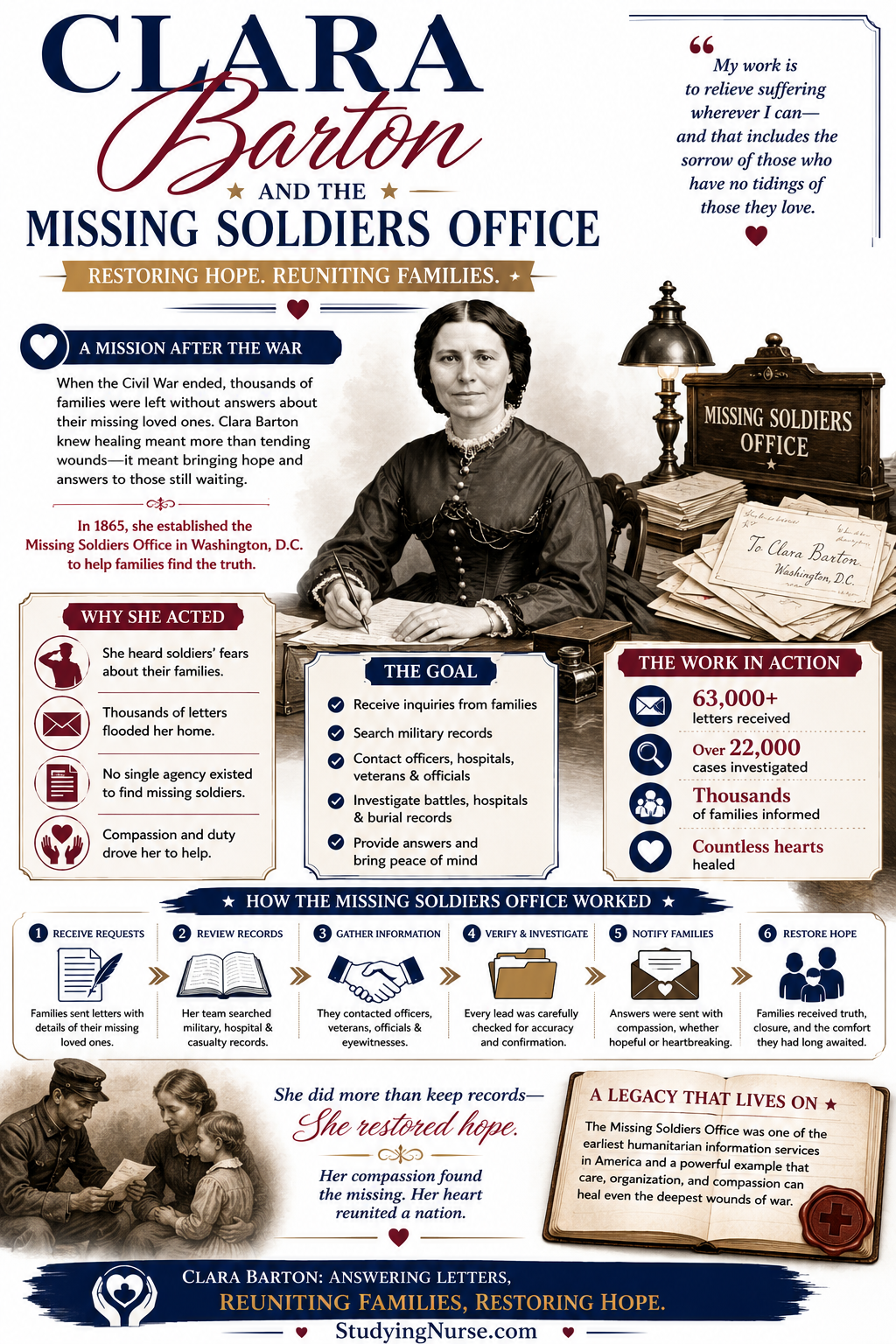
With government authorization, she opened the office in Washington, D.C., creating what became known as the Missing Soldiers Office, sometimes referred to as the Office of Correspondence Relative to Missing Men of the United States Army. The office represented one of the earliest large-scale humanitarian information services in American history.
The objectives of the Missing Soldiers Office were straightforward but enormously challenging:
- Receive inquiries from families searching for missing relatives.
- Compare letters with available military records.
- Contact military officers, hospitals, and veterans for additional information.
- Investigate burial records and battlefield reports.
- Notify families when reliable information became available.
Unlike many government offices of the period, the Missing Soldiers Office placed compassion at the center of its operations. Every inquiry represented a family living with uncertainty, and Clara Barton insisted that each request deserved careful attention regardless of how much time or effort the investigation required.
Her experience as a clerk in the Patent Office proved invaluable in this undertaking. Years of managing official documents, maintaining records, and organizing correspondence had prepared her to oversee thousands of investigations simultaneously. What she had learned through administrative work now became an essential tool for humanitarian service.
How the Missing Soldiers Office reunited families after the Civil War
The Missing Soldiers Office quickly became one of the busiest humanitarian organizations in postwar America. Thousands of letters arrived from across the U.S., each containing a family’s hope of discovering the fate of a missing loved one.
Rather than relying solely on existing military records, Clara Barton developed an extensive investigative process that combined documentation, correspondence, and firsthand testimony. Her office collaborated with:
- Military commanders.
- Hospital administrators.
- Former soldiers.
- Government departments.
- Cemetery officials.
- Local community leaders.
- Families and eyewitnesses.
Every piece of information was carefully compared with other available records before conclusions were reached.
The investigation process generally followed several important steps.
1. Receiving family requests
Families submitted detailed letters describing the missing individual. These letters often included:
- Full name.
- Military unit.
- Rank.
- Last known location.
- Date of last communication.
- Physical description.
- Personal circumstances that might assist identification.
Many letters also contained deeply emotional appeals from parents and spouses who had spent months—or even years—waiting without answers.
2. Searching official records
Staff members reviewed military rosters, casualty lists, hospital admissions, transportation logs, and burial records to identify possible matches.
Because Civil War recordkeeping was inconsistent, this process frequently required comparing multiple independent sources before confirming a soldier’s identity.
3. Contacting witnesses
When official documentation proved insufficient, Clara Barton sought testimony from individuals who had served alongside the missing soldier. Fellow servicemen often remembered where comrades had last been seen or whether they had been transported to hospitals after battle.
These eyewitness accounts frequently provided critical information unavailable in official records.
4. Identifying burial locations
One of the most important aspects of the office’s work involved locating burial sites.
Following the war, Clara Barton participated in efforts connected with Andersonville, the notorious Confederate prisoner of war camp, where thousands of Union soldiers had died under horrific conditions. Working alongside former prisoner Dorence Atwater, who had secretly preserved burial records, she helped identify thousands of graves that otherwise might have remained anonymous.
This work enabled numerous families to learn where loved ones had been buried, providing long-awaited answers and preserving the identities of soldiers who might otherwise have been forgotten.
5. Responding to families
Once reliable information had been verified, the office prepared written responses explaining the findings.
Although not every investigation ended successfully, many families finally received confirmation regarding the fate of loved ones after years of uncertainty.
Historical records indicate that the Missing Soldiers Office responded to more than 63,000 inquiries and helped identify or clarify the fate of approximately 22,000 missing soldiers. These extraordinary achievements reflected not only Clara Barton’s determination but also the effectiveness of systematic documentation, careful investigation, and compassionate public service.
For many families, receiving this information represented the first opportunity to begin the grieving process. Instead of living indefinitely with uncertainty, they gained knowledge that allowed them to honor their loved ones appropriately.
The lasting significance of the Missing Soldiers Office
Although the Missing Soldiers Office existed for only a relatively brief period, its impact extended far beyond the years immediately following the Civil War. The office established important principles that continue to influence humanitarian organizations, military services, emergency management agencies, and healthcare systems today.
One of its greatest contributions was demonstrating the importance of accurate documentation.
Modern healthcare depends heavily upon comprehensive medical records, patient identification systems, and coordinated communication among healthcare professionals. Similarly, disaster response agencies rely on detailed documentation to identify victims, reunite families, and coordinate emergency services.
The work performed by Clara Barton illustrated that effective humanitarian assistance requires more than compassion alone. It also depends upon organized information management, careful verification, and effective communication.
The Missing Soldiers Office also expanded the definition of humanitarian care.
Before the Civil War, assistance often focused primarily on treating immediate physical injuries. Clara Barton recognized that emotional suffering continued long after medical treatment ended. Families searching for missing soldiers experienced profound psychological distress, and helping them obtain answers became another form of compassionate care.
Today, this philosophy remains central to many healthcare disciplines.
Examples include:
- Hospital family liaison services that provide updates during medical emergencies.
- Disaster victim identification teams.
- Missing persons coordination centers.
- Military casualty assistance programs.
- Bereavement support services.
- Social work and family-centered nursing care.
Each reflects the understanding that caring for patients also means supporting families affected by illness, injury, or loss.
The office likewise demonstrated the value of interdisciplinary collaboration.
Its investigations required cooperation among government officials, military personnel, physicians, cemetery administrators, community members, and volunteers. This collaborative approach resembles today’s multidisciplinary healthcare teams, where physicians, nurses, pharmacists, social workers, therapists, and emergency responders work together to achieve better patient outcomes.
Perhaps most importantly, the success of the Missing Soldiers Office strengthened Clara Barton’s belief that humanitarian assistance should become more organized, permanent, and nationally coordinated. Managing thousands of investigations revealed both the strengths and limitations of volunteer-based efforts.
When Clara Barton later traveled to Europe and learned about the International Red Cross, she recognized that a structured humanitarian organization could respond far more effectively to wars, epidemics, and natural disasters than temporary volunteer groups alone. The administrative experience she gained through the Missing Soldiers Office directly influenced her leadership during the founding of the American Red Cross in 1881.
Today, visitors can still see the restored Clara Barton Missing Soldiers Office in Washington, D.C., where preserved documents, artifacts, and workspaces provide valuable insight into one of the earliest organized humanitarian information centers in American history. The office stands as a powerful reminder that humanitarian service is not limited to providing first aid or treating injuries. It also includes preserving identity, restoring hope, supporting grieving families, and ensuring that those who sacrificed their lives are remembered with dignity.
The legacy of the Missing Soldiers Office continues to resonate within nursing, emergency management, military medicine, and humanitarian organizations around the world. It exemplifies how compassion, combined with organization, documentation, and perseverance, can profoundly improve the lives of individuals and communities. More than simply locating missing soldiers, Clara Barton helped restore peace of mind to thousands of families, reinforcing the enduring principle that humanitarian care extends beyond saving lives—it also honors lives, preserves memory, and provides comfort long after a crisis has ended.
Clara Barton and the Founding of the American Red Cross
The establishment of the American Red Cross marked the culmination of decades of humanitarian service, leadership, and practical experience gained by Clara Barton. Her work during the American Civil War had demonstrated the urgent need for organized emergency assistance, while her leadership of the Missing Soldiers Office revealed the importance of effective coordination, recordkeeping, and national cooperation during times of crisis. However, it was her exposure to the International Red Cross in Europe that transformed these experiences into a vision for a permanent humanitarian organization in the United States.
The founding of the American Red Cross represented far more than the creation of another charitable institution. It fundamentally changed how the U.S. prepared for and responded to wars, epidemics, floods, hurricanes, fires, and other public emergencies. Under Clara Barton’s leadership, humanitarian aid evolved from scattered volunteer efforts into an organized national system capable of mobilizing trained personnel, supplies, and financial resources wherever they were needed most.
Today, the American Red Cross remains one of the world’s most recognized humanitarian organizations, and its origins cannot be understood without examining how Clara Barton adapted international humanitarian principles to meet the unique needs of the United States.
Learning from the International Red Cross in Europe
Following years of physically and emotionally demanding work during the Civil War, Clara Barton experienced significant health problems brought on by exhaustion. Acting on medical advice, she traveled to Europe in 1869 to rest and recover. Although intended as a period of recuperation, the journey became one of the most transformative experiences of Clara Barton’s life.
While visiting Switzerland, Clara Barton learned about the International Red Cross, an organization established to provide impartial humanitarian assistance during armed conflicts. The movement had emerged from the vision of Swiss businessman Henry Dunant, whose experiences witnessing the suffering of wounded soldiers at the Battle of Solferino inspired him to advocate for organized volunteer relief societies and international protections for the wounded.
The humanitarian principles that impressed Clara Barton were revolutionary for the nineteenth century. They emphasized:
- Neutral and impartial care for the wounded regardless of nationality.
- Organized volunteer networks prepared before emergencies occurred.
- International cooperation during humanitarian crises.
- Protection of medical personnel and relief workers during armed conflicts.
- Respect for human dignity even in times of war.
These principles formed the foundation of the red cross movement, which sought to reduce suffering without discrimination. For Clara Barton, the organization represented a solution to many of the challenges she had personally witnessed on the American battlefield.
Rather than merely observing the organization, Clara Barton became actively involved in its work. During the Franco-Prussian War (1870–1871), she volunteered with the International Committee and collaborated with relief workers assisting civilians and military casualties. Working alongside members of the Committee of the Red Cross, she gained firsthand experience in coordinating large-scale humanitarian operations across national boundaries.
This experience differed significantly from her Civil War service. During the American conflict, she had often relied on personal determination, informal volunteer networks, and locally gathered donations. In Europe, she witnessed a coordinated international system that combined government cooperation, standardized procedures, trained volunteers, and established humanitarian principles.
Several lessons profoundly influenced Clara Barton:
- Emergency response should be organized before disasters occur rather than after they begin.
- Volunteers require leadership, training, and clear organizational structures.
- Humanitarian assistance should serve both military personnel and civilians.
- International cooperation strengthens disaster response capabilities.
- Effective relief depends upon preparation as much as compassion.
These observations convinced Clara Barton that the United States would greatly benefit from establishing its own national Red Cross society.
Another important influence was the Geneva Convention, adopted in Geneva, Switzerland, in 1864. The convention established internationally recognized protections for wounded soldiers, medical personnel, and humanitarian workers during armed conflict. Clara Barton became a strong advocate for these principles and later encouraged the U.S. government to support them, believing they would improve humanitarian response both during wars and in times of peace.
Her European experiences therefore served two important purposes. They expanded her understanding of organized humanitarian work while also providing a practical model that could be adapted to meet America’s growing need for coordinated emergency assistance.
Bringing the Red Cross movement to the United States
When Barton returned to Washington, she carried with her not only memories of European humanitarian work but also a clear vision for the future. She believed that the United States needed a permanent organization capable of responding rapidly to emergencies while promoting the humanitarian ideals she had observed abroad.
Establishing such an organization, however, proved far from easy.
Many government officials questioned whether a Red Cross society was necessary because the Civil War had ended only a few years earlier. Others believed humanitarian relief should remain the responsibility of local charities rather than a national organization.
Clara Barton therefore embarked on an extensive campaign of education and advocacy.
She delivered public lectures describing the work of the International Red Cross, met with political leaders, wrote articles explaining the benefits of organized humanitarian assistance, and encouraged civic organizations to support the movement. Her reputation as the Angel of the Battlefield gave considerable credibility to her efforts because Americans already recognized her extraordinary Civil War service.
One of Clara Barton’s most significant contributions was broadening the traditional mission of the Red Cross.
European Red Cross societies had primarily focused on wartime relief. However, Clara Barton recognized that the United States faced relatively few wars but experienced frequent floods, hurricanes, epidemics, droughts, fires, and other natural disasters.
She therefore proposed what became known as the “American Amendment.”
This innovative idea expanded the mission of the Red Cross to include peacetime disaster relief as well as wartime humanitarian assistance.
The proposal reflected lessons Clara Barton had learned throughout her career:
- Human suffering occurs during both wars and natural disasters.
- Communities require organized assistance regardless of the cause of the emergency.
- Volunteers should remain prepared throughout the year.
- Humanitarian organizations should prevent suffering whenever possible rather than merely respond after tragedy strikes.
Today, this expanded mission remains one of the defining characteristics of the American Red Cross and has influenced humanitarian organizations worldwide.
Clara Barton also worked tirelessly to persuade the U.S. government to support participation in the Geneva Convention, arguing that international humanitarian cooperation would strengthen the nation’s ability to respond to future conflicts and disasters.
Her persistence ultimately succeeded, demonstrating the same determination that had characterized her earlier work on the battlefield and within the Missing Soldiers Office.
Founding the American Red Cross and expanding disaster relief
After years of advocacy, Clara Barton founded the American Red Cross in 1881, becoming its first president. The organization’s establishment represented the realization of a vision that had developed through decades of humanitarian experience, from caring for wounded soldiers during the Civil War to collaborating with the International Red Cross in Europe.
The newly established organization immediately embraced a broader humanitarian mission than many of its European counterparts.
Its responsibilities included:
- Coordinating emergency disaster relief.
- Assisting communities affected by floods and hurricanes.
- Providing emergency shelter, food, and clothing.
- Organizing volunteers during public emergencies.
- Supporting health education and community preparedness.
- Promoting humanitarian principles throughout the nation.
One of the earliest major tests of the American Red Cross occurred following the devastating Thumb Fire of 1881 in Michigan. Under Clara Barton’s leadership, the organization mobilized supplies, volunteers, and financial assistance to support affected communities. This response demonstrated that the newly established organization could effectively coordinate large-scale civilian relief efforts.
Over the following decades, Clara Barton led responses to numerous national emergencies, including:
- The Johnstown Flood of 1889 in Pennsylvania, one of the deadliest natural disasters in American history.
- Major droughts affecting agricultural communities.
- Yellow fever epidemics in the southern United States.
- Hurricanes and coastal storms.
- Famines and severe winter emergencies.
During each operation, Clara Barton emphasized careful planning, rapid mobilization, accountability, and compassionate service.
Her leadership introduced several practices that remain central to modern emergency management:
Preparedness before disasters
Rather than waiting until disasters occurred, the American Red Cross encouraged planning, volunteer recruitment, supply storage, and community education.
Organized volunteer management
Instead of relying solely on spontaneous volunteers, relief efforts became coordinated through structured leadership and defined responsibilities.
Community-centered assistance
Aid was tailored to meet the immediate needs of affected populations while also supporting long-term recovery.
Collaboration
The organization worked alongside government agencies, local communities, healthcare providers, and charitable organizations to maximize available resources.
For healthcare professionals, these developments represented important milestones in organized public health and emergency response. Many concepts that guide disaster nursing today—including rapid needs assessment, triage, coordinated logistics, volunteer management, and interdisciplinary collaboration—reflect principles that Clara Barton championed more than a century ago.
The American Red Cross also strengthened America’s connection to the global Red Cross network, reinforcing cooperation between national humanitarian societies while respecting the unique needs of individual countries. Through this international partnership, humanitarian organizations could exchange knowledge, improve disaster response strategies, and strengthen protections for vulnerable populations.
Although Clara Barton eventually retired from active leadership in 1904, the organization she established continued to expand both nationally and internationally. Today, millions of volunteers and staff members carry forward the humanitarian vision that began with one woman’s determination to relieve suffering wherever it existed.
The founding of the American Red Cross remains one of the most significant achievements in the history of nursing and humanitarian service. It transformed isolated acts of charity into a coordinated national movement dedicated to protecting health, responding to emergencies, and promoting human dignity. More importantly, it reflected Clara Barton’s enduring belief that compassion is most effective when supported by preparation, organization, leadership, and a commitment to serving all people in times of need.
Clara Barton’s Leadership Beyond the Battlefield
The conclusion of the Civil War did not mark the end of Clara Barton’s humanitarian career. Instead, it marked the beginning of an even broader mission that extended far beyond military conflicts. Having witnessed the devastating consequences of war and later established the American Red Cross, Clara Barton believed that organized humanitarian assistance should be available whenever people faced life-threatening emergencies, regardless of whether those emergencies were caused by armed conflict or natural disasters.
Under Clara Barton’s leadership, the American Red Cross expanded its focus to include floods, hurricanes, epidemics, famines, wildfires, and other public emergencies. This innovative approach distinguished the American organization from many of its European counterparts and transformed humanitarian response in the U.S. Her work demonstrated that compassion should not be limited by geography, politics, or the nature of a disaster. Instead, relief efforts should be guided by preparedness, rapid response, and an unwavering commitment to protecting human life.
Beyond directing emergency operations, Clara Barton also became an influential advocate for international humanitarian cooperation, helping strengthen America’s relationship with the global humanitarian community through support for the Geneva Convention and continued engagement with the International Red Cross. Although her leadership eventually faced criticism and organizational challenges, her vision permanently changed how humanitarian organizations operate both nationally and internationally.
Disaster relief efforts across the United States
One of Clara Barton’s greatest innovations was expanding the mission of the American Red Cross beyond wartime relief. During her experience with the International Red Cross, she recognized that while Europe often focused on military conflicts, the United States faced a different reality. Large-scale natural disasters—including floods, hurricanes, droughts, epidemics, and wildfires—frequently caused suffering comparable to that experienced during war.
Rather than creating separate organizations for different emergencies, Clara Barton believed that one well-organized humanitarian institution could respond effectively to both wartime and peacetime crises. This philosophy became one of her most enduring contributions to modern emergency management.
Under her leadership, the American Red Cross adopted several guiding principles that continue to influence humanitarian organizations today:
- Respond rapidly whenever lives are threatened.
- Deliver assistance without discrimination.
- Coordinate volunteers through organized leadership.
- Provide immediate relief while supporting long-term recovery.
- Work collaboratively with local communities and government agencies.
These principles were repeatedly demonstrated through major disaster response operations.
The Michigan Thumb Fire (1881)
Shortly after the American Red Cross was established in 1881, one of its earliest humanitarian missions involved assisting communities devastated by the Michigan Thumb Fire.
The wildfire destroyed entire towns, displaced thousands of residents, and caused extensive loss of life and property. Under Clara Barton’s leadership, relief teams delivered:
- Food and clean drinking water.
- Clothing and blankets.
- Temporary shelter.
- Medical supplies.
- Financial assistance for recovery.
Although the organization had only recently been founded, this response demonstrated that coordinated volunteer efforts could successfully assist civilian populations affected by large-scale disasters.
The Johnstown Flood (1889)
Perhaps the most famous civilian relief mission led by Clara Barton followed the catastrophic Johnstown Flood in Pennsylvania.
After the failure of the South Fork Dam, millions of tons of water swept through the city, destroying homes, businesses, schools, and public infrastructure. More than 2,200 people lost their lives, making it one of the deadliest natural disasters in American history.
Despite being nearly 68 years old, Clara Barton personally traveled to the disaster area and directed relief operations for several months.
Her leadership extended far beyond distributing emergency supplies. The American Red Cross organized:
- Temporary housing for displaced families.
- Community kitchens.
- Medical treatment centers.
- Clothing distribution.
- Financial assistance.
- Reconstruction support.
One particularly innovative aspect of her response involved constructing temporary shelters that enabled families to begin rebuilding their lives while permanent homes were under construction.
Today, disaster recovery programs emphasizing both immediate assistance and long-term rehabilitation remain central to humanitarian practice.
Responses to epidemics, droughts, and hurricanes
The leadership of Clara Barton also extended to numerous public health emergencies.
During outbreaks of yellow fever and other infectious diseases, the American Red Cross supplied medical equipment, food, nursing assistance, and financial support to affected communities.
Similarly, prolonged droughts devastated agricultural regions throughout the country. Rather than limiting assistance to emergency food distribution, relief workers helped communities recover by providing farming supplies, livestock assistance, and practical support designed to restore long-term economic stability.
Hurricanes, tornadoes, and severe winter storms likewise became priorities under Clara Barton’s leadership.
These operations demonstrated an important shift in humanitarian philosophy: relief organizations should not simply respond to isolated tragedies but should strengthen community resilience before, during, and after disasters.
For modern healthcare professionals, these initiatives illustrate the broad scope of disaster nursing.
Today’s disaster response teams perform responsibilities remarkably similar to those introduced under Clara Barton’s leadership, including:
- Rapid community needs assessments.
- Emergency triage.
- Public health education.
- Shelter management.
- Distribution of essential medications.
- Coordination with multiple government and healthcare agencies.
- Psychological support for affected individuals and families.
Her work established many organizational principles that continue to guide emergency management worldwide.
International humanitarian work and the Geneva Convention
Although Clara Barton is most closely associated with humanitarian work in the United States, her influence extended well beyond national borders. Her experiences in Europe during 1869 and the Franco-Prussian War fundamentally shaped her understanding of international humanitarian cooperation.
While overseas, Clara Barton observed how the International Red Cross coordinated assistance across multiple countries. She also worked directly with volunteers and humanitarian leaders, gaining practical experience in organized international relief operations.
These experiences reinforced her belief that humanitarian crises frequently transcend political boundaries and require cooperation among governments, volunteers, healthcare professionals, and international organizations.
One of the most influential ideas she encountered was the Geneva Convention.
Developed in Geneva, Switzerland, the convention established internationally recognized standards for protecting:
- Wounded military personnel.
- Medical staff.
- Humanitarian volunteers.
- Military hospitals.
- Civilians affected by armed conflict.
The convention emphasized that humanitarian workers should be allowed to care for injured individuals regardless of nationality or military affiliation.
For Clara Barton, these principles reflected values she had already practiced throughout the Civil War.
She had consistently believed that compassionate care should never depend upon politics, military rank, or social status. Every injured person deserved dignity, medical attention, and humane treatment.
After returning to America, Clara Barton became one of the nation’s strongest advocates for participation in the Geneva Convention.
Her efforts included:
- Educating political leaders about international humanitarian law.
- Explaining the benefits of joining the red cross movement.
- Encouraging cooperation with the Committee of the Red Cross.
- Promoting humanitarian neutrality during emergencies.
Her advocacy contributed significantly to the United States signing and ratifying the Geneva Convention in 1882, strengthening the country’s participation in the growing global Red Cross network.
This achievement had lasting consequences.
It established stronger protections for medical personnel during armed conflicts while encouraging closer collaboration between the American Red Cross and humanitarian organizations worldwide.
Today, the humanitarian principles promoted by Clara Barton continue to influence international disaster response, refugee assistance, military medicine, emergency nursing, and humanitarian law.
Organizations operating in conflict zones—including medical relief agencies and international humanitarian missions—still rely upon many of the legal protections and ethical principles that she worked tirelessly to advance.
Leadership challenges and retirement from the American Red Cross
Although Clara Barton’s accomplishments were extraordinary, her leadership was not without controversy.
As the American Red Cross expanded, the organization became increasingly complex. Managing national disaster operations required sophisticated financial oversight, administrative systems, volunteer coordination, and organizational governance.
Clara Barton had built the organization largely through personal leadership and direct involvement. During its early years, this approach proved highly effective because the organization remained relatively small and flexible.
However, as responsibilities expanded, some members believed the organization required more formal administrative structures.
Several challenges emerged.
Organizational growth
The rapid expansion of disaster relief programs placed enormous demands on leadership.
Maintaining accurate financial records, coordinating nationwide volunteers, and overseeing increasingly complex relief operations required administrative systems that were still evolving.
Public criticism
Some critics questioned aspects of financial management and organizational procedures, although many historians acknowledge that much of the criticism reflected changing expectations for nonprofit governance rather than evidence of humanitarian failure.
Despite these challenges, investigations generally recognized Clara Barton’s personal integrity and lifelong dedication to public service.
Leadership transition
By the early twentieth century, Clara Barton was in her eighties.
After decades devoted almost entirely to humanitarian work, she recognized that the organization required new leadership capable of guiding it through continued growth and modernization.
In 1904, Clara Barton retired as president of the American Red Cross.
Although stepping away from organizational leadership marked the end of one chapter, it did not diminish her influence.
Even after retirement, Clara Barton’s ideas continued shaping disaster preparedness, emergency nursing, volunteer management, and humanitarian policy throughout the United States.
She spent her remaining years at her home in Glen Echo, Maryland, reflecting on a lifetime dedicated to service before her death in 1912.
Today, that residence is preserved as the Clara Barton National Historic Site, managed by the National Park Service, allowing visitors to explore the headquarters where she planned many of the relief missions that transformed American humanitarian work.
The leadership legacy of Clara Barton extends far beyond the organizations she founded. She demonstrated that effective humanitarian leadership requires a balance of compassion, vision, courage, organization, and adaptability. Whether responding to war, floods, epidemics, or famine, she consistently emphasized that relief efforts should prioritize human dignity and practical action.
Modern emergency management, disaster nursing, humanitarian medicine, and volunteer organizations continue to reflect principles that Clara Barton championed more than a century ago. Her ability to adapt lessons learned on the battlefield to civilian disasters established a new model of humanitarian leadership—one that recognizes that the greatest measure of leadership is not authority, but the capacity to relieve suffering wherever it exists.
Clara Barton’s Legacy in Nursing and Humanitarian Care
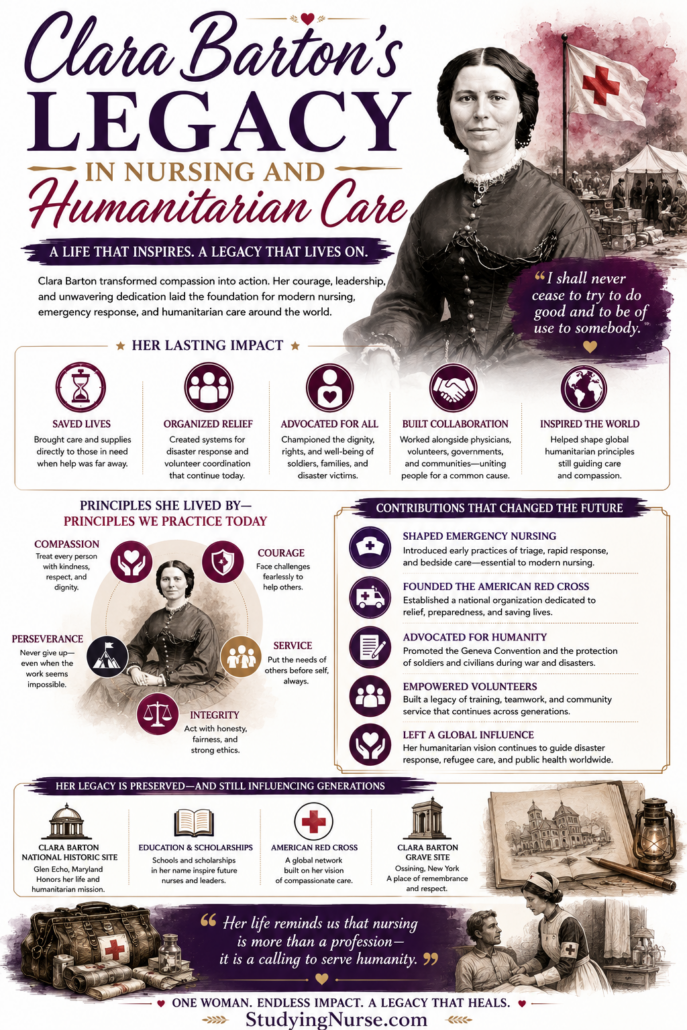
Few individuals have influenced nursing, humanitarian service, and disaster response as profoundly as Clara Barton. Although she lived during a period when nursing had not yet become the highly regulated profession it is today, her contributions helped establish many of the principles that continue to guide emergency care, disaster preparedness, humanitarian relief, and patient advocacy. From her courageous service on the battlefield during the Civil War to the founding of the American Red Cross, Clara Barton demonstrated that effective healthcare extends beyond treating disease—it also involves leadership, organization, compassion, and a commitment to protecting vulnerable populations during times of crisis.
The legacy of Clara Barton cannot be measured solely by the organizations she founded or the disasters she responded to. Rather, her enduring influence lies in the systems she helped create, the humanitarian values she championed, and the countless healthcare professionals inspired by her example. More than a century after her death, many aspects of modern nursing, emergency management, military medicine, and humanitarian work continue to reflect principles that she practiced long before they became recognized standards.
Today, Clara Barton’s contributions are preserved through historic landmarks, educational institutions, museums, and humanitarian organizations that continue to promote her vision of compassionate service. For those entering the nursing profession, her life offers valuable lessons about resilience, leadership, ethical responsibility, and lifelong service.
How Clara Barton transformed nursing and emergency response
Although Clara Barton never received formal nursing education in the way nurses are trained today, she became one of the most influential figures in the evolution of emergency and humanitarian care. Her practical experience caring for wounded soldiers, organizing medical supplies, and coordinating large-scale relief operations introduced approaches that closely resemble many modern nursing practices.
One of her most important contributions was demonstrating that prompt intervention saves lives.
During the Civil War, medical assistance often arrived hours—or even days—after battles had ended. Instead of accepting this delay, Clara Barton insisted on bringing supplies and nursing care directly to active battlefield locations. Her willingness to provide immediate assistance anticipated principles now considered fundamental in emergency medicine.
Modern emergency nursing emphasizes:
- Rapid patient assessment.
- Early intervention.
- Effective triage.
- Timely transportation.
- Continuous monitoring.
- Coordination among healthcare teams.
Although these systems have evolved considerably since the nineteenth century, Clara Barton recognized the importance of many of these concepts through direct experience.
Advancing organized disaster response
Another lasting contribution involved the transformation of disaster relief.
Before Clara Barton founded the American Red Cross, disaster response in the United States often depended upon local charities, churches, or spontaneous volunteer efforts. While these groups provided valuable assistance, they frequently lacked coordination, standardized procedures, and adequate resources.
Clara Barton demonstrated that effective humanitarian assistance requires:
- Advance planning.
- Organized leadership.
- Volunteer coordination.
- Supply management.
- Clear communication.
- Collaboration among multiple agencies.
These principles remain central to contemporary disaster nursing.
For example, when hurricanes, earthquakes, floods, or pandemics occur today, healthcare professionals work within coordinated emergency management systems that resemble the organizational framework Clara Barton advocated more than a century ago.
Strengthening patient advocacy
Throughout her career, Clara Barton consistently advocated for individuals whose voices were often overlooked.
Whether assisting injured soldiers, supporting families searching for missing soldiers, or helping disaster victims rebuild their communities, she emphasized that every individual deserved dignity, respect, and compassionate care.
Modern nursing identifies patient advocacy as one of its core professional responsibilities.
Examples include:
- Protecting patient rights.
- Ensuring equitable access to healthcare.
- Supporting informed decision-making.
- Respecting cultural and personal values.
- Speaking on behalf of vulnerable populations.
These values closely mirror the humanitarian philosophy that guided Clara Barton’s work.
Promoting interdisciplinary collaboration
Another important aspect of Clara Barton’s legacy is her emphasis on teamwork.
Her humanitarian operations required collaboration among physicians, volunteers, military officers, government officials, community leaders, and ordinary citizens.
Today’s healthcare environments similarly depend upon interdisciplinary cooperation involving:
- Nurses.
- Physicians.
- Pharmacists.
- Physical therapists.
- Social workers.
- Emergency medical personnel.
- Public health professionals.
The collaborative leadership demonstrated by Clara Barton continues to influence how healthcare teams coordinate patient care during both routine practice and public emergencies.
Inspiring humanitarian nursing worldwide
Through her collaboration with the International Red Cross and advocacy for the Geneva Convention, Clara Barton helped connect American humanitarian work with broader international efforts.
Her contributions influenced the development of disaster nursing, humanitarian medicine, refugee assistance, and emergency relief programs throughout the world.
Organizations responding to earthquakes, armed conflicts, disease outbreaks, and refugee crises continue to apply humanitarian principles that she helped promote, including neutrality, impartiality, compassion, and respect for human dignity.
The Clara Barton National Historic Site and the American Battlefield Trust
The achievements of Clara Barton continue to be preserved through historical organizations dedicated to protecting her legacy and educating future generations.
The Clara Barton National Historic Site, located in Glen Echo, Maryland, serves as one of the most important locations associated with her life. Managed by the National Park Service, the National Historic Site preserves the home where Clara Barton’s lived during her later years and where she directed many of the humanitarian operations of the American Red Cross.
Unlike many historic homes that simply display personal belongings, the Clara Barton National Historic Site functions as both a residence and an operational headquarters preserved in remarkable detail.
Visitors can explore:
- Original living quarters.
- Offices where relief missions were organized.
- Historic documents and correspondence.
- Medical equipment and humanitarian supplies.
- Personal artifacts illustrating Clara Barton’s daily work.
The site provides valuable insight into how humanitarian organizations functioned during the late nineteenth century.
For healthcare professionals and historians, visiting the Historic Site offers a unique opportunity to appreciate the organizational skills required to coordinate nationwide relief efforts long before the development of modern communication technologies.
Another organization that contributes significantly to preserving Clara Barton’s legacy is the American Battlefield Trust.
The American Battlefield Trust protects numerous Civil War battlefields where Clara Barton provided assistance to wounded soldiers. Through preservation initiatives, educational programs, maps, digital resources, and historical interpretation, the organization helps ensure that future generations understand both the military history of the Civil War and the extraordinary humanitarian work performed on those battlefields.
The Trust’s educational resources emphasize that battlefields were not merely sites of military conflict but also locations where remarkable acts of compassion, courage, and medical innovation occurred.
One individual closely associated with preserving this history is historian Harlowe Barton, whose work with the American Battlefield Trust has contributed to documenting Clara Barton’s battlefield service and its historical significance. Through publications, educational initiatives, and public history programs, these preservation efforts help connect modern audiences with the realities of Civil War medicine and humanitarian relief.
Together, the Clara Barton National Historic Site, the National Park Service, and the American Battlefield Trust ensure that Clara Barton’s contributions remain accessible for researchers, healthcare professionals, students, and the general public.
Lessons modern nursing students can learn from Clara Barton
Although healthcare has changed dramatically since the nineteenth century, many professional qualities demonstrated by Clara Barton remain essential in contemporary nursing practice.
Her life offers practical lessons that extend beyond historical knowledge.
1. Compassion must remain the foundation of patient care
Technical expertise is indispensable in nursing, but Clara Barton demonstrated that genuine compassion is equally important.
Whether treating injured soldiers or comforting grieving families, she consistently recognized the emotional needs of those she served.
Modern nurses likewise care for patients experiencing fear, pain, uncertainty, and loss.
Compassion strengthens therapeutic relationships while improving patient satisfaction and overall quality of care.
2. Leadership is demonstrated through action
Clara Barton rarely waited for perfect circumstances before taking action.
When supplies were unavailable, she organized donations.
When hospitals became overwhelmed, she brought care directly to patients.
When families lacked information, she established the Missing Soldiers Office.
When disaster response proved inadequate, she founded the American Red Cross.
Her example reminds healthcare professionals that leadership often begins with identifying unmet needs and working proactively to address them.
3. Adaptability is essential during crises
Throughout her career, Clara Barton continually adapted to changing circumstances.
She transitioned from educator to government employee, from humanitarian volunteer to relief organizer, and from battlefield caregiver to international humanitarian leader.
Healthcare professionals likewise encounter rapidly changing clinical situations that require flexibility, critical thinking, and effective decision-making.
4. Lifelong learning strengthens professional practice
Although Clara Barton possessed extensive practical experience, she continuously sought new knowledge.
Her decision to study the International Red Cross while in Europe illustrates the importance of learning from global best practices and applying them to local healthcare systems.
Modern nursing similarly emphasizes continuing education, evidence-based practice, certification, and professional development throughout one’s career.
5. Every healthcare professional can influence society
Perhaps the most enduring lesson from Clara Barton’s life is that healthcare professionals can shape communities far beyond individual patient encounters.
Her influence extended into:
- Emergency preparedness.
- Public health.
- Humanitarian law.
- Disaster management.
- Volunteer coordination.
- Healthcare leadership.
- International humanitarian cooperation.
Her achievements demonstrate that nurses and other healthcare professionals possess the ability not only to care for individual patients but also to improve healthcare systems, influence policy, and strengthen communities.
More than a century after her death, Clara Barton’s legacy remains deeply woven into the fabric of nursing and humanitarian care. The systems she helped establish, the values she championed, and the organizations she inspired continue to save lives across the world. From emergency departments and disaster response teams to military hospitals and international relief organizations, her influence remains evident wherever healthcare professionals respond to human suffering with skill, courage, and compassion.
For modern nurses, Clara Barton represents far more than a historical figure. She exemplifies the highest ideals of the profession: service before self, unwavering commitment to patient welfare, ethical leadership, and the belief that even in the most difficult circumstances, one person’s dedication can transform the lives of countless others.
Conclusion
Clara Barton remains one of the most influential figures in the history of nursing, humanitarian service, and emergency response. Her remarkable journey—from a dedicated teacher and Patent Office employee to the Angel of the Battlefield, founder of the Missing Soldiers Office, and leader who founded the American Red Cross—demonstrates how compassion, courage, and determination can transform both individual lives and entire healthcare systems. At every stage of her career, she identified unmet needs and responded with practical solutions, whether by delivering medical supplies to wounded soldiers, reuniting families searching for missing soldiers, or establishing organized systems for disaster relief.
Beyond her achievements during the Civil War, Clara Barton reshaped the way humanitarian assistance was delivered in the United States. Inspired by the International Red Cross and the humanitarian principles established in Geneva, she helped introduce a new model of organized emergency response that extended beyond wartime to include natural disasters, epidemics, and public health crises. Many practices that healthcare professionals now consider standard—rapid emergency response, coordinated volunteer management, patient advocacy, interdisciplinary collaboration, and community preparedness—reflect the values and leadership principles she championed more than a century ago.
For nurses and other healthcare professionals, Clara Barton’s legacy offers lessons that remain as relevant today as they were during the nineteenth century. Her life illustrates that excellent patient care requires more than clinical knowledge; it also demands empathy, resilience, adaptability, ethical leadership, and a willingness to advocate for vulnerable populations. She demonstrated that healthcare providers have the ability not only to care for individual patients but also to improve communities, influence public policy, and strengthen humanitarian systems on a national and global scale.
Today, the enduring work of the American Red Cross, the preservation of the Clara Barton National Historic Site, and continued efforts to protect Civil War history ensure that her contributions remain accessible to future generations. More importantly, her humanitarian philosophy continues to guide disaster response teams, military medical personnel, emergency nurses, public health professionals, and humanitarian organizations around the world.
Ultimately, Clara Barton should be remembered not only as a pioneering nurse and humanitarian leader but also as a visionary whose commitment to relieving human suffering forever changed the landscape of nursing, emergency care, and humanitarian service. Her legacy reminds us that one person’s dedication, guided by compassion and supported by action, can leave an impact that endures for generations.
Need a high-quality nursing paper fast?
Submit your brief, and get a fully completed assignment ready to submit.
Frequently Asked Questions
What is Clara Barton best known for?
Clara Barton is best known for serving as the “Angel of the Battlefield” during the American Civil War and for founding the American Red Cross in 1881. She provided medical supplies and care to wounded soldiers on the battlefield, established the Missing Soldiers Office to help families locate missing loved ones after the war, and pioneered organized disaster relief in the United States.
What were Clara Barton’s last words before she died?
Clara Barton’s exact last words have not been reliably documented in historical records. Although various quotations are sometimes attributed to her online, no authoritative source verifies her final spoken words. She died peacefully on April 12, 1912, at her home in Glen Echo, Maryland.
What was Clara Barton’s famous quote?
One of Clara Barton’s most famous quotes is:
“I may be compelled to face danger, but never fear it, and while our soldiers can stand and fight, I can stand and feed and nurse them.”
This quote reflects her courage and unwavering commitment to caring for soldiers during the Civil War.
Why didn’t Clara Barton marry?
Clara Barton never married because she devoted most of her life to education, public service, nursing, and humanitarian work. Historians believe her demanding career and lifelong commitment to helping others left little opportunity or desire for marriage. Instead, she dedicated her time and energy to serving soldiers, disaster victims, and communities in need, making humanitarian service the central focus of her life.
